From SaaS to Agent as a Service: The Era of AI CRM 2.0 Has Arrived
 04/02 2026
 442
442
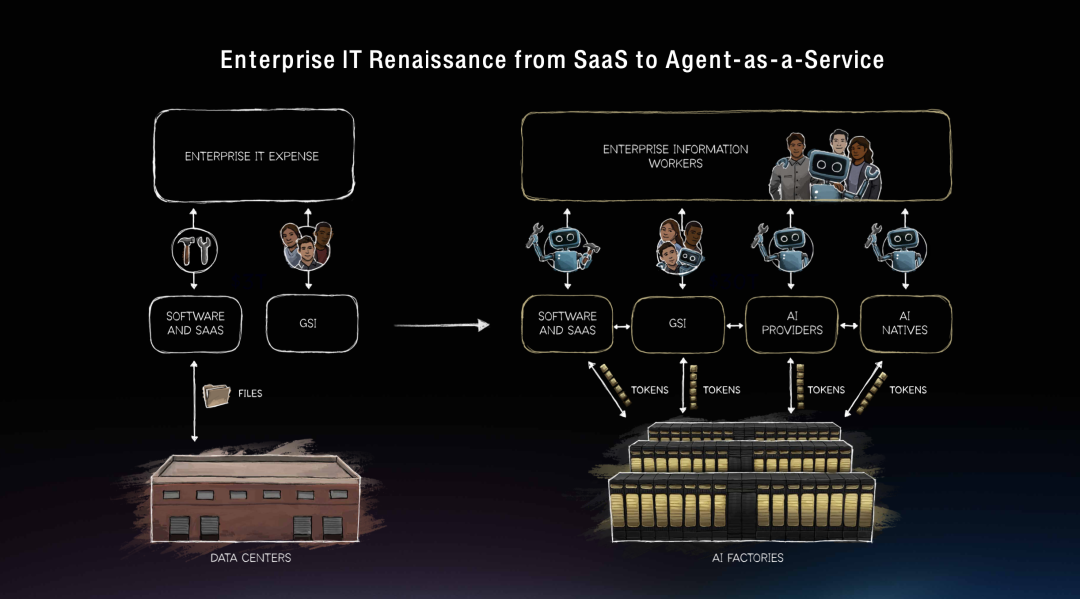
At this year's GTC, Jensen Huang made a statement about the software industry: SaaS is evolving towards 'Agent as a Service,' and every company needs its own OpenClaw strategy.
In fact, this is not a prediction but a reality that is already unfolding. Over the past year, the enterprise software industry has undergone its most profound AI-driven transformation. Oracle is restructuring its Fusion cloud applications for finance and procurement to better align with Agentic workflows; Salesforce continues to advance the flexible pricing model of Agentforce, proposing a consumption-based model; HubSpot has incorporated AI actions into its Credits system; ServiceNow has launched the AI Control Tower to uniformly manage its own and third-party AI agents, models, and workflows.
All these actions point to the same conclusion: the product logic and business model of SaaS are being rewritten.
In early 2026, after communicating with some domestic SaaS companies, Intelligent Evolution discovered that the industry's consensus on enterprise AI implementation focuses on several keywords: autonomous execution, business semantics, AI-native, and ecosystem collaboration. These elements constitute the underlying logic driving this round of software transformation.
Amidst this grand narrative, CRM, which is closest to customer operations, has become a 'bellwether' for observing this SaaS transformation. When AI evolves from merely providing suggestions to autonomous execution, it clearly delineates the divide between the AI CRM 1.0 and 2.0 eras.

Why Now Is the
Dividing Line for AI CRM 2.0
In recent years, the CRM industry has been talking about AI and Agents, but most products remain in the AI CRM 1.0 stage: providing sales teams with an additional AI dialog box to help with data queries, knowledge Q&A, generating communication scripts, recommending clients, and providing insights and alerts. While this enhances efficiency, it does not alter the fundamental nature of CRM as a recording system and management tool.
The dividing line for AI CRM 2.0 lies in AI beginning to take over actions that previously had to be performed by humans. For example, identifying customer churn risks, determining sales opportunity progression nodes, generating next steps, automatically verifying work orders, retrieving knowledge, and initiating process collaboration. For enterprise software, this means that CRM is transitioning from 'assisted judgment' to 'autonomous execution' for the first time. Although this execution is still partially limited, its nature has fundamentally changed.
Why now? There are three driving forces behind this.
First, Agents are gradually forming a standard paradigm
In the past, Agents were more like a loose collection of technologies: some emphasized reasoning, some emphasized workflows, some emphasized multi-agent collaboration, and others emphasized tool invocation. However, by 2026, with the emergence of more and more Claw-like products, the core capabilities of Agents are rapidly converging into a clearer standard paradigm: memory, planning, tool invocation, multi-agent collaboration, and autonomous execution. In other words, the stack of capabilities that enterprises once had to assemble themselves is now being solidified into a reusable, general-purpose capability stack.
Second, major players are productizing and platformizing Agent capabilities
Jensen Huang compared OpenClaw to foundational capabilities like Linux and Kubernetes, and NVIDIA also introduced NemoClaw, emphasizing privacy, security, and controllable deployment. In the domestic market, Claw-like products for individual users have proliferated, and the 'Hundred Shrimp Battle' reflects the same trend: Agent capabilities are being rapidly standardized. Next, enterprise-grade OpenClaw-like products are likely to emerge at an accelerated pace.
For CRM vendors, this means they no longer need to exhaust resources repeating wheel-building efforts. General-purpose Agent atomic capabilities will increasingly resemble infrastructure. Agent capabilities themselves will no longer be a moat for CRM vendors.
Third, the market is also validating this inflection point
McKinsey's 2025 Global AI Survey points out that among the enterprise revenue growth driven by AI usage, marketing and sales remain one of the most prominent scenarios. CRM is naturally at the forefront of customer operations and revenue conversion, making it one of the enterprise software solutions most suitable for AI implementation.
As a pioneer in implementing the AI-native CRM concept domestically, Neocrm, after co-creating and practicing with dozens of leading customers over the past year, has gained the insight that enterprises' attitudes toward AI CRM are shifting from 'trying it out' to 'scenario planning.' The goal is no longer just to improve single-point efficiency but to truly drive business growth.
Some implementation cases already demonstrate that AI CRM is moving from Demo to real-world business applications. For example, at Michelin, Neocrm's AI CRM can quickly generate visit plans that previously took hours and automatically refine visit records and generate next-step action recommendations. At Eaton, AI CRM can identify order collisions and sales opportunity risks in complex projects through semantic analysis. At Igus, AI CRM has begun mining dormant customer data to identify cross-selling opportunities and achieve incremental revenue.
This also means that AI CRM 2.0 is not just about who is the first to develop features but who enters real customer scenarios earlier and can continuously iterate through customer validation. Customer validation itself has become another layer of moat for AI CRM 2.0.

What Does AI CRM 2.0 Look Like?
If the focus of AI CRM 1.0 was adding AI capabilities to CRM, then the focus of AI CRM 2.0 is rewriting product forms, execution logic, and underlying barriers around Agents. From the current industry evolution, AI CRM 2.0 has at least three distinct characteristics.
1. AI-native interaction experience centered on goals and intentions
This is the most intuitive change in AI CRM 2.0.
The interaction logic of traditional CRM involves menus, forms, lists, and searches. Users must first learn the software and then follow predetermined paths to complete operations. As a result, after enterprises launch CRM, they often spend a significant amount of time training employees on how to use the system. In AI CRM 2.0, the entire system upgrades from 'people finding functions' to 'AI organizing work around results.'
Take Neocrm's newly launched NeoAgent 2.0 homepage as an example. Different employees entering the system see a customized interface tailored to their needs: the most prominent positions display the gap between current performance targets and actual progress, next-step action recommendations from the Agent, task schedules, and some processes already executed by the Agent and awaiting employee confirmation and approval. Although the underlying system is still connected to complex business systems, what is presented to users on the front end is closer to a 'goal cockpit.'

(Figure: Neocrm's NeoAgent 2.0 interaction interface)
'The current interaction is directly oriented toward my goals and centered on intentions. The 1.0 era was more about notifications, while the 2.0 era can proactively provide insights and analysis. For salespeople, CRM will proactively warn which customers may be at risk of churn, where sales opportunities are stuck, and what actions are recommended next,' said Luo Yi, Vice President of Product at Neocrm.
2. Autonomous Agent execution as a core feature
If interaction changes are the most visible aspect of AI CRM 2.0, then a more core change is that Agents are beginning to truly 'get to work.' 'AI CRM 2.0 is essentially a system built around the autonomous execution of Agents,' said Liu Zhiqiang, CTO of Neocrm.
In the AI CRM 1.0 stage, Agents were more like assistants: helping you find information, write summaries, provide suggestions, and set reminders. In the 2.0 stage, Agents are evolving into 'digital employees.' They not only tell you what to do next but also, within permitted rules, proactively complete some actions and await review.
Take Neocrm's 'Sales Manager Agent' as an example. It attempts to internalize the experience accumulated by sales managers over the years into the system, continuously analyzing sales opportunity health during the sales process and providing decision support closer to real-world combat. It acts as a 'sales brain' with precipitate ed experience.
However, it is important to note that enterprise-grade Agents are still far from fully autonomous closed-loop execution. The reason is simple: the enterprise environment is far more complex than personal scenarios. Processes have permission boundaries, actions have approval requirements, data has security rules, and results must be traceable, explainable, and auditable. The current industry consensus for addressing this challenge is specification programming: writing requirements as Specs, constraints as rules, and completion standards as tests and evaluations, allowing Agents to act within clear boundaries.
3. Building data + business semantic layer barriers to enable Agents to understand the business
The true barrier of AI CRM 2.0 lies not in the Agents themselves but in the underlying data and business semantic layers, which are prerequisites for Agents to 'understand the business.' 'The data plus business semantic layer is also the true moat for CRM companies,' said Liu Zhiqiang.
The reason is that no matter how powerful Agents are, they cannot naturally understand enterprise businesses. They know how to invoke tools but not necessarily how 'customers' are defined within the enterprise; they can identify contacts but not necessarily whether those contacts are supporters, decision-makers, or merely communicators in specific sales opportunities.
To 'understand the business,' CRM companies need to complete modeling based on the basic semantics of the aPaaS platform: abstracting entities, attributes, relationships, and action models within the enterprise, supplementing semantic definitions, and then connecting these semantics with rules, Skills, and processes to form executable business logic. This is why the aPaaS platform has regained value in the AI era. The modeling capabilities carried by aPaaS precisely determine whether enterprises can quickly build semantic layers.
Essentially, AI CRM 2.0 aims to translate enterprise business rules, processes, objects, and relationships into a language that Agents can understand and execute. Only by clearly defining every rule, action, and notification in SOPs can Agents truly know what to do.

The Decisive Factor in AI CRM 2.0: Ecosystem Collaboration
AI's transformation of SaaS is not only reflected at the product level but also directly impacts the traditional SaaS pricing logic at its core. Over the past two decades, the valuation basis of SaaS has largely been built on the seat-based model: enterprises purchase accounts, vendors sell features, and revenue grows with the increase in the number of seats. In the Agent era, the objects of enterprise procurement are shifting from 'management tools' to 'digital labor.'
'The biggest transformation AI brings to the SaaS business model is the disruption of the seat-based system,' said Liu Zhiqiang. This judgment is becoming an industry consensus.
Salesforce's Agentforce has already introduced a hybrid pricing model combining basic subscriptions with Flex Credits and Conversations. Domestic vendors are also exploring similar directions. Take Neocrm as an example; its AI product pricing is gradually transitioning from traditional subscription revenue to a hybrid structure of 'platform subscription revenue + consumption.' In other words, this is not a pricing innovation by a single company but a refactor that the entire SaaS industry must face.
However, compared to changes in the business model, the more critical point is that the competition in AI CRM 2.0 is no longer just about products and technology but ecosystem collaboration.
The past software ecosystem revolved around APIs, plugins, and module integration; the future ecosystem is more likely to revolve around Agents, Skills, workflow orchestration, and unified governance. Whoever controls the entry point is closer to users; whoever precipitate s Skills and business capabilities has a greater chance of remaining in the background as a 'capability provider to be invoked.'
This is why the entry points for enterprise software such as CRM are likely to change in the future. 'The entry points for enterprise software such as CRM are likely to be on social platforms like WeCom, DingTalk, and Lark,' said Liu Zhiqiang.
This is also the reality that many application vendors must face today: product functionality can be caught up with, business models can be imitated, but the ability to establish a sustainably evolving ecological closed loop determines who can go further. This is because the implementation of enterprise-level AI is not just a single technological issue, but the result of the combined effects of computing power, models, access points, knowledge, collaboration, and scenarios.
From this perspective, the collaboration between Xiaoshouyi and Tencent provides a valuable reference. The two sides are no longer just a combination of an AI giant and a vertical SaaS enterprise, but have extended their collaboration to the levels of technology, products, and scenarios: Tencent Cloud's infrastructure, the capabilities of the Hunyuan large model, and access points such as WeCom and Tencent Meeting, form a closed loop of "computing power-model-Agent-scenario" with Xiaoshouyi's CRM product matrix and years of industry know-how.
This also validates an increasingly clear trend in the AI CRM 2.0 era: embracing AI is just the entry ticket; ecological collaboration is the key to determining who can continue to compete in the long run. For SaaS vendors, without an ecosystem, even the strongest product capabilities will struggle to sustain; for platform-based enterprises, without real customer scenarios, even the best models and Agents can only remain in the demonstration stage.
Conclusion
AI will not make SaaS disappear, but it will render tool-based SaaS obsolete.
The changes brought about by AI CRM 2.0 have already begun: the era when enterprises start to procure, schedule, and evaluate software as digital employees has arrived. The front-end access points of CRM may shift, underlying capabilities will become platform-based, and general-purpose Agents will become increasingly affordable; however, enterprise data, business semantics, execution boundaries, and scenario-specific know-how will become even more valuable.
AI CRM 2.0 is not just an ordinary product upgrade, but a deeper reconstruction of the SaaS industry: software is no longer just used by people, but begins to work for them. Only those who can make this happen will have the qualification to survive the next round of reshuffling in enterprise software.
ENDThis article is an original work of "Intelligent Evolution Theory." Welcome to follow us.
-
![]()
Model Giant Jieyue Xingchen Steps into Smartphone Arena: A Strategic Alliance with Huaqin Technology
-
![]()
Big Model Firm Dives into Phone Market: StepFun and Wingtech Forge a ‘Dynamic Duo’
-
![]()
Zhongrun Optics Makes a Bold Move with 1 Billion Yuan Investment: Is a Turning Point on the Horizon for the Precision Optics Industry?
-
![]()
Deploy CLBO Crystals and YIG Single Crystals! Erythritol Leader Invests 30 Million in Youwei Optoelectronics
-
CXMT’s July 16 Subscription: Leading Domestic Memory Manufacturer—What’s the Earning Potential per Lot?
-
![]()
Rhythm Discrepancy and Premium Value Erosion: Foreign Luxury Brands Must Re-evaluate Their China Strategy
-
![]()
Half-Year, 1 Billion Yuan Financing, 7 Billion Yuan Valuation: A New Dark Horse Emerges in the Embodied AI Sector
-
![]()
Strong Rebound for Tech Stocks in Hong Kong Stock Market: Is It Time to Bottom-Fish?