Accio Evolution: The 'Magic' Unleashed by Alibaba International's Cross-Border AI Agent Experiment
 04/03 2026
 471
471

Recently, an AI agent named Accio Work has been creating quite a stir in the industry.
In fact, Alibaba International rolled out Accio as early as 2024, with the goal of integrating global B-side supply chains. At that time, the product was positioned as a conversational AI search engine, boasting three core modules: 'AI-powered search,' 'AI-reconstructed product encyclopedia pages,' and an 'end-to-end e-commerce platform.' It marked the world's first B2B AI search engine.
Its design was reminiscent of chatbots, with the innovative twist of bringing AI search experiences into traditional e-commerce settings. At the 2024 Tech Summit, Zhang Kuo, President of Alibaba International, remarked that the current version was still a 'work in progress,' covering only 10% of the envisioned B2B commerce forms in the AI era, with plans for rapid and continuous iteration.
Since then, Accio has indeed undergone an iterative evolution, including a PC version upgrade and the introduction of an agent mode. On March 24th of this year, Alibaba International officially launched Accio Work, an enterprise-grade AI agent. Accio has now transformed into the most sought-after product form, equipped with versatile skills akin to a 'Lobster,' capable of autonomously completing complex tasks around the clock while specializing in e-commerce operations.
Accio's iteration path mirrors the AI evolution trajectory of the past two years. As the AI competition shifts from eloquent general-purpose large models to practical agents, Accio has evolved from a 'procurement search engine' into a 'full-funnel digital employee.'
Unlike the mature ecosystem of domestic e-commerce, cross-border e-commerce operates in a typically 'long-chain, fragmented' environment. It inherently spans multiple dimensions, including language barriers, regulatory differences, logistical complexities, exchange rate fluctuations, and cultural nuances, making it an ideal high-pressure testing ground for AI agents.
The naming of Accio is quite intriguing. Derived from the Latin word meaning 'summon/call together,' it was also borrowed by J.K. Rowling in the bestselling Harry Potter series as the incantation for the 'Accio' charm, which makes target objects fly into the caster's hand. Users have playfully referred to prompts as 'spells,' as AI's capabilities seem magical to ordinary people, with spells serving as the gateway to that magic.
A More Suitable Testing Ground for 'Lobster'
From the product description, Accio Work is a plug-and-play, one-stop digital workforce. It can autonomously conduct market analysis, design product selections, list products, and handle business negotiations through conversational interactions. More critically, Accio Work can even assemble an agent team to collaboratively tackle complex, long-term tasks.
Officially dubbed the 'e-commerce version of Lobster,' it supports connections to tools like Gmail, Google Drive, and Notion, completing tasks by reading application data. It also integrates with platforms such as Telegram, Discord, DingTalk, and WeChat to reply to messages, assist users, and actively engage in communication.
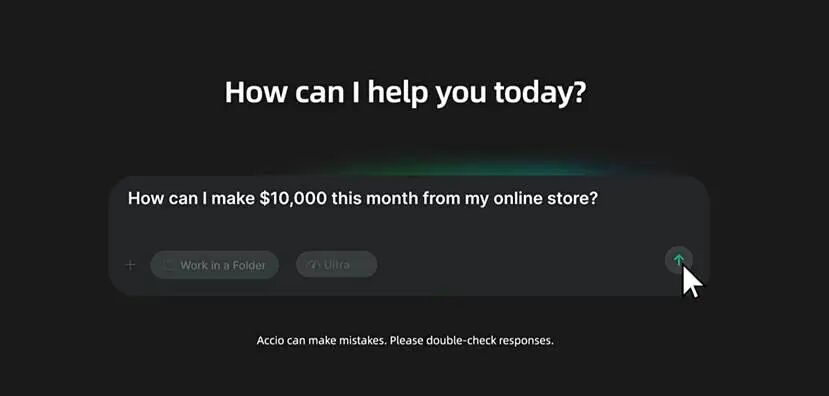 Image source: Accio official website
Such services hold even greater value in the cross-border e-commerce context.
Cross-border e-commerce is a massive yet underdeveloped market in terms of tooling, filled with variables, friction, and a highly fragmented work environment. Due to cross-cultural differences like language and regulations, information asymmetry is ubiquitous, with each layer adding to manual processing costs.
The most authentic and challenging daily tasks for cross-border sellers involve assessing product potential on language-barriered platforms, building compliant overseas stores without local experience, and chasing quotes across time-zone-spanning supply chains.
Rather than being a 'nice-to-have,' agents here primarily help overcome entry barriers, creating a more rigid demand. After all, the more operational friction exists, the higher the value of automation; the greater the uncertainty, the scarcer data-driven decisions become.
In the years of competition among domestic e-commerce platforms, efforts have been made to eliminate operational barriers. Consumers see standardized ratings, transparent pricing, and complete after-sales processes. However, cross-border operations are too complex for many sellers to handle alone.
We've also witnessed the surge of 'full-service/semi-service' cross-border models in recent years, essentially outsourcing complexity to platforms. Accio Work attempts to achieve this hosting (custodianship) through AI, or rather, assist merchants in taking over. It has evolved from an initial advisor and assistant to a 'chief business steward.'
This scenario value becomes clearer when contrasted with the 'Lobster' situation in China.
OpenClaw is arguably the most talked-about open-source agent framework in recent AI circles. It set a record for open-source software growth on GitHub, surpassing 250,000 stars in about four months, exceeding React's ~240,000 stars accumulated over 13 years. Major domestic cloud providers quickly followed suit, launching one-click deployment services or cloud-hosted versions.
However, real-world usage has seen mixed evaluations. High customization implies high configuration barriers, with many ordinary users deterred by complex local deployment processes. Task execution stability varies, with long-chain operations prone to mid-task loss of control or endless loops.
A more fundamental issue is its general-purpose nature, lacking vertical scenario-specific data and process accumulation. While Lobster promises alluring visions—fully automated workflows, ultra-efficiency, and customization—the higher the expectations and barriers, the more pronounced the gap between promise and delivery feels.
On one hand, this is due to imperfect technical 'tuning.' OpenClaw isn't a large model itself but more of a command framework, with final task execution quality heavily reliant on the underlying model's capabilities. First, it's not plug-and-play, requiring user exploration and debugging; second, substantial costs from Token consumption must be considered.
On the other hand, the scenario is ambiguous. OpenClaw provides a Swiss Army knife, but users often need a scalpel tailored for specific tasks. Many domestic users who followed the trend spent significant time configuring environments, only to stabilize automation tasks limited to low-value operations like sending emails or organizing files.
Thus, packaging concepts into products is a pragmatic choice. Cross-border transaction operational demands are rigid, scenarios are specific, and friction is real and unavoidable. In this environment, a vertical agent for cross-border procurement chains at least starts with what general frameworks lack: a clearly defined scenario and a user base with explicit needs.
The AI Agent Arms Race
Of course, Accio Work doesn't face an empty competitive landscape.
E-commerce platform Shopify launched its built-in AI assistant, Shopify Sidekick, in 2023. The CEO explained its design philosophy in a video at the time: an AI assistant to help merchants with daily tasks. Deeply embedded in Shopify's admin backend, it reads store sales data, inventory levels, and customer behavior, answering questions like 'Why did my sales drop this week?' in natural language and directly executing commands.
 Image source: Shopify
This product has also undergone iterative upgrades. In last year's update, Shopify emphasized that Sidekick had evolved from an assistant to a collaborator, capable of anticipating merchant needs and proposing actions. For example, it can customize any store element via natural language commands, create automated workflows, conduct in-depth store analyses, and provide actionable improvement plans.
Shopify has long been proactive in AI deployment and now actively repositions itself as commercial infrastructure for the AI agent era.
A more familiar AI assistant to overseas C-side consumers is Amazon's Rufus, also launched during the Chatbot craze, positioned as a specialized online shopping aid. It represents a demand-side evolution, with overseas consumers rapidly being educated into AI-powered shopping habits.
According to Amazon's Q3 2025 earnings call, as of October 2025, over 250 million customers had used Rufus that year, with users 60% more likely to complete purchases than non-users.
The market is ready, and multiple platforms await to fill ecological niches.
Shifting focus to China, as agents replace chatbots as the new AI application paradigm, the arms race has moved to agents.
A week before Accio Work's release, Alibaba unveiled 'Wukong,' an enterprise AI-native work platform allowing users to coordinate multiple AI agents through a single gateway to execute complex tasks.
This launch followed organizational restructuring. On March 16th, Alibaba announced the establishment of the Alibaba Token Hub (ATH) business group, integrating divisions like QianWen and Wukong. Subsequently, B-side commercial capabilities from Taobao, Tmall, 1688, Alipay, and Alibaba Cloud will gradually integrate into Wukong.
The productivity revolution promised by Wukong can also deeply bind to e-commerce scenarios, such as helping merchants select products and source suppliers on 1688, investigate supplier backgrounds, compare prices across the web, automate operations, and quickly list products.
Similar to Accio Work, both emphasize empowering users to 'command an agent team single-handedly.' This approximates a business judgment: when agents' execution capabilities are strong enough, organizational scale's significance to efficiency will be reevaluated. Its potential lies in how, if every individual or small team needs an AI workflow, the market ceiling shifts from enterprise numbers to human numbers.
In the broader tech company AI race, layout strategies converge: rather than competing for vertical scenario users, the priority is to occupy entry points, accumulate data, and lock in workflows before agents become infrastructure.
Meanwhile, the emphasis on agents has expanded the 'AI e-commerce' discourse.
It's no longer just 'adding an AI feature to an e-commerce platform.' In the Chatbot era, this approach was common, with AI search or assistant Q&A pages added to apps—essentially high-end customer service.
Now, AI is redefining commercial activity boundaries, taking over operational steps in workflows. It no longer waits at the window for questions but, upon authorization, directly contacts suppliers, sends inquiries, handles compliance, and lists products.
Epilogue
On March 30th, according to the Kechuangban Daily, ByteDance's Doubao has integrated with Douyin E-commerce, supporting direct commodity purchases and payments within the Doubao App without redirecting to Douyin. The feature is reportedly in beta testing.
The barrier between AI and commercial activities is being stripped away layer by layer.
From answering questions to recommending products, completing payments, and executing entire procurement workflows autonomously, tools like Accio Work with autonomous task execution capabilities are entering practical operation, suggesting that AI application focus has shifted from mere 'content generation' to 'process intervention.'
Major players are repackaging B-side assets for the AI era: converting accumulated supply chain resources, operational experience, and compliance processes into callable automated agents. Gradually, the competition will shift from whose large model chats better to who can first solidify complex commercial logic into low-cost, highly reliable digital labor.
A 'smart agent commercial era' is unfolding, where AI once tried to mimic human sensibilities but now takes over commercial rationality.
*The featured image and illustrations in the text are sourced from the internet.
-
![]()
Model Giant Jieyue Xingchen Steps into Smartphone Arena: A Strategic Alliance with Huaqin Technology
-
![]()
Big Model Firm Dives into Phone Market: StepFun and Wingtech Forge a ‘Dynamic Duo’
-
![]()
Zhongrun Optics Makes a Bold Move with 1 Billion Yuan Investment: Is a Turning Point on the Horizon for the Precision Optics Industry?
-
![]()
Deploy CLBO Crystals and YIG Single Crystals! Erythritol Leader Invests 30 Million in Youwei Optoelectronics
-
CXMT’s July 16 Subscription: Leading Domestic Memory Manufacturer—What’s the Earning Potential per Lot?
-
![]()
Rhythm Discrepancy and Premium Value Erosion: Foreign Luxury Brands Must Re-evaluate Their China Strategy
-
![]()
Half-Year, 1 Billion Yuan Financing, 7 Billion Yuan Valuation: A New Dark Horse Emerges in the Embodied AI Sector
-
![]()
Strong Rebound for Tech Stocks in Hong Kong Stock Market: Is It Time to Bottom-Fish?