Can Alibaba’s Zhipu and Minimax Sustain Robin Li’s Vision for Closed-Source AI ‘Legacy’?
 04/09 2026
 574
574
Robin was right, but Baidu missed its moment
Robin Li is characterized by an uncanny blend of extreme market sensitivity and a puzzling lack of timing awareness—a combination that has defined his leadership.
Recently, Alibaba unveiled three flagship AI models, including Qwen3.6-Plus. Unlike previous generations, which were fully open-sourced, these models have transitioned entirely to closed-source, offering only API access and disallowing local deployment or secondary distribution.
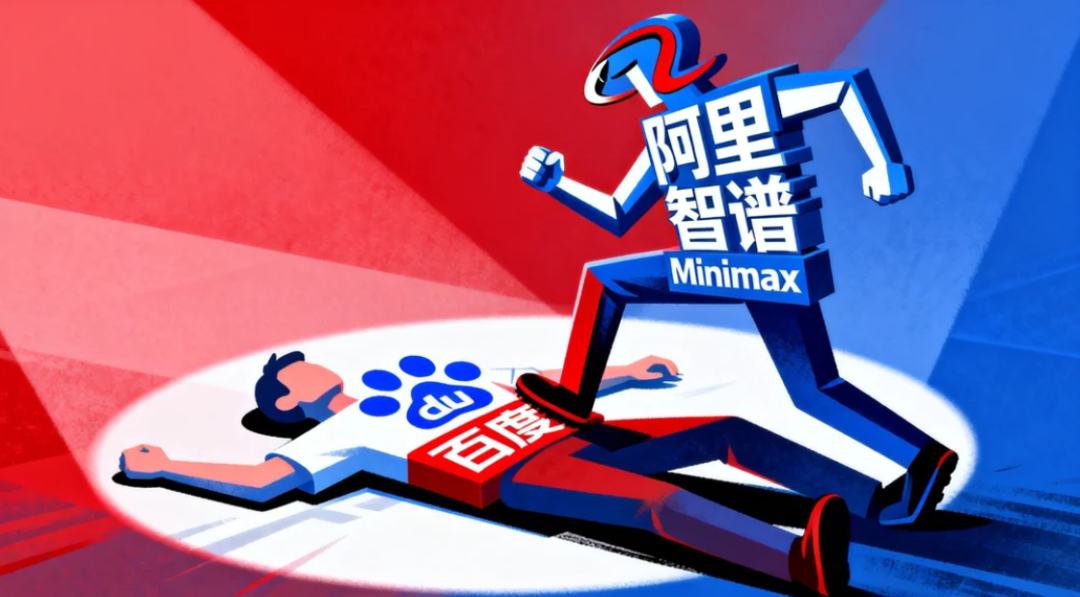
Alibaba is not alone in this shift. Minimax and Zhipu—two emerging stars recently listed on the Hong Kong stock exchange—have also opted for closed-source strategies with their latest models, M2.7 and GLM-5-Turbo, respectively.
As a result, among China’s leading open-source large language model (LLM) developers, only DeepSeek (likely to maintain open-sourcing) and Kimi (status unclear) remain exceptions.
This has reignited a heated debate in China’s AI community over open-source versus closed-source models—a debate that feels eerily familiar. Upon closer inspection, it becomes clear that Baidu, the pioneer in championing closed-source AI, has been left behind.
01
How did ‘CEO Li, who called open-source an IQ tax,’ end up bowing to market pressure?
Robin Li’s advocacy for closed-source AI was evident as early as 2024.
In April 2024, Li stated in an internal memo: “Closed-source large models offer cost and efficiency advantages, representing a truly viable business model.”
According to Yicai Global, intense internal debates ensued at Baidu. Ultimately, the consensus was that the market would see multiple open-source LLM providers, and Baidu would neither dominate nor be irrelevant.
From Li’s perspective, open-source models thrived on fragmented, small-scale applications rather than large-scale computational power, failing to achieve the “network effects” seen in Android’s ecosystem. Over time, closed-source models would consistently outperform open-source alternatives in capability and cost-efficiency.
Baidu ultimately aligned with its founder’s vision and embraced closed-source AI.
During the 2024 World Artificial Intelligence Conference, Li gave an in-depth interview to Yicai Global and Silicon Valley 101, sharing insights that were controversial at the time but now seem prescient.
The crux of the discussion centered on the choice between open-source and closed-source paths.
In the interview, Li reiterated that open-source was essentially an “IQ tax.”
“Think carefully: Why do we build large models? To enable applications that enhance efficiency, reduce costs, and deliver unprecedented value to clients and users across scenarios. When you rationally consider what value a large model brings—and at what cost—you should always choose closed-source models. Today’s closed-source models, whether ChatGPT, ERNIE Bot, or others, consistently outperform open-source alternatives in average capability and inference cost.”
Li repeated such statements, all met with external skepticism or outright criticism.
Coincidentally, Baidu was perceived as technologically stagnant at the time. A consensus emerged in the tech community: Baidu’s lag was due to Li’s insistence on closed-source AI against market trends.
The criticism was straightforward: Look at foreign models like Llama or domestic ones like Qwen. Open-source fosters collaboration and ecosystem growth. By refusing to open-source, Baidu was unwilling to share technology or drive collective progress. No wonder it fell behind.
Even the stubborn Li had to heed financial realities and public opinion.
When B-end clients abandoned Baidu for open-source alternatives, API call growth fell short of expectations, and daily online ridicule of “Baidu’s closed-source delusion” intensified, CEO Li finally relented.
In February 2025, Baidu open-sourced ERNIE Bot 4.5, attempting to win back developers and enterprise users who had already migrated.
But as it turned out, technological lag had nothing to do with open-source/closed-source choices—it stemmed from Baidu’s failure in product iteration and organizational execution.
Open-sourcing did not revive Baidu’s developer ecosystem; instead, it became a disruptive force. This pressure-driven strategic shift left Baidu painfully “inconsistent.”
Its open-source efforts lacked enthusiasm, failing to rally communities like Alibaba’s Tongyi Qianwen and build genuine grassroots support. Meanwhile, its closed-source approach lacked resolve, eroding its initial first-mover advantage and strategic clarity.
Ultimately, Baidu pleased no one and lost its way in 2025.
02
Robin predicted closed-source’s endgame, but Baidu missed the Agent revolution
Why did Baidu collapse in 2025 while Alibaba, Zhipu, and MiniMax successfully monetized their closed-source APIs?
The answer lies in their differing “eras.”
Over the past year, Chinese LLM firms have grappled with “closed-source phobia.” Majors and unicorns feared that switching to closed-source or raising prices would drive clients to competitors accustomed to free or low-cost options.
However, Zhipu’s recent earnings call dispelled these strategic concerns about client loss.
During the call, Zhipu disclosed core Q1 2026 operational data: Despite a massive 83% API price hike amid market downturns, its daily API calls surged 400% year-on-year.
An 83% price increase, yet clients used four times more. This reveals that at this juncture, valuable clients don’t care about open-source status or pricing—they only care whether your model can handle complex tasks effectively.
Revisiting Li’s 2024 statements, we see he was almost entirely correct. He recognized early that open-source struggled to build commercial moats and that enterprises would eventually pay for cost efficiency.
If his logic was sound, where did Baidu fail?
The answer lies in timing. While Li was 99% right about the commercial endgame, he faltered in the crucial 1%—a mix of “bad timing” and “inadequate execution.”
“Bad timing” refers to Baidu’s attempt to force a premature business model during the wrong market cycle.
Rewind to 2024, when Li derided open-source. The AI application ecosystem then revolved around chatbots, used for trivial tasks like writing limericks, generating generic PR drafts, or creating images of attractive women—scenarios with high tolerance for errors.
During this phase, enterprises and developers treated large models as toys. Why pay premium prices for Baidu’s closed-source APIs when open-source alternatives like Llama 3 or early Qwen could be fine-tuned locally for “nonsense” interactions?
In this cycle, Baidu’s closed-source, high-price strategy marked it as a “fool” in the market’s eyes.
But by 2026, the rules had changed.
AI agents replaced chatbots as major token consumers and productivity hubs. When large models ceased being mere chat companions and started performing work, error tolerance vanished.
Even a 1% dip in model capability or a slight rise in hallucination rates could collapse enterprise workflows.
Clients’ purchasing logic shifted. They realized open-source models saved on API fees but incurred steep hidden costs in fine-tuning, compute maintenance, and business trial-and-error due to unreliable model performance.
In contrast, premium closed-source models like Zhipu’s GLM-5-Turbo, MiniMax’s M2.7, and Alibaba’s Qwen3.6-Plus offered stable inference, lossless recall of long contexts, and out-of-the-box engineering support—all at one-tenth the cost of North American alternatives.
Thus, B-end clients willingly paid for usable closed-source models, explaining Zhipu’s audacity to raise prices 83% while achieving 400% growth.
Regrettably, Baidu didn’t survive to reap the “tool era’s” rewards—a failure of “inadequate execution” on Li’s part.
Had ERNIE demonstrated clear superiority over open-source models in 2024, it might have endured. Instead, ERNIE Bot lagged for extended periods, showing no decisive product edge against rapidly iterating open-source alternatives.
Attempting to charge closed-source premiums without overwhelming technical superiority was fatal. Strategic foresight couldn’t mask weak product iteration and organizational combativeness.
Li saw the coming storm and treasure across the shore, only to find Baidu’s raft couldn’t sail far. That, perhaps, was the greatest pain.
History is written by victors. Today, as Alibaba, Zhipu, and MiniMax tighten controls and monetize rapidly on the closed-source fast lane, few recall that among them stood a “prophet” who first pointed the way—yet found no place for Baidu in this correct commercial endgame.
Robin Li predicted closed-source’s outcome, but sadly, that outcome had no room for Baidu.
- END -
-
![]()
Model Giant Jieyue Xingchen Steps into Smartphone Arena: A Strategic Alliance with Huaqin Technology
-
![]()
Big Model Firm Dives into Phone Market: StepFun and Wingtech Forge a ‘Dynamic Duo’
-
![]()
Zhongrun Optics Makes a Bold Move with 1 Billion Yuan Investment: Is a Turning Point on the Horizon for the Precision Optics Industry?
-
![]()
Deploy CLBO Crystals and YIG Single Crystals! Erythritol Leader Invests 30 Million in Youwei Optoelectronics
-
CXMT’s July 16 Subscription: Leading Domestic Memory Manufacturer—What’s the Earning Potential per Lot?
-
![]()
Rhythm Discrepancy and Premium Value Erosion: Foreign Luxury Brands Must Re-evaluate Their China Strategy
-
![]()
Half-Year, 1 Billion Yuan Financing, 7 Billion Yuan Valuation: A New Dark Horse Emerges in the Embodied AI Sector
-
![]()
Strong Rebound for Tech Stocks in Hong Kong Stock Market: Is It Time to Bottom-Fish?