$81.6 Billion in a Single Quarter! Duan Yongping Makes a Bold Bet with Real Money: NVIDIA is More Than Just a Chip Seller—It's the 'Shovel' Provider
 05/21 2026
 609
609
Produced by | Yiguan Finance
Author | Xuanye Baixue
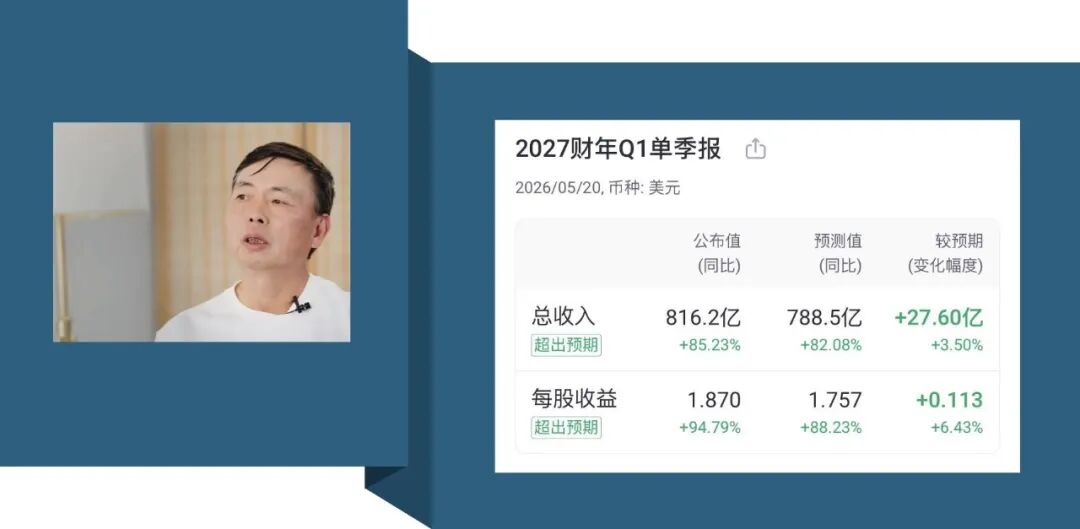
In May 2026, NVIDIA once again unveiled a financial report that could aptly be described as 'money-printing machine' level. During the first quarter of FY2027 (from January 26, 2026, to January 31, 2027), the company's revenue soared to $81.6 billion, marking an 85% year-over-year increase.
Notably, the data center business contributed a staggering $75.2 billion, a 92% surge from the previous year, accounting for over 92% of the total revenue. Even more remarkably, NVIDIA directly provided a revenue guidance of $91 billion for the next quarter, once again far exceeding market expectations.
Meanwhile, Duan Yongping continued to significantly bolster his stake in NVIDIA through H&H International Investment, with NVIDIA becoming a cornerstone of his investment portfolio.
01
Duan Yongping's Unconventional Move Signals AI Competition's 'Second Half'
When a long-term value investor, who once publicly stated he 'couldn't grasp the semiconductor cycle,' starts consistently investing heavily in a chip company, this move itself may be more noteworthy than the financial report figures.
NVIDIA's financial report reveals more than just the fact that 'AI is hot.'
It signals to the market that the AI competition is gradually shifting from a model-level arms race to a long-term struggle at the infrastructure level.
Despite stringent restrictions on China's high-end AI GPU business, AI capital expenditures in other regions worldwide remain robust. Over the past year, there has been ongoing market debate about whether the 'AI bubble will burst.' However, the reality is that training large models may just be the beginning, with more enduring demand stemming from AI Agents, enterprise-level deployments, inference scenarios, and future embodied intelligence.
In the past internet era, the key was 'connecting people'; in the AI era, it may be 'connecting computing power.'
Looking ahead, national and corporate competition will not solely revolve around model capabilities but also encompass the comprehensive capabilities of chips, networks, electricity, data centers, and industrial systems. This is why NVIDIA has transcended its identity as a mere GPU company.
02
NVIDIA: More Than Just Chips—It's the 'Shovel' Provider
NVIDIA is evolving into a platform-level infrastructure company in the AI era, covering nearly the entire AI computing power chain—from chips to CUDA ecosystems, from high-speed networks to complete data center solutions. NVIDIA is not just selling GPUs; it's offering the 'operating system' of the entire AI era.
And Duan Yongping's rationale for increasing his stake precisely aligns with this vision.
He wasn't always an NVIDIA enthusiast. Early on, he repeatedly expressed skepticism about the semiconductor industry's cyclicality. However, over the past two years, as he personally experimented with various AI tools, his perspective evidently evolved.
He noted that AI has 'taken a significant leap forward' and may even represent an industrial revolution-level change. Thus, his ultimate choice was not to bet on which large model company would emerge as the final winner.
Because the application layer remains highly uncertain. The large model landscape is still evolving, AI application profit models are still being explored, and today's hottest products may not retain their leading positions in a few years.
But one thing is relatively certain: all AI players require computing power infrastructure.
This embodies a classic 'shovel seller' logic.
During the gold rush era, the most stable earners were often not the gold miners themselves but those selling shovels, jeans, and railroads. Similarly, in the AI era, the most certain demand may not be for a specific AI application but for GPUs, networks, data centers, AI servers, and power and liquid cooling systems.
Duan Yongping is not merely investing in a specific generation of GPUs.
He is betting on the long-term value of the underlying infrastructure in the AI era.
This follows a classic value investment path: the right business, the right people, and the right price.
To some extent, this mirrors his past logic for heavily investing in Apple. Truly great long-term companies are often not single-product entities but ecosystem platform companies.
AI computing power is increasingly resembling cloud computing, electricity, and networks, gradually becoming the new infrastructure of the digital economy.
Future true competition may no longer hinge solely on model parameters but on who possesses stronger chip design capabilities, a more complete data center system, a more stable energy supply, and more mature network and cooling capabilities.
AI competition is essentially reverting to 'industrial capability competition.'
And this is precisely NVIDIA's greatest competitive advantage.
Many perceive NVIDIA's strength to lie in its chips, but what is truly difficult to replicate is its nearly two-decade-long accumulated CUDA ecosystem, developer network, and comprehensive software toolchain.
Hardware can be caught up with, but ecosystems are challenging to replicate.
Meanwhile, China and the U.S. are gradually forming a 'dual-track AI system': the U.S. continues to dominate the high-end AI ecosystem and core technologies, while China accelerates domestic substitution and full-stack autonomy.
This global AI supply chain restructuring endows AI infrastructure with even stronger strategic attributes.
03
Beyond NVIDIA: Who Are the Other 'Shovel Sellers'?
From an investment perspective, the truly long-term noteworthy players in the AI supply chain may not be the short-term hottest AI applications but those companies with robust infrastructure capabilities.
In the GPU and AI chip space, NVIDIA remains the global leader, while China has companies like Huawei Ascend, Baidu Kunlunxin, Cambricon, Biren Technology, and SmarCo rapidly catching up. In the AI server space, companies like Super Micro, Dell, Inspur Information, and Foxconn Industrial Internet are essentially building 'computing power containers.' In the network and optical module space, Broadcom, Arista, Zhongji Innolight, and Tianfu Communication are constructing the 'highways' of the AI era.
And what may be most underestimated by the market are actually power, liquid cooling, and data centers.
Because, ultimately, AI may very well hinge on power and cooling.
04
Infrastructure Also Experiences Cycles
Of course, this doesn't imply that AI infrastructure will perpetually rise linearly.
Every infrastructure wave that has genuinely transformed the world in history—railways, electricity, the internet, cloud computing—has undergone bubbles, controversies, and violent fluctuations.
AI may similarly experience capital expenditure cycle fluctuations, overvaluation, ASIC substitution, geopolitical policy changes, and AI commercialization falling short of expectations.
But the companies that truly transform the world in the long run often emerge from such cycles.
Over the past two decades, internet companies vied for user attention.
Over the next two decades, AI companies may compete for inference capabilities, computing power scale, and energy security.
The truly long-term beneficiaries may not be a single hit large model application.
They are more likely to be the infrastructure companies that provide 'water, electricity, and shovels' for the entire AI era.
Perhaps years from now, looking back, what the market truly underestimates today is not a specific AI product.
But the AI era itself, which is rebuilding an entirely new infrastructure system.
Duan Yongping's choice may be another validation of this trend.
Investing involves risks. This article is solely for information sharing and logical discussion and does not constitute any investment advice. True value investing ultimately requires personal understanding, judgment, and long-term commitment.
-
![]()
Doubao Work Unveiled! Domestic AI Leaders Fully Commit to the 'Work' Sector
-
![]()
Who’s Sounding the Alarm on ‘Rushed Vehicles’?
-
![]()
Over 5.3 Billion Yuan in Losses Over Three and a Half Years! Can Yonyou Reverse Its Fortunes Through Streamlining and AI Transformation?
-
![]()
Baidu AI Adopts Free Model: A Strategic Maneuver in Traffic and Monetization
-
![]()
Silicon-Based OLED Pioneer Unveils Financial Results: H1 Shipments Outpace Entire 2025 Volume
-
![]()
AI's First "Lost Summer"
-
![]()
Zeiss Makes Another €2.2 Million Bet: Will Eye Tracking Be the Next Big Thing in the Smart Glasses Industry?
-
![]()
RUNTO Ranking | Global Top TV ODM Factories' Shipment Figures for July 2026