Is FSD Finally Making Its Way to China? Will Tesla Dominate the Intelligent Driving Scene?
 05/21 2026
 712
712
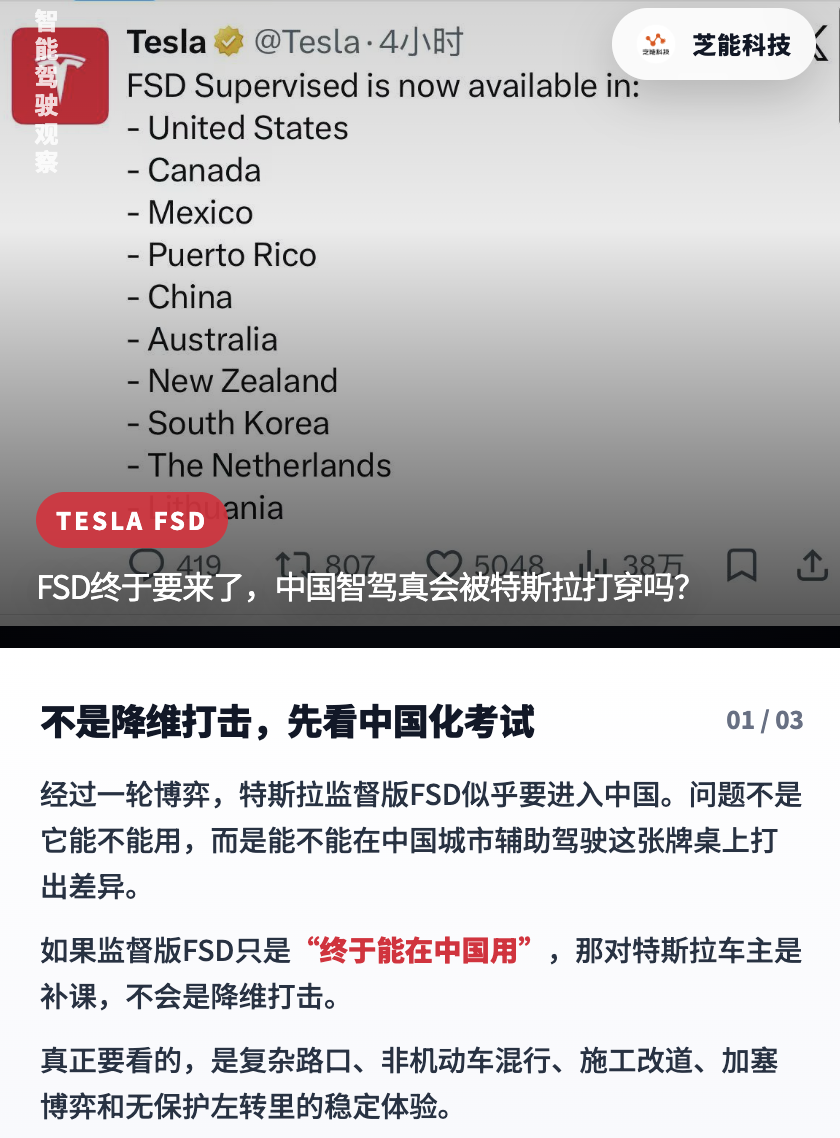
Following a series of negotiations, it appears that Tesla's FSD (Full Self-Driving) Supervised Version is poised to make its debut in China. In the competitive landscape of urban assisted driving in China, can FSD replicate its dominance in the United States and make a significant impact? Tesla's strengths lie in its end-to-end strategy, global fleet data, and its ability to generalize across complex scenarios.
The pressure is mounting: Domestic assisted driving leaders have been honing their urban NOA (Navigate on Autopilot), highway NOA, parking, memory-based driving, LiDAR perception, and localized scenario adaptations for years.
If the supervised FSD version merely becomes "finally available in China," it will represent a catch-up moment for Tesla owners rather than a revolutionary shift.
Should FSD deliver a consistently reliable experience in China's intricate intersections, mixed traffic environments with non-motorized vehicles, construction detours, aggressive lane changes, and unprotected left turns, we anticipate that domestic assisted driving companies will invest heavily in benchmarking and rigorous testing.
Two contrasting viewpoints have emerged: one welcomes the "catfish effect," while the other cautions, "Success in North America doesn't guarantee success in China."
FSD's entry into China transcends mere software deployment. The true capabilities of the supervised FSD version, the local data and regulatory landscape in China, and the performance gap between domestic assisted driving companies (empowered by LiDAR technology) and Tesla's FSD will only become evident after direct competition unfolds.
01
The Arrival of the FSD Supervised Version
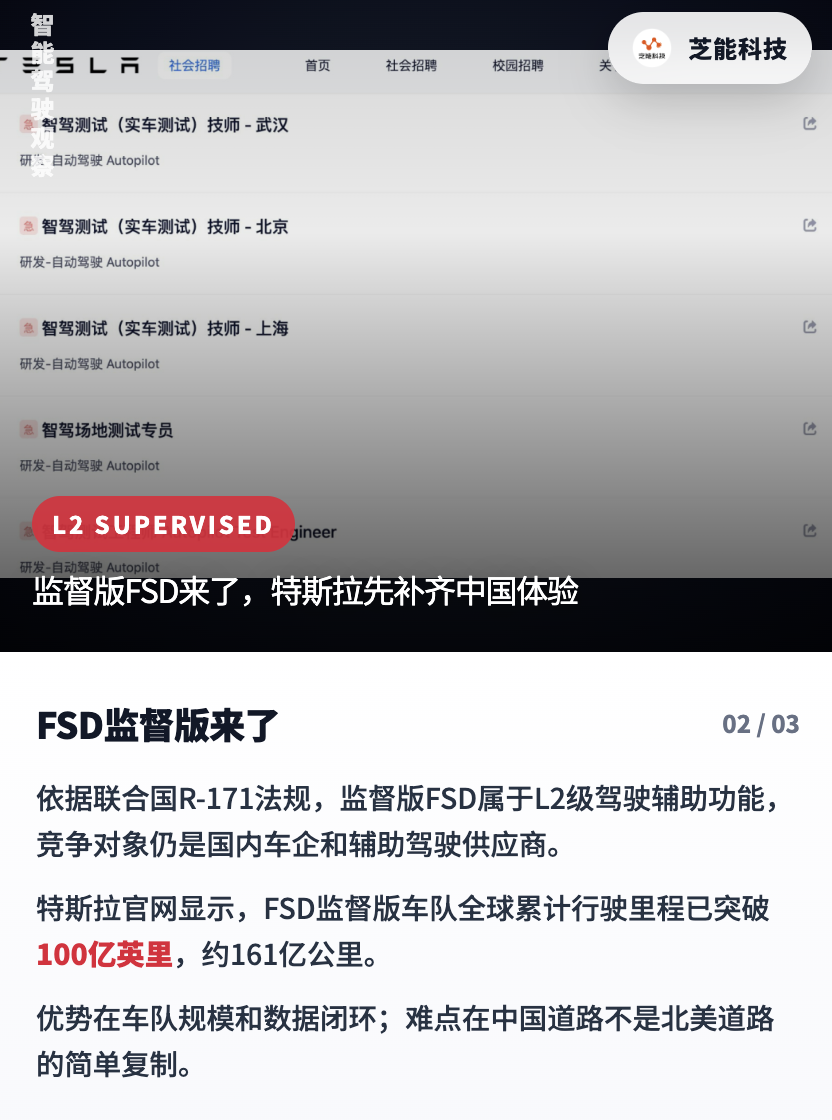
FSD now offers both supervised and unsupervised versions. The former is designed for drivers in vehicles, while the latter caters to L4-level Robotaxi applications. According to UN Regulation R-171, the supervised FSD falls under the L2-level driving assistance category.
Consequently, the competition remains fierce among domestic companies (Li Auto, XPENG, NIO) and assisted driving suppliers (Huawei, Momenta, Horizon Robotics, YuanRong, Zhuoyu).
Previously, FSD operated with limited capabilities. This time, it seems to be approaching full functionality. Can it cover a broader range of road scenarios, reduce the driving burden, and provide stable and predictable actions in complex situations?
Chinese Tesla users have paid 64,000 RMB for the FSD software package, yet the actual usable experience has long been incomplete. This time, whether it's urban NOA or highway NOA, the experience is finally comprehensive.
The true allure of FSD lies in its utilization of large-scale real-world road data to train neural networks, enabling the system to learn judgment and actions from vast driving scenarios.
In early May 2026, Tesla's official website announced that the global cumulative mileage of the FSD Supervised Version fleet surpassed 10 billion miles (approximately 16.1 billion kilometers). From 1 billion miles in June 2024 to 10 billion miles in May 2026, it achieved a tenfold increase in less than two years.
Tesla's underlying advantage with FSD is not solely vehicle intelligence but also fleet size and the data closed-loop system. More vehicles mean more scenarios; more scenarios enhance the model's ability to address long-tail problems.
However, this also poses the first challenge for FSD's entry into China: Chinese roads are not mere replicas of North American roads. Chinese cities boast more electric vehicles, tricycles, food delivery riders, temporarily parked vehicles, narrow road encounters, complex ramps, non-standard construction zones, and high-density aggressive lane changes.
These scenarios cannot be naturally transferred by simply excelling in North America. Currently, Tesla faces regulatory hurdles regarding data export in China. Road data collected in China must be stored domestically and cannot be transmitted overseas.
For FSD to achieve more complete localization in China, it must navigate the relationships between data storage, processing, model training, and regulatory approval. In the initial phase of FSD Supervised Version's entry into China, the focus is on refining the basic driving experience on Chinese roads and rapidly achieving full capability through Chinese data.
02
How Far Have Domestic Assisted Driving Systems Progressed?
FSD's entry into China is dubbed the "catfish effect" because Tesla has long been a benchmark in intelligent driving discussions. However, the Chinese market has evolved significantly in recent years and is no longer waiting to be "educated" by FSD.
In recent years, domestic mainstream assisted driving companies and automakers have rapidly adopted end-to-end, VLA (Vehicle-Level Automation), and world model approaches, advancing competition to the urban NOA stage.
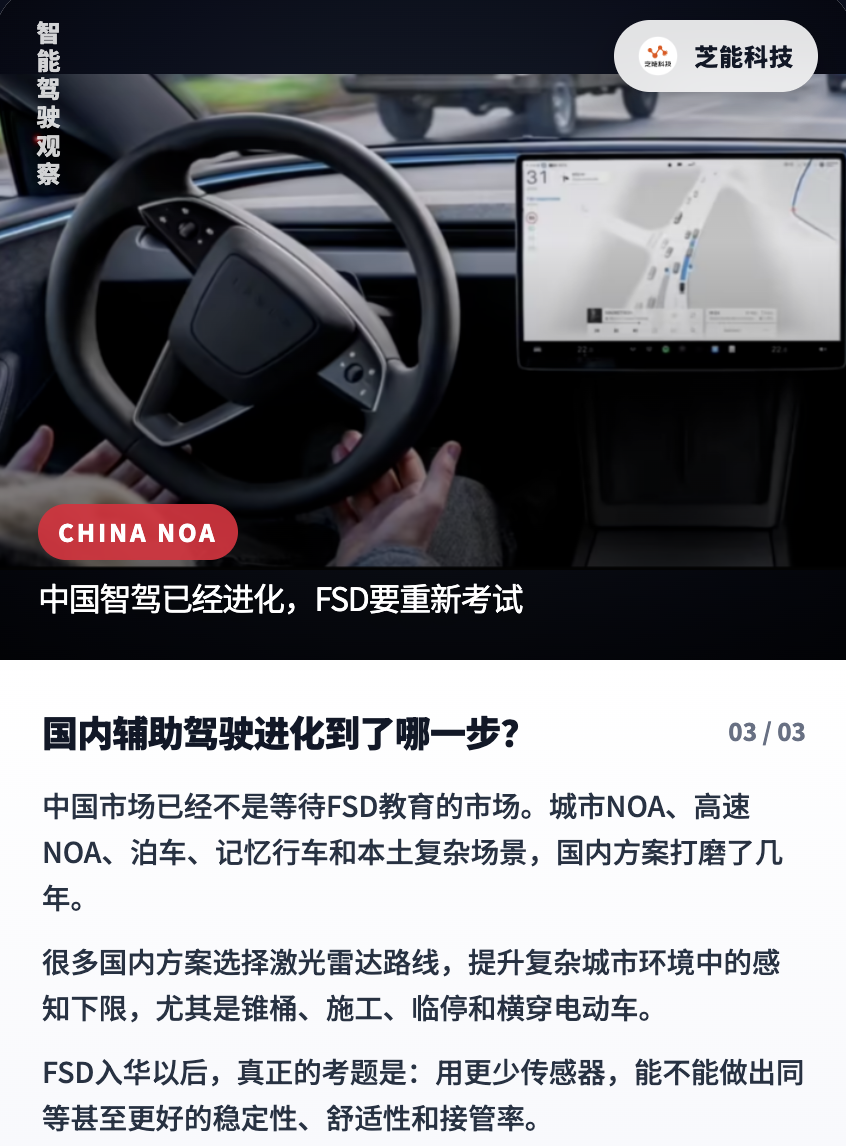
Unlike Tesla, many domestic solutions have opted for LiDAR as their perception hardware.
LiDAR is not a panacea; it cannot replace algorithms or automatically solve all long-tail problems.
Nevertheless, LiDAR does elevate the baseline for many assisted driving experiences. Iterations in 2026 feature stronger and more integrated LiDAR combinations, directly providing 3D shapes and distances of obstacles ahead, aiding in recognizing abnormal obstacles, stationary objects, cones, construction zones, and low-lying obstacles.
After upgrading to LiDAR, mainstream domestic assisted driving solutions have made vehicles' conservative boundaries in complex urban environments more stable.
For instance, when cones, roadwork, temporarily parked vehicles, or crossing electric vehicles appear, the system can more easily establish spatial awareness. In scenarios like unprotected left turns, narrow road encounters, and intersection negotiations, LiDAR provides a layer of more certain distance and obstacle information.
Of course, if the LiDAR algorithm is inadequate, LiDAR becomes mere decoration, enhancing perception redundancy but still ultimately relying on systemic capabilities. This is the core route difference between FSD and domestic solutions. Domestic solutions tend to adopt multi-sensor fusion, adding LiDAR alongside cameras to reassure consumers at the delivery level.
The benefits of FSD's approach will become apparent after its entry into China. Can it achieve equal or superior stability, comfort, and disengagement rates with fewer sensors in front of users already familiar with domestic automakers' offerings? Can it convince domestic users? We await the answer.
FSD's current focus is on learning Chinese regulations and road conditions. Chinese urban arterials feature highly specific traffic lights, various tidal lanes and bus lanes, non-motorized vehicles, temporarily parked vehicles, food delivery riders, and dense aggressive lane changes.
Complex intersections are the true litmus test for urban assisted driving. Chinese urban intersections present numerous challenges: unprotected left turns, U-turns, pedestrians and electric vehicles jostling, unclear lane markings, complex diversion lines, and non-standard signal light positions.
When to yield, when to proceed, when not to hesitate, and when to be conservative—we await FSD's upper performance limits in Chinese cities.
Of course, after FSD's entry into China, its success will largely hinge on its ability to handle long-tail abnormal scenarios, such as construction detours, temporary cones, electric vehicles traveling against traffic, tricycles crossing, low-light conditions at night, rainy day puddles, street vendor obstructions, and mixed traffic at parking lot exits. Encountering these scenarios will determine user trust. Tesla's advantage lies in its global fleet data and model iterations, which must now undergo a Chinese localization exam.
Summary
Finally, regarding pricing, the supervised FSD version currently only supports a subscription model. The one-time purchase option was globally discontinued in February 2026. The subscription price has not been finalized, but China will also adopt the subscription model, turning FSD into a competition of experience and pricing.
-
![]()
Doubao Work Unveiled! Domestic AI Leaders Fully Commit to the 'Work' Sector
-
![]()
Who’s Sounding the Alarm on ‘Rushed Vehicles’?
-
![]()
Over 5.3 Billion Yuan in Losses Over Three and a Half Years! Can Yonyou Reverse Its Fortunes Through Streamlining and AI Transformation?
-
![]()
Baidu AI Adopts Free Model: A Strategic Maneuver in Traffic and Monetization
-
![]()
Silicon-Based OLED Pioneer Unveils Financial Results: H1 Shipments Outpace Entire 2025 Volume
-
![]()
AI's First "Lost Summer"
-
![]()
Zeiss Makes Another €2.2 Million Bet: Will Eye Tracking Be the Next Big Thing in the Smart Glasses Industry?
-
![]()
RUNTO Ranking | Global Top TV ODM Factories' Shipment Figures for July 2026