Former Google CEO Met with Booing: Has AI First ‘Wreaked Havoc’ on the Young Generation?
 05/22 2026
 653
653
Recently, a similar scenario has played out at graduation ceremonies across several American universities: Whenever tech leaders sing the praises of AI on stage, the graduating students respond with a chorus of boos, brimming with outright hostility.
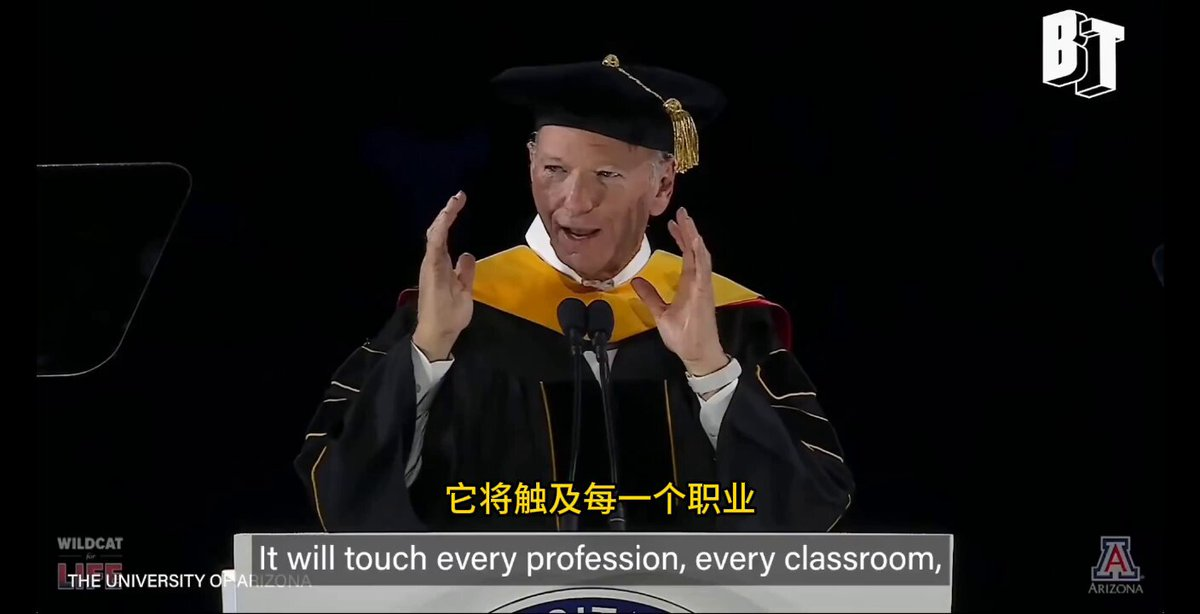
Former Google CEO Eric Schmidt was among the hardest hit by this wave of booing. During his commencement speech at the University of Arizona, he suggested that graduates should form teams of AI agents to tackle tasks that surpass individual capabilities. However, his remarks were met with such intense jeers that his speech was disrupted, forcing him to backtrack and reassure the students: “I understand your concerns, and these fears are entirely justified.”
(Image source: X)
Yet, there was nothing inherently wrong with Schmidt’s speech. The students weren’t booing out of a misunderstanding of AI technology; rather, they were venting their frustrations from job-hunting rejections onto the tech leaders. “Booing AI” has become a new rallying cry. A report by Business Insider revealed that some American fresh graduates have spent months searching for full-time jobs without receiving a single offer. Many had chosen majors that were most vulnerable to AI displacement even before the AI boom took off.
But is there truly a “right” major in the AI era? A few days ago, a friend asked me to help find a job for his younger brother, a fresh graduate in artificial intelligence. The irony is palpable—when even AI majors struggle to find suitable work, something is deeply amiss.
For decades, the world has followed a default path: study hard, get into college, acquire technical skills, become a white-collar worker, and secure a stable life. Computer science, in particular, was once considered a golden ticket: high salaries, abundant job opportunities, rapid growth, and significant salary increases from job-hopping.
Yet, AI’s first strike targeted precisely this group. People assumed that AI would first replace manual labor—cleaners, assembly line workers, cashiers—following the classic technological substitution pattern since the Industrial Revolution: steam engines replacing spinning wheels, cars replacing horse-drawn carriages, and robotic arms replacing factory workers. Logically, it should have worked this way.
Instead, AI stormed into offices, targeting white-collar jobs first—starting with its own creators: programmers. Coding has become AI’s most mature, widely applied, and commercially valuable production scenario. Anthropic’s Claude Code has propelled its valuation to surpass OpenAI’s trillion-dollar market cap.
According to a survey by The Economist, full-time employment rates for U.S. computer science graduates plummeted from over 70% in 2015 to around 55% by 2025, leveling off with average majors. Entry-level software engineer positions dropped by 73.4%, with many fresh graduates sending out hundreds of resumes without landing a single interview. Tools like GitHub Copilot, Cursor, and Claude Code enable one person to write code that previously required five, reducing the need for programmers. A few senior engineers, augmented by AI agents, now suffice.
What a perfectly aimed boomerang.
Moreover, coding isn’t just coding—it’s the foundation of everything. The software world is essentially a code-driven realm. Products, design, interactions, operations, marketing, content, BI, and customer service—the entire white-collar system rests on digital workflows. Thus, AI doesn’t just replace junior programmers but also designers, product managers, translators, researchers, analysts, marketers—many of whom studied these fields in college.
If this were a cyclical issue, recovery and job returns would follow. But AI has altered society’s demand structure for “human” labor. When students boo AI, they’re booing the agents taking their jobs. The Fourth Industrial Revolution deserves its name.

(Columbia University graduation ceremony)
While young people are locked out of job opportunities, those over 30 are being pushed out from within.
Caitlin Kalinowski, former head of OpenAI’s robotics team, made a jarring remark on the Lenny podcast: “It’s hard to find someone in their 30s who truly masters AI.” She argues that true “AI natives” are young people in their early 20s who grew up with AI, whose thinking aligns with large language models.
This view is shared by many tech leaders. Reddit CEO Steve Huffman, Otis CEO Judy Marks, Box CEO Aaron Levie, and LinkedIn co-founder Reid Hoffman all state that young employees from the AI-native generation hold significant workplace advantages because they instinctively use AI tools from childhood, rather than adapting to them later in life.
Those over 30 can never become AI natives—they’ve already lost at the starting line. This fuels middle-aged anxiety: higher chances of AI replacement, lower chances of “re-adapting” to AI.
In Silicon Valley, middle-aged workers waking up to job losses is a daily occurrence.
In 2025, Oracle’s net profit grew by 19% while laying off 20,000–30,000 employees. Meta earned $37.7 billion in the first three quarters, continuing to lay off 16,000. Microsoft laid off 15,000; Amazon’s two rounds of layoffs approached 30,000; Salesforce directly replaced 4,000 customer service roles with AI.
Layoffs once signaled corporate decline. Now, they reflect AI-driven hyper-efficiency. Internet companies previously needed to expand headcount to grow their business. Today, they use AI to distill human skills, leaving a few to form “human-AI teams”—the more they earn, the more they cut; the more they cut, the more they earn.
This efficiency has triggered a true capital carnival: The U.S. tech industry saw over 600,000 layoffs from 2023 to 2026. Meanwhile, tech giants’ profits and market caps soared to new heights, with the “super-giant” market cap threshold rising from $1 trillion to $5 trillion. Someone posted on social media: “We’re witnessing the most golden era in stock market history.”
Wealth is concentrating at an unprecedented speed toward those controlling computing power and tokens.
During the early Industrial Revolution in 19th-century Britain, a similar phenomenon occurred: rapid economic growth, factory expansion, and soaring productivity from steam engines, yet ordinary workers’ wages stagnated for 60 years. Economics later dubbed this period “Engels’ Pause.” Technological progress concentrated wealth among the few—today’s AI is creating a new “Engels’ Pause.”
AI is an extremely capital-biased technology. Steam engines still needed workers to shovel coal; assembly lines still required employees. But once a large language model is trained, its marginal replication cost nears zero. Wealth thus concentrates at an unprecedented speed toward the few owning computing power, models, and data.
NVIDIA exemplifies this. Its Q1 revenue hit $81.6 billion (up 85% YoY), setting a quarterly record; net profit reached $58.3 billion (up 211% YoY), with its market cap repeatedly breaking human records. Chip prices, storage, and optical modules surged. Samsung Electronics became Asia’s second trillion-dollar company (after Taiwan’s TSMC), while SK Hynix employees became hot commodities in South Korea’s dating market, with average employee bonuses reaching 6.1 million RMB last year.
A stark divide: some thrive, others struggle.
Industries like software, design, and SaaS have collapsed, even “wiped out.” Google’s latest AI search directly signals the death of websites, nearly killing PC-based internet.
Inequality breeds resentment. While throwing Molotov cocktails at Altman’s home remains an extreme outlier, booing AI leaders on stage is becoming more common, especially among young people. A Walton Family Foundation and Gallup survey of American youth revealed that enthusiasm for AI among Gen Z (ages 14–29) dropped 14% over the past year, while anger rose from 22% to 31%, and anxiety remained steady at around 40%. Young people, dubbed “AI natives” by AI companies as the most promising demographic, are now the first to oppose AI—fearing job displacement and cognitive dumbing-down from over-reliance. This is the “AI Paradox.”
Some are already sabotaging quietly. AI company Writer surveyed 2,400 “knowledge workers” in the U.S., UK, and Europe (half employees, half executives). 29% admitted to sabotaging or resisting their company’s AI strategy—44% among Gen Z employees. They feign cooperation while secretly undermining, poisoning AI systems, even feeding company secrets to public AI to deliberately make it perform poorly. This mirrors taxi drivers’ hostility toward autonomous vehicles—a reincarnation of Luddism in the AI era.
AI giants aren’t unaware of the problem—they just can’t stop. April saw the busiest AI launch week, with technological storms brewing. Google unveiled its more powerful Gemini product matrix, including Omni, which can input and output anything. Tesla converted its Model S/X production lines into Optimus robot factories, targeting annual production of 1 million units. AI is penetrating the physical world, eyeing everyone’s livelihoods.
AI giants inject pain while offering candy. Anthropic established TAI (Anthropic Research Institute), focusing on AI’s employment impact. It just released a “One-Person Team Guide”—if you can’t find a job or got laid off, use Claude to form a one-person team. This is perhaps the year’s most subtly ironic “kindness.” Meanwhile, AI media consistently claims: “AI will replace some jobs but create more.” Yet no one can specify what those jobs are or how many positions will exist.
Then there’s the narrative of technological inclusivity.
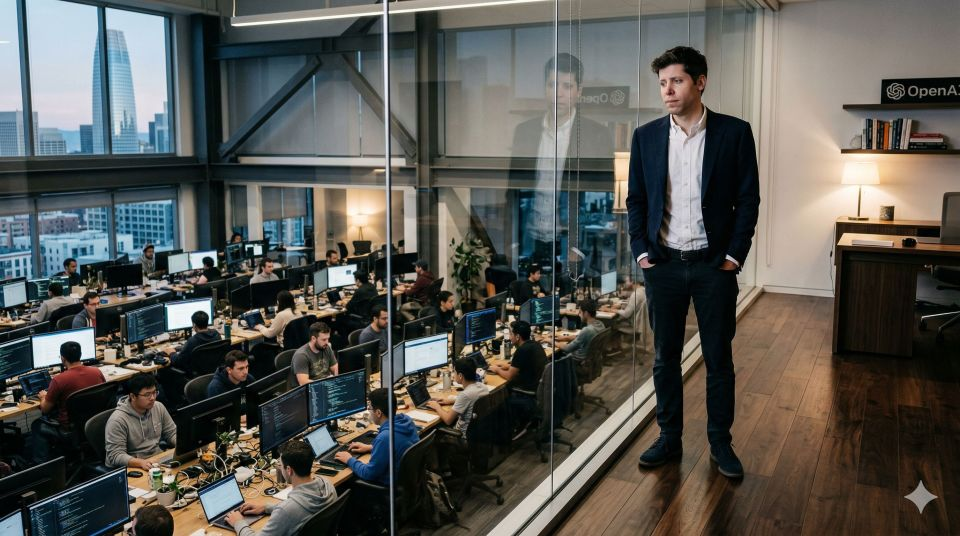
The internet era fostered illusions of “democratized traffic,” where ordinary people could turn the tables (reverse their fortunes) through content creation or e-commerce. What about the AI era? After being targeted with Molotov cocktails, Altman wrote a sleepless reflection on AI’s societal rifts. He argued AI would become the most powerful tool ever seen to expand human capabilities. “Demand for this tool is virtually unlimited—people will use it to create amazing things. The world deserves abundant AI, and we must find a way to deliver it.” He also pledged to empower individuals with AI, ensuring its democratization. Whether this is empty rhetoric depends on OpenAI’s actions.
(Image source: Leikeji)
As conflicts intensify, the ultimate hope rests on the “invisible hand.” Governments may impose AI taxes to subsidize displaced workers or increase layoff costs. In the AI era, employer-employee relationships are transforming. Companies once bought employees’ time; now they distill employees’ experience, knowledge, and creativity into “Skills,” turning human assets into interchangeable interfaces. When laying off workers, companies must compensate for this distilled value—“buying out Skills.”
Horse-drawn carriage drivers’ protests didn’t stop cars, nor did textile workers’ machine-smashing halt steam engines. Today’s college students’ boos won’t derail AI’s progress or even slow it down.
History doesn’t repeat, but it rhymes.
-
![]()
Doubao Work Unveiled! Domestic AI Leaders Fully Commit to the 'Work' Sector
-
![]()
Who’s Sounding the Alarm on ‘Rushed Vehicles’?
-
![]()
Over 5.3 Billion Yuan in Losses Over Three and a Half Years! Can Yonyou Reverse Its Fortunes Through Streamlining and AI Transformation?
-
![]()
Baidu AI Adopts Free Model: A Strategic Maneuver in Traffic and Monetization
-
![]()
Silicon-Based OLED Pioneer Unveils Financial Results: H1 Shipments Outpace Entire 2025 Volume
-
![]()
AI's First "Lost Summer"
-
![]()
Zeiss Makes Another €2.2 Million Bet: Will Eye Tracking Be the Next Big Thing in the Smart Glasses Industry?
-
![]()
RUNTO Ranking | Global Top TV ODM Factories' Shipment Figures for July 2026