China Telecom’s Monumental 17.4 Billion Yuan ‘Token Factory’ Deal Revealed! A New Stealthy Competition Among Telecom Operators in the AI Era
 05/22 2026
 512
512
In April of this year, China Telecom’s Ningxia Branch announced the ‘2026 Centralized Procurement Project for Token Generation Capability Services’ through a public bidding process. The estimated project scale is 16.451 billion yuan (tax-exclusive) or 17.43806 billion yuan (tax-inclusive), divided into 11 bid packages. Bidding has already commenced for five of these packages, with a service period of 60 months from the order placement date. The delivery timeline requires the provision of standard Token generation capabilities within 30 days from the order date.
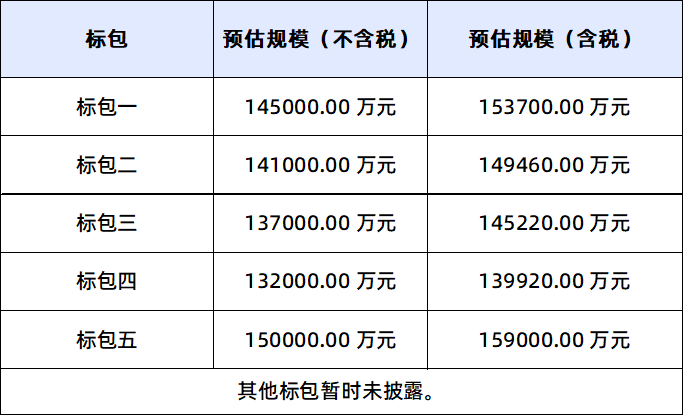
On May 10th, the winning bidders for the first package of this major domestic procurement initiative for Token generation capability services were announced. The successful companies included Beijing Teamsun Technology Co., Ltd., Beijing Lexun Technology Co., Ltd., Hubei Big Data Group Computing Power Technology Co., Ltd., and Qingxin Intelligent Computing (Beijing) Technology Co., Ltd. These firms are set to share a procurement amount of approximately 1.5 billion yuan.
In March of this year, China Telecom’s Chairman Ke Ruiwen underscored the necessity of reshaping the business landscape through AI and Token operations. He emphasized the integration of key elements such as technology, talent, and channels to develop systematic integration capabilities and provide comprehensive, digital, intelligent, and localized AI services. Against this backdrop, the centralized procurement project marks a significant step in China Telecom’s transition from traditional ‘traffic operations’ to ‘Token operations.’ It represents far more than a mere procurement; it is a landmark event in the transformation of telecom operators in the AI era, with far-reaching industry implications.
This ‘Token Factory’ Is No Ordinary Facility
In the realm of AI, Tokens (or ‘word elements’) serve as the fundamental units for models to process information. Whether it’s a user’s query or AI-generated code, it must ultimately be broken down into Tokens for computation. Consequently, Token usage has become a crucial metric for gauging the activity and industrial value of AI models. The higher the Token usage, the more the model is utilized, and the greater the actual value generated. Thus, a ‘Token Factory’ is an infrastructure platform specifically designed for the large-scale production of these Token capabilities. This concept was initially introduced by NVIDIA CEO Jensen Huang at the 2024 GTC Conference and further elaborated upon at the GTC 2026 Conference with the ‘Token Factory Economics.’
However, in China Telecom’s bidding announcement, the term ‘factory’ carries a deeper connotation. It implies industrialized supply, which is also the focal point of the bidding documents—whether candidate suppliers can consistently generate Tokens, achieve standardized delivery, ensure low latency and service level agreements (SLAs), and maintain supply in large-scale concurrent scenarios.
From a core output perspective, the ‘factory’ produces and delivers standardized ‘Token generation capabilities.’ This capability is broad and likely encompasses the generation of text, code, images, and even videos. From a production mode perspective, it shifts from customized projects to large-scale, centralized industrial production, akin to a power plant that uniformly accesses various ‘energy sources’ (heterogeneous computing power and multi-vendor large models) and converts them into stable, standardized services. From a delivery and supply perspective, the ‘factory’ must establish a network that can be called upon as needed and serve the entire nation, enabling customers to access Token generation capabilities in real-time, much like using water and electricity. From an operational management perspective, the ‘factory’ requires a comprehensive operational system, including order processing, service metering and billing, quality assurance, etc., to ensure continuous and stable operation during the service period.
In essence, this 17.4 billion yuan deal represents China Telecom’s procurement of production equipment and raw materials for constructing a ‘Token Factory.’ It invites partners to jointly establish a super service system that transforms computing power and models into standardized AI capabilities. Currently, the winning bidder candidates for the first package include traditional IT service providers, local state-owned enterprises, and emerging computing power vendors, reflecting China Telecom’s strategic orientation of building an open ecosystem and developing ‘ecosystem Tokens.’
Why Are Telecom Operators Leading the Charge in ‘Token Operations?’
Represented by China Telecom, the three major telecom operators have fully embarked on their strategic positioning in ‘Token operations.’
China Mobile leverages its vast user base and ecological partner advantages. On May 8th, China Mobile officially launched its Token operation system, aiming to establish Tokens as a ‘universal currency’ connecting computing power, models, applications, and users. Relying on its 5G network, computing network infrastructure, billion-user reach, and integrated ‘cloud, pipe, end, and edge’ operational advantages, China Mobile seeks to build a Token ecosystem operation system that spans ‘capability foundation, operation platform, and application portal.’ Concurrently, China Mobile also jointly launched the Token Operation Ecosystem Alliance with ecological partners such as Tencent, Alibaba, Huawei, ZTE, and iFLYTEK.
China Unicom focuses on solidifying its ‘computing-network convergence’ advantages to deliver AI capabilities with low latency and high efficiency. Unicom experts state that the core of Token operations is the ‘value realization of a new model for computing power operations.’ Therefore, Unicom emphasizes a new computing power operation model of ‘applications + models + resources’ and has specified that computing power investment will account for over 35% in 2026, leveraging computing-network convergence and cloud-network integration to solidify the foundation for Token operations.
Overall, the three operators have distinct focuses: China Telecom emphasizes ‘heavy-asset procurement,’ China Mobile focuses on ‘ecosystem operations,’ and China Unicom delves into ‘computing-network infrastructure.’ Faced with opportunities in the AI era, each path has its merits, reflecting the strategic thinking of the three operators based on their own strengths.
Compared to internet platforms or large model startups, the telecom operators’ early entry into ‘Token operations’ is not a spontaneous decision but a strategic positioning centered around their core resources, responding to industry changes, and seizing dominance in the new ecosystem.
For a long time, the core capability of telecom operators has been the organization, scheduling, and operation of large-scale foundational resources. Since the communication era, operators have established a mature system: pooling resources through networks, ensuring stable supply through scheduling systems, meeting concurrent demands from massive users through SLAs, and completing commercial loops through standardized billing systems. Whether it’s voice, SMS, data, or later cloud computing and IDC, they all essentially fall under the category of ‘foundational capability servitization.’ Today’s Token services share a high degree of similarity with these businesses in their underlying logic.
From a resource endowment perspective, according to Zhang Bin, an associate professor at the School of Economics and Management at Beijing University of Posts and Telecommunications, operators possess several capabilities that other players find difficult to combine: mature account, authentication, billing, and clearing systems; a vast base of government and enterprise customers and a localized service network; ‘cloud, network, edge, and end’ coordination capabilities; and relatively stronger compliance, security, identity authentication, and auditing capabilities.
While internet giants fiercely compete for the ‘strongest model,’ operators have chosen a different path: creating an ‘arena’ and ‘distribution channel’ that support the operation of all models. Regardless of which model leads in the future, its capabilities will need to reach end-users through infrastructure like the ‘Token Factory.’ This represents a more controlling ‘ecosystem positioning.’ It is not only a strategic move to revitalize their own networks and computing power but also an important attempt to escape ‘pipelization’ and open up new growth curves. More importantly, through this strategic positioning, they have the potential to become super intermediaries in the era of AI capability public servitization.
In Conclusion
Looking back at the history of the communications industry, from telegraphs to telephones, from SMS to data, each leap in ‘foundational capability servitization’ has undergone a cyclical transformation from hype to calmness, from bubbles to real value. Today’s Token operations are at a critical juncture transitioning from the first ‘conceptual consensus’ to ‘commercial value.’ Those who can navigate this cycle will not be mere concept hypesters but enterprises that truly transform Tokens into reliable utilities like water and electricity while adding unique value. For telecom operators, the 17.4 billion yuan centralized procurement is just the prologue; the real test has just begun.
References: Tokens Get a Chinese Name - ‘Word Elements’! - CCTV News Tokens Are Not Traffic: Opportunities, Paradoxes, and Boundaries in Telecom Operators’ Competition for AI Operation Entry Points - C114 17.4 Billion Mega-Deal! China Telecom Launches ‘Token Factory’ Centralized Procurement - C114 Cao Chang: Three-Level Precise Token Supply - Communications Industry Network China Telecom: Full Transition to Token Operations! - 5G and 6G
-
![]()
Doubao Work Unveiled! Domestic AI Leaders Fully Commit to the 'Work' Sector
-
![]()
Who’s Sounding the Alarm on ‘Rushed Vehicles’?
-
![]()
Over 5.3 Billion Yuan in Losses Over Three and a Half Years! Can Yonyou Reverse Its Fortunes Through Streamlining and AI Transformation?
-
![]()
Baidu AI Adopts Free Model: A Strategic Maneuver in Traffic and Monetization
-
![]()
Silicon-Based OLED Pioneer Unveils Financial Results: H1 Shipments Outpace Entire 2025 Volume
-
![]()
AI's First "Lost Summer"
-
![]()
Zeiss Makes Another €2.2 Million Bet: Will Eye Tracking Be the Next Big Thing in the Smart Glasses Industry?
-
![]()
RUNTO Ranking | Global Top TV ODM Factories' Shipment Figures for July 2026