DeepSeek's Financing Details Revealed! How Liang Wenfeng Secured Control
 06/17 2026
 600
600
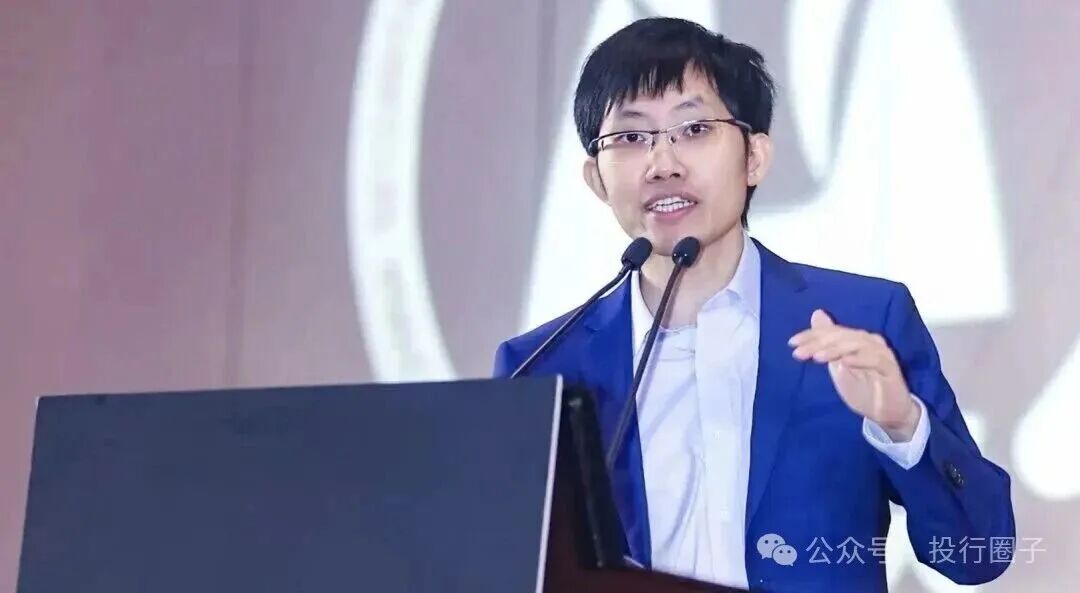
The biggest news in the AI circle these past two days is none other than the finalization of DeepSeek's first round of financing.
50 billion RMB, or 7.4 billion USD, with a valuation exceeding 50 billion USD. This marks the largest single-round financing in China's AI industry to date.
Among the investors, Tencent contributed 10 billion, CATL 5 billion, JD.com and IDG 3 billion each, and the National AI Fund invested 1 billion directly... The numbers are big, the shareholders impressive, and the presence substantial.
The truly fascinating part of DeepSeek's financing round is how Liang Wenfeng managed to retain firm control of the company's steering wheel after presenting this 50 billion capital feast.
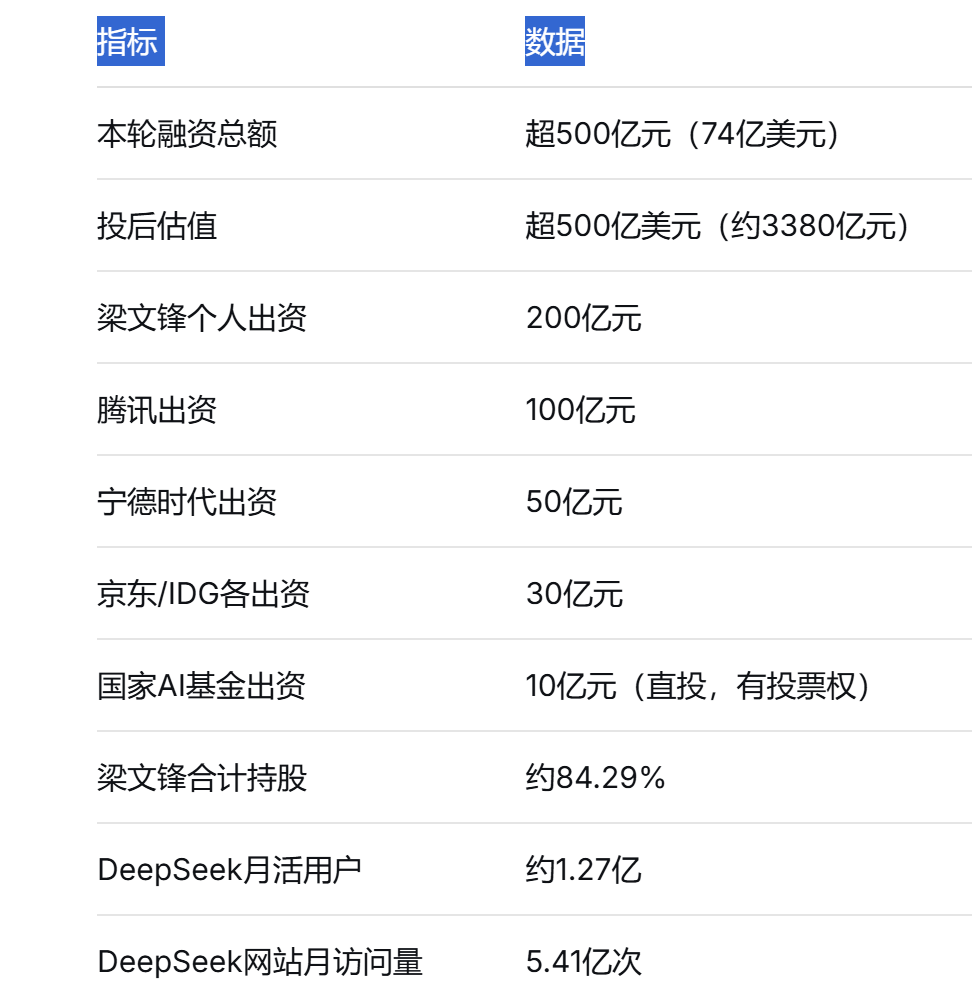
Data Source: Public Queries, Compiled and Summarized by Investment Bank Junior Sister

Liang Wenfeng's 'Unconventional Moves'
Let's briefly review the framework of this financing round.
On June 16th, according to The Information, DeepSeek completed its first external financing round, raising over 50 billion RMB.
Liang Wenfeng personally contributed 20 billion, making him the largest contributor; Tencent 10 billion, CATL 5 billion, JD.com and IDG 3 billion each. The valuation surpassed 50 billion USD.
If it were just these numbers, it would be just another 'big AI financing news.' But DeepSeek's unique approach lies in its transaction structure, a textbook-level defense of control.
Liang Wenfeng's meticulously arranged 'triple safeguard.'
The uniqueness of this financing round lies not in the amount but in how the money flows in, how rights are distributed, and how parties exit.
The money doesn't go directly into the company but first into 'Liang Wenfeng's pocket.' Reports indicate that, except for the National AI Fund, other external investors were required to inject funds into a limited partnership managed by Liang Wenfeng, rather than directly investing in DeepSeek itself.
In plain terms: the money you invest doesn't directly buy equity in DeepSeek but goes into a 'fund pool' controlled by Liang Wenfeng. This pool then connects to the company in some way, but voting rights—sorry, none.
External investors gain economic benefits, priority participation in future financing rounds, and higher-level financial information access. But how the company is run, strategies set, or technical routes chosen—that's none of your concern.
Five-year lock-up period, no quick profits. This financing round also includes a five-year lock-up period. During these five years, most investors cannot sell their stakes.
Five years. In the impetuous AI track (which roughly translates to 'sector' or 'field'), where 'going public in three years and retiring in five' is the norm, a five-year lock-up essentially cuts off any short-term arbitrage ambitions. DeepSeek's logic is clear: we don't welcome quick-profit capital; we only accept funds willing to stay with the company for the long haul.
Liang Wenfeng's team also demanded verification of the real identities of limited partners behind all contributing funds to mitigate the risk of equity ending up in unknown hands. They want to know exactly who you are and where your money comes from.
The National AI Fund as the sole exception. The most unique part of the entire transaction is the National AI Industry Investment Fund, which directly invested 1 billion RMB in DeepSeek, is not subject to the five-year lock-up, and holds voting rights in the company.
Other external funds are placed within a limited partnership structure, while the National AI Fund directly enters the company's equity layer. This arrangement reflects DeepSeek's extreme caution over control and indicates the company's elevated position within China's AI industrial ecosystem, beyond just an ordinary startup.
With these triple safeguards superposition (which means 'combined' or 'stacked'), Liang Wenfeng has implemented the principle of 'taking the money but not the orders' to the extreme.
In my view, this is no coincidence but a meticulously designed 'control preservation battle' by Liang Wenfeng's team.
Why did Liang Wenfeng go to such lengths?
The answer lies in DeepSeek's DNA.
Founded in 2023, the company originated from the AI team under Liang Wenfeng's quantitative fund, High-Flyer. Before the R1 model gained fame in early 2025, DeepSeek had not engaged in external financing nor followed the typical path of large model startups by continuously bringing in venture capital.
It more closely resembles a research-oriented model lab: a small team, minimal external pressure, and an emphasis on open-source and model efficiency.
For nearly three years, DeepSeek adhered to a zero-external-equity-financing principle, with all costs for R&D, computing power procurement, and talent compensation fully covered by the parent company, High-Flyer's operational earnings.
At its peak, High-Flyer managed assets exceeding 70 billion RMB, with its products averaging a 56.55% return rate in 2025. This stable cash flow continuously supported DeepSeek's supercomputing cluster construction and large model pre-training investments.
In other words, DeepSeek has never relied on VC funding to survive. Its underlying logic is 'internal hematopoiesis' (self-sufficiency) rather than 'external acceleration.'
However, large model R&D continuously consumes computing power, and the competition for top researchers has become increasingly costly.
The Information reported that DeepSeek has lost some core researchers: Luo Fuli, a key contributor to V3, joined Xiaomi; another researcher, Guo Daya, who participated in previous model development, also joined ByteDance at a higher salary.
According to public information, at least five core R&D personnel have left, covering four core technical areas: base models, reasoning, OCR, and multimodality.
Financing became an unavoidable choice. But Liang Wenfeng's approach was to raise funds while maintaining control.
He had already laid the groundwork before financing. On April 27th, DeepSeek increased its registered capital from 10 million to 15 million, with Liang Wenfeng's direct shareholding rising from 1% to 34%, giving him a combined direct and indirect stake of approximately 84.29%.
Before financing even began, the 'firewall' for control had already been erected.
Where will the money go?
With 50 billion secured, the intended use of funds and DeepSeek's strategic direction have also drawn significant attention.
Two keywords: infrastructure and productization.
Infrastructure: From rented server rooms to self-built data centers. Job postings reveal that DeepSeek is recruiting for its Ulanqab Intelligent Computing Center in Inner Mongolia while creating a new position for 'IDC Design and Planning Engineer' responsible for planning and constructing ultra-large-scale intelligent computing centers ranging from MW to GW capacity. This indicates a shift from rented server rooms to self-built data centers.
This is a clear signal: DeepSeek is not satisfied with being just a 'model company'; it aims to become an owner of AI infrastructure. Self-built intelligent computing centers mean lower long-term computing costs, higher scheduling efficiency, and absolute control over core resources.
Productization: From models to Agents. On the product front, DeepSeek is assembling an 'Agent Harness' team led by senior researcher Chen Delli, aiming to create DeepSeek Code Harness, modeled after Anthropic's Claude Code.
Job postings show that DeepSeek is transforming its cutting-edge model capabilities into Agent products, with all work beyond the model itself falling under the Harness category.
The core path is defined as 'Model + Harness = Agent,' with all engineering actions outside the model—such as context management, tool invocation, file read/write, and terminal execution—classified under Harness.
This is less a routine team expansion and more the first organizational signal of DeepSeek's strategic shift from a 'model company' to a 'product company.'
Claude Code has already turned AI coding into a business with annualized revenue exceeding 2.5 billion USD. OpenAI's Codex saw its weekly active users grow from 3 million to 4 million in 15 days.
DeepSeek clearly doesn't want to be left behind in this race.
Industry Transformation
Now, let's look at the competitive landscape. DeepSeek's rise is reshaping the global AI large model competition.
In terms of usage, OpenRouter data shows that DeepSeek-V4-Flash ranked first globally for three consecutive weeks, with a weekly usage volume of 3.69 trillion Tokens. Among the top five globally in weekly usage, the first four are Chinese AI large models. Chinese large models have surpassed the U.S. in weekly usage for six consecutive weeks and firmly hold the global top spot.
In terms of pricing, DeepSeek has taken a path starkly different from its peers.
Amid industry-wide price hikes, Zhipu raised its API prices three times within the year, each increase exceeding 30%; Tencent Cloud's CodeBuddy Enterprise Edition saw a 154% increase; Alibaba Cloud's computing products rose by 5% to 34%. In contrast, DeepSeek announced a permanent 75% price cut for V4-Pro. At 0.025 RMB per million Tokens with cache hits, this is roughly 1/14,960 of GPT-5.5's long-context version.
In terms of user base, QuestMobile data shows that as of March 2026, DeepSeek had approximately 127 million monthly active users, ranking third in the industry. In May, its website monthly visits reached 541 million, up 11.22% month-over-month, ranking first domestically and fifth globally.
On one side, the industry collectively raises prices; on the other, DeepSeek bucks the trend with price cuts.
On one side, overseas giants see declining usage; on the other, Chinese models continue to lead. DeepSeek is redefining the competitive rules for AI large models with its 'ultimate cost-effectiveness + open-source ecosystem' combination.

Liang Wenfeng Sets an Example for Tech Innovators
The most intriguing aspect of this financing round is not the 50 billion figure but how Liang Wenfeng completed the largest financing in history using an almost 'anti-capital' approach.
What does 'anti-capital' mean?
The traditional financing logic is: entrepreneurs take money, investors take control. The more money given, the greater the say. Board seats, veto rights, preferred liquidation rights... capital's rules of the game have long been written into countless Term Sheets.
But Liang Wenfeng tore up this widely used script.
He placed investors in a cage where they 'only provide money, not control.'
A five-year lock-up, no voting rights, and funds not entering the company's main body—this isn't financing; it's 'borrowing money,' and even then, it's 'borrowing without interest, but you can't tell me what to do.'
With his 20 billion, he drew a clear red line for all external investors. 'Founder as largest investor'—this structure means that even if all external investors united, they couldn't outweigh Liang Wenfeng individually in terms of capital contribution. He is not just the rule-maker but the largest stakeholder.
He placed the National AI Fund in a special position. With a direct 1 billion investment, voting rights, and no lock-up period, this arrangement meets the 'national team's' strategic needs while ensuring, through controlled amount, that external forces won't shake Liang Wenfeng's absolute control.
This 'limited openness, precise concession' operation is a perfect blend of political and commercial wisdom.
He wrote 'no quick profits' into the financing terms. A five-year lock-up and Penetrating verification (which means 'thorough verification') of LP identities—this isn't capital's usual playbook. Liang Wenfeng is telling everyone: my company is not your arbitrage tool.
Some call this 'the founder's victory over capital.' I believe a more accurate description is the story of someone who never lacked money refusing to cede control of his company even when he needed funds.
The uniqueness of DeepSeek lies in the fact that it has never been a company that relies on venture capital (VC) to survive. The cash flow from High-Flyer Quant has given Liang Wenfeng sufficient confidence, allowing him to be selective in financing, set thresholds, and establish rules. Ordinary entrepreneurs do not have this luxury, but Liang Wenfeng does.
Therefore, the significance of this round of financing extends far beyond 'DeepSeek having money now.'
It sends a signal to the entire industry: financing does not necessarily mean losing control, provided you have sufficient leverage and clear boundaries.
Of course, there is another side to the coin. The introduction of external capital will inevitably bring about changes in the governance structure, even if Liang Wenfeng has set up multiple defenses.
Previously, DeepSeek established itself in the industry as a 'research-oriented model laboratory.' After introducing commercial capital, whether it can continue to maintain its technical idealism is a question that only time can answer. The pressure of talent drain also remains, as the departure of core R&D personnel will not automatically cease with a single round of financing.
But at least for now, Liang Wenfeng has provided an impressive answer.
He has proven DeepSeek's commercial value with 50 billion yuan and demonstrated through a sophisticated institutional design that the company still bears the 'Liang' name.
This is not just a financing story. It is a narrative about how to stay true to one's original aspirations amidst the torrent of capital.
Liang Wenfeng, who possesses both high intelligence and emotional intelligence, has shown everyone through his actions: money can be accepted, but no one should touch the steering wheel.
Disclaimer: This article is solely for financial hotspot analysis. The data and information are sourced from publicly available queries, company announcements, and iFinD. The views expressed are for reference only and do not constitute any investment or consumption advice.
#FinancialHotspots #DeepThinking #BusinessFinance #InvestmentBankingCircle #ListedCompanies #AI #FinancialHotSearch #PrimaryMarket #Listing #DeepSeek
What are your thoughts on the topic of DeepSeek's financing?
-
![]()
Registered Capital Slashed to 372 Million Yuan! Yutong Optical Finalizes Industrial and Commercial Change Registration
-
![]()
Zhuque-3 Successfully Lands, and 'Time Traveler' Secures Another ¥100 Million in Funding: China's Commercial Space Industry Experiences a 'Dynamic August'
-
![]()
Autohome Faces a Shrinking Window of Opportunity
-
![]()
Even a Titan Like Musk Has Faced Setbacks in Fulfilling Promises
-
![]()
AI Office: The End of the Racing Era, Context Becomes the Key to Success
-
![]()
Domestic Vehicle Chassis Revolution ②: The Steering Wheel Remains, But Mechanical Connections in the Steering System Are Decreasing
-
![]()
Exploring MiniMax Design: Can Video Editing Be as Simple as Speaking?
-
![]()
Why Can SenseTime Achieve Profitability While CloudWalk Still Faces Challenges, Despite Both Adopting Large Models?