The Evolutionary Path of Agent Engineering: From Prompt to Harness by Zhang Yutao, Co-founder of Moonshot AI
 07/07 2026
 665
665
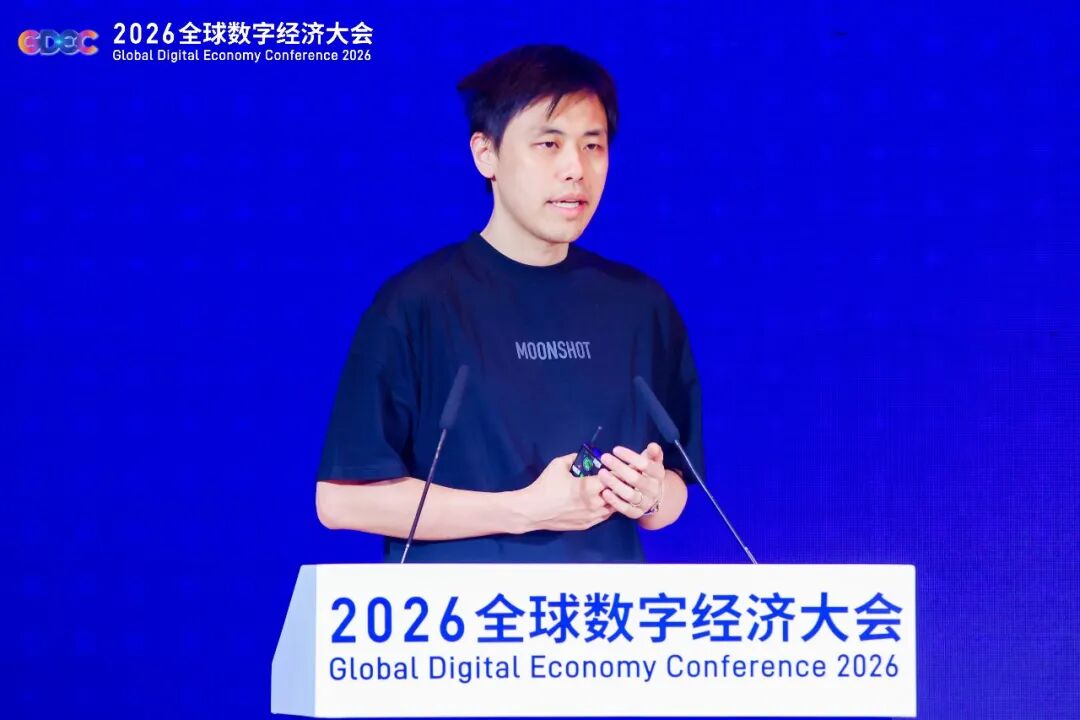
©Tide AI Editorial Team
As large models transition from single-question-answer dialogue tools to Agents capable of autonomous planning, iterative execution, and completing complex tasks over extended periods, the industry's focus on AI engineering transformation continues to shift. Today, the true challenge lies in establishing a complete operational environment that supports models in autonomously completing closed-loop tasks at the hourly level.
The continuous emergence of large models' understanding, reasoning, and planning capabilities necessitates simultaneous iteration of engineering methodologies. On July 3, Zhang Yutao, co-founder of Moonshot AI, delivered a keynote speech titled 'The Evolutionary Path of Agent Engineering: From Prompt to Harness' at the '2026 Global Digital Economy Conference Artificial Intelligence Integration Application Development Forum.' He comprehensively outlined the three-stage technical evolution of large models, combining his team's practical experience in implementing Agents to dissect the underlying logic, core principles, and long-term development strategies of next-generation Agent engineering. Below is the transcript of Zhang Yutao's speech, compiled and published by Tide AI:
Three Buzzwords: Prompt → Context → Harness Engineering It's a great honor to be here to share model vendors' know-how in AI engineering and the practical aspects of building Agents with AI. Large models have undergone continuous iteration since their development in 2023.
Three buzzwords have marked this journey: In 2023, when ChatGPT was first released, the concept we emphasized was Prompt Engineering. By 2024, it evolved to Context Engineering. Now, in 2026, the hottest term is Harness Engineering.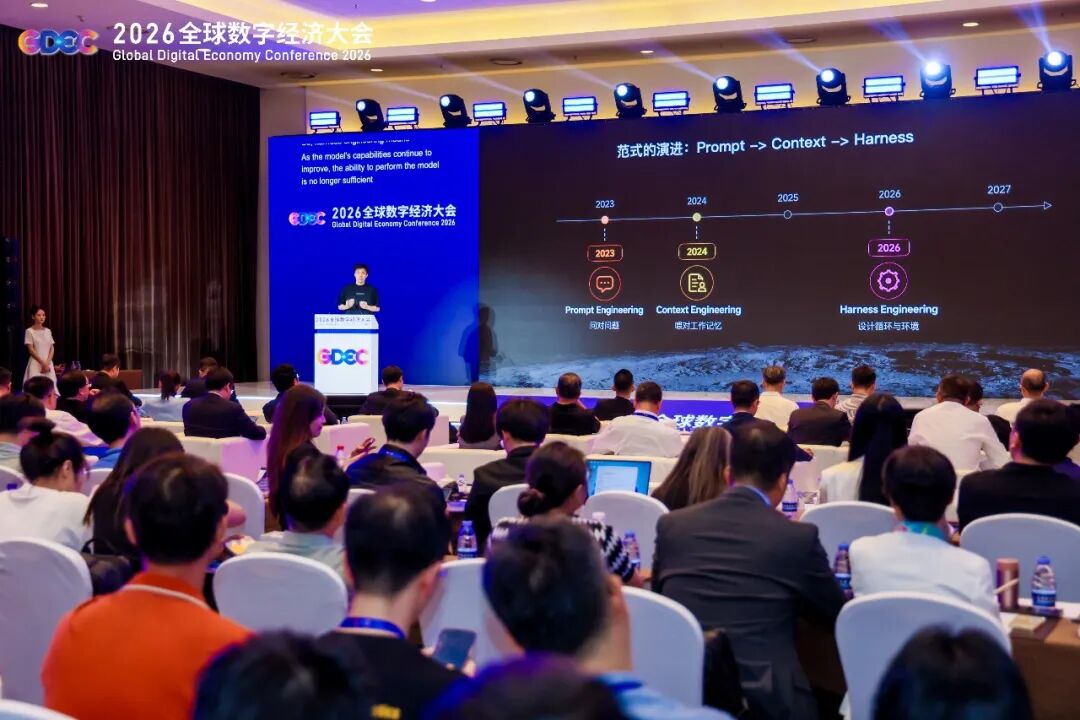
What do these three terms signify?
First, we need to ask questions. How can we clearly articulate a problem within a focused, limited context to enable precise AI responses? This is the essence of Prompt Engineering.
Second, Context Engineering. As the context space and model window expand, how can we provide more comprehensive and accurate information to enable models to complete more complex tasks?
Third, Harness Engineering. With continuously improving model capabilities, models are no longer limited to single-round tasks or answering questions but can undertake complex tasks lasting over an hour. How can we enable them to complete such tasks through an iterative process of continuous self-exploration?
1. 2023: The Era of Prompt Engineering and the Limitations of 4K Context Let's go back to 2023. At that time, with the release of ChatGPT, we faced a perplexing issue: it only supported a 4K context space. Within such a limited context, the possibilities were highly constrained. You had to utilize this space very skillfully to pose your questions and assign tasks.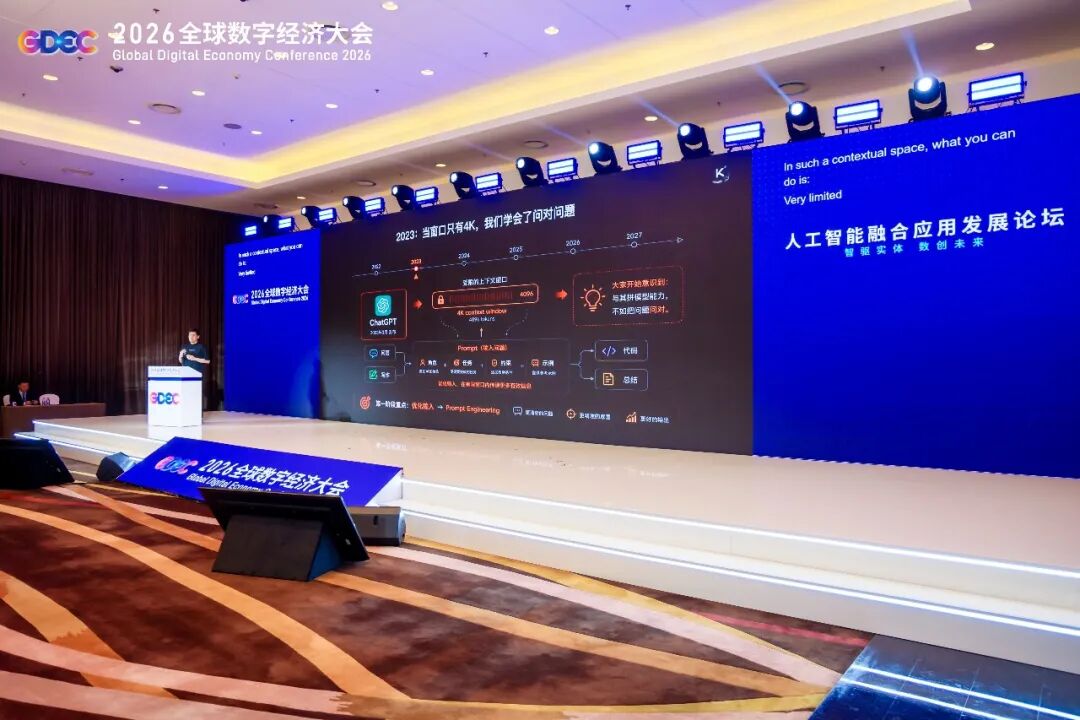
Therefore, we constantly emphasized the importance of Prompt Engineering. Essentially, it was about how to precisely deploy problems to the model within a limited context space for completion. Moreover, given the model's limited intelligence at that time, adapting to its understanding of prompts was crucial.
2. 2024: The Era of Context Engineering and the Integration of Tool Calls into Context Entering 2024, the context windows of various models began to expand, from 4K to 32K, 128K, and even beyond 1MB. With improved model capabilities, we started to explore having models perform more complex tasks beyond just answering questions.
This led to the introduction of the concept of Context Engineering. We focused on integrating tool calls into the context space, providing the model with sufficient information and well-organized structures to leverage external information for completing more complex tasks. This was our primary focus during this stage.
3. 2026: The Era of Harness Engineering and the Turning Point for Hourly-Level Tasks As model capabilities continue to improve, we've observed a turning point. Previously, models had limited capabilities and adherence to instructions, as well as limited understanding of long tasks, enabling them to complete only minute-level tasks—usually expressible within a single context space.
Now, we see that models are fully capable of handling tasks lasting over an hour. In this scenario, we must provide models with a better environmental space to fully unleash their capabilities. At this point, the limitation no longer lies within the model itself but in how to provide it with an optimal space for expression. This leads us to consider how to construct an environment that drives the model to solve problems autonomously within a closed loop.
This is the essence of Harness Engineering. While it may sound sophisticated, the concept of an Agent is actually quite simple—it's essentially a loop. For code developers, it's akin to a while loop. When the model hasn't resolved an issue, it explores and decides on the next steps independently, executes those decisions, and evaluates whether the desired outcome has been achieved.
If errors occur, it considers how to recover from them and whether human intervention is necessary. Ultimately, it assesses whether the problem has been resolved—if so, the task is completed, and the loop ends; if not, the loop continues. This is the core of Agent engineering, which revolves around solving this fundamental issue.
The Scaffolding Philosophy: Timely Removal After Model Capability Enhancement What we need to do is better define the Agent framework within this loop, allowing it to explore freely in a fully secure environment, discover solutions, and provide it with adequate tools to excel. Therefore, these three concepts are not entirely independent but rather progressive and even inclusive.
In the current landscape of Agent engineering, we need to consider how to design Prompts that enable models to understand user intent more clearly. Simultaneously, we must optimize Context by injecting and organizing external tools and superior elements to facilitate comprehensive understanding. Ultimately, we construct a better Harness to enable execution in a highly confident and self-consistent manner.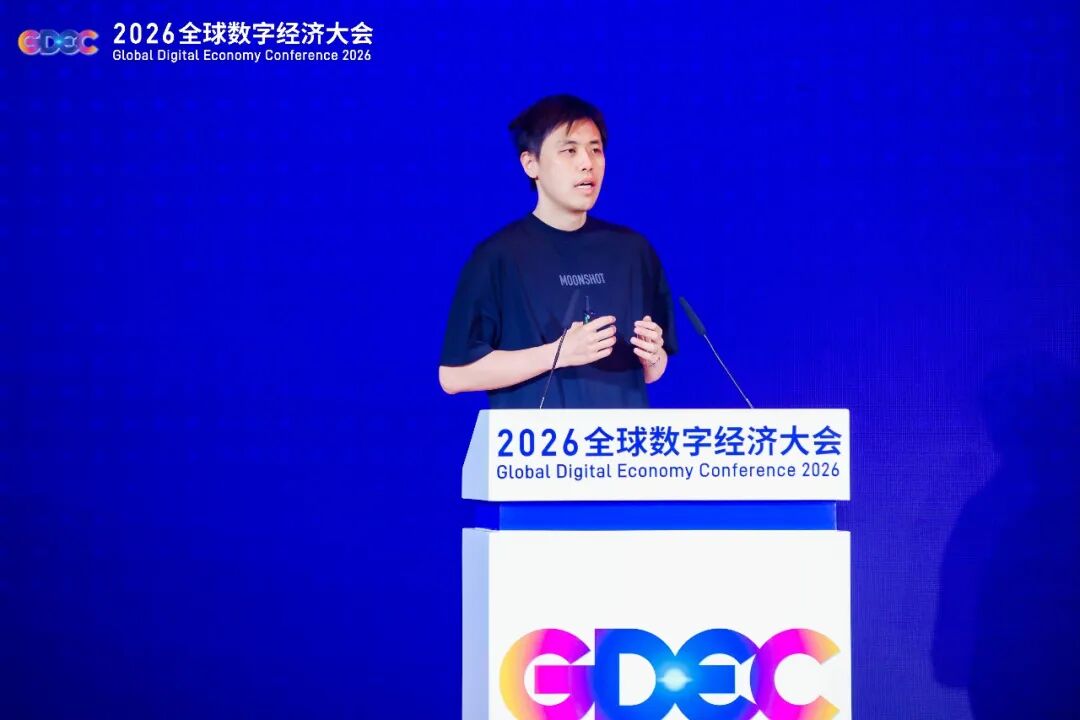
Earlier, Professor Zhu Jun, founder of Shengshu Technology, mentioned the concept of the Bitter Lesson. This is a question that all model developers constantly ponder: how to solve all problems through a more generalized approach rather than continually adapting and defining them manually. Typically, as models continue to improve, those manual definitions tend to become obsolete and even burdensome.
Therefore, when engaging in AI engineering, we also contemplate this issue. A common misconception is the need to intricately design a framework to enable optimal model performance. However, the actual process is quite different.
The true process involves defining the framework based on the model's boundaries and capabilities. Initially, we construct such a framework, allowing the model to experiment and discover its capabilities and limitations. When issues arise, we introduce scaffolding—elements that elevate the model's performance slightly, enabling it to exceed its current capabilities.
As the model continues to improve, we promptly remove these scaffolds to prevent them from becoming future burdens. For example, when Kimi was first released in 2023, the model lacked the ability to autonomously call search engines. At that time, we introduced a small, carefully trained model dedicated to determining which search engine to call and what search terms to use.
This small module enabled the model to breakthrough (break through) its limitations at that time, and the feature was well-received by users. However, as the model's capabilities improved, we observed that the small model had become a bottleneck in the entire process.
A small model, perhaps a few hundred megabytes or 1B in size, possesses far less intelligence than a multi-terabyte large model. Its preliminary judgments could lead to overall accuracy issues, becoming a bottleneck for everyone.
Therefore, during the development of the K2 stage, we began to consider whether we should remove this crutch. In reality, we could allow the model to operate autonomously, deciding for itself whether to call a tool or search engine, how to search, whether to conduct multiple searches or a single one, and even utilizing advanced search engine syntax—such as limiting the search to a specific site.
The model could complete highly complex multi-round search tasks, even solving problems that were challenging for humans. This was a crucial observation that aligned perfectly with the principles of the Bitter Lesson.
Four Core Principles of Agent Engineering While iterating on these AI engineering approaches, we also reflected on certain principles.
The paradigm is quite simple: regardless of the current state, observe whether the model has resolved the issue, contemplate how to solve it, execute the solution, provide feedback mechanisms for errors, and continuously iterate. The model's capabilities emerge continuously. We cannot predefine solutions for the current state early on, and even the world's leading AI companies may not have the correct answers. Certain capabilities emerge iteratively.
In this scenario, we should not limit what the framework should do but rather provide better support for the model as it progresses and identify its current boundaries. This is also the principle we've summarized in our own AI and Agent engineering endeavors:
First, as mentioned earlier, an Agent is essentially a simple concept. We should not overcomplicate it.
Second, it's crucial to incorporate the right, appropriate, and more important information into the context and leverage this window effectively. This is the most critical aspect that determines whether the model's capabilities can be fully utilized.
Third, we must design these tools effectively. For the model, tools are akin to interface design in programming—they need to be sufficiently clear and unambiguous. Otherwise, the model may struggle to use them effectively, and they could even become burdensome. Fourth, there is no perfect solution for the model's memory system.
Given the model's limited context space and its limited control over it, a trade-off must be made between consistency and creativity. In this process, we can choose to place all information within the context, allowing the model to develop continuously, or introduce compression mechanisms, including summarization or filtering, to enable more precise targeting of critical information. This is an ongoing exploration in our practice.
Measuring the Value of an Agent: Human Trust Earlier, we mentioned the Bitter Lesson—allowing the model to explore and learn from mistakes freely, continuously evolving and growing through feedback, is superior to predefining a complex framework for execution. Ultimately, our core approach involves creating the best possible closed loop, enabling the model to operate within it and grow naturally, rather than preconceiving how to construct a complex system. This is our core strategy in developing effective Agents.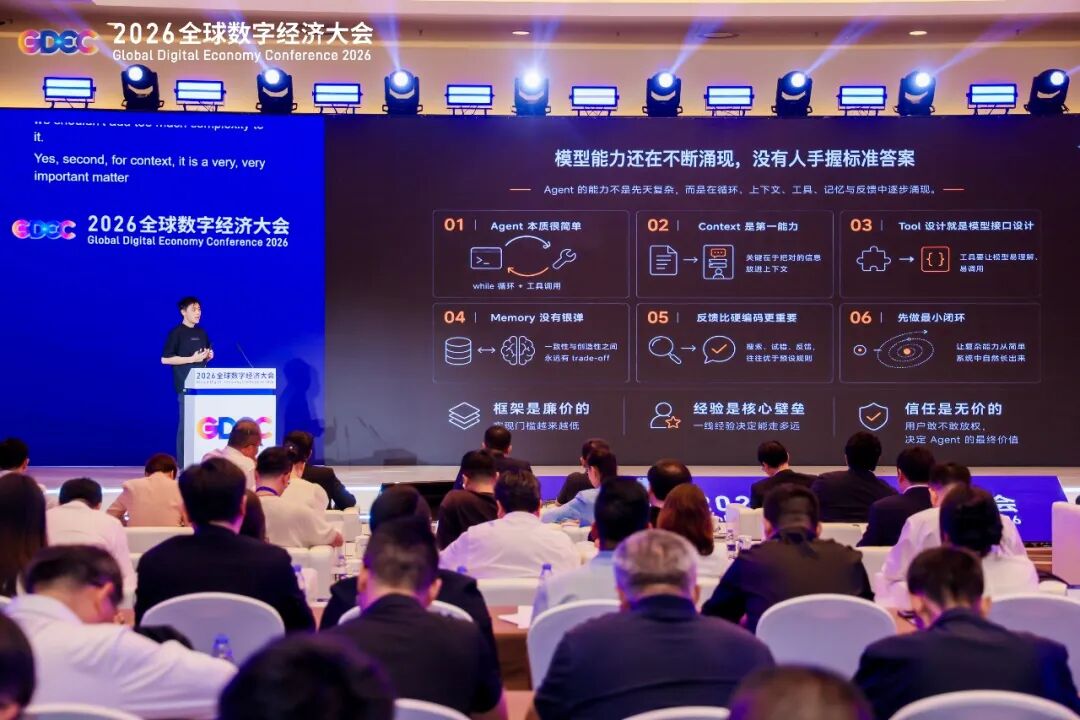 We measure the value of an Agent not by its ability to demonstrate peak performance in a single instance but by the level of trust humans place in it to undertake complex tasks. In essence, the more confidently humans can delegate tasks to a model, the higher its value. Our goal is to create an environment where humans can fully trust the model, enabling it to perform at its best without causing issues, and maximizing its self-exploratory capabilities—this is what we consider to be the most valuable Agent.
In the entire Agent engineering process, the core issue to address is: how to make people trust Agents more to operate freely. The above represents our own reflections during model iteration and AI engineering iteration. Thank you very much!
The '2026 Global Digital Economy Conference Artificial Intelligence Integration and Application Development Forum' is hosted by the Organizing Committee of the Global Digital Economy Conference, and organized by the Beijing Municipal Economy and Information Technology Bureau and the People's Government of Chaoyang District, with assistance from the Chaoyang Park Management Committee of Zhongguancun Science Park (Beijing Chaoyang District Science, Technology, and Information Technology Bureau), Beijing Shuzhi Yunke Information Technology Co., Ltd., Beijing Informatization Association, Beijing Artificial Intelligence Industry Alliance, and Beijing Shuzhi Julian Enterprise Management Co., Ltd.
-
![]()
Alibaba's AI Offensive: Over Half of Investment Allocated, Time to Reap Returns
-
![]()
Alibaba’s AI Push: Over Half of Investments Made, Time to Harvest Returns
-
![]()
Chinese Enterprises Going Global 3.0: From World Factory to AI Infrastructure Builder
-
![]()
Honor RobotPhone Review: Half Movie Camera, Half Robot
-
![]()
AI-Driven Cheating Surges in Universities! Online Exams Reduced to Mere Formalities, Degree Credibility on the Line
-
Insta360’s Decade in Panoramic Imaging: Making Cameras ‘Invisible’ and Returning Creation to the Masses
-
![]()
Foreign Media Claims Apple is Concentrating Resources on AI Development: Vision Pro and Siri Teams Lay Off 200 People
-
Big News! Huaneng and Huawei Hold Talks in Shenzhen with Ren Zhengfei in Attendance; Huawei Emerging as the 'Second Brain' of China's Energy System