Breaking Through Storage Cycle Barriers: How AI Large Models and Coding Technology Synergize to Drive Transformation in the Security Industry
 07/07 2026
 657
657
The global digital industry's computing power is expanding at an unprecedented rate, leading to a persistent structural imbalance between the supply and demand for storage resources. The industry is currently grappling with a cycle of rising hard drive prices and constrained supply, a trend expected to continue until 2028. This presents a significant challenge, hindering the large-scale and intelligent growth of the security sector. Traditional coding systems are ill-equipped to differentiate between static, low-value images—which constitute 70% of surveillance scenes—resulting in the indiscriminate compression and continuous waste of storage resources. The industry is in dire need of groundbreaking technological solutions to overcome these storage bottlenecks.
Two Decades of Technological Evolution in the Industry: The Historic Convergence of Coding and AI
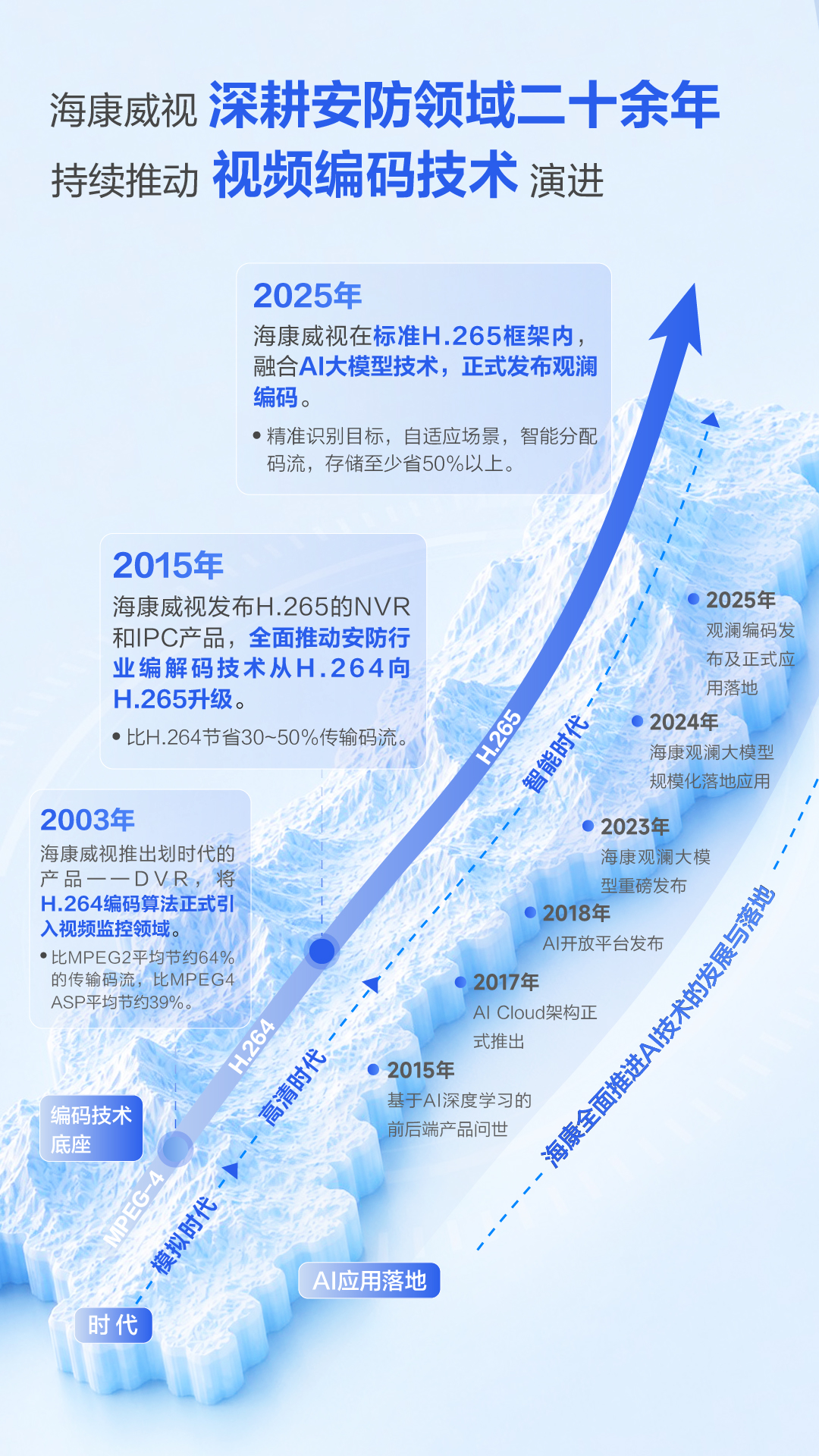
From MPEG-4 to H.264: The Dawn of Large-Scale Video Applications
In the early days, security videos predominantly relied on MPEG-4, with systems that prioritized "visibility" but struggled with long-term storage and remote access capabilities.
In 2003, Hikvision revolutionized the security landscape by introducing H.264, enabling standardized compression and systematic video data management. This paved the way for the widespread adoption of DVR/NVR systems. Compared to MPEG-4, H.264 offered significantly improved compression efficiency, transforming videos from merely "usable" to "scalable for deployment."
At this juncture, the primary focus was on addressing the fundamental industry challenge: ensuring videos could be "stored and utilized effectively."
From H.264 to H.265: Ushering in the Era of High Definition and Big Data
As high-definition and networked surveillance became ubiquitous, video data volumes skyrocketed. H.265 (HEVC) emerged, optimizing bitrate compression by 30%–50% compared to H.264, thus providing crucial support for the proliferation of higher-resolution videos.
The essence of this phase was striking a balance between "clearer images" and "more manageable costs," facilitating the large-scale deployment of high-definition surveillance.
However, the underlying coding logic remained unchanged—it was still fundamentally a pixel data compression optimization, devoid of any understanding of the image content.
H.265 + Large Models: Stepping into the AI Coding Era
The proliferation of AI applications has led to continuously rising storage costs, fueling further industry demand for upgrades—not only seeking "lower storage costs" but also ensuring "no loss of critical information."
Leveraging the "Guanlan Large Model," Hikvision introduced Guanlan coding technology, integrating scene/object understanding capabilities into the H.265 coding framework. This technology marks a leap towards "object-based coding," intelligently identifying key targets like people and vehicles for high-priority preservation while drastically compressing background information. In various scenarios, it achieves at least a 50% storage savings over a 24-hour period.
At this point, coding began to truly "comprehend images" and optimize data representation based on business value.
An Intelligent Coding Solution Tailored for Industry Transformation: Adhering to Standards and Making Informed Trade-offs
Guanlan coding, born out of the industry's storage crises and technological transformation, represents a breakthrough solution driven by industry demand and long-term technological accumulation. Relying on the large model's 99% target detection rate, Guanlan coding automatically differentiates between high-value targets like faces and license plates and static backgrounds, allocating bitrates differentially to balance key image clarity and compression efficiency.
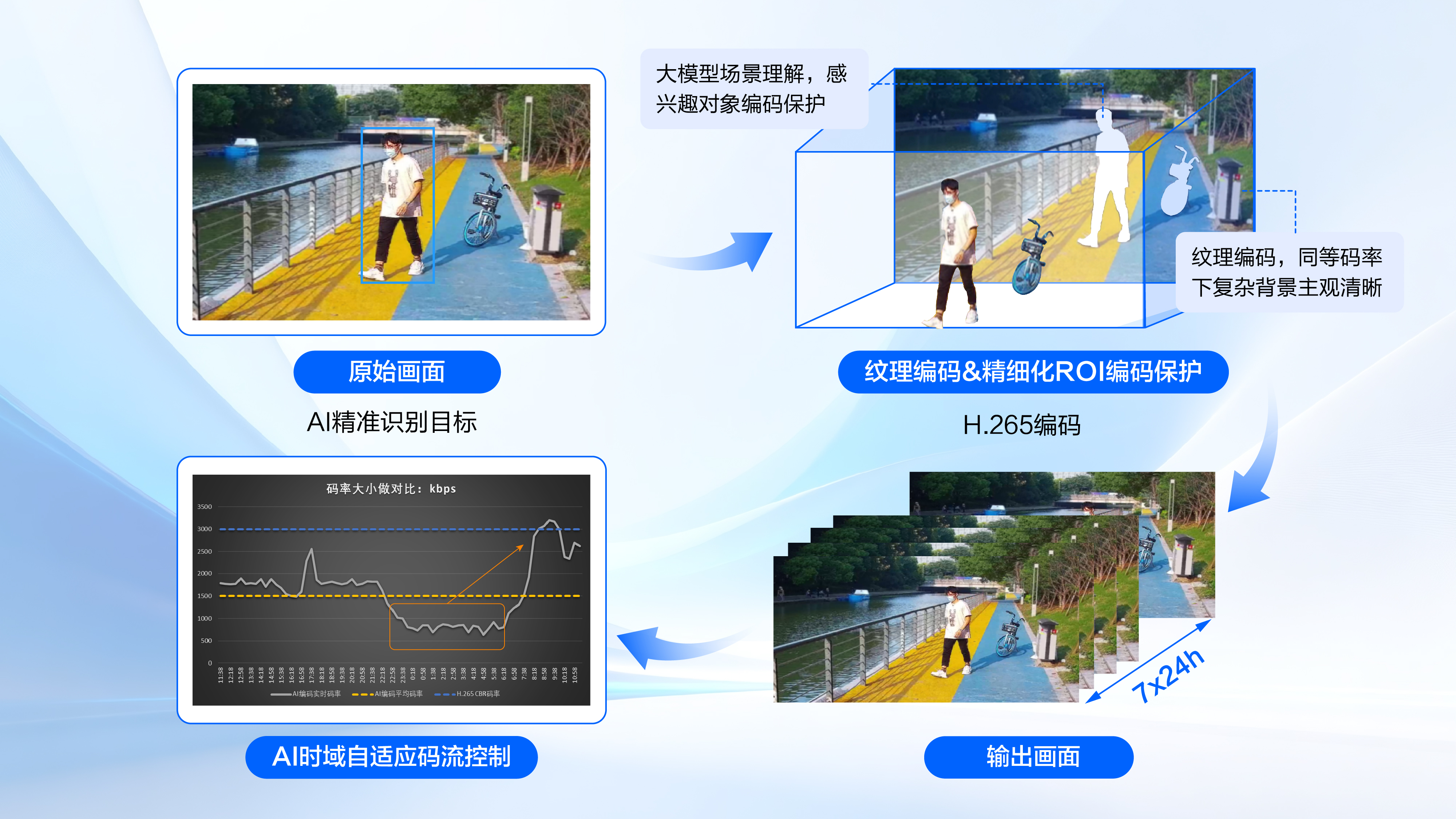
Guanlan coding seamlessly integrates AI large model technology into the standard H.265 coding framework, optimizing compression parameters through AI-adaptive bitrate control without altering core metadata such as original video pixels, timestamps, resolution, or frame rate. The output stream fully complies with the H.265 standard, ensuring plug-and-play compatibility with all Hikvision and third-party H.265-compliant cameras and storage devices, thereby preserving the industry's interoperable standard ecosystem.
Leveraging Computing Power to Enhance Storage Capacity and Support Long-Term Industry Intelligence Upgrades
With over two decades of expertise in security industry coding, Hikvision has consistently refined accessible technologies based on universal standards, from pioneering H.264 adoption in security to introducing Guanlan coding. Currently, Guanlan coding harnesses AI computing power to offset storage capacity, using technological soft advantages to counterbalance the hardware cost pressures of rising hard drive prices, delivering tangible real-world value:
For a project with 2,000 1080P channels and 90-day storage, compared to traditional coding solutions, hard drive procurement can be reduced by 60%, server room space saved by 60%, and electricity costs over five years cut by 50%. This enables users to meet longer-term compliance archiving needs within existing budgets while allowing channel partners to escape hard drive cost pressures and achieve reasonable project profits.
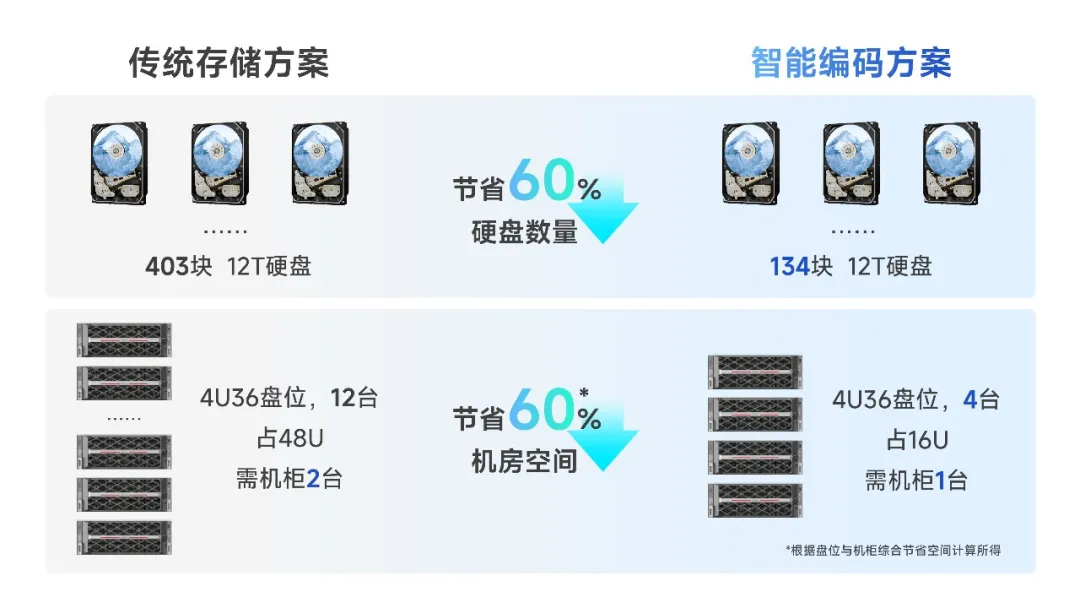
Amid an industry cycle of sustained rising storage hardware costs, Guanlan coding eliminates ineffective data accumulation at its source, significantly freeing up project construction budgets. It serves not only as a cost-reduction tool to mitigate storage cost fluctuations but also as a potential innovative engine driving the deep intelligence and high-quality development of the security industry.
-
![]()
Alibaba's AI Offensive: Over Half of Investment Allocated, Time to Reap Returns
-
![]()
Alibaba’s AI Push: Over Half of Investments Made, Time to Harvest Returns
-
![]()
Chinese Enterprises Going Global 3.0: From World Factory to AI Infrastructure Builder
-
![]()
Honor RobotPhone Review: Half Movie Camera, Half Robot
-
![]()
AI-Driven Cheating Surges in Universities! Online Exams Reduced to Mere Formalities, Degree Credibility on the Line
-
Insta360’s Decade in Panoramic Imaging: Making Cameras ‘Invisible’ and Returning Creation to the Masses
-
![]()
Foreign Media Claims Apple is Concentrating Resources on AI Development: Vision Pro and Siri Teams Lay Off 200 People
-
Big News! Huaneng and Huawei Hold Talks in Shenzhen with Ren Zhengfei in Attendance; Huawei Emerging as the 'Second Brain' of China's Energy System