Doubao Stealthily Deactivates App Generation Function; No Official Notification Received. Likewise, Qianwen Plans to Deactivate Its AI Agent Function, Possibly Increasing the Barrier for User-Generate
 07/08 2026
 685
685
It has been reported that Doubao has deactivated its app generation function, with several AI tools following suit by deactivating their agent functions amid tightening industry regulations.
According to a Dujia report on July 6, prior to Doubao's announcement of the complete deactivation of its "agent" function, its "app generation" function had already ceased operations on May 31. However, users can still view, copy, download, and share previously created apps through Doubao sessions, but new apps cannot be generated or updated. The programming function remains operational.
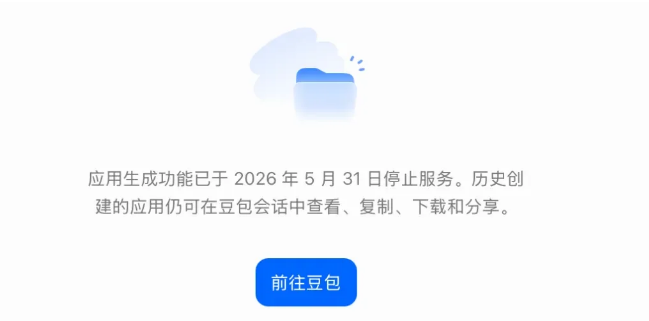
Image source: Dujia
In response, Doubao's official customer service informed the New Knowledge Research Institute that they have not yet received a notification regarding the deactivation of the app generation function. They have only been informed that the AI agent function will be deactivated on July 15, 2026, and advised users to monitor Doubao's official website for further updates.
The "app generation" function, previously launched by Doubao, was underpinned by the technology of Trae, an AI-native programming tool developed by ByteDance. This function aimed to lower the barrier to development, enabling users to swiftly create digital tools such as web apps, interactive mini-games, or form dashboards by simply describing their requirements in natural language. Whether it was a simple calculator, a word puzzle game, or an event registration form, automation could be achieved "with just one sentence."
According to The Paper, on July 4, Doubao issued a "Notice on the Deactivation of Doubao Agent Function," stating that due to product feature adjustments, the agent function will be deactivated on July 15, 2026.
Doubao announced that after the deactivation, users will still be able to view and save agent information and historical conversation data for a certain period. After October 15 of this year, Doubao will process agent-related data in accordance with its "Privacy Policy," and it will no longer be possible to view or retrieve the data within Doubao.
For important content, it is recommended to make backups in advance by taking screenshots or exporting text through sharing. Additionally, ByteDance's Maoxiang APP allows users to create new agents and initiate conversation services. Users can explore new agent experiences on the Maoxiang APP later if needed.
Previously, ordinary individuals could build work agents tailored to their needs without any programming knowledge. The low barrier opened the door for the public to create their own AI tools. However, with Doubao now opting to deactivate this function, the path for individuals to "hand-craft" lightweight AI tools has narrowed, potentially raising the creative barrier for ordinary users.
Nevertheless, in the context of stricter regulations in the current AI industry, the deactivation of the agent function is not merely a functional reduction but a continuation of normalized regulatory efforts. According to Securities Daily, on June 26, the Shanghai Municipal Cyberspace Administration reported the outcomes of a special campaign titled "Clear and Bright: Rectifying AI Application Disorders."
The campaign led to the removal of over 4.87 million pieces of non-compliant information, the handling of over 18,000 non-compliant accounts, and the takedown of over 14,000 self-built non-compliant agents.
In April of this year, the Cyberspace Administration of China, the National Development and Reform Commission, the Ministry of Industry and Information Technology, the Ministry of Public Security, and the State Administration for Market Regulation jointly issued the "Interim Measures for the Administration of AI Personified Interactive Services," clarifying regulatory rules for AI personified interactions and role-playing services, including content safety, intellectual property protection, and minor protection. The measures officially took effect on July 15.
In addition to Doubao, Alibaba's Qianwen, Tencent's Yuanbao, and NetEase Cloud Music's emotional AI product "Miaoshi" have all issued notices regarding the suspension of their agent services. The timing of the agent deactivation for Doubao and Qianwen closely coincides with the implementation of relevant policies.
Therefore, Doubao's decision to deactivate its self-built agent function does not mark the end of the era of AI democratization but rather reflects the industry's transition from unrestrained growth to compliance and maturity.
For the general public, while the convenience of casually creating personalized AI tools may decrease, stricter regulations will, in the long run, thoroughly eliminate low-quality, non-compliant, and infringing agents, purifying the AI ecosystem.
-
![]()
Alibaba's AI Offensive: Over Half of Investment Allocated, Time to Reap Returns
-
![]()
Alibaba’s AI Push: Over Half of Investments Made, Time to Harvest Returns
-
![]()
Chinese Enterprises Going Global 3.0: From World Factory to AI Infrastructure Builder
-
![]()
Honor RobotPhone Review: Half Movie Camera, Half Robot
-
![]()
AI-Driven Cheating Surges in Universities! Online Exams Reduced to Mere Formalities, Degree Credibility on the Line
-
Insta360’s Decade in Panoramic Imaging: Making Cameras ‘Invisible’ and Returning Creation to the Masses
-
![]()
Foreign Media Claims Apple is Concentrating Resources on AI Development: Vision Pro and Siri Teams Lay Off 200 People
-
Big News! Huaneng and Huawei Hold Talks in Shenzhen with Ren Zhengfei in Attendance; Huawei Emerging as the 'Second Brain' of China's Energy System