As Large Models Step into the Agent Era, Where Do Domestic AI Models Lag?
 07/10 2026
 412
412
Layout by Xiaoxi
Tutorials on overseas AI Agents, such as the "Codex Nanny Level Link Tutorial (Codex Ultimate Link Guide)" and "Claude Code Zero Base Environment Configuration (Claude Code Zero-Foundation Environment Setup)," have become some of the hottest topics on recent social media.
The domestic AI large model market is undoubtedly booming: Doubao boasts hundreds of millions of daily active users, DeepSeek has slashed API call prices to levels that even Silicon Valley finds remarkable, and major vendors are flooding the market with press releases claiming to "surpass GPT-4."
Logically, in a fiercely competitive domestic market for large models, users should have a wealth of affordable and user-friendly options. Yet, a significant number of domestic users are willing to endure time costs, navigate cumbersome network barriers, and pay hefty monthly subscription fees to persistently use overseas AI Agents—even giving rise to a clandestine industry chain in the process.
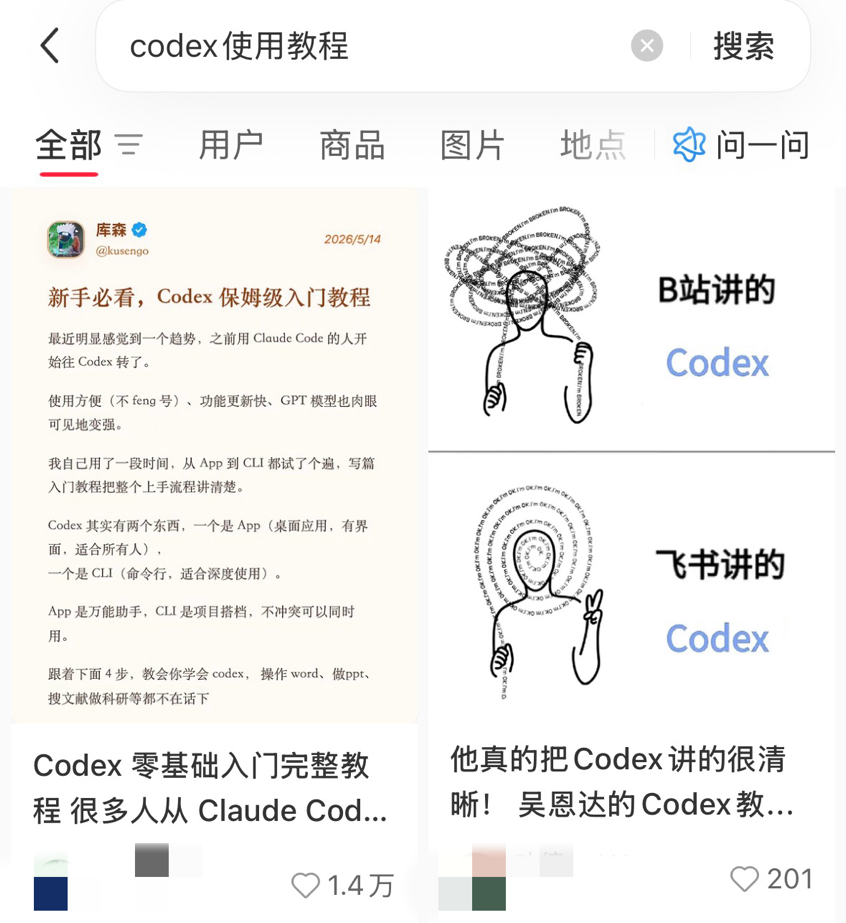 ▲ Note: Image sourced from Xiaohongshu
This fragmented and peculiar market phenomenon naturally sparks curiosity: As large models step into the Agent era, is the perception among domestic users that domestic AI falls short merely a stereotype, or is there indeed an unmistakable generational gap between Chinese and foreign AI?
| Domestic Agents: Strengths and Persistent Shortcomings |
In fact, based on comprehensive leaderboard data and market feedback, domestic large models have not only avoided falling behind comprehensively over the past three years but have even achieved significant breakthroughs in multiple domains and specific dimensions.
Text comprehension and processing are core tests of a large model’s localization capabilities and underlying logic—after all, language serves as both a symbol and a carrier of culture, thought patterns, and commercial logic.
While overseas top-tier models like GPT-5 and Claude Opus can use Chinese fluently, they often reveal an unmistakable "translationese" tone during in-depth text creation. Their expressive logic leans more toward Western linear narratives, a trait that feels somewhat out of place when handling texts imbued with Chinese cultural nuances or business contexts.
This is where domestic AI Agents demonstrate their unique advantages in Chinese language comprehension and text processing.
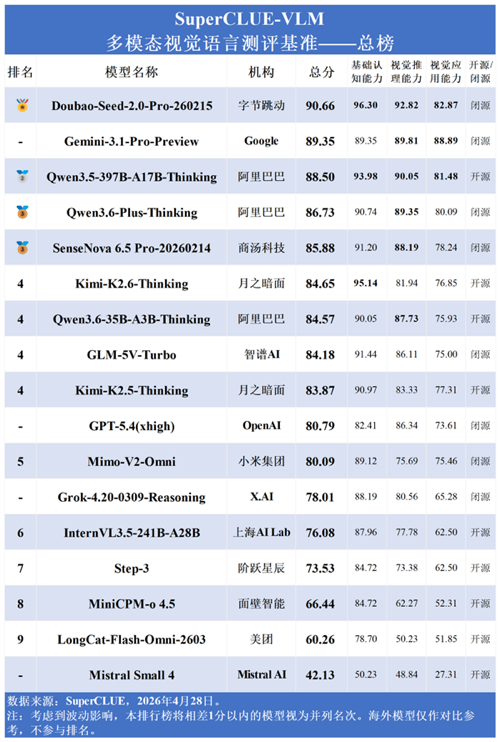
On April 29, in the SuperCLUE-VLM’s April 2026 evaluation of Chinese multimodal visual-language models, ByteDance’s model claimed the top spot with a score of 90.66, while a series of domestic large models—including Alibaba’s Qwen3.5, SenseTime’s SenseNova, and Zhipu’s GLM—ranked among the leaders. In contrast, overseas models like OpenAI’s GPT-5.4 and X.AI’s Grok only managed mid-tier rankings.
 ▲ Note: Image sourced from Sina Finance
The resurgence of domestic large models in the Chinese language context primarily stems from their access to massive amounts of high-quality local corpus data and their deep integration with China’s internet ecosystem.
Whether crafting year-end reviews steeped in workplace social dynamics or generating highly emotive e-commerce live-streaming scripts like “Family, let’s go live,” domestic models accurately capture subtle linguistic tones and internet memes—something overseas products currently cannot achieve.
Moreover, domestic models also demonstrate distinct market competitiveness in hardcore capabilities like ultra-long text processing and code reasoning.
While overseas flagship models generally remain comfortable in the 128K to 200K context window range, domestic models like Kimi have pushed lossless context parsing to the 2-million-word level, and Tongyi Qianwen Qwen3-Max even reaches a 10-million-word capacity. This means domestic Agents can effortlessly process dozens of pages of complex, jargon-heavy Chinese texts—such as in-depth research reports or legal documents—and perform precise cross-referencing and information extraction.
Meanwhile, the once-formidable code and mathematical logic "moat" of overseas giants is now being leveled by domestic contenders like DeepSeek V4 Pro and Doubao 2.1 Pro.
On June 23, ByteDance officially released the Doubao Large Model 2.1 series, which surpassed Anthropic’s flagship Claude Opus 4.7 in multiple metrics across nine authoritative benchmarks—including Terminal Bench 2.1, SWE-Pro, and SciCode—catapulting it into the top tier.
However, despite these impressive local achievements, when AI Agents extend their boundaries from text/code processing into the physical world and multimedia vision, domestic models still lag noticeably behind their overseas counterparts.
In April of this year, OpenAI officially launched GPT Image 2, which dominated the Image Arena text-to-image leaderboard within hours of release, securing the top spot by a landslide. It not only autonomously breaks down tasks, plans layouts, and self-reviews but also directly generates accurate Chinese typography. Meanwhile, mainstream domestic models still struggle with inconsistent image quality, unrealistic physics simulations, and spatial coherence issues.
For future Agents aiming to manage complex workflows, lagging multimodal capabilities mean more than just less polished images or videos. Critically, Agents will lack the visual cortex and physical intuition needed to understand computer desktop GUIs, process complex cross-software visual inputs, or even drive embodied intelligence in the future.
This specialization gap in core multimodal generation architectures creates the first layer of disparity domestic users experience between Chinese and foreign large models.
| Divergent Strategies Shape Distinct Agent Experiences |
As large models evolve from chatbots to intelligent agents, the strategic paths chosen by domestic and overseas tech giants in deploying AI—more so than underlying technical strengths or weaknesses—dictate the vastly different real-world experiences for users.
Overseas AI giants like OpenAI and Anthropic remain focused on achieving artificial general intelligence (AGI). In their strategic vision, an Agent is not merely a Q&A bot confined to a web browser but a "silicon collaborator" capable of highly autonomous thinking and utilizing all human digital tools.
Codex officially rolled out computer usage capabilities this year, abandoning API dependencies in favor of powerful visual multimodal abilities that allow it to "understand" any pixel on a computer screen directly. It can autonomously move the mouse, click desktop icons, and type instructions just like a human.
 ▲ Note: Image sourced from AI
When a user issues a complex command covering data organization, detailed analysis, and document dissemination, Codex doesn’t respond with a segment of operational advice or code for the user to run manually—like traditional AI assistants do. Instead, it automatically launches software on the desktop to retrieve and process data, then initiates an email client to send the results to designated contacts, achieving true end-to-end full automation.
Under this approach, users perceive not just a smart search engine but a "digital collaborator" capable of discussing underlying architectures, autonomously planning task chains, and even possessing independent reflection and error-correction capabilities.
According to OpenRouter’s public data, in May 2026, Hermes Agent—equipped with self-reflection mechanisms—consumed 291 billion Tokens in a single day, proving that large numbers of users are deeply engaging with Agents capable of autonomous deep-link task execution beyond mere chatboxes.
In contrast, the domestic AI Agent landscape sees major players leveraging globally unique app ecosystems like WeChat, Feishu, Douyin, and Taobao to position Agents primarily as commercial efficiency tools from the outset.
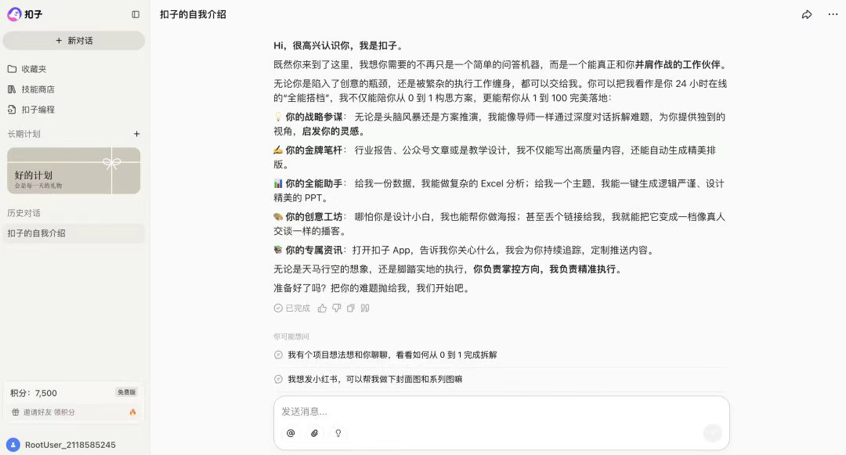
ByteDance’s Kouzi boasts over 2,000 official plugins and excellent visual workflow design, enabling even code-illiterate users to build Bots without programming. Tencent’s WorkBuddy integrates 80,000+ skill packages, receives 8.85 million monthly visits, and deeply connects with Enterprise WeChat and Tencent Docs.
 ▲ Note: Image sourced from Kouzi
These tools cater to ToB scenarios like e-commerce, marketing, official document writing, and PPT creation—rigid demands for commercialization, cost reduction, and efficiency gains. Within specific business loops, they compress repetitive labor to the extreme.
However, despite their thriving plugin ecosystems, domestic Agents remain confined to chatbox paradigms in terms of product form. When users propose complex system-level tasks spanning multiple local software, domestic Agents cannot directly take over mouse control like Codex; instead, they mostly offer advice and code support.
Users eagerly seek a "deep partner" capable of handling intricate low-level operations, only to find domestic Agents delivering a polite, scripted "intern assistant" limited to reading documents and writing official texts within specific web pages.
| Business Models Define Agent Capabilities |
Technological and strategic divergences ultimately manifest in the commercial realm. Beyond lofty technological ideals, the ultimate factor determining whether an Agent is genuinely intelligent lies hidden in server compute bills.
A truly capable Agent involves far more than receiving prompts and spitting out answers. A mature Agent operates across at least four backend layers: task planning, execution, state/context memory, and verification/rollback. Each closed-loop cycle consumes massive Tokens—a seemingly simple code debugging task may involve dozens of silent self-debates and API calls in the backend.
Given this compute-intensive reality, the mature software subscription ecosystem in overseas markets provides the financial backbone for Agents to "think deeply."
On the consumer side, ChatGPT Plus and Claude Pro charge $20/month in personal subscription fees, yet attract massive paying user bases. By March this year, ChatGPT had surpassed 900 million weekly active users, with roughly 50 million paying subscribers. Semi Analysis reports also show Anthropic’s annualized operational revenue surging nearly fivefold since late 2025, driven primarily by Claude Code’s strong performance and enterprise demand.
Only when users pay sufficiently can overseas vendors afford to supply backend compute generously. High customer pricing empowers Agents with long-term memory management and multi-round self-correction capabilities, ensuring high task closure stability.
Back in the domestic market, however, major players almost uniformly adopt free models for consumer-facing Agent apps to compete for C-end traffic, while API pricing wars reach jaw-dropping levels.
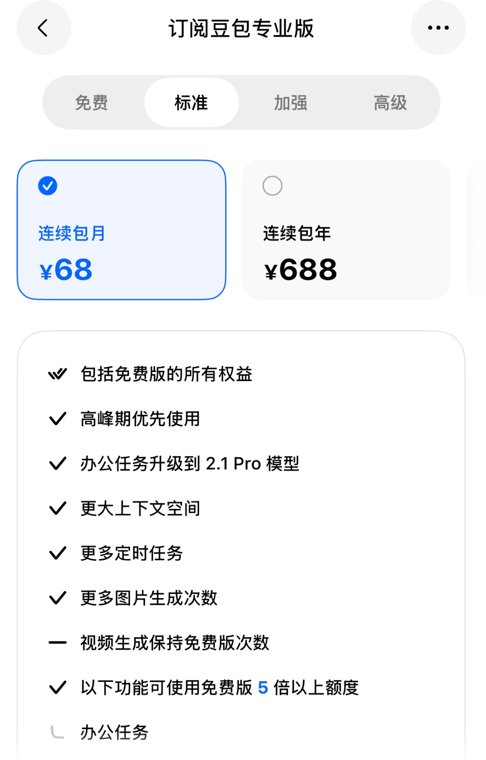
In April 2026, DeepSeek slashed V4-Pro’s regular input price to 3 RMB per million Tokens and output to just 6 RMB per million Tokens—roughly one-twelfth of GPT-4o’s pricing. Even Doubao Pro, which introduced paid tiers, charges only 68 RMB/month for standard packages and even offers a 38 RMB student discount.
 ▲ Note: Image sourced from Doubao
When product pricing is pushed to rock-bottom levels—or even fails to cover Agent inference costs—domestic vendors must compromise on backend compute engineering or drastically reduce medium-to-long-term memory retention rounds to control server costs.
Agents lacking backend verification and error-correction mechanisms will not repeatedly retry when faced with unresolved code or incorrect data. Instead, they confidently output erroneous conclusions or even start spouting nonsense.
Thus, the reputation gap for domestic products in the Agent era stems not purely from algorithmic limitations but represents a systemic issue intertwined with technological biases, strategic constraints, and business model restrictions. After all, according to Stanford University’s 2025 AI Index Report, the performance gap between top Chinese and U.S. large models had already narrowed from 9.3% in January 2024 to just 1.7% by February 2025.
For domestic Agents to truly close this "last-mile" experience gap, perhaps the key lies in exploring reconstruction paths from business workflows to commercial closures—establishing healthy business models to sustain compute consumption and enabling domestic AI Agents to break free from low-price or even free shackles, evolving into genuine "digital partners."
Image sourced from the internet. Rights reserved for original creators.
-
Lenovo: Liu Jun Goes Left, Yang Yuanqing Goes Right
-
![]()
MiniMax Shares Unlock: Cornerstone Shareholders Show Long-Term Optimism, Yet Stock Plummets Nearly 30% in Two Days; Zhipu Also Sees Nearly 20% Drop Today
-
![]()
Single-Day Plunge of 40%: The 'First AGI Stock' Faces More Than Just Share Price Concerns
-
![]()
Ricoh and Fuji Hike Prices on Legacy Edge; Insta360 Poised to Disrupt Mirrorless Camera Market
-
![]()
Ricoh and Fujifilm Raise Prices in Tandem, Relying on Established Reputations; Insta360 Poised to Disrupt Mirrorless Camera Market
-
![]()
Strategic Shift in Photoelectric Sensing: Maxvision Secures Controlling Stake in CAS Optotech
-
![]()
Optical Communication and Robot Vision: OFILM’s Bold Transformation Amid a 460 Million Yuan Loss
-
![]()
From 100,000-GPU Computing Might to Industrial Efficiency: The Logic Behind AI4S-Driven Intelligence