Why Does AI Competition Start with Computing Power?
 07/27 2026
 365
365
The busiest exhibition area at this year's WAIC featured robots, but the quietest yet equally attention-grabbing exhibits were rows of computing power cabinets.
Vendors such as Huawei, Alibaba, Baidu, ZTE, and Moore Threads showcased super nodes and computing clusters, with computing power and embodied intelligence emerging as the two clearest industrial themes at the event. On one side were walking, carry (Note: ' carry ' means 'carrying' or 'transporting'—context suggests robots capable of movement and handling tasks) robots, and on the other, nearly motionless servers. Though seemingly far apart, they shared the same industrial logic.
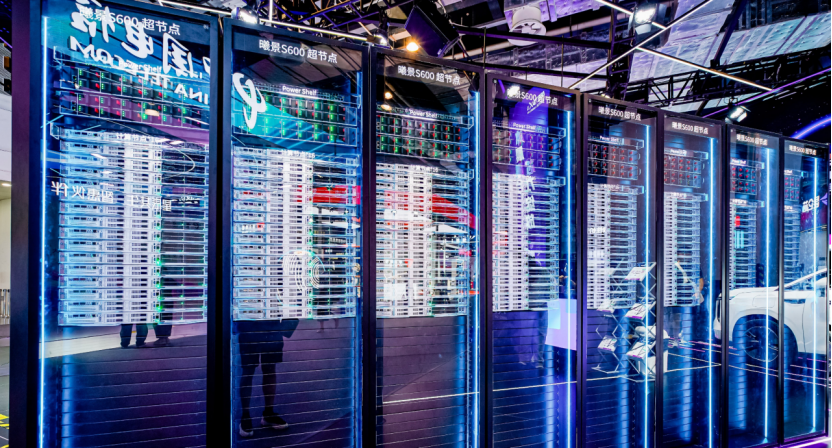
Moore Threads S600 Super Node Display at WAIC
Image Source: China Entrepreneur; Original Image Source: Interviewee
Models generate intelligence, while robots and intelligent agents bring it into reality. Chips, servers, and networks in data centers support their continuous operation. The closer AI applications get to real-world deployment, the more critical computing power becomes.
Amid the AI wave, NVIDIA stands as one of the biggest beneficiaries.
From GPU chips and CUDA to servers, network interconnection, and data center solutions, NVIDIA has built a complete computing ecosystem spanning hardware, software, and infrastructure. At GTC 2025, Jensen Huang stated that NVIDIA is transitioning from a chip company to an AI infrastructure company—revealing its true strength.
GPU performance is the ticket to the AI era, while the CUDA ecosystem forms a long-term barrier.
After CUDA's launch in 2006, developers, algorithm tools, and enterprise applications gradually coalesced around it. Mainstream AI frameworks like PyTorch and TensorFlow have long supported CUDA deeply. Switching computing platforms requires software adaptation, process adjustments, talent training, and application migration—costs far exceeding mere chip procurement.
This is a key reason for NVIDIA's strong profitability. Customers buy not just a GPU but a validated AI computing infrastructure.
01 Why NVIDIA Leads
NVIDIA wasn't originally an AI company.
Founded in 1993, it focused on gaming graphics cards. GPUs were initially designed to enhance graphical processing for smoother gaming visuals.
After deep learning's rise, researchers found GPUs ideal for parallel computing tasks in neural network training. Traditional CPUs excel at complex logic with few high-performance cores, while GPUs, with massive parallel units, handle vast matrix operations—critical for AI model training.
In 2012, AlexNet's breakthrough at ImageNet spurred rapid deep learning growth. GPUs evolved from graphics tools to AI computing cornerstones.
The large model era further amplified this demand. Larger models require more GPUs working in tandem, increasing training cycles and computational costs. However, NVIDIA's true advantage lies beyond hardware. After nearly two decades, CUDA now links chips, software tools, and developer ecosystems.
Chip performance can be chased generation by generation, but development habits and software ecosystems are hard to replicate quickly—a core challenge for domestic AI chips.
02 Why AI Demands More Computing Power
A model's journey from R&D to deployment involves pre-training, fine-tuning, alignment, and inference.
Pre-training consumes the most resources. Models learn linguistic patterns, knowledge structures, and complex relationships from massive datasets. Large-scale training often requires thousands of GPUs running for weeks or longer.
Fine-tuning and alignment adapt models to specific tasks. A bank training a customer service model must teach it business rules and financial products; a hospital developing a diagnostic assistant must impart medical expertise and norms.
But inference drives sustained demand for computing power.
After training, every customer query, code generation, office collaboration, and content creation still requires computational resources. Intelligent agents amplify this further: while basic chat involves simple Q&A, agents must decompose tasks, gather data, call tools, and verify results to complete work. A single user command may trigger multiple model calls.
At WAIC this year, agents moved from chatboxes to workstations, becoming a key thread connecting models, endpoints, and industry applications. As AI shifts from "answering questions" to "completing tasks," computational consumption depends not just on query volume but task complexity.

Baidu's Dazi General-Purpose Intelligent Agent.
Image Source: China Entrepreneur; Original Image Source: Interviewee.
According to the National Data Bureau, China's public cloud large model token calls surged from ~100 billion daily in early 2024 to ~100 trillion daily by late 2025. After models like DeepSeek reduced call costs, more applications became viable. Larger scales and higher frequencies amplify demand for computing power.
Training capability determines a model's potential, while inference capability determines how many users it can serve.
03 How China Closes the Computing Power Gap?
Large model competition may seem cloud-based, but its foundation lies in data centers.
For China, building autonomous AI computing power is vital for industrial development and future AI application scale.
Chinese firms are exploring AI computing along diverse technical paths.
Huawei's Ascend exemplifies this approach. Instead of focusing solely on individual chips, it built a holistic ecosystem around Ascend processors, Atlas servers, CANN software platforms, high-speed interconnection, and developer tools.
In 2025, Huawei launched the Ascend 384 super node solution, boosting system performance through 384-card collaboration. At WAIC this year, the Atlas 950 SuperPoD debuted with real-machine displays, scalable up to 1,024 cards. High-speed interconnection and unified memory addressing minimize data transfer losses between devices.
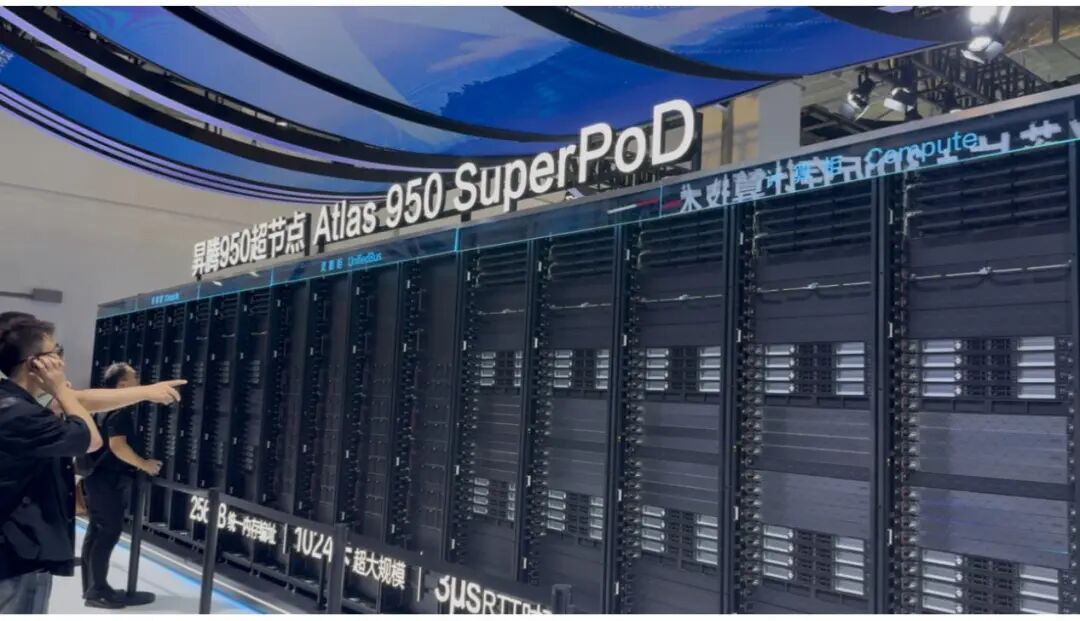
Huawei's Ascend Atlas 950 SuperPoD at WAIC.
Image Source: China Fund News, taken by reporter.
This doesn't mean domestic single cards have fully caught up with NVIDIA, but it shows an alternative path: leveraging larger-scale system collaboration to enhance overall computing power despite gaps in individual chips and advanced processes.
Other domestic vendors are advancing along different routes. Cambricon and Hygon Information focus on chips for training and inference breakthroughs. Baidu's Kunlun Core and Alibaba's T-Head integrate with their cloud businesses, driving chip iteration through internal applications. Moore Threads and Moore Elite target general-purpose GPUs, aiming to bridge graphics, general computing, and AI acceleration.
At WAIC this year, multiple vendors showcased super nodes or cluster solutions. While their architectures, chip configurations, and software systems differed, industry consensus emerged: domestic computing power competition now spans complete systems—chips, interconnection, servers, and software—rather than individual chips.
Domestic computing power must address more than just chips.
04 Computing Power Competition Goes Systemic
Large models typically run across multiple GPUs. More chips mean frequent data exchanges. Insufficient interconnection speeds waste time moving data between devices, creating a "communication wall." If devices' memory can't be unified and efficiently scheduled, model scale and computing utilization face a "memory wall."
Doubling machines doesn't double computing power. Larger scales can sometimes increase coordination overhead.
Super nodes aim to make dozens, hundreds, or even thousands of cards function like a single machine. NVIDIA uses NVLink and InfiniBand networks to enhance GPU cluster collaboration. Domestic players like Huawei, Alibaba, Baidu, and ZTE offer systemic solutions for high-speed interconnection, unified memory addressing, liquid cooling, and software scheduling.
Competition has shifted from single-card speed to efficient multi-chip collaboration.
According to WAIC reports, the previous-generation Ascend 384-card super node has shipped 750 units across internet, telecom, finance, education, healthcare, transportation, and manufacturing sectors. Super nodes are moving beyond displays into real-world operations.
Customers now care less about theoretical peak performance and more about system stability, software migration ease, and energy efficiency per token generated.
Energy supply and data center construction have also entered the fray. A 10,000-card training cluster may consume tens of megawatts. Data center location, power costs, liquid cooling, and power-computing coordination all affect final computing prices.
At WAIC this year, vendors like SuperFusion showcased high-density liquid cooling and diverse computing clusters, while State Grid and China Southern Power Grid advanced power-computing coordination. Computing power competition now extends beyond semiconductors, enveloping telecommunications, power, energy, and engineering.
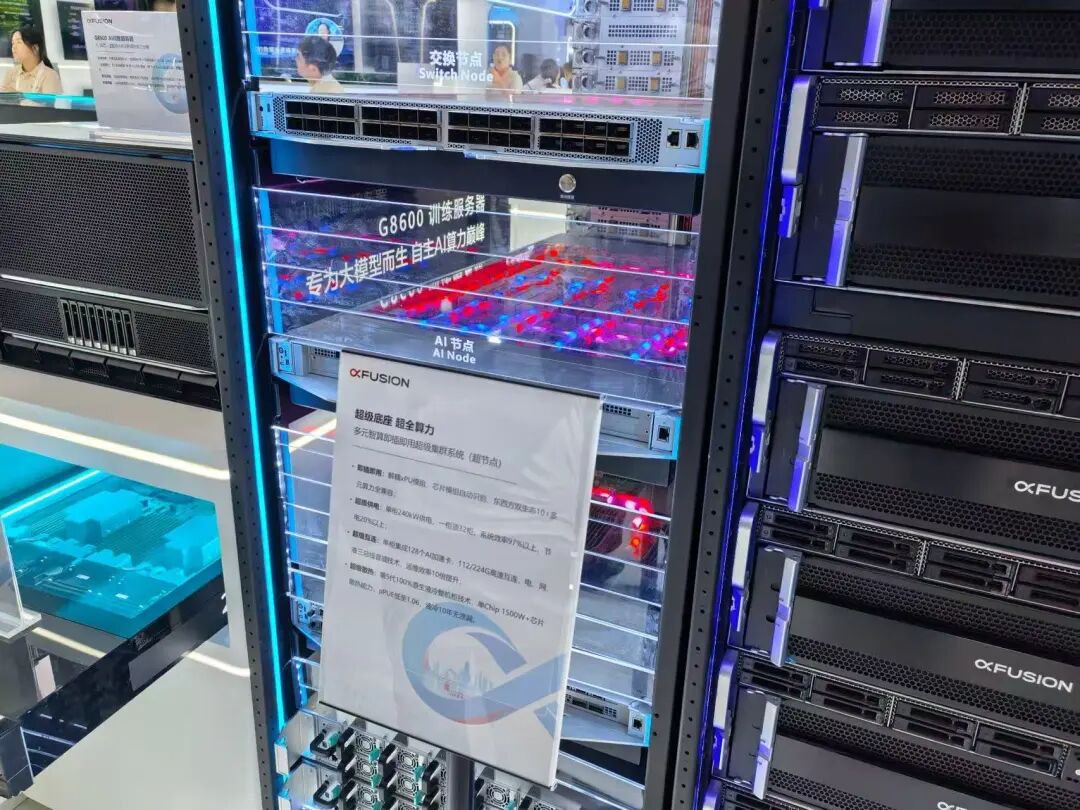
SuperFusion's Diverse Computing Super Cluster System.
Image Source: China Entrepreneur; Photographer: Li Yanyan.
For latecomers, this shift creates new opportunities. Even with temporary chip gaps, they can boost overall system efficiency through interconnection, scheduling, hardware integration, and application adaptation.
However, systemic competition doesn't mean relying solely on quantity. Shortcomings in chips, interconnection, software, or energy efficiency can drag down overall performance. Domestic computing power must progress from "functional" to "stable, user-friendly, and cost-effective."
05 Computing Power Must Transform into Intelligence
During the internet era, servers, networks, and data centers underpinned digital economic growth. In the AI era, computing power is becoming the new infrastructure.
Large model training, intelligent agent operation, and robotic environmental understanding and action planning all require computing power. Super nodes, intelligent agents, and robots dominated WAIC this year because they form a virtuous cycle: larger models drive computing system upgrades, lower costs enable commercialization of agents and robots, and more applications generate fresh computing demands.
Yet computing power alone isn't the goal. A massive data center is just an expensive machine unless it translates into better models, cheaper tokens, and widely used products.
So, why does AI competition start with computing power?
Because computing power determines eligibility. Models define what AI can achieve, while computing power determines if these capabilities can serve more people at sufficiently low costs.
After securing eligibility, actual value creation by models will decide the true winners.
Next, we'll explore how large model competition is entering a new phase post-DeepSeek.

-
On the Eve of Its IPO, Avatr Finds Itself Embroiled in a 'Farce of Controversy and Belittlement'
-
![]()
Yutong Optics' Japanese Subsidiary Unveiled in Tokyo, Shifting Strategic Focus to Technology-Driven Growth
-
![]()
Half-Year Revenue Outstrips Last Year’s Total! Zhongrun Optics Forecasts 80.2% H1 Revenue Growth
-
![]()
Why Does AI Competition Start with Computing Power?
-
![]()
Apple AI Finally Makes Its Debut in China, Yet iPhone's 'AI Autonomy' Faces Uncertainty
-
![]()
Apple AI and QianWen Make Up Lessons: Alibaba Has Its Own 'Doubao Phone'
-
![]()
QianWen Joins Apple, Signal for Large Models to ‘Fade into the Background’
-
![]()
The ‘Anchor’ Strategy of Google Hidden Behind the Bleeding Financial Report