Apple AI and QianWen Make Up Lessons: Alibaba Has Its Own 'Doubao Phone'
 07/27 2026
 376
376
Author | Zhang Qian
Editor | Hu Zhanjia
Operations | Chen Jiahui
Produced by | LingTai LT (ID: LingTai_LT)
Header Image | Publicly available online
On July 15, the Cyberspace Administration of China posted a relatively inconspicuous announcement: Seven mobile-side generative artificial intelligence services have completed filing.
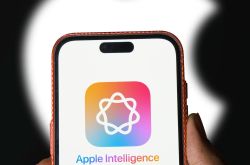
The list includes Huawei Xiaoyi, OPPO's AI assistant, vivo's Blue Heart AI, Xiaomi's Surge AI, Samsung AI, Nubia's Doubao Phone Large Model. One name stands out—Apple Intelligence. The filing entity is Apple Technology Development (Shanghai) Co., Ltd., with the date stamped July 8.
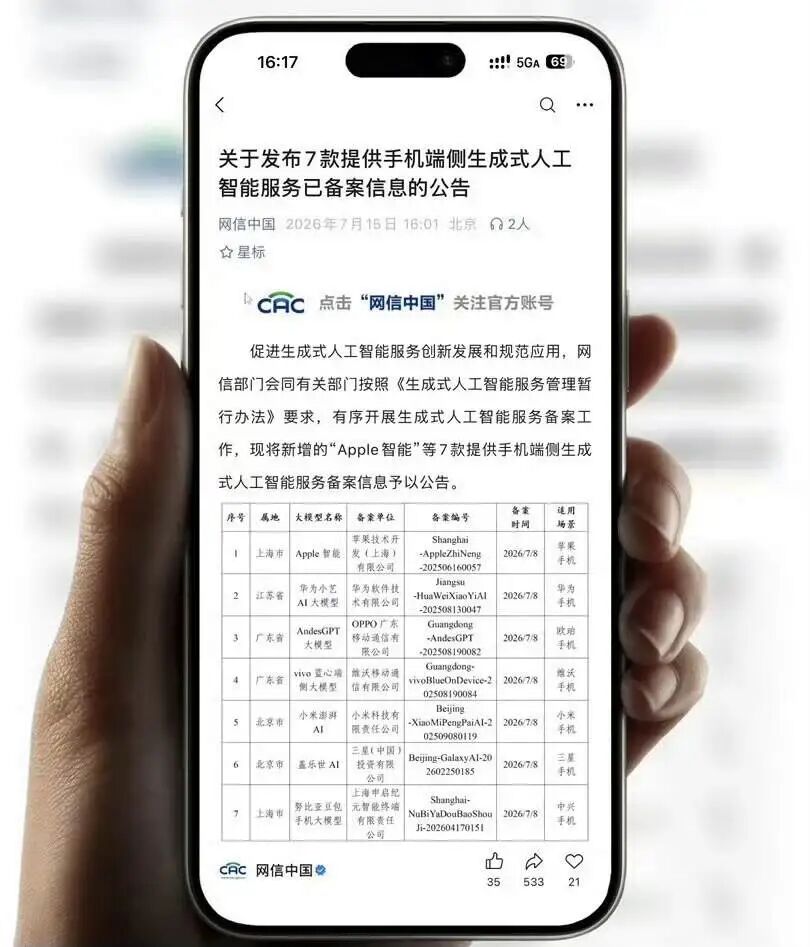
This signifies one thing: The on-device large models of China's mainstream smartphone makers have all secured regulatory approval. Apple was the last to arrive but managed to make it in time.
Sources claim that Alibaba's QianWen is responsible for the underlying large model capabilities, while Baidu provides visual search support—a classic case of 'Apple sets the stage, Chinese companies perform.' Some netizens joked: 'Now, Alibaba finally has its own 'Doubao Phone.'
The real question worth asking is: Why did Apple AI choose Alibaba's QianWen for its 'invasion' of China?
The answer lies in business strategy, not technical rankings.

Filing Approved, But Why QianWen Specifically?
This move was actually foreshadowed earlier.
In February 2025, Alibaba Chairman Joe Tsai announced at a summit in Dubai: 'Apple has always been extremely picky. They've spoken with multiple Chinese companies. Ultimately, they chose to do business with us.'
This statement carries significant weight. 'Multiple companies' indicates Apple indeed shopped around. 'Extremely picky' suggests a high bar. 'Chose to do business with us'—Tsai couldn't hide his pride when saying this.
But pride aside, a key question remains unanswered: QianWen isn't the most prominent among Chinese large models.
Comprehensive media data from Tianyancha shows that as of June 2026, the QianWen app had 167 million monthly active users. That's substantial, but ByteDance's Doubao had 382 million in the same period—nearly two and a half times QianWen's. DeepSeek also had 129 million, closely trailing. In terms of user base, QianWen isn't first.
In terms of technical reputation, DeepSeek's early 2025 breakthrough in low-cost, high-performance models rewrote the narrative for Chinese large models. While QianWen enjoys a good reputation in open-source communities, it hasn't dominated public perception.

So what does Apple want?
It wants 'no competitive relationship'—those five words.
What about self-developed models? Apple does have its own on-device model overseas—the Apple Foundational Model, with 3 billion parameters, running locally and focusing on privacy and security. But at that scale, it's sufficient for daily tasks yet struggles with complex Chinese semantic understanding, long-text generation, and multi-turn conversations.
The full architecture of Apple Intelligence overseas consists of three layers: an on-device 3-billion-parameter model for lightweight tasks, private cloud computing for moderately complex tasks, and the chatbot from that U.S. AI company for the most complex requests. This combo can't be directly replicated in China—the U.S. AI company's services are unavailable domestically.
Thus, Apple needs a local cloud-based large model to fill the gap. QianWen happens to meet all criteria: competent technical capabilities, no competitive relationship, and an urgent need for a super consumer-facing entry point.
Simply put, this isn't a beauty contest to find the 'best' model but a matchmaking event to find the 'most suitable' one. QianWen isn't the prettiest but has the best compatibility, cleanest background, and strongest willingness to cooperate.

For Alibaba, This Is a Lifeline for Consumer-Facing Entry
QianWen is in an awkward position.
167 million monthly active users pale in comparison to Doubao's 382 million, with DeepSeek's 129 million hot on its heels.
Even more threatening is Tencent. Rumors about WeChat embedding an AI agent have circulated for rounds. Once WeChat's AI assistant officially launches, the consumer-facing landscape for Chinese large models could be rewritten overnight. WeChat has over 1.3 billion monthly active users—a traffic pool unimaginable for any standalone app.
Alibaba knows better than anyone: QianWen must urgently find a super entry point in the consumer market. And then Apple appeared.
Apple has hundreds of millions of active users in China. These aren't ordinary netizens—they're high-net-worth individuals willing to spend $1,000 or more on a phone. They have strong purchasing power, high brand loyalty, and demanding expectations for user experience.
For QianWen, this is the ideal seed user group.
When Tsai said 'they chose to do business with us,' it was ostensibly an official cooperation announcement but more like a shoutout to the entire market: QianWen has aligned with the world's most valuable tech company.
QianWen launched a unified brand in March 2026, clearly preparing for massive user growth. Apple's entry point couldn't have come at a better time.
But here's the crucial 'but.'
Will Apple users buy it?
This isn't an idle question. Apple users have a distinct trait: They're deeply attached to native experiences. If a feature isn't smooth, elegant, or 'Apple-like,' they'd rather not use it. Whether QianWen can seamlessly integrate into Apple's OS, making users feel like it's not a third-party service, will directly determine this partnership's success.
Alibaba isn't new to this. Alipay once deeply integrated with Apple's OS but gradually faded due to various reasons. This time, QianWen needs to make hundreds of millions of Apple users feel: 'My iPhone just got smarter,' not 'I'm using QianWen.'
QianWen must provide text understanding, image interpretation, content generation, and other capabilities within Apple's OS, callable without app switching. This requires QianWen's outputs to be not just accurate but invisible—not too verbose, not overly formal, not robotic.
No small feat. But if achieved, QianWen's user base could undergo a qualitative leap. Once hundreds of millions of Apple devices fully integrate, QianWen's daily calls could jump from tens of millions to billions overnight. No advertising campaign could deliver that scale.

For Apple, This Is Catching Up in China's AI Race
Apple should feel the urgency.
Look at what competitors are doing. Huawei's Xiaoyi has already run on-device large models within HarmonyOS, capable of intelligent recommendations using local schedules, contacts, and photos. OPPO's Andes Model, vivo's Blue Heart AI, and Xiaomi's Surge AI are all deeply integrated into their respective OSes, with some enabling cross-app operations like ordering food via voice commands. Even Samsung and Nubia completed filings long ago.
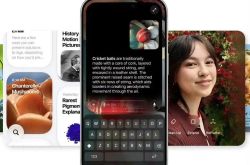
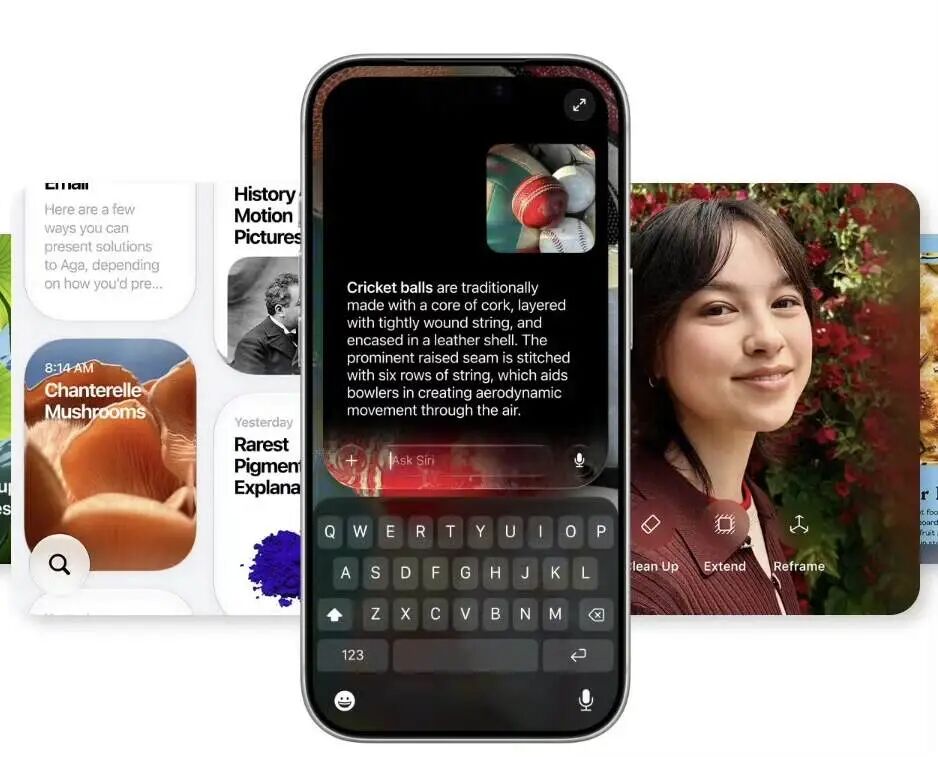
In AI, Apple leads overseas—writing assistance, smart email search, image editing, real-time translation, Siri understanding personal contexts for cross-app operations. These features have rolled out in Western markets. But in China, it's back to square one.
Chinese smartphone makers have been hyping AI for two full years. When buying a phone, AI capabilities have shifted from a bonus to a must-have. If Apple delays further, the perception that 'iPhones lack AI' could solidify, with dire consequences for sales.
Comprehensive media info from Tianyancha shows Apple's 2025 annual report already listed AI as a risk factor. Paraphrased: 'AI may generate harmful content, trigger copyright infringements, and intellectual property disputes, with Apple bearing responsibility, not model partners.'
In plain terms: If QianWen says or generates something inappropriate on iPhones, the blame falls on Apple.
Apple's willingness to shoulder this risk underscores its urgency to catch up in China's AI market.
Overseas, Apple Intelligence has a robust technical foundation. The on-device 3-billion-parameter Apple Foundational Model handles local lightweight tasks, keeping private data on-device. Complex tasks upload to private clouds processed by Apple's self-developed server chips, which even Apple can't access. Only the most complex requests go to the U.S. AI company's cloud. At WWDC 2026, Apple announced collaborations with Google's AI models to expand on-device capabilities and integrated Google Cloud and NVIDIA GPUs for cloud services.
This architecture is luxurious overseas. But in China, the top-tier external AI service must be replaced—the U.S. AI company's services are inaccessible, and Google's AI models face compliance hurdles.
The domestic solution: Alibaba's QianWen provides cloud AI capabilities. This means when users make complex requests, data flows to QianWen's servers. How Apple explains to users that 'your data is now processed by Alibaba' will be a delicate messaging challenge.
According to the current timeline, Apple Intelligence is expected to debut with iOS 27's official release in fall 2026, rolling out gradually to Chinese iPhone users. Apple's Chinese website already teases the iPhone 17 Pro with the tagline 'Ready for Apple Intelligence'—basically hinting: 'Don't worry, AI is coming soon.'
But concerns linger.
The full overseas Apple Intelligence experience relies on three-tier collaboration: on-device model, private cloud, and the U.S. AI company's chatbot. In China, the top layer switches to Alibaba's QianWen cloud service. Can QianWen match the complex task-handling capabilities of top overseas models? Will users perceive the domestic version as inferior?
No answers yet.
Apple will likely adopt a conservative strategy at launch—pushing basic features like writing assistance and image editing first, then gradually unlocking more complex scenarios. Even so, if the experience gap is too wide, comparison posts on social media could erupt quickly.
For Apple, however, launching sooner rather than later may be the most pragmatic choice. Chinese smartphone makers have all completed filings, and the large model arms race is underway. If Apple insists on 'only the best,' it might miss the entire window.
After all, user patience is finite. You can be late, but not absent for too long.
Apple chose QianWen not because it's the best but because it's the safest—no competitive threat, no traffic ambitions, and desperate for this entry point.
QianWen partnered with Apple not for exclusive tech but because Alibaba desperately needs a consumer-facing stronghold to compete with Doubao.
This is a mutually beneficial cooperation. Apple catches up in China's AI race, and QianWen gains access to hundreds of millions of high-net-worth users. But the real test comes in fall: When iOS 27 rolls out, users won't cheer just because 'Apple finally has AI.' They'll ask one question—
'Is this thing actually any good?'
If yes, QianWen rides Apple to a comeback, and Apple stabilizes its foothold in China with large models. If no, this filing clearance becomes merely an admission ticket to disappointment.
In the large model war, filing is never the finish line. Getting users to adopt, enjoy, and keep using is the only metric that matters.
After all, filings get you in the door, but what keeps people inside isn't the doorplate—it's the experience.
-
On the Eve of Its IPO, Avatr Finds Itself Embroiled in a 'Farce of Controversy and Belittlement'
-
![]()
Yutong Optics' Japanese Subsidiary Unveiled in Tokyo, Shifting Strategic Focus to Technology-Driven Growth
-
![]()
Half-Year Revenue Outstrips Last Year’s Total! Zhongrun Optics Forecasts 80.2% H1 Revenue Growth
-
![]()
Why Does AI Competition Start with Computing Power?
-
![]()
Apple AI Finally Makes Its Debut in China, Yet iPhone's 'AI Autonomy' Faces Uncertainty
-
![]()
Apple AI and QianWen Make Up Lessons: Alibaba Has Its Own 'Doubao Phone'
-
![]()
QianWen Joins Apple, Signal for Large Models to ‘Fade into the Background’
-
![]()
The ‘Anchor’ Strategy of Google Hidden Behind the Bleeding Financial Report