Trinity: ByteDance Dismantles ToB 'Departmental Barriers'
 08/03 2026
 471
471
For ByteDance, this represents a strategic bet on the ToB landscape in the AI era: the competition for AI work entry points will determine the rankings in the enterprise services market for the next decade.
Author | Liu Shanshan
Editor | Yang Ming
The AI race has moved beyond model parameters, leaderboard competition, and price wars over API calls. For giants like Tencent, Alibaba, and ByteDance, the core of competition is shifting toward building full-stack AI ecosystems.
On July 30, an internal email from ByteDance marked the latest chapter in this ecosystem competition.
The email revealed that ByteDance has launched an organizational restructuring focused on its AI business: the Feishu product team and the Doubao product team have been integrated to form a new Doubao product team, led by Doubao head Zhao Qi, with Feishu head Xie Xin reporting to Zhao Qi. The Feishu GTM (Go-to-Market) system and the Volcano Engine team have been merged to form a new ToB GTM organization called the 'Creativity Service Platform,' led by Volcano Engine head Tan Dai.
This marks ByteDance's largest ToB organizational adjustment since implementing business segmentation in 2021. It signifies a shift away from the independent development paths of Feishu, Doubao, and Volcano Engine as separate major businesses, toward creating a unified AI system with Doubao as the intelligent core, Feishu as the work entry point, and Volcano Engine as the cloud foundation, spanning from underlying computing power to upper-layer applications and commercial delivery.
1. Dismantling ToB 'Departmental Barriers'
The logic behind ByteDance's adjustment is not complex.
On the product side, Feishu and Doubao have been integrated into a new 'Doubao Product Team,' led by Doubao head Zhao Qi, with Feishu head Xie Xin reporting to him. This signifies a shift in product decision-making for office scenarios from 'collaboration tools first' to 'AI productivity first.' Feishu's accumulated capabilities in documents, meetings, and messaging within the collaborative office space will now directly support Doubao's B-end expansion. Feishu's role in the new system is clear: focusing on the integration of AI and office scenarios in product development, while unifying commercialization under Volcano Engine's enterprise services Export (which means 'export' or 'channel' in this context, referring to the pathway for services).
The Doubao Enterprise Edition, currently in beta testing among some Feishu clients, will be the direct product outcome of this adjustment. Previously, Feishu had its own AI, Doubao was a standalone C-end application, and Volcano Engine sold MaaS services, creating significant costs for enterprises. ByteDance is now combining Doubao and Feishu to create an 'Office Edition Doubao,' embedding AI capabilities as native features within Feishu, forming a virtuous cycle where 'increased usage leads to better model understanding of the enterprise, making users more reliant on it.'

On the commercialization side, the Feishu GTM team and the Volcano Engine team have been integrated to form the 'Creativity Service Platform,' led by Volcano Engine head Tan Dai, with Feishu sales head Lin Chan and Feishu strategy and marketing head Shi Zhijun reporting to Tan Dai. This ends the previous situation where Feishu and Volcano Engine had overlapping clients but operated with separate sales teams. The new unified platform packages MaaS and SaaS into an integrated enterprise AI solution, eliminating internal friction at the organizational level.
This integration was not entirely unexpected, as previous personnel adjustments may have foreshadowed it.
Media reports previously noted that to strengthen collaboration between Doubao and Feishu's office suite, Feishu product head Tong Yao reported virtually to Zhao Qi. Some observers believe that reassigning someone long involved in enterprise collaboration products to lead an AI product for individual users subtly revealed Doubao's expansion into office and productivity scenarios.
Product integration preceded the organizational restructuring. Feishu previously launched the enterprise intelligent agent platform Aily, enabling businesses to integrate large models, internal knowledge, and business systems into a unified platform. When Doubao Professional Edition officially launched on June 24, some Feishu capabilities were already embedded. From this perspective, the organizational restructuring simply formalizes the long-term gradual product integration through organizational structure.
However, a deeper understanding of the logic requires examining several key variables.
Currently, AI ToB commercialization has passed a critical point, with revenue growth structure creating an urgent need for ByteDance to push for integration.
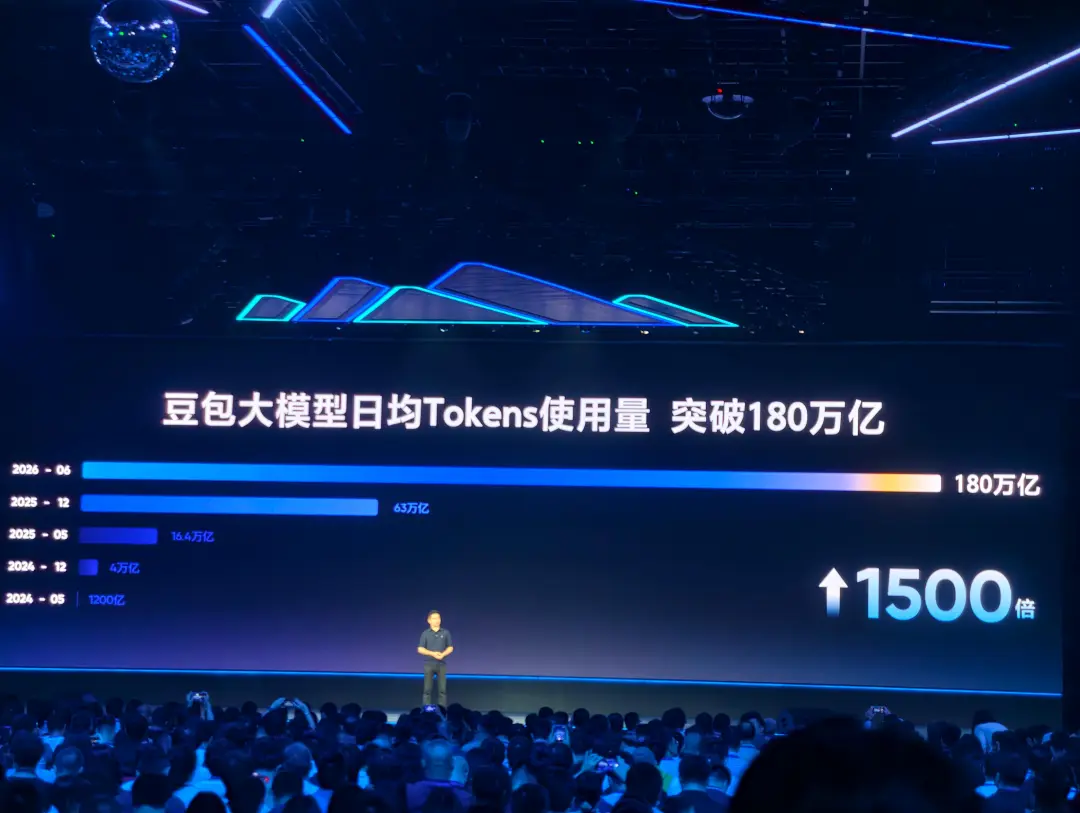
As of June 2026, the Doubao large model's daily Token calls reached 180 trillion. Based on July's computing power consumption metrics, ByteDance's overall large model annualized revenue (ARR) exceeded $4 billion. However, growth in C-end personal user traffic has natural ceilings, with the real growth potential lying in the B-end.
Data confirms the monetization potential of office scenarios. Among Feishu's new clients in Q2 2026, over 90% simultaneously purchased AI products, with ARR growing over 100% year-on-year. Leveraging Feishu's existing enterprise client base for Doubao's B-end deployment represents ByteDance's most efficient path for AI commercialization.
More importantly, intelligent agents are redefining the competitive rules of enterprise services. Before large models emerged, Feishu handled enterprise collaboration while Volcano Engine provided cloud computing, with clear divisions of labor. However, once agent capabilities surpassed productivity thresholds, enterprise clients began caring about whether 'AI can read my enterprise knowledge, understand my organizational permissions, invoke my business tools, and ultimately complete real tasks.'
This means models, computing power, data, and entry points must be integrated. Doubao serves as the intelligent entry point, Feishu as the work entry point, and Volcano Engine as the computing foundation. Feishu's years of accumulated documents, messages, organizational relationships, and permission systems provide the necessary contextual environment for agents to operate within enterprises.
After integration, Doubao provides model and agent capabilities, Feishu supplies enterprise knowledge, organizational relationships, and workflows, while Volcano Engine handles computing power, model services, and enterprise delivery. By breaking down data silos, they will construct a complete closed-loop system from underlying computing power to upper-layer applications and commercial delivery, enhancing external competitiveness and execution efficiency.
2. The Desktop Entry Point Battle Has Begun
ByteDance's adjustment is not an isolated case. Around the same time, Alibaba and Tencent made similar moves, intensifying competitive pressure in the Track (which means 'track' or 'field,' referring to the competitive arena).
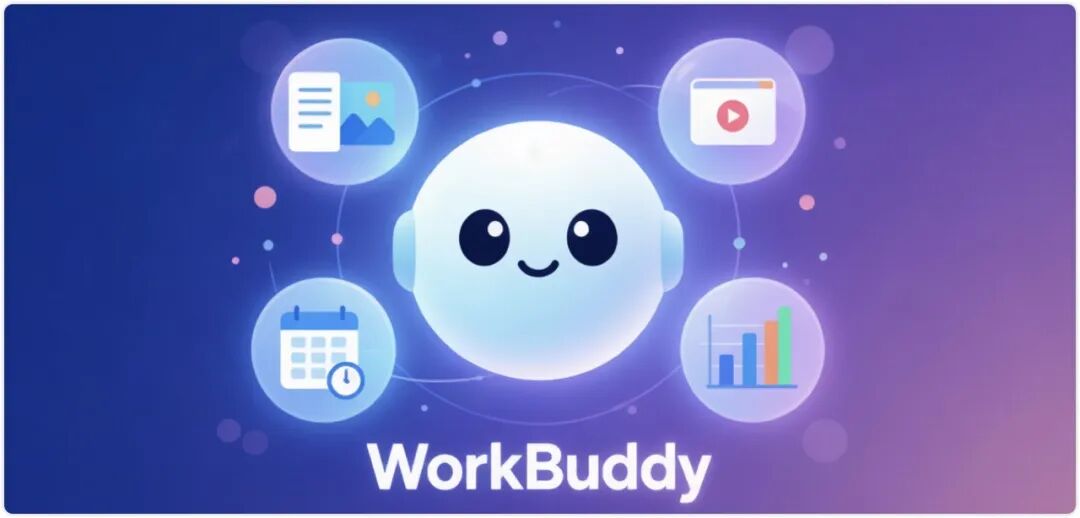
On July 20, Tencent placed QClaw under the same department as WorkBuddy for unified management, with the latter recently launched on the HarmonyOS PC app market. On July 27, Alibaba integrated three agent products—QoderWork, Wukong, and MuleRun—into 'Qianwen Office,' led by newly appointed DingTalk CEO Chen Yusen, with underlying ties to the Tongyi Qianwen model and DingTalk ecosystem.
Every shift in computing paradigms involves fierce competition for entry points. The recent synchronized moves by these three giants target the same core Track : desktop office agents.
Unlike traditional conversational AI that only offers suggestions, desktop agents truly 'get things done': organizing data, generating documents, scheduling corporate emails, and even automating multi-step workflows across applications. Competing for PC desktop entry points has become the frontline for preempt (which means 'seizing' or 'capturing') enterprise digital services.
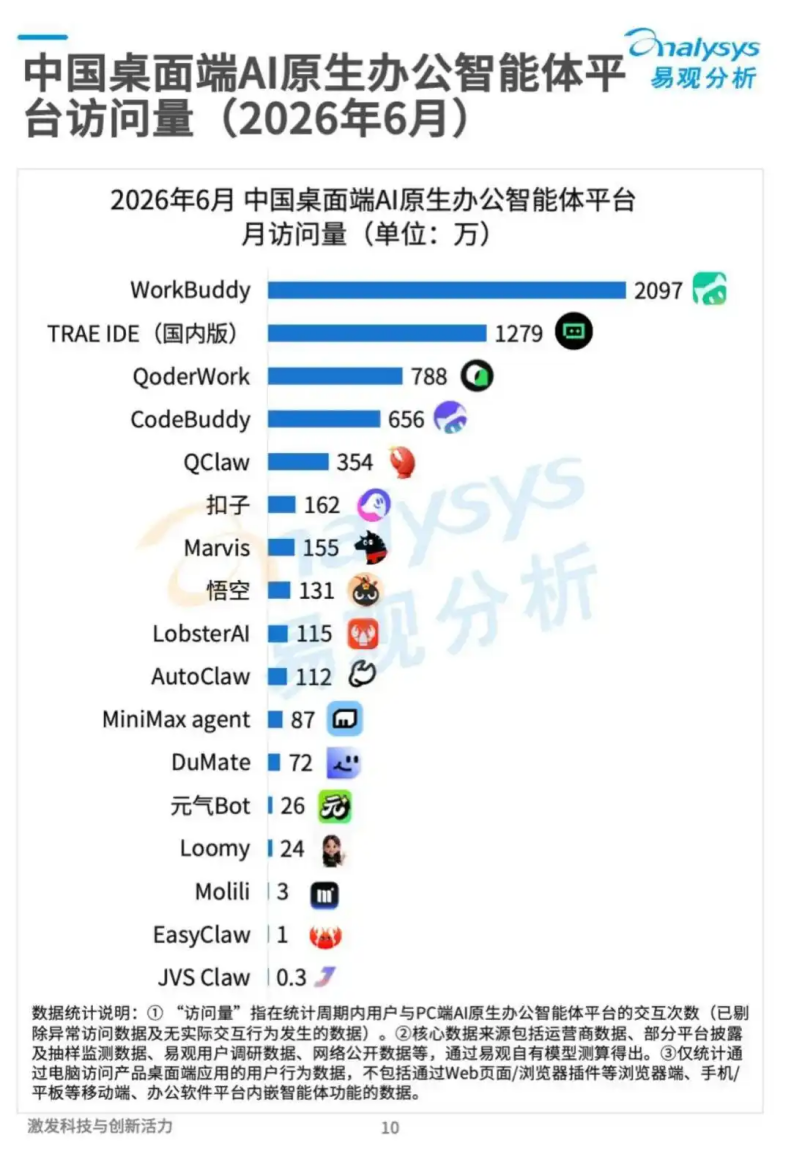
Analysys data shows that in June 2026, the 17 mainstream Chinese desktop AI-native office agent platforms included in the statistics surpassed 60 million combined visits. All these visits occurred on PCs, with users' demands for desktop agents being highly specific—writing long documents, processing complex spreadsheets, scheduling corporate emails, etc.—resulting in far higher frequency and stickiness than mobile chat AI.
This represents a vast potential market. As of June 2025, China had 16 million one-person companies (OPCs), naturally requiring AI to replace roles like assistants, finance, and design. Nearly 60% of AI office agent users explicitly expressed willingness to pay for such services.
Thus, a desktop-level 'final battle' to decide the enterprise AI entry points for the next decade has begun. Currently, Tencent's WorkBuddy leads with 20.97 million monthly visits, followed by ByteDance's TRAE IDE domestic version at 12.79 million, and Alibaba's QoderWork at 7.88 million.
However, in an AI landscape changing by the month or even week, current rankings are far from final. The true competition among these three giants lies in who can first weave model capabilities, office scenarios, and cloud services into a network that enterprises 'cannot live without,' making them the ultimate winners of this battle.
This also means that measuring this competition with old metrics like monthly active users, client numbers, and ARR is already outdated. AI has shifted the battlefield from office software itself to deeper layers like models, clouds, and chips, as well as to higher layers like consumer entry points and transaction ecosystems.
More importantly, the similar organizational languages used by these three giants signal a clear attitude: the basic unit of AI competition has shifted from a single product to an entire ecosystem.
Alibaba established the Alibaba Token Hub business group in March 2026, led personally by CEO Wu Yongming, consolidating Tongyi Labs, MaaS, Qianwen, and the AI Innovation Business Division under one organization, covering the full chain from self-developed chips and Alibaba Cloud to Qianwen models, DingTalk, and even Taobao and Tmall. Morgan Stanley upgraded Alibaba to its top pick in China's internet sector, citing its full-stack capabilities in chips, clouds, models, and applications as the core reason.
In reality, these three giants are competing not just for AI application market share but for the default entry points through which individuals and enterprises access the digital world in the AI era.
For ByteDance, this represents a crucial move to create a unified intelligent foundation spanning C-end and B-end. The Doubao large model has already become the unified model foundation supporting Douyin, Jianying, Feishu, Volcano Engine, and even more ByteDance businesses. Meanwhile, Feishu's years of accumulated enterprise digital infrastructure, organizational permissions, and workflows will accelerate Doubao's B-end commercialization from its C-end base of over 100 million monthly active users, helping ByteDance secure a core position in the AI-era enterprise services market.
3. Can ByteDance Win This Tough Battle?
To some extent, this latest organizational restructuring represents an important strategic recalibration by ByteDance.
In previous years, ByteDance pursued an 'internal horse race' approach in its ToB business—Feishu and Volcano Engine operated independently, each with its own product logic, sales system, and performance metrics.
This model proved effective during the exploration phase, but as AI blurred product boundaries and integrated commercial logic among the three, the costs of running separately began to outweigh the benefits. ByteDance's current move to 'centralize products under Doubao and sales under Volcano' essentially uses organizational adjustment to force product and business collaboration, representing an inevitable choice to align with industry trends.
However, achieving true organizational synergy remains an arduous battle.
The most obvious challenge lies in repositioning Feishu's role. Previously an independent SaaS company, Feishu had its own product culture and commercial rhythm. Now, with product decision-making under Doubao and sales under Volcano Engine, the Feishu team must transition from 'leaders' to 'collaborators.'

From another perspective, this also relieves Feishu of the burden of independent commercialization growth, allowing it to focus more deeply on integrating AI with office scenarios. Feishu's past efforts in driving enterprise digitalization and helping clients achieve AI readiness have prepared the organizational context—documents, messages, permissions, and business processes—that Doubao needs to move from C-end to B-end, making these indispensable pieces of the puzzle.
Additionally, Doubao faces core tests in meeting B-end expectations. While Doubao excels in C-end with over 100 million monthly active users, leading by a wide margin, C-end product logic differs fundamentally from B-end. Enterprise clients don't just want 'smarter chatbots' but 'productive tools that can work, avoid errors, and have permission controls.'
Feishu's years of experience in large enterprise deployments, permission management, and compliance security can address Doubao's B-end scenario shortcomings. The critical issue is whether the Doubao team can quickly develop deep understanding of B-end scenarios—requiring not algorithmic capability but insight into enterprise organizational behavior.
Moreover, the long-term nature of B-end commercialization cannot be ignored. While $4 billion in large model ARR is impressive, ToB business fundamentally requires a long-term perspective. With AI as a new variable, it needs time to translate into market share and client stickiness. Merging Feishu's commercialization team into Volcano Engine suggests ByteDance is attempting to find a commercialization path different from traditional SaaS standalone sales through a bundled 'cloud + AI + applications' model.
Ultimately, this represents a prolonged tough battle: whose agent can complete tasks with higher success rates at lower 'task costs.'

Enterprise agent Token consumption far exceeds that of Q&A products. A single data organization task may require multiple API calls, database accesses, and intermediate file generations, with Token consumption per task often tens or even hundreds of times higher than in Q&A scenarios. However, as long as agents can truly 'get things done,' enterprises are willing to pay. IDC predicts that China's enterprise-level Token consumption will grow about 20-fold from 2025 to 2026.
Reducing task costs relies on triple optimization of model efficiency, cloud service costs, and application scenario depth. From this perspective, this may be one of the underlying logics behind ByteDance integrating Doubao, Feishu, and Volcano Engine—the more frequent the model calls, the deeper Feishu's scenario penetration, and the cheaper Volcano Engine's computing power, the more these three elements mutually reinforce each other, creating a cost structure difficult for competitors to replicate.
Once companies form usage habits on a large scale, the barriers to migration will not be as simple as reinstalling a software; instead, the entire team's workflow, historical data, and collaboration records will all need to be reset. Therefore, the sense of urgency among vendors stems from a simple yet harsh judgment: the desktop entry point is not a question of 'whether to pursue it,' but rather, 'if you delay, you won't even qualify to enter the game.'
For players who have already established a foothold in the collaborative office space, this is a 'battle to defend the fortress'—to safeguard the user relationships and ecological barriers cultivated over years by WeCom, DingTalk, and Feishu, while simultaneously redefining the product's value boundaries with AI. For ByteDance, it ultimately boils down to a strategic bet on the ToB landscape in the AI era: the competition for AI work entry points will determine the pecking order in the enterprise services market for the next decade.
ByteDance CEO Liang Rubo set the keyword for 2026 as 'scaling new heights,' with the core objective of overcoming the technical capabilities of large models. This integration precisely illustrates that ByteDance is leveraging its most adept product and scenario coupling to wage a tough battle on the B-side.
The outcome remains uncertain, but the battle lines are drawn.
END
Producer: Huang Qiangqiang
-
Financing and IPO: Is Ant Group a Financial Giant or a Pioneer in Cutting-Edge Tech?
-
![]()
Revenue Soars Twofold in Three Years! Optical Firm Reignites Bid for Hong Kong Stock Exchange Listing
-
![]()
Jiangsu LEAD Microelectronics Successfully Hands Over Its Inaugural 12-Inch Wafer-Level Optical Magnetron Sputtering System!
-
![]()
Domestic Computing Power Hits Breakthrough: Super Nodes as the Pivotal Force
-
![]()
Tongze Kangwei Secures IPO Registration on GEM: Broadband Terminal Equipment Provider Set for Imminent Share Issuance
-
![]()
Transforming Car Manufacturing into a 'Smartphone Launch' Frenzy: 5 Tips to Avoid Pitfalls When Purchasing a New Car
-
![]()
The Three-Way Battle Among AI Office Software: A Decade of War Among BAT
-
![]()
The Three-Way Battle Among AI Office Software: A Decade-Long War Among BAT