Tongze Kangwei Secures IPO Registration on GEM: Broadband Terminal Equipment Provider Set for Imminent Share Issuance
 08/03 2026
 544
544
Source: Xiaocaimi
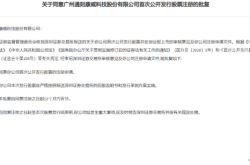
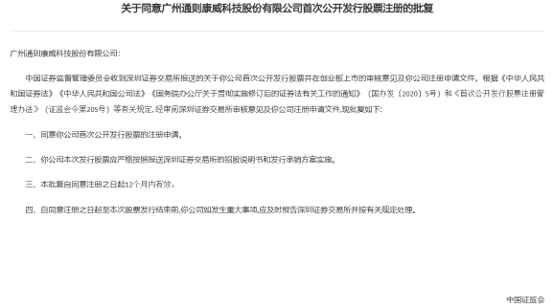
On July 28, 2026, the China Securities Regulatory Commission (CSRC) issued the "Approval for the Registration of the Initial Public Offering of Shares by Guangzhou Tongze Kangwei Technology Co., Ltd." (CSRC License [2026] No. 1878), formally granting approval for the company to issue shares publicly for the first time and list on the Growth Enterprise Market (GEM). This approval remains valid for 12 months from the date of issuance. The company's listing journey began with its application acceptance by the Shenzhen Stock Exchange on June 30, 2025, followed by approval from the Shenzhen Stock Exchange Listing Committee on June 30, 2026. It then submitted its registration to the CSRC on July 10 and received final approval on July 28. Remarkably, the entire process from submission to approval spanned just 18 days.
Tongze Kangwei is a leading enterprise specializing in the design, research and development, production, and sales of self-branded broadband connection terminal equipment. Headquartered in Nansha District, Guangzhou, the company directly supplies products and services to global telecom operators while actively expanding its applications for vertical industry clients. Its products have reached more than 80 countries and regions worldwide. According to the global 5G FWA CPE supplier competitiveness ranking released by ABI Research in January 2025, Tongze Kangwei ranks seventh globally and stands as the highest-ranked Chinese enterprise after ZTE and Huawei.
The company's core product offerings revolve around CPE (Customer Premises Equipment). CPE serves as a crucial device bridging operator networks with end-users, converting mobile communication signals or fixed broadband signals into Wi-Fi or wired network signals for household and business use. In simpler terms, routers connected to optical modems in users' homes and 5G mobile routers that access the internet via SIM cards fall under the CPE category. Tongze Kangwei's diverse product matrix encompasses 5G CPE, 4G CPE, optical network terminals, and enterprise-grade gateways.
Financial data reveals that from 2023 to 2025, the company's operating revenues stood at RMB 1.025 billion, RMB 1.152 billion, and RMB 1.646 billion, respectively. Net profits attributable to shareholders of the parent company, calculated based on the lower of the amounts before and after deducting non-recurring gains and losses, were RMB 98.7496 million, RMB 75.2372 million, and RMB 87.6122 million, respectively. While revenue experienced significant growth in 2025, net profit did not increase proportionally. In fact, net profit declined in 2024 and, although it stabilized and rebounded in 2025, it did not return to the 2023 level.
The company's prospectus attributes this phenomenon of "revenue growth without proportional profit growth" to several factors. In 2024, the company's R&D expenditure ratio rose to 7.74%, an increase of 1.17 percentage points from the previous year, with R&D expenses surging by RMB 21.8261 million. Simultaneously, the company expanded its sales regions to Sub-Saharan Africa, where longer transportation distances and higher air freight costs, compounded by geopolitical factors such as disruptions in the Red Sea shipping route, led to increased freight expenses. Additionally, sales fluctuations in some high-margin products based on self-developed cellular communication units also impacted net profit. In 2025, the successful launch of CPE products based on Unisoc's second-generation domestic 5G chip solution contributed to the stabilization and rebound in net profit.
From a revenue structure perspective, CPE products dominate the company's portfolio. In 2025, revenue from CPE products reached RMB 1.3699579 billion, accounting for 83.87% of main business revenue. Among this, revenue from 5G products amounted to RMB 1.0336442 billion, representing 63.28%. The company is currently in the midst of an accelerated transition from 4G to 5G products, with the proportion of 5G product revenue increasing from 54.66% in 2023 to 63.28% in 2025.
From a market size perspective, the global broadband CPE market continues to expand. Market research firm data indicates that the global wireless broadband user terminal equipment market is projected to grow from USD 17.64 billion in 2025 to USD 19.36 billion in 2026, with a compound annual growth rate (CAGR) of approximately 9.8%. Another firm, QYResearch, estimates that the global broadband customer premises equipment market size was approximately USD 14.69 billion in 2025. While statistical scopes vary among institutions—some cover all wireless broadband CPE, while others focus solely on broadband customer premises equipment—the overall growth trend remains consistent. The 5G FWA CPE submarket, in which Tongze Kangwei operates, is experiencing even faster growth. According to Research and Markets data, this market is expected to expand from USD 3.14 billion in 2025 to USD 3.71 billion in 2026, with a CAGR of 17.9%.
The ongoing upgrade of China's broadband network infrastructure provides a solid foundation for the terminal equipment market. As of the end of May 2026, the total number of internet broadband access users for China Mobile, China Telecom, and China Unicom reached 699 million. Among them, the number of users with gigabit or higher speeds exceeded 255 million, with a penetration rate of 36%. In February 2026, the number of 10G-PON ports capable of providing gigabit network services in China reached 32 million, accounting for 74.3% of all PON ports. Ao Li, Vice President of the China Academy of Information and Communications Technology, previously stated that the gradual development path of "gigabit—super gigabit—10 gigabit" may become the trend for China's broadband services. The widespread adoption of gigabit broadband implies a continuous demand for upgrading household gateways, optical network terminals, and other equipment.
The generational shift in Wi-Fi technology is another significant driver of upgrades. In January 2026, the Wi-Fi Alliance officially opened Wi-Fi 7 certification for 20MHz narrowband devices. From the opening of certification to the mass production and delivery of modules, it took less than six months. According to IDC data, in the first quarter of 2026, the total size of the global enterprise wireless local area network (WLAN) market reached USD 2.7 billion, a year-on-year increase of 15.9%. Among this, revenue from access point products supporting the Wi-Fi 7 standard reached USD 958.4 million, a year-on-year surge of 348%, accounting for 44.5% of the overall revenue from enterprise-grade access points—compared to less than 1% a year earlier. IDC expects Wi-Fi 7 to account for more than 50% of enterprise WLAN revenue in the short term. The explosive growth of Wi-Fi 7 imposes clear upgrade requirements on CPE devices, including higher throughput, lower latency, and multi-link operation capabilities, all of which necessitate simultaneous upgrades in terminal equipment in terms of chip platforms, antenna design, and thermal management solutions.
5G fixed wireless access (FWA) represents the most direct market segment for Tongze Kangwei. 5G FWA leverages 5G mobile networks to provide broadband access for households and businesses without the need for laying fiber, making it particularly suitable for areas with insufficient fiber coverage. According to industry data, the global 5G CPE market size exceeded USD 38 billion in 2026, a 31% increase from USD 29 billion in 2025, with shipments reaching 120 million units. This growth is primarily driven by broadband infrastructure gaps in Southeast Asia, the Middle East, and Africa. Tongze Kangwei's sales regions are expanding from Asia-Pacific to the Middle East and Sub-Saharan Africa—areas with low fiber coverage, where 5G FWA serves as an effective means to bridge the digital divide.
In response to these market dynamics, Tongze Kangwei has adopted a strategy focused on the industrial application of domestic chips. The company successfully launched its CPE products based on Unisoc's second-generation domestic 5G chip solution in 2025. Against the backdrop of ongoing uncertainties in the global chip supply chain, the application of domestic chip solutions not only helps safeguard supply chain security but may also offer certain cost advantages. However, the prospectus also cautions that the gross profit margins of products using different chip solutions vary, and switching chip solutions may impact the company's profit levels.
From a supply chain perspective, Tongze Kangwei operates in the middle of the industry chain. Upstream suppliers provide chips and communication modules, PCBs, and electronic components, while downstream clients are domestic and foreign telecom operators, with products ultimately used by end-users in household, government, enterprise, commercial, and industrial settings. The company primarily provides products and services directly to global telecom operators. This business model means the company's revenue is highly dependent on operators' capital expenditure plans and terminal procurement rhythms. Cyclical fluctuations in operator network investments, annual price reduction requirements for procurement, and the length of supplier certification cycles all directly impact the company's operations.
Data from Dell'Oro Group shows that after three years of declining spending, the broadband access equipment market is expected to resume growth in 2026. In the first quarter of 2026, total revenue in the global broadband access equipment market reached USD 4.4 billion, a year-on-year increase of 2%. The firm expects total revenue in the broadband access equipment market to peak in 2028 between 2026 and 2030. The restorative growth in operator spending is a positive signal for equipment suppliers like Tongze Kangwei.
In terms of cutting-edge technologies, Tongze Kangwei outlines a strategic positioning of "deepening 5G and looking toward 6G" in its prospectus. The company states that it will continue to invest in three major R&D directions: next-generation enhanced mobile broadband connection terminals based on 5G-A, new-generation broadband intelligent connection terminals for "5G+Industrial Internet," and wired broadband intelligent connection terminals for next-generation communication technologies. On a broader scale, the China Academy of Information and Communications Technology has officially initiated the development of international standards for AI broadband networks at the Broadband Forum (BBF) 2026 Spring Members Meeting. The integration of AI and broadband—including AI-assisted network optimization, intelligent fault diagnosis, and traffic scheduling—is moving from laboratories to standardization and industrialization. Whether Tongze Kangwei can establish a first-mover advantage in the R&D of AI broadband terminals remains to be seen.
However, risks and challenges cannot be overlooked. Customer concentration is a primary concern. Tongze Kangwei's core target customer base consists of global large-scale telecom operators. This means the company's revenue is highly dependent on the procurement decisions of a few operators. Any demand fluctuations, supplier switches, or procurement price adjustments by major customers could significantly impact the company's performance.
A high proportion of overseas revenue exposes the company to multiple external risks. The expansion of sales regions to areas like Sub-Saharan Africa has led to increased transportation costs and extended delivery cycles. Changes in the international trade environment, geopolitical factors, and exchange rate fluctuations could all affect the company's export revenue and profits. The prospectus notes that the temporary increase in freight cost proportions due to changes in the international situation impacted net profit in 2024.
Technological iteration risks are also prominent. The rapid and continuous development of communication technologies imposes higher requirements on the performance, functionality, and compatibility of broadband connection terminals. Each generational shift, from 4G to 5G and from Wi-Fi 6 to Wi-Fi 7, necessitates the redesign of product platforms and sustained increases in R&D investment. If the company fails to make forward-looking judgments in response to market changes and experiences prolonged new product R&D cycles, it risks a decline in product competitiveness.
Gross profit margin pressure is a common issue in the industry. As operators actively seek to increase user penetration by lowering 5G broadband package prices, terminal equipment prices also face downward pressure. The company reduces material costs by promoting the localization of core components such as 5G main control chips and streamlining structural designs. However, balancing cost control with product performance and weighing price reductions against gross profit margins are ongoing challenges for the company.
China's broadband connection terminal equipment industry stands at the intersection of technological upgrades and market expansion. The widespread adoption of gigabit broadband, the commercialization of Wi-Fi 7, and the surge in 5G FWA provide triple drivers for industry growth. However, the cyclicality of operator procurement, uncertainties in chip supply, and the complexity of international markets continuously test the comprehensive capabilities of enterprises. Tongze Kangwei has grown from a startup to the seventh-ranked global 5G FWA CPE supplier in seven years. How far it can go in the new round of technological cycles and on the new stage of capital markets remains to be answered by time.
-
Financing and IPO: Is Ant Group a Financial Giant or a Pioneer in Cutting-Edge Tech?
-
![]()
Revenue Soars Twofold in Three Years! Optical Firm Reignites Bid for Hong Kong Stock Exchange Listing
-
![]()
Jiangsu LEAD Microelectronics Successfully Hands Over Its Inaugural 12-Inch Wafer-Level Optical Magnetron Sputtering System!
-
![]()
Domestic Computing Power Hits Breakthrough: Super Nodes as the Pivotal Force
-
![]()
Tongze Kangwei Secures IPO Registration on GEM: Broadband Terminal Equipment Provider Set for Imminent Share Issuance
-
![]()
Transforming Car Manufacturing into a 'Smartphone Launch' Frenzy: 5 Tips to Avoid Pitfalls When Purchasing a New Car
-
![]()
The Three-Way Battle Among AI Office Software: A Decade of War Among BAT
-
![]()
The Three-Way Battle Among AI Office Software: A Decade-Long War Among BAT