OpenAI is becoming a company we no longer understand
 08/10 2026
 404
404
"When AI starts iterating on its own, who is still writing code?"
Author|Jiachang
Produced by|Jixin
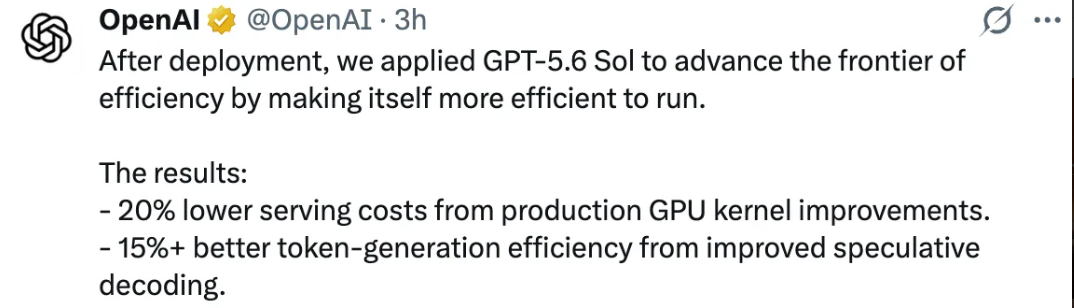
In August 2026, without any prior announcement, OpenAI pushed an experimental branch version of GPT-5.6 to a select group of internal beta users. This version was the first to feature what was internally termed 'recursive self-optimization': the model could detect inefficient links in its own logical chain during reasoning and rewrite this part of the reasoning code in real time. After the news leaked, the technical community was thrown into a complex mix of excitement and unease. In the past, all AI advancements were driven by human engineers, but now, AI was beginning to optimize itself. The deeper significance of this event lies not in how much GPT-5.6 outperformed its predecessors in percentage points, but in the fact that it changed the fundamental driving force behind AI technological progress—from human-designed algorithms to algorithms designing algorithms. This represents a defining turning point for OpenAI as a company, for the entire AI industry, and for the relationship between humanity and technology.
1. The True Meaning of Self-Evolution: From 'Stronger Models' to 'Different Species'
To understand what self-evolution means, it is necessary to distinguish between two easily confused concepts.
Over the past two years, when the AI industry spoke of 'model upgrades,' it referred to human engineers collecting more data, designing better architectures, investing more computational power, training a new version of the model, and then deploying it. No matter how fast this process was, it was always driven by humans. GPT-5 was stronger than GPT-4 because human engineers did a better job, not because GPT-4 became smarter on its own.

The self-evolving capability of GPT-5.6 breaks precisely this boundary. Its ability to optimize its reasoning code in real time during inference means that the model's behavior is no longer fixed at deployment but dynamically evolves during operation. The quality of output from this model may differ between this morning and tonight—not because human engineers did anything, but because the model itself learned more efficient processing methods over the past few hours.
Once this capability is released into production environments, it will trigger a series of chain reactions. The most direct impact is a change in the slope of the performance curve. In the past, AI model capability growth was stepwise: human engineers released a new version, capabilities jumped, then plateaued until the next release. Self-evolution transforms this curve from 'steps' to a 'slope'—models can continuously improve without human intervention, and the acceleration of capability growth will no longer be limited by human research and development cycles.
A deeper impact lies in the further loss of explainability. When a model's behavioral logic is not designed by anyone but is the result of self-modification during runtime, even its developers cannot fully predict how it will behave under specific inputs. This is not a theoretical philosophical question but a practical engineering risk: if you don't know how a model arrived at a certain conclusion, you cannot be held responsible for the consequences of that conclusion.
2. OpenAI's Role Transformation: From Model Manufacturer to Ecosystem Manager
The self-evolving capability of GPT-5.6 not only changes the model itself but is also redefining the fundamental identity of OpenAI as a company.
In the past, OpenAI's definition was clear: an AI model manufacturer. It designed models, trained models, deployed models, and sold model capabilities to developers and enterprise customers via APIs. While this positioning was already more ambitious than most companies, it still fell within the realm of a 'product company'—no different in business model from companies manufacturing cars or chips.
But when a model can self-optimize during operation, OpenAI is no longer selling a 'product' but operating an 'ecosystem.' The model itself becomes a living system that grows, changes, and requires continuous supervision. OpenAI's role shifts from 'manufacturer' to 'manager'—it must not only be responsible for the model's initial state but also for its evolutionary boundaries, monitoring of abnormal behaviors, and control over the rate of capability growth.
This role transformation has profound implications for OpenAI's internal organizational structure, talent composition, and decision-making logic. First, the status of the security team has risen sharply. Under traditional development models, the security team's role was to conduct red-team testing and vulnerability patching after model training was complete. But under the self-evolution model, security is no longer a checkpoint in the research and development process but a continuous process that must run in sync with the model's operation. The security team must evolve from 'quality inspectors' to 'fire brigades'—on call 24/7, ready to intervene at any moment.
Second, the structure of talent demand is undergoing dramatic changes. In the first half of 2026, OpenAI launched a large-scale recruitment drive, with job postings revealing the company's areas of anxiety. In the past, the majority of hires were machine learning engineers and algorithm researchers; now, the fastest-growing roles are experts in mathematical formal verification, complex system stability analysis, and AI behavioral ethics. The recruitment of Fields Medal winners into the security team is merely the latest extension of this logic—when models begin modifying themselves during runtime, you need top mathematicians to establish formalized safety boundaries for such modifications.
3. The Invisible Restructuring of the Industry Landscape
If models can self-optimize, the competitive barriers in the AI industry will be redefined.
In the current AI industry landscape, competitive advantages primarily come from three dimensions: model performance, computational power reserves, and the data flywheel. The company with the strongest model can attract the most users, who generate the most data, which in turn trains even stronger models. This cycle is the fundamental logic of competition in the AI industry.
Self-evolving capability introduces a new variable: time. If a model can self-optimize, first-mover advantage will be dramatically amplified. A model that deploys self-evolution capability first not only starts ahead but also automatically widens its lead over time. Pursuers no longer face a fixed technological target but one that is constantly moving forward. This is unsettling news for competitors chasing OpenAI—whether Anthropic, Google, or Chinese large model vendors.
But the flip side of the coin is uncertainty. A model capable of self-modification during runtime has behavior boundaries that are not fully controllable. If a self-evolving model deployed in critical sectors such as finance, healthcare, or defense exhibits unexpected behavioral mutations, the consequences could far exceed the losses caused by any traditional software bug. This means the adoption of self-evolving capability in high-risk industries will face regulatory and trust barriers far exceeding the technical difficulties themselves.
For China's AI industry, the self-evolution route raises a strategic judgment that must be taken seriously. In the traditional arms race of large models, China's pursuit path was clear—expand parameter scale, optimize training efficiency, and reduce inference costs. But if self-evolution becomes the main track of competition in the next phase, the focus of competition will shift from 'who trained a stronger model' to 'who built a safer self-evolution framework.' The latter requires not just computational power and algorithms but also a deep intersection of mathematical foundational research, complex systems theory, and AI safety ethics. This represents a comprehensive test of the industry's foundational research capabilities.
4. The Twilight of Human Engineers?
Among all the discussions sparked by GPT-5.6's self-evolving capability, the most disruptive is not a technical question but an identity one: when AI begins optimizing its own code, what role can human engineers still play in AI R&D?
This question has sparked fierce debate in the developer community. Pessimists argue that self-evolution is the first domino in the automation of AI R&D. If reasoning optimization can be automated, then data processing, feature engineering, hyperparameter tuning, and even model architecture design may all be taken over by AI in the foreseeable future. Human engineers will be downgraded from 'creators' of AI to 'supervisors' of AI, and eventually, they may not even retain the supervisor role.
Optimists, however, believe that this concern misunderstands the nature of self-evolution. GPT-5.6's self-optimization is currently limited to reasoning efficiency and is still astronomically far from 'AI independently developing the next generation of AI.' More importantly, the boundaries of self-evolution are set by humans—which dimensions the model can self-modify, the upper limits of modification amplitude, which core weights are locked and untouchable—all these rules are formulated by human engineers. Humans may no longer be the specific executors of every step in AI evolution, but they remain the ultimate decision-makers of the evolutionary direction and constraints.
Both viewpoints have merit, but they share an implicit judgment: the role of human engineers is being redefined. In the past, an engineer's value lay in 'writing better code.' Now, when code can optimize itself, an engineer's value is shifting toward 'designing better rule frameworks.' This is not unemployment but transformation. However, this transformation places entirely different skill requirements on practitioners compared to the mainstream technology stack of the past decade—the weight of mathematical and theoretical abilities is rising, while the weight of engineering implementation abilities is declining.
In August 2026, without any official announcement or media hype, OpenAI quietly changed the way AI progresses. GPT-5.6's self-evolving capability may not be the biggest technical breakthrough, but it is certainly the most profound turning point in terms of industry significance. It adds an unprecedented attribute to AI: time. Before this, AI was a tool in the hands of engineers, and its capability ceiling depended entirely on human investment. After this, AI begins to exhibit a dynamic characteristic similar to biological evolution—it can self-improve during use, with capabilities growing over time without requiring human intervention.
At an internal discussion of a well-known Silicon Valley venture capital firm, one partner made a remark that was noted by those present: 'We've invested in so many AI companies, but suddenly realized we may never truly understood what we were investing in.'
This sentence may serve as the best footnote for this moment. When AI begins optimizing itself, all the established formulas in the industry regarding competitive barriers, talent value, and company positioning face rewriting. And OpenAI stands on the right side of this new equation, defining for itself what it equals.
-
![]()
Why I'm Not Optimistic About Meituan?
-
![]()
Tencent Goes All In on WorkBuddy: The Battle for AI Office Entry Points Has Just Begun
-
![]()
950 Million Users Fail to Rescue Gemini
-
![]()
Weekly Stock Review | Auto Industry: Profit Margins Thinner Than Factory Work Pay, Thousands of Investors Caught Unawares
-
![]()
Kimi's Valuation Rockets to $50 Billion Amidst Frenzy of Secondary Share Sales! Who's Exiting, Who's Buying?
-
![]()
SAIC-GM Signs 20-Year Contract Extension, Yet Chevrolet Falters at Third Decade’s Dawn
-
![]()
Charging Costs Climb to Parity with Fueling, Will Electricity Prices Reach European Levels?
-
![]()
Tax and Fee Restructuring: The End of 'Special Perks' for Electric Vehicles?