Tencent Goes All In on WorkBuddy: The Battle for AI Office Entry Points Has Just Begun
 08/10 2026
 363
363
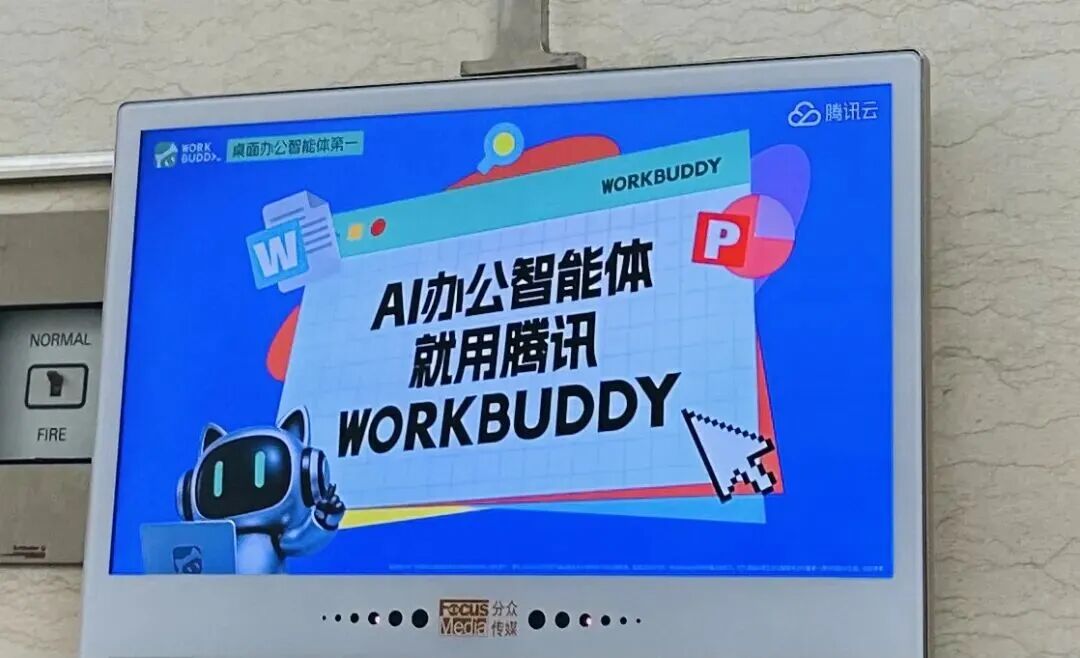

Tencent's AI is breaking through entry barriers in another way. Image source | Internet (please contact for deletion if infringement occurs)
Office workers in Beijing, Shanghai, Guangzhou, and Shenzhen probably feel "surrounded" these days. WorkBuddy ads are everywhere—in subway corridors, office building elevators, and WeChat information feeds—spreading from Zhichun Road in Beijing to the High-Tech Park in Shenzhen, both online and offline.
This marks a rare saturation-level product rollout by Tencent in recent years. But if you think this is just another routine App promotion, you're vastly underestimating Tencent's ambitions.
Tencent is aggressively promoting WorkBuddy, striving to position it as the ultimate gateway to office work in the AI era.
At this table sit domestic and international giants including Alibaba, ByteDance, Baidu, Microsoft, and Google.

20 Million Monthly Active Users in Just Three Months for WorkBuddy
WorkBuddy's starting point was far humbler than you might imagine.
It originated from an AI code assistant team of about ten people.
In January 2026, after Claude Cowork's release, Wang Shengjie, Tencent Cloud's AI product lead for developers, proposed the idea for WorkBuddy based on an existing intelligent agent platform. Alongside an operations colleague, they developed the initial version over a single weekend and two all-nighters.
At the time, numerous AI coding tools for programmers already existed. However, non-technical staff—such as those in finance, HR, operations, and marketing—also had strong demand for AI-driven efficiency improvements but lacked suitable tools. WorkBuddy was born to fill this gap.
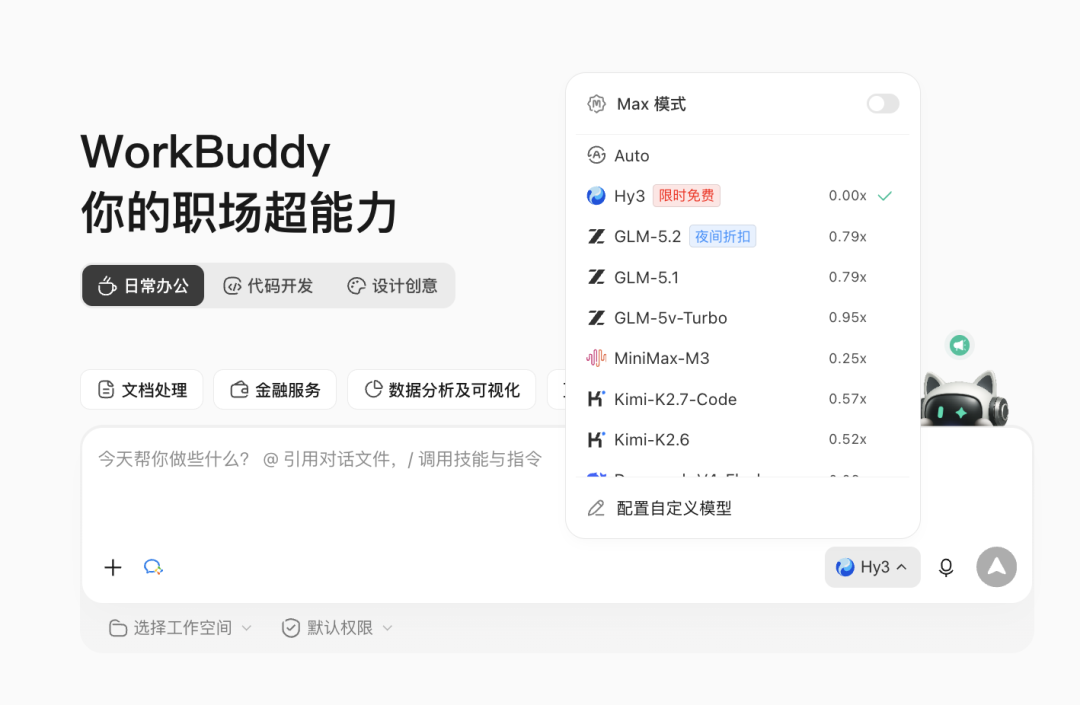
In terms of product design, it eliminated complex code configuration steps, supporting task initiation with single-sentence commands. Users didn't need to study functions or write instruction templates—natural language descriptions sufficed to obtain complete results.
A lawyer user described it this way: "OpenClaw's configuration difficulty is a bit much for me as a lawyer. With WorkBuddy, it's one-click installation and ready to use immediately after download." This extremely low barrier to entry caused a surge of non-technical white-collar workers.
The result? After its official launch on March 9, 2026, user traffic far exceeded expectations, putting immense instantaneous pressure on core services. The team urgently scaled capacity tenfold.
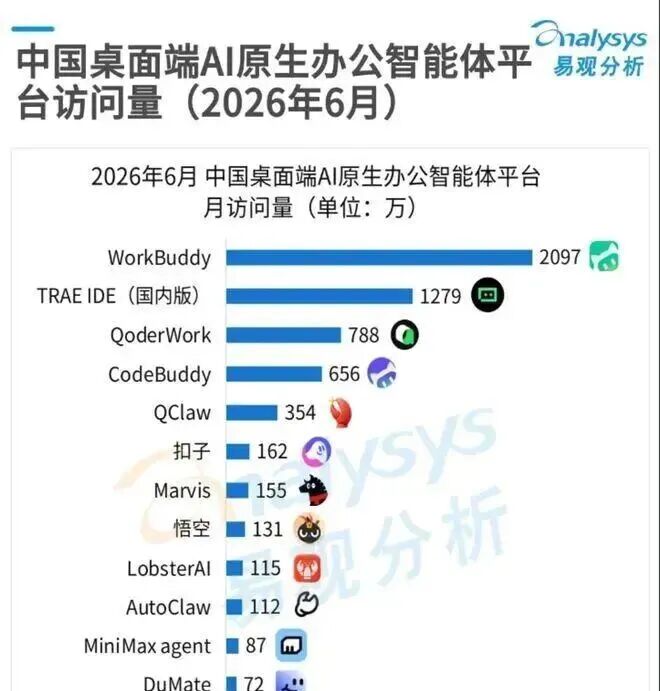
Monthly PC-side visits reached 8.85 million in the launch month, an 831% month-over-month increase. By June, this figure exceeded 20.97 million—a 2.4-fold increase in three months, with traffic for this single product surpassing the combined total of the second and third-ranked competitors.
A product created over a single weekend became the industry leader in three months—a speed rarely seen even within Tencent. But what's even more noteworthy is what Tencent did after WorkBuddy took off.
What truly transformed WorkBuddy from "a good product" into "Tencent's strategic-level product" was Tencent's subsequent move—nearly group-wide saturation investment.
First, at the human level. Tencent founder Pony Ma rarely misses WorkBuddy's product meetings.
According to sources, the project has advanced as a "super project," with Pony Ma personally participating in product discussions. Most requests for computing power, technology, and marketing resources are swiftly approved, described internally as "getting the green light all the way."
A Tencent CSIG insider revealed that WorkBuddy has become one of Tencent's highest-priority AI application products, with internal rumors even calling it "the third strategic-level product after QQ and WeChat."
Next, at the financial level. The WorkBuddy team expanded urgently from over ten to over 100 members, with 52 version iterations to date—an average of one every two days.
Enterprise versions, efficiency agent toolkits, and mobile apps were successively launched. In terms of marketing, WorkBuddy adopted Tencent's internal playbook for "strategic new products."
Offline, it saturated subway and office building elevator ads. Online, it leveraged WeChat traffic to target office workers, frequently demonstrating functions like report writing, PPT creation, Excel processing, and file organization in WeChat's information feeds.
Then, at the organizational and ecological levels. On July 20, 2026, Tencent restructured the QClaw product center, transferring related businesses and teams to WorkBuddy's department.
Previously, Tencent had multiple "lobster" products like QClaw, WorkBuddy, and Marvis coexisting, dubbed by outsiders as the "Hundred Shrimp Battle." The July integration signaled the end of early multi-track exploration, with resources gradually concentrating within the WorkBuddy ecosystem.
All six of Tencent's business groups have rarely all gotten involved, giving WorkBuddy the green light. This level of group-wide coordination was absent during previous promotions like Yuanbao.
Many believe WorkBuddy will almost certainly enter Tencent's "Hall of Fame" this year—one of Tencent's highest honors for milestone products, previously awarded to QQ, WeChat Public Accounts, and WeChat Channels.
From "taking off" to "receiving full group backing," Tencent needed less than three months. This speed is rare in Tencent's history.

Strategic Pivot: From Yuanbao to WorkBuddy
To understand why Tencent is so aggressively betting on WorkBuddy, we must consider the broader context: Tencent's strategic anxiety in the AI field.
At Tencent's 2026 annual shareholder meeting, Pony Ma made a telling remark: "A year ago, we thought we'd boarded the ship, only to realize later it was leaking. We hurriedly switched ships. Now we're standing on board but can't sit comfortably yet—we hope the ship speeds up."
The "leaking ship" referred to C-end AI products like Yuanbao, which, despite significant investment, failed to meet expectations.
For over a year, Tencent's AI moves have been criticized as "always a step behind." C-end AI products like Yuanbao didn't achieve desired results—the "leaking" metaphor directly points to Tencent's early strategic indecision in AI.
WorkBuddy's emergence presented Tencent with another possibility: instead of being an "application" in the AI era, become the "gateway." This shift in thinking represents a strategic-level transformation.
In 2013, WeChat secured its "ticket" for the mobile internet era. Thirteen years later, AI's seismic waves have forced Tencent to once again confront the question: "Do we have a ticket?"
In industry eyes, WorkBuddy has become Tencent's heaviest new "vessel" bet, helping the company navigate beyond its earlier confusion in C-end general AI applications.
Why are "gateways" more important than "applications"? Because AI office agents now compete not for traffic distribution rights but for intent interpretation rights—whoever first understands user needs and completes complex tasks on their behalf becomes the primary interaction layer when users turn on their computers.
In the PC era, this gateway was browsers; in the mobile era, super apps. In the AI era, this gateway is being redefined. A senior industry insider broke down the underlying logic:
First, a massive user base—hundreds of millions of white-collar workers across administration, business, and HR can all use it.
Second, strong stickiness—programmers shop around for the cheapest options, but white-collar workers, once they've built their workspace, tend to stay.
Third, and most critically, data. Programmers act cautiously, often using privacy modes, but office users upload hundreds of files for AI processing, creating extremely rich data dimensions. Within China's tech giants' walled gardens, these data barriers hold long-term value.
The spending power of a programmer and a female white-collar worker aren't in the same league—this is the kind of battle tech giants favor. Once "work" scenarios open up, they amplify 100x or even 1,000x.
This explains why, within just two weeks, Tencent, Alibaba, ByteDance, and Baidu simultaneously pressed their integration buttons, collectively charging toward AI office solutions.

WeChat: WorkBuddy's Strongest Trump Card
If we look only at product functionality, the gap between WorkBuddy and competitors might not be huge. But WorkBuddy holds an ace no other player can match: WeChat.
In March 2026, WorkBuddy introduced one-click WeChat connectivity. Users could send text commands via WeChat while commuting or out and about, and WorkBuddy on their office computers would execute tasks like research, copywriting, or file processing.
By late March, the WorkBuddy WeChat mini-program officially launched. Now, you could send a WeChat message from your phone while on the subway, and the Agent on your computer would automatically start working, sending results back to your phone when done.
Once users grow accustomed to "chatting as commands," the switching cost becomes extremely high. Supporting both cloud sandbox and local computer remote execution modes, users can assign tasks via voice, photos, or file transfers on their phones.
A typical scenario: On your way home from work, you suddenly remember a proposal due tomorrow. You pull out your phone, send WorkBuddy a voice message: "Help me write an outline for Q3 marketing promotion PPT." When you get home and open your computer, the outline is already waiting on your desktop.
The WeChat/Enterprise WeChat account system forms the infrastructure for "login interoperability" among Tencent products.
Users operating Tencent Docs or initiating Tencent Meetings within WorkBuddy don't need repeated authorization—this seamless experience creates the first barrier for latecomers.
A leading AI blogger commented that Tencent's rapid ecological integration and localized product capabilities are WorkBuddy's clearest advantages over other domestic office agents. WorkBuddy has integrated with Tencent Docs and links with products like ima, Tencent Meeting, Enterprise WeChat, and Tencent Lexiang for knowledge and collaboration.
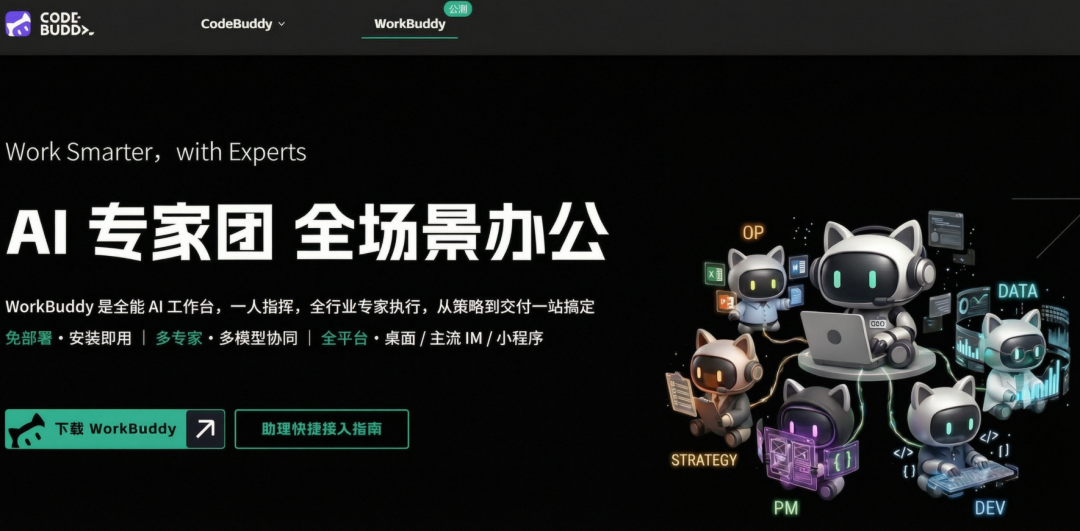
It houses up to 340 domain experts covering roles from operations and design to data, development, and finance, with the SkillHub marketplace offering over 10,000 skills.
This combination of "social relationship chains + office tool chains" is unreplicable by others. Relationship chains represent Tencent's greatest asset—and WorkBuddy's most natural gateway.
TRAE lacks ByteDance's social relationship chains, Qianwen Office lacks Alibaba's, and while DingTalk has organizational relationships, it's nothing like WeChat's pan- social connections.
WeChat covers not just work scenarios but a person's entire social life. When your boss, colleagues, and clients all use WeChat, WorkBuddy naturally sits at the center of your information flow.
Others can replicate functions but not a social network of 1.2 billion users.

Three Approaches, One Goal
WorkBuddy isn't the only player at the table. But each competitor's strategy differs dramatically, making this a fascinating industry experiment.
Alibaba follows an "enterprise infrastructure" approach. On August 3, Qianwen Office officially launched public beta, integrating three products: QoderWork, Wukong, and MuleRun.
Alibaba aims to deeply fuse Tongyi Qianwen's model foundation with DingTalk's B-end ecosystem. DingTalk's years of accumulated organizational relationships, approval workflows, and business rules form Qianwen Office's strongest asset.
Alibaba's office strategy approaches from enterprise management, with approvals, reimbursements, attendance, and workflows as DingTalk's foundation. Qianwen Office seeks to add AI to these scenarios.
Qianwen Office's Personal Standard Edition costs 98 RMB/month, following an enterprise-level pricing model.
ByteDance takes a "technology product" approach. On July 30, the Feishu and Doubao product teams merged. The original Feishu products continue operating, but a relatively complete business line—from product and R&D to sales and delivery—was split into two parts.
ByteDance's strategy combines Doubao's AI capabilities with Feishu's scenarios for native integration. Doubao Professional Edition's standard tier costs 68 RMB/month. QuestMobile data shows Doubao topped China's AI-native app charts with 382 million monthly active users in June, but its office attributes remain relatively weak—more of a general AI assistant than a specialized office agent.
ByteDance's strengths lie in its algorithmic capabilities and product iteration speed, but its accumulation in the enterprise services sector is not as profound as Alibaba's.
Baidu is also entering the fray. On August 4th, Baidu initiated the integration of its internal office intelligent agent, dodo, with the Baidu Dazi team, focusing on Baidu Dazi (DuMate) as the primary platform.
Baidu holds an early advantage in AI technology but still has a long way to go in terms of application scenarios and ecosystem development.
Additionally, Kingsoft Office has launched WPS Lingxi for individuals and WPS Comate for enterprises. Microsoft has deeply embedded Copilot into Windows and Edge, while Google has fully integrated Gemini into Chrome and Workspace. The penetration of AI capabilities at the desktop and operating system levels has become an inevitable trend.
From the perspective of traffic distribution, Tencent is temporarily leading. In June 2026, Tencent-affiliated products accounted for 53.8% of the AI office intelligent agent desktop market, with the top three companies collectively occupying over 90% of the market share.
However, the battle has just begun. In this contest for entry points, each player has its own strengths and weaknesses, and it is too early to predict who will ultimately prevail.

Ecosystem Integration is Key
Returning to the original question: Why is Tencent promoting WorkBuddy? What is its purpose?
The superficial answer is to seize the 'operational layer' in the AI era. Tencent has traditionally excelled in social (WeChat, QQ) and content (gaming, video) but has been weak in enterprise services and productivity tools.
If WorkBuddy can become the first interaction layer when users turn on their computers, Tencent will gain entry into the productivity scene in the AI era. This is equivalent to Tencent acquiring another 'high-frequency + essential' ticket alongside WeChat.
The mid-level answer is to establish a closed loop between C-end and B-end. WeChat is China's largest C-end entry point, Enterprise WeChat is the B-end connector, and WorkBuddy is the AI execution layer.
Once these three are integrated, Tencent will have constructed a complete closed loop from 'social → collaboration → execution.' Users can send a message in WeChat to operate their computers, creating a habit that is extremely costly to replace.
The vision of the WorkBuddy leader is even grander: to make WorkBuddy the 'central entry point for work and life.' Once users become accustomed to an AI as their work entry point, they will continue to use it even after leaving their workstations for eight hours.
In other words, WorkBuddy ultimately aims to penetrate not just offices but every aspect of your life.
The deep-seated answer is to find a definitive landing scenario for AI commercialization and complete the strategic positioning of data assets.
The commercialization path of foundational large models remains unclear, but AI office automation is one of the most definitive and largest-scale scenarios for AI commercialization today.
IDC predicts that by 2026, enterprise-level token consumption in China will grow approximately 20-fold compared to 2025. In this trillion-dollar incremental market, whoever dominates the office entry point will hold the distribution rights.
Data generated in office scenarios, such as documents, spreadsheets, emails, meeting records, and project progress, will constitute an impenetrable competitive barrier once precipitate (chén diàn, meaning ' precipitate ' or 'accumulated') within the WorkBuddy ecosystem.
On July 30th, WorkBuddy, in collaboration with Tencent Docs, launched a 'human-machine dual-writing' collaborative editing feature, achieving multi-terminal synchronous collaboration between 'human-human, human-machine, and machine-machine' for the first time in the industry. This marks the transition of office software from personal local Office (first generation) and multi-person collaborative online documents (second generation) to the AI-native collaboration era (third generation).
What Tencent aims to do is not to add an AI plugin to Office but to reconstruct the entire underlying logic of office work with AI.
Pony Ma once described Tencent's strategic shift in AI as 'changing ships.' Whether WorkBuddy, this new ship, can reach the other side remains to be seen over time.
Of course, WorkBuddy is not without concerns. In fact, its weaknesses are equally prominent.
At the product level, practical tests reveal that its shortcomings cannot be ignored: its visual representation of natural geographical and climatic distribution maps is weak; once local file names or storage paths are modified, the product loses contextual memory and requires re-issuing instructions.
This exposes WorkBuddy's technological bottlenecks in deep understanding and continuous memory. For complex office tasks, it is not yet 'smart' enough.
At the competitive level, Alibaba and ByteDance's counterattacks are accelerating. A Tencent insider also admits that both Alibaba and ByteDance originally had more mature office products than Tencent.
The accumulation of DingTalk and Feishu in the enterprise services sector cannot be caught up with overnight. ByteDance's TRAE still holds significant advantages in programming scenarios, while Alibaba's QianWen Office naturally possesses deep scenarios for enterprise management.
Although WorkBuddy is temporarily leading in traffic, it still lags in product depth and scenario coverage.
At the ecosystem level, although WorkBuddy has integrated with WeChat, Tencent's accumulation in core document processing, project management, and team collaboration in office scenarios is far less profound than that of Feishu and DingTalk.
Tencent Docs still lags behind Kingsoft Docs and Feishu Docs in terms of user base and functional depth; in project management, Tencent lacks mature products similar to Feuish's multi-dimensional tables or DingTalk's Teambition.
WorkBuddy's 'entry point' status is, to some extent, built on 'calling external tools' rather than Tencent's proprietary office ecosystem.
A more fundamental question is: Will AI office intelligent agents ultimately lead to a 'winner-takes-all' scenario or 'multiple entry points coexisting'? Industry judgments lean more toward the latter.
Those handling complex document formatting may prefer WPS Lingxi, those in cross-departmental collaboration may stay with DingTalk or Feishu, and white-collar workers seeking cross-application workflow efficiency may frequent WorkBuddy or QianWen Office.
Differences in workflows across industries and demographics determine that a single entry point cannot cater to all needs. However, one thing is certain: the switching costs for enterprise-grade products are extremely high.
Once users form habits and accumulate data assets, the cost of replacement will rise exponentially. Whoever completes the habit-formation process first will gain the initiative in this protracted battle.
And WorkBuddy, leveraging WeChat's entry point advantage and Tencent's full commitment, is attempting to be the first to complete this 'habit-formation' process.
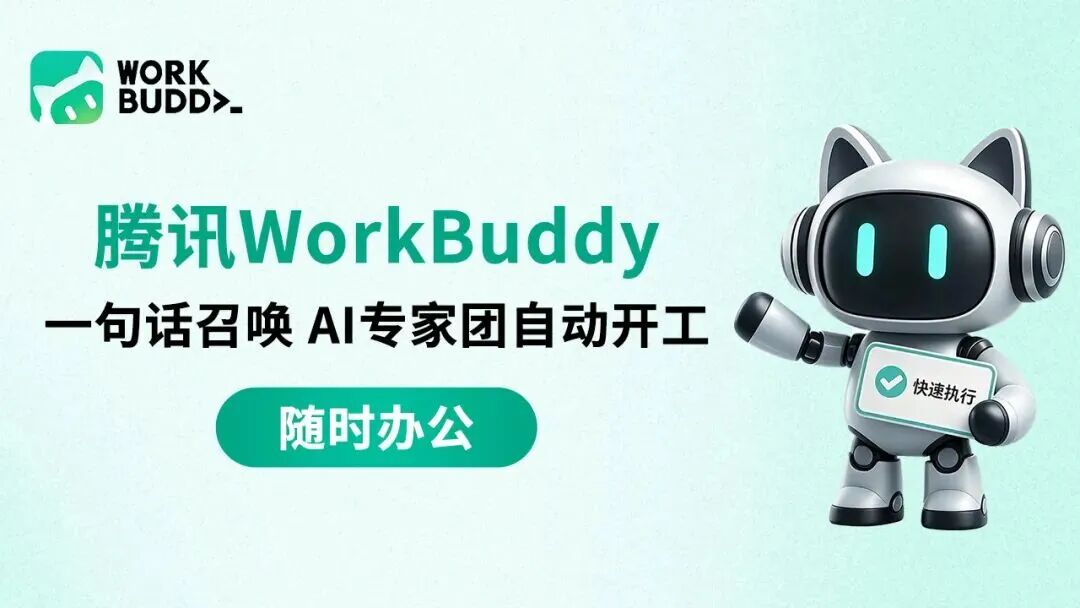

Tencent is placing WorkBuddy on the table. This is not just the promotion of a product but a strategic-level bet—on the ownership of the 'office entry point' in the AI era.
From a weekend idea of a 10-person team to a strategic-level product personally endorsed by Pony Ma, WorkBuddy's rise itself tells a story of 'seizing the trend and showing determination.'
The table is already crowded with players: Alibaba has DingTalk's foundation, ByteDance has Doubao's traffic, Baidu has technological accumulation, while Microsoft and Google are positioning themselves at the operating system level.
The real battle has just begun.
-
![]()
Why I'm Not Optimistic About Meituan?
-
![]()
Tencent Goes All In on WorkBuddy: The Battle for AI Office Entry Points Has Just Begun
-
![]()
950 Million Users Fail to Rescue Gemini
-
![]()
Weekly Stock Review | Auto Industry: Profit Margins Thinner Than Factory Work Pay, Thousands of Investors Caught Unawares
-
![]()
Kimi's Valuation Rockets to $50 Billion Amidst Frenzy of Secondary Share Sales! Who's Exiting, Who's Buying?
-
![]()
SAIC-GM Signs 20-Year Contract Extension, Yet Chevrolet Falters at Third Decade’s Dawn
-
![]()
Charging Costs Climb to Parity with Fueling, Will Electricity Prices Reach European Levels?
-
![]()
Tax and Fee Restructuring: The End of 'Special Perks' for Electric Vehicles?