Beyond APIs: Future-Oriented Strategies for AI Global Expansion
 08/25 2026
 476
476
"In the latter half of AI's global expansion, selling capabilities pales in comparison to selling outcomes."
Author|Xingyu
Produced by|Jixin International Expansion
Today, every business leader venturing into the international expansion of AI applications recognizes that the primary goal is to profit from token and API interface fees. However, history has repeatedly shown that when a money-making avenue becomes common knowledge, it often ceases to be profitable. So, are there new avenues to explore?
Let's delve into a fresh case study for insights.
In July 2026, Benyuan Wanxiang, a subsidiary of South Software, introduced an AI universal tool in North America. A month later, the mobile version was officially launched, extending its reach from computers to smartphones.
This product caters to various scenarios, including life, learning, entrepreneurship, and office work. However, beyond the product itself, its business model—how it generates revenue—is truly remarkable.
South Software eschewed the traditional path of selling large model APIs overseas. Instead, it directly developed a C-end user app, taking control of token consumption scenarios. Every Q&A session and every Agent task represents both token consumption and revenue for the company.
Bringing AI applications to the smartphones of users worldwide may signify a predictable new trend.
01. The Real Challenges of AI Application International Expansion
Every industry faces its unique set of challenges, and AI application international expansion is no exception, encountering significant obstacles.
Products that are overly simplistic lack barriers and can be easily supplanted. This perspective is not novel, but in the context of AI's global expansion, it is evolving into a tangible commercial dead end.
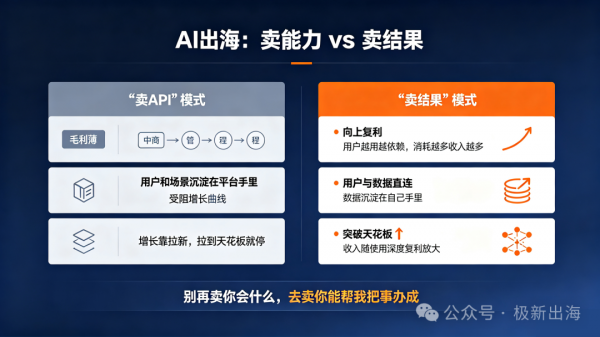
Packaging large model capabilities into APIs or single-point tools for overseas sales may seem like international expansion, but it essentially equates to selling access rights. The issue lies in the low barrier to entry; anyone with technical prowess can replicate it. The model interfaces we connect to today can be accessed by any technically capable company tomorrow. When large corporations slash prices, our profit margins evaporate instantly. We cannot compete on parameters with foundational models built with billions of dollars, nor can we undercut large corporations that use APIs as a user acquisition tool. We are left in a no-man's-land, going nowhere.
More concerning is if we persist in earning only pipeline revenue, meaning those with users wield the power, and we are merely an intermediary layer. We invest in channel development and marketing to push our products to users, but once users are done, they depart. Data accumulates on the platform's side, and repeat purchases are beyond our control. At best, we are porters. If traffic flows smoothly, money goes into the platform's coffers; if not, we bear the losses alone. Growth is stifled, and the more effort we exert, the more lost we become, dependent on the platform's willingness to allocate traffic to us. It feels like our fate is being held hostage.
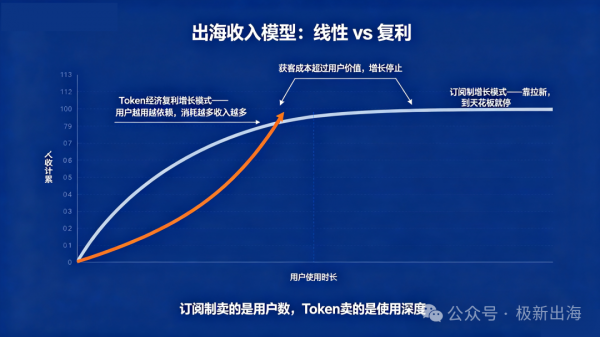
The revenue structure is predictable and may even dwindle over time. The subscription model hinges on the number of users multiplied by the average revenue per user, with growth contingent on acquiring new users until reaching a saturation point. We must continually spend more to buy traffic and retain our current user base, yet the marginal benefit of each new user diminishes. Old users depart after use, and we can only rely on a constant influx of new users to offset losses. At some juncture, our customer acquisition cost will surpass the user's lifetime value, meaning the more we spend, the more we lose.
After all this, the root cause becomes evident: current AI application international expansion sells capabilities, not final outcomes. When capabilities become obsolete and are inevitably replaced, we realize that outcomes hold value, and only with outcomes can there be repeat purchases.
02. The Advantages We Currently Enjoy
China's global share of large model token calls has surpassed that of the United States for the first time. In February 2026, China's weekly large model token calls reached 4.12 trillion, exceeding the 2.94 trillion of US models. This signifies that technology is no longer a shortcoming; ultimately, success hinges on who reaches the consumption end first and grasps user demand scenarios to gain pricing power.
Currently, whether it's Claude's coding scenarios or China's AI office wars, all are demonstrating that future token consumption will shift from conversational to task-oriented scenarios. Ordinary conversations consume around 10,000 tokens per round, inference models increase this to 100,000, and intelligent agents often exceed 1 million. International authorities predict that global AI inference token consumption will grow exponentially by hundreds of times over the next five years.
The mobile end is the primary battlefield for sustained token consumption. Over 70% of global internet usage occurs on smartphones, with emerging markets prioritizing mobile even more. The PC end serves as a tool, while the mobile end represents daily life. In this era, the PC end resembles high-value, low-frequency token transactions, whereas the mobile end involves low-value, high-frequency transactions.
As token capabilities begin to saturate, the focus is shifting towards competing to sell outcomes in specific scenarios.
03. South Software's Problem-Solving Approach
We fear becoming pioneers in commercial failure, but by adopting a sell-outcomes logic, we have blazed a new trail and are poised to become early adopters.
We do not focus on interfaces but on outcomes. We do not blindly develop products but create tools that solve specific scenarios. Tokens serve as a unified unit of measurement, allowing users to pay as needed and by quantity, but also enabling payment based on outcomes. South Software puts it bluntly: users pay for completed tasks, not for accessed interfaces.
We are positioning ourselves at the consumption end. The industry typically outputs capabilities via APIs, earning low-margin pipeline revenue, but the lucrative users and scenarios are held by others. South Software takes the opposite approach, recognizing that developing token interfaces is inferior to creating token consumption scenarios. By directly facing user terminals through proprietary applications, every Q&A session and every task becomes revenue and actual user data, fostering a virtuous cycle.
Leveraging compound interest to break through ceilings. The token consumption for an Agent completing a task is tens to hundreds of times greater than that of traditional conversations. Revenue no longer grows linearly with the number of subscribers but amplifies through compound interest based on usage depth. Users become increasingly dependent, leading to more consumption and higher revenue. However, at its core, this depends on users developing trust and dependence on you. Not betraying user trust is one of the most significant propositions of this era.
The mobile end has secured its position as the primary battlefield. The PC version was released in July, followed by the mobile version in August. Shifting from desktop to pocket, token consumption transforms from infrequent to daily, integrating into the public's routine. The power of habitual compound interest will overturn our perceptions. If users consistently turn to you for the same issues, it represents the greatest opportunity.
Four progressively layered strategies can be summarized as: defining direction, defining scenarios, defining models, and defining terminals.
04. What Can We Gain?
With insights into future trends and successful case studies at hand, we only need to focus on implementation.
Redefine what we sell. Are we selling technology, tools, or outcomes? The closer we align with outcomes and scenarios, the stronger our pricing power and the harder we are to replace. South Software sells completed tasks, not accessed interfaces. This proves that having our own vision is crucial to avoid being passively pushed forward in the future AI wave.
Keep users and data in our own hands, safeguarding the foundation of trust. We cannot merely serve as channels or API interfaces; we must move towards direct user-facing scenarios. Increased communication fosters greater trust, enhancing repeat purchase opportunities and data accumulation.
Design compound interest-based pricing and offer deep customization. Everyone possesses unique strengths, and depth ensures we do not lose ourselves. While future subscription models are viable, they must incentivize deeper user engagement to drive higher payments. The deeper the engagement, the more indispensable we become, requiring long-term trust cultivation. The commercial core of the token economy lies in user growth, with consumption growth translating to revenue growth. Deep customization signifies value compounding.
Our focus remains solely on the user.
-
The Foundation of AI is Being Built
-
![]()
Huawei and Apple Embrace Change, Samsung Steps Back: Is Variable Aperture Technology a Game-Changer?
-
![]()
Huawei and Apple Embrace the Trend, Samsung Steps Back: Is Variable Aperture Technology Truly Worthwhile?
-
How AI Changes the Flow of Money: Budget, Self-Development, and the Last Mile
-
![]()
SAIC Volkswagen’s Bold “Self-Revolution”: ID.ERA 5S Targets the Heart of the Fuel-Powered Family Sedan Market
-
![]()
Beyond APIs: Future-Oriented Strategies for AI Global Expansion
-
![]()
Behind the Daily Average of 140 Trillion Token Calls: Who Will Become China's Future New Three Major Operators?
-
![]()
How Many Zhipu Members Were Wrongly Banned?