From Bestsellers to Foundational Strength: How Far Has XREAL Come?
 04/10 2026
 621
621

【Abstract】As XREAL races to become the 'first smart glasses IPO,' its approach offers the market fresh inspiration: in the early stages of technological immaturity, it prioritizes market penetration through products before retroactively building foundational capabilities in chips, optics, and systems. This path has proven effective over the past few years—by 2025, the company’s revenue reached 516 million yuan, up 30.8% year-on-year, while ranking first globally in the AR glasses market by revenue for four consecutive years, with a global market share of approximately 24.8% by unit sales.
However, as the industry shifts toward platformization, this sequential approach has begun to face new pressures.
The relocation of its headquarters to Shanghai and the emergence of patent disputes should not be viewed as mere coincidences but as natural outcomes of this strategic path reaching a certain stage.
There is no right or wrong path; the question is whether XREAL is prepared for the next phase as competition shifts from products to ecosystems.
Below is the main text:

Starting with Products: Avoiding Technical Definitions, Anchoring in the Market
If we revisit the initial wave of enthusiasm for AR glasses, the industry’s early focus was nearly entirely on technology: optical solutions, spatial computing, and interaction methods, with everyone attempting to define a complete product form.
XREAL took the opposite approach. Instead of trying to answer what AR should ultimately be, it first addressed a more direct question: what are users willing to use now?
The Air series emerged from this logic.
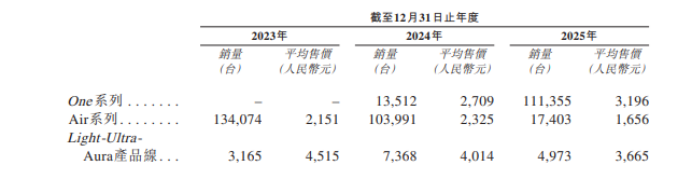
Source: XREAL prospectus (AR glasses sales volume and average selling price)
It did not emphasize complex spatial capabilities or strive for a seamless interaction experience. Instead, it redefined AR into a more accessible form—a portable large screen for watching videos, gaming, and connecting to computers for office work.
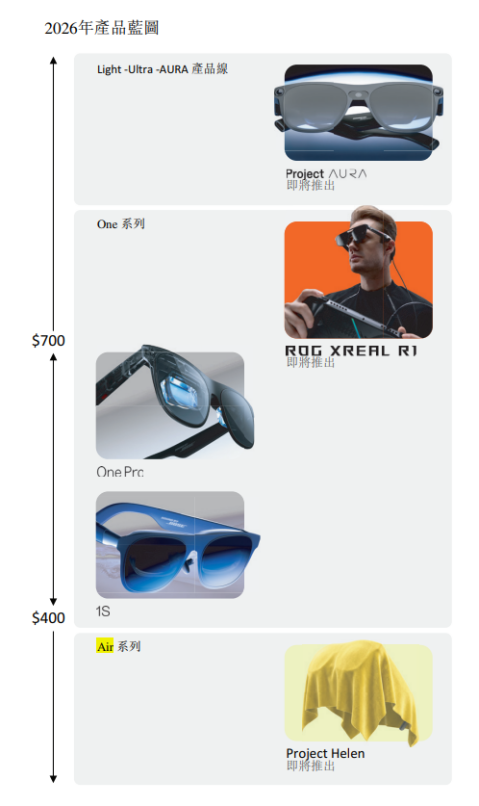
Source: Prospectus (XREAL’s product lineup)
This approach might seem like a downgrade, but it effectively reframed the question. While the industry was still validating technological feasibility, XREAL was already validating user adoption.
This difference quickly became evident in results.
The Air series delivered stable shipments, and XREAL almost immediately focused on overseas markets. In regions with more mature consumer electronics environments, such as the United States, Japan, and Europe, AR glasses found practical use cases more easily.
According to the prospectus, by 2025, XREAL’s overseas revenue accounted for 71.0% of its total, with a sales network covering over 40 countries and regions. Meanwhile, the company’s annual revenue reached 516 million yuan, up 30.8% year-on-year.
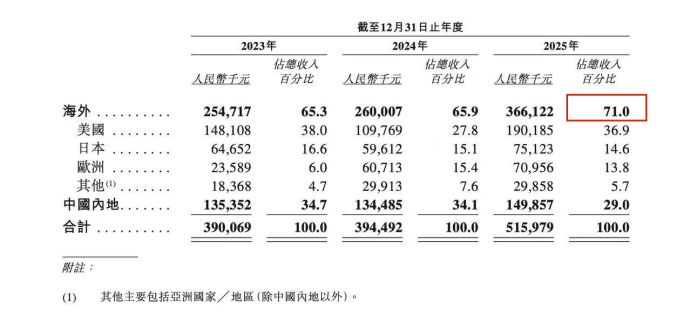
Source: Prospectus
In terms of market share, by unit sales, XREAL held a 24.8% share of the global AR glasses market in 2025—meaning one in every four AR glasses sold globally was from XREAL. Additionally, according to iResearch data, by revenue, XREAL ranked first globally for four consecutive years, with a market share of 27.0%.
An often-overlooked reason lies here: AR glasses are essentially closer to personal entertainment devices than essential productivity tools.
Given this nature, users are more sensitive to price, content, and the maturity of use cases. In contrast, overseas markets offer greater maturity in streaming, gaming ecosystems, and device payment habits, making optional consumption like AR more viable.
This explains why the same product sees significantly different acceptance levels across markets. The significance of this step extends beyond sales—it serves as a model for the industry: AR devices do not need to wait for full maturity to enter the market.
However, every strategy has trade-offs. After establishing its product path, XREAL faces a more pressing question: how far can it go if it remains confined to the form of display devices?
Similar paths are not uncommon in consumer electronics. Once core capabilities can no longer be stacked, products easily fall into homogeneous competition after a few generations, ultimately reverting to price and channel battles.
This means the advantages built in the first stage may not automatically carry over to the next.

The Cost of Building Foundations: Simultaneous Changes in Technology, Organization, and Patents
Since around 2021, XREAL’s pace has noticeably shifted.
According to prospectus data, XREAL remains in a typical phase of “high investment, weak profitability.”
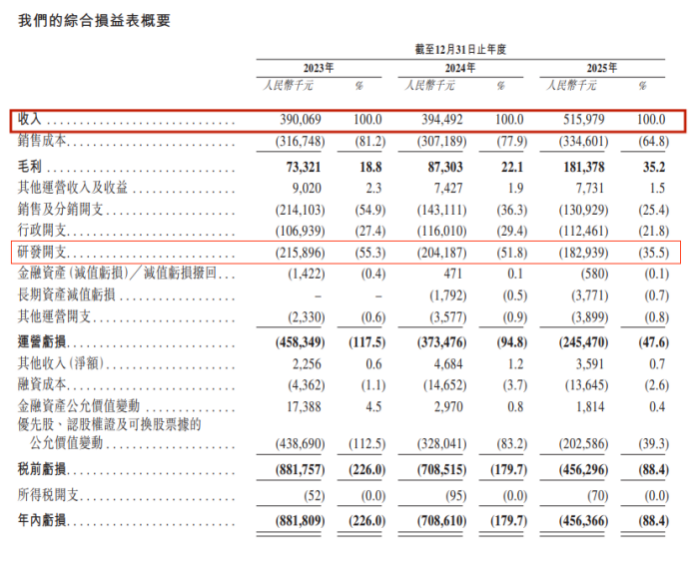
Source: Prospectus
The company’s revenue has sustained growth (continued to grow), reaching 390 million yuan, 394 million yuan, and 516 million yuan in 2023, 2024, and 2025, respectively. However, its net loss for 2025 was 456 million yuan, with an adjusted net loss of 250 million yuan.
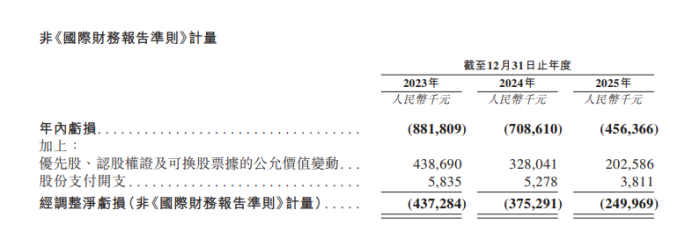
Source: Prospectus
More notably, its cash flow remains under pressure—sustained R&D investment and channel expansion have kept operating cash flow in a tight balance, with cash reserves shrinking significantly, from 205 million yuan at the end of 2024 to 64 million yuan by the end of 2025.
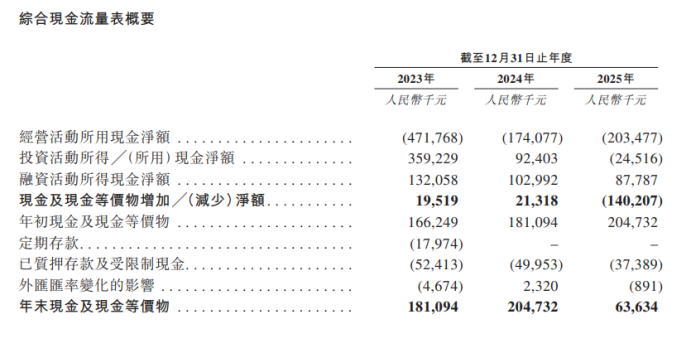
Source: Prospectus
Operationally, accounts receivable have grown in tandem with revenue, reflecting reliance on extended payment terms for channel partners during overseas expansion—a common practice among consumer electronics exporters but one that demands higher working capital efficiency.
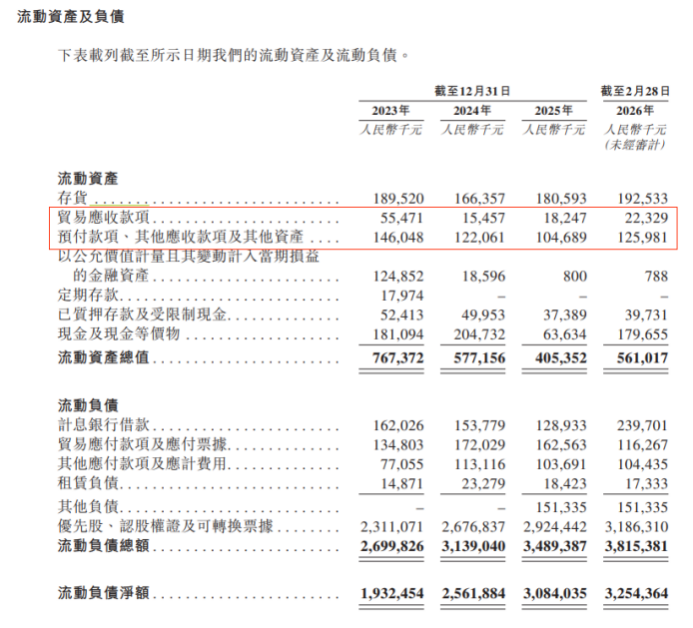
Source: Prospectus
From a cost structure perspective, R&D investment is one of XREAL’s largest expenses.
Over the past few years, the company has invested hundreds of millions of yuan annually in R&D, with expenditures of 216 million yuan, 204 million yuan, and 183 million yuan in 2023, 2024, and 2025, respectively, accounting for a high proportion of revenue. Combined with sales expenses, these two costs have long exceeded current revenue.
This explains why, despite achieving global leadership in shipments, XREAL still struggles to turn a profit—its competition extends beyond hardware sales to include sustained investment in foundational capabilities.
Thus, entering a new phase, XREAL continues to maintain shipments of its existing product lines to preserve market share while significantly ramping up investment in foundational capabilities. Through multiple funding rounds, it has directed capital toward R&D, production line upgrades, and global expansion to strengthen long-term competitiveness.
In 2021, XREAL secured over 100 million USD in Series C funding led by NIO Capital, Yunfeng Capital, and Hongtai Fund. In 2024, it raised 60 million USD in strategic financing, primarily for R&D and expansion of its optical engine production base.
From the X-Prism optical engine and X1 edge coprocessor to the NebulaOS operating system and Real3D spatial algorithms, XREAL has gradually brought components previously reliant on external solutions in-house.
According to Cailian Press, over 65% of its core components are now self-developed, with a cumulative patent portfolio of 481 items, over half of which are invention patents.
This transformation, simply put, marks a shift from making good products to building deep capabilities.
Self-developed chips serve as a clear signal in this regard. AR devices’ stringent requirements for power efficiency and latency make it difficult to rely solely on smartphone chip architectures. Without a certain degree of self-developed chip capabilities, many user experiences cannot be elevated.
However, “self-developed chips” is also a term prone to misinterpretation.
From industry experience, for a team of XREAL’s scale (several hundred people), independently completing the entire chip design, tape-out, and mass production process is extremely challenging and capital-intensive.
A more realistic path involves co-design with upstream chip vendors or solution providers—deeply customizing architectures and functionalities rather than starting from scratch.
Thus, XREAL’s “self-developed chips” likely reflect system-level definitions for AR scenarios rather than full-stack chip R&D capabilities in the traditional sense.
Additionally, XREAL’s technological moat extends to internal organizational structure and external partnerships.
A notable move came in 2025 when XREAL established its headquarters in Shanghai and collaborated with Google on Project Aura for the Android XR platform.
The Yangtze River Delta’s supply chain capabilities facilitate smoother hardware iteration, while concentrated funding and talent, along with deeper Google collaboration, further support long-term R&D. After this step, XREAL more closely resembles a complete industrial organization rather than a mere product team.
Another change has emerged—patent disputes. In AR, where optical and display technologies face dense patent barriers, self-development efforts inevitably encounter existing patent landscapes.
As XREAL accumulates patents, it also inevitably enters these overlapping areas, leading to friction with other companies.
On January 15, 2026, XREAL filed a lawsuit in the U.S. District Court for the Eastern District of Texas, alleging that Viture infringed its core U.S. patent (US11988839) across multiple AR glasses products—a proactive move in its patent battles.
Such situations are common in technology-intensive industries. Whether in early smartphones or upstream semiconductor fields, patent conflicts tend to rise as companies approach core technological paths.
In a sense, this represents both a cost and a barrier to entry—you only encounter such rivals once you reach their level.

As the Industry Shifts Gears: XREAL Faces Timing Challenges
Breaking down XREAL’s development reveals two distinct phases.
The first phase followed a classic consumer electronics rhythm: product launch, channel expansion, and sales growth—all measurable and linear.
The second phase has become less predictable. As spatial computing, operating systems, and AI capabilities emerge as critical, AR devices transition from mere screens to new computing interfaces.
However, in this second phase, XREAL was not among the earliest movers, and the advantages of its rapid first-phase growth no longer fully address the new challenges.
More fundamental, foundational issues arise—is the terminal nature of AR glasses clearly defined?
As previously discussed, AR glasses primarily serve as carriers for pan-entertainment (pan-entertainment) platforms rather than productivity tools, lacking sustained, essential use cases.
As an entertainment carrier, its early market anchoring enabled rapid growth, but unresolved foundational issues leave overall demand uncertain, making it more vulnerable to substitution or marginalization in platform ecosystems.
In contrast, companies like Nintendo, Sony PlayStation, and Microsoft Xbox drive user purchases through self-developed hardware and exclusive game content, forming relatively stable ecosystems. AR glasses lack such core pull, with demand driven more by peripheral applications than essential products.
Companies like Apple and Meta have prepared for platform capabilities from the outset, not just device development.
When Apple launched the Apple Vision Pro, its spatial computing concept drew industry attention. As a platform, it supports a vast application ecosystem, positioned as a next-generation computing platform alongside the iPhone and Mac.
However, XREAL's products have not yet made corresponding arrangements for platform construction. Therefore, the cooperation with Google represents another instance where XREAL addresses its underlying issues through a 'fill-in-the-gap' approach.
Currently, XREAL is one of Google's important partners in the AR glasses sector. The two companies are jointly advancing the next generation of XR products (Project Aura) and attempting to integrate the Android XR ecosystem and AI capabilities into the devices.
Observing this collaboration model, it is evident that XREAL is accelerating its entry into the platform ecosystem. However, its actual path still relies on external ecosystems and has not truly grown roots from within itself.
This has created a somewhat delicate situation: XREAL is neither a pure hardware company nor has it become a true platform company.
There is a time gap between these two identities, and the impact of this gap is not just about 'who is faster' but also includes the reversibility of the path.
If a platform company decides to venture into hardware, it can quickly fill in the gaps using its existing system and ecosystem. However, if a hardware company wants to ascend to a platform, it must gradually invest in chips, systems, and developer ecosystems, which is difficult to achieve overnight.
This asymmetry may be amplified when the industry enters the next stage.
If the next stage arrives more slowly, XREAL will have time to fill in its underlying capabilities, and its early-accumulated users and channels will become advantages.
However, if the industry accelerates, this 'products first, then ecosystem' approach may appear somewhat passive.
According to the forecasts disclosed in the prospectus, global AR glasses sales are expected to reach 22.2 million units by 2030, with sales revenue projected to reach $9.4 billion. This means that the time window for companies to achieve a capability leap may not be very long.
Furthermore, if this leap is not completed within the window, the company is likely to remain in the position of 'high-end display hardware,' becoming a part of the platform ecosystem and subject to the manipulation of the rule-makers.
This is also why, in the AR field, different companies appear to have vastly different paces. Some seem to be engaged in manufacturing, while others appear to be building operating systems. In the short term, it is hard to tell who will win, but in the long term, they will inevitably converge at some point.

Epilogue
Looking back at XREAL's development over the past few years, it is difficult to simply summarize it as a success or a risk.
It has done one very important thing right—bringing AR glasses into the consumer market and establishing a global presence. With annual revenue exceeding 500 million yuan and a global market share of nearly 25%, this step cannot be merely summarized as an attempt; it has become a validated path.
However, it also has to face another reality: as the industry begins to shift from products to platforms, the previous path advantages will not automatically continue.
Establishing its headquarters in Shanghai, increasing self-research efforts, and getting involved in patent disputes—these seemingly disparate events all point in the same direction: the company is attempting to enter a deeper level of competition.
What truly determines its position next will no longer be the number of devices sold but whether it can secure a more critical position in the next stage.
As for whether this position is part of a platform or the platform itself, it depends on whether XREAL can truly turn this time gap into its own window rather than a passive interlude.
- XINLIU -
-
![]()
Registered Capital Slashed to 372 Million Yuan! Yutong Optical Finalizes Industrial and Commercial Change Registration
-
![]()
Zhuque-3 Successfully Lands, and 'Time Traveler' Secures Another ¥100 Million in Funding: China's Commercial Space Industry Experiences a 'Dynamic August'
-
![]()
Autohome Faces a Shrinking Window of Opportunity
-
![]()
Even a Titan Like Musk Has Faced Setbacks in Fulfilling Promises
-
![]()
AI Office: The End of the Racing Era, Context Becomes the Key to Success
-
![]()
Domestic Vehicle Chassis Revolution ②: The Steering Wheel Remains, But Mechanical Connections in the Steering System Are Decreasing
-
![]()
Exploring MiniMax Design: Can Video Editing Be as Simple as Speaking?
-
![]()
Why Can SenseTime Achieve Profitability While CloudWalk Still Faces Challenges, Despite Both Adopting Large Models?