Sony Hands the Knife to Steam
 07/06 2026
 494
494
Produced by I Xiahai fallsea Written by I Hu Buzhi
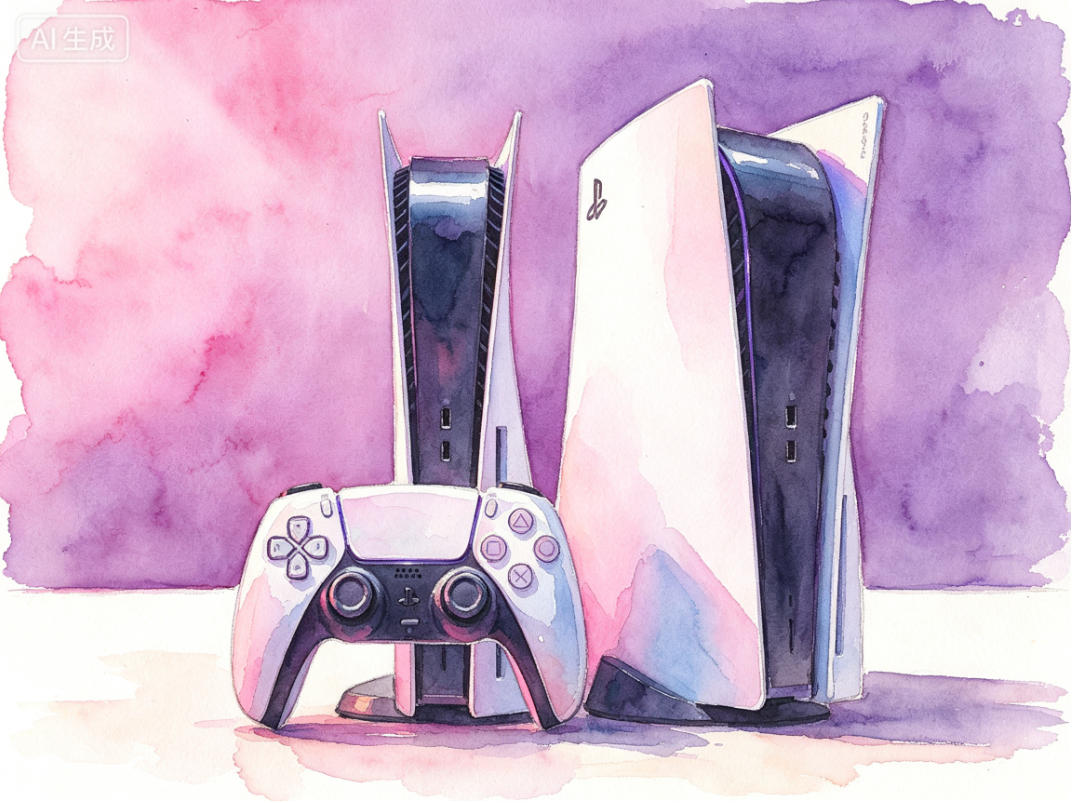
On July 1, 2026, Sony Interactive Entertainment released a restrained announcement via the PlayStation official blog, stating that starting from January 2028, all newly released games on the PlayStation platform will cease production of Blu-ray physical discs, with new titles available only in digital format.
In the announcement, Sony referred to this as 'an inevitable choice for digital transformation.'
On the same day, on the other side of the globe, Valve's Steam platform had just set a new record for concurrent online users for the third time in the past six months—42.31 million users online simultaneously, with over 13 million actively gaming. This number is equivalent to the entire population of Belgium flooding into a single PC gaming platform at once.
Sony emphasized 'efficiency' and 'the future' in its press release. What it didn't mention is that when the last PS game disc rolls off the production line, the difference between PlayStation and a living room PC running Steam will boil down to a 30% 'toll fee.' The console wars have raged for 25 years.
Sony defeated Microsoft but may lose to a man who has never built a console.
Sony's Most Underestimated Moat
Why is Sony killing physical discs?
The financial report provides the most straightforward answer. In FY2025 (ending March 2025), the PlayStation division generated approximately $31.5 billion in annual revenue, up 10% year-over-year. However, physical game sales accounted for just 3%, roughly $945 million—a historic low. In the first quarter of FY2026, digital downloads accounted for 85% of total game software sales, with physical versions making up the remaining 15%.
In stark contrast, digital game sales reached 248 million units during the same period, with digital software revenue nearing $7 billion—seven times the volume of physical disc sales.
From the perspective of Sony's CFO, this is a simple arithmetic problem. Profits from 70 million discs are meager after accounting for pressing, logistics, and offline channel splits. Meanwhile, 248 million digital downloads have near-zero marginal costs, with the entire 30% platform cut retained. Digital editions boast far higher profit margins than physical discs, making the elimination of the latter seem like a classic case of 'cost reduction and efficiency improvement.'
But the most dangerous trap in business is misjudging 'strategic assets' as 'redundant costs.' Physical discs have never been just 'a way to sell games.' They are the core infrastructure that differentiates console gaming from PC gaming—a foundation that has built four heavily underestimated moats for consoles over the past 25 years. The first moat is price competition. Physical discs face retail channel competition. Amazon, Walmart, and Best Buy often sell games below PS Store's official pricing to drive traffic—sometimes even at a loss. This means players can 'shop around.' When physical discs disappear and the PS Store becomes the sole gateway, pricing power is fully monopolized by Sony. $70 is $70, with no channels offering discounts.
The second moat is the secondhand market. A $70 physical disc can be resold for $30 to GameStop or a friend after completion, reducing the player's net cost to $40. Digital versions cannot be resold, leaving the player with a $70 net cost. GameStop's FY2025 (ending January 2026) revenue reached $3.63 billion, with secondhand game trades as a core profit driver. This revenue will vanish entirely after digitization—players lose not just a commodity but an asset.
The third moat is collection and emotional connection. Physical discs, limited-edition metal cases, and bonus booklets are material carriers of console gaming's 'community culture.' On eBay, annual trading volume for rare physical games exceeds hundreds of millions of dollars and continues to grow. PC gaming has never possessed such cultural capital because Steam has been a purely digital platform since its inception.
The fourth moat is channel diversity. Physical discs can be sold in any store, independent of the PS Store. This means Sony's 30% 'toll fee' at least coexists with alternative pathways. When discs disappear, publishers face a single channel, a single price, and a single set of rules.
This leads to a critical psychological difference. PC players have long accepted that 'purchasing ≠ ownership'—games bought on Steam are essentially 'revocable usage licenses.' But console players who spend $70 on a disc, insert it into their machine, and display it on a shelf subconsciously believe they 'own' the game.
Physical discs are the 'physical anchor' of console gaming—they make players feel like they're buying a product, not a license that could be revoked at any moment.
Sony has pulled out this anchor, unaware that the ship will drift toward Steam's harbor.
Steam's Living Room Ambitions
Gabe Newell ('Gaben' to players) has never abandoned the living room.
Over the past decade, the Valve co-founder has played a three-move chess game with one goal: bringing PC gaming into the living room.
The first move was Steam Machines (2013–2015), which failed. Hardware was too expensive, game libraries incompatible, and the Linux ecosystem immature. But Gaben learned a lesson: hardware isn't the focus—ecosystems are.
The second move was Steam Deck (2022–present), a resounding success. According to IDC data, cumulative shipments of the Steam Deck exceeded 4 million units by early 2025, with an additional 1.93 million units projected for 2025, totaling nearly 6 million units—more than double all Windows handheld competitors combined. The Steam Deck proved one thing: PC players are willing to pay for a 'portable + living room' experience. More importantly, it runs the full Steam ecosystem—games you buy are yours forever, unrestricted by region locks or deletions.
The third move is the rumored Steam Machine 2.0. Multiple supply chain sources indicate Valve is developing a next-gen living room device with partners, aiming for a 'Steam Deck for the living room' to directly compete with next-gen consoles.
If the Steam Deck merely gave PC players another handheld option, Sony's elimination of physical discs is what truly helps Steam complete the most critical step—making console players realize the PS5 is just a 'living room PC that can only use the PS Store.'
Let's make a direct comparison.
In terms of game library size, the PS Store offers ~4,000 titles, while Steam has over 100,000. For AAA game launch pricing, the PS Store lists games at $70 with almost no discounts, while Steam prices them at $60–$70 but frequently offers discounts within six months. For annual sales events, the PS Store hosts just two (summer and winter), while Steam holds four or more (spring, summer, autumn, winter, plus themed promotions). For average discount rates, the PS Store offers 30–50%, while Steam provides 50–80%. For refund policies, the PS Store rarely allows refunds, while Steam offers unconditional refunds within 14 days and under two hours of gameplay. For offline mode, the PS Store doesn't support it, while Steam does.
For regional pricing, the PS Store enforces global uniform pricing, while Steam adjusts based on regional purchasing power. For mod support, the PS Store doesn't allow it, while Steam fully supports it. In this comparison, Steam's only disadvantage is 'secondhand trading'—which it also doesn't support. But Steam compensates with lower prices, more frequent discounts, looser refund policies, and regional pricing, largely offsetting this drawback.
Meanwhile, the PS Store's disadvantages are systemic: fewer games, higher prices, harder refunds, no offline mode, and stricter region locks.
When physical discs existed, these drawbacks were masked by the 'physical presence' of discs. The feeling of 'this is mine' after inserting a disc blurred dissatisfaction with the PS Store experience. But when discs vanish and all games become strings of digital codes in the PS Store, players will inevitably do one thing: open a browser and check Steam's prices.
The price comparison effect is lethal. When a AAA game costs $70 on the PS Store with no discounts and $20 during Steam's summer sale, players will calculate better than Sony.
What worsens Sony's situation is 'ownership fear.' Since 2024, multiple incidents of digital platforms deleting purchased content (e.g., removing bought movies and shows due to expired licenses) have deepened players' fear that 'digital = rental.' While Steam is also digital, Gaben insists on offering offline mode and looser refund policies, positioning it as 'more friendly' in players' minds.
Sony thinks eliminating discs is 'closing the door to collect rent.' It forgets—when only one door remains and the neighboring window is bigger, cheaper, and offers a better view, people will climb through it.
Microsoft Has 'Surrendered'
To understand Sony's predicament, we must first examine the shifting dynamics of the console wars.
Microsoft has 'gracefully surrendered.'
Global cumulative sales of the Xbox Series consoles stand at ~30 million units, less than half of the PS5's 80.3 million units (as of June 2025). Xbox head Phil Spencer has long stopped fixating on hardware sales. He has publicly stated multiple times, 'Our competitor isn't Sony—it's mobile devices and PCs.'
Microsoft's actions align with its words. Xbox Game Pass has launched on PC, mobile, and smart TVs. In 2025, Microsoft ported several former Xbox exclusives to PS5 and Steam—unthinkable a decade ago. Microsoft is transforming into 'the Netflix of gaming,' shifting from a hardware company to a services and subscription company.
Microsoft chose 'if you can't beat them, join them.' Sony chose 'if you can't beat them, close the door.' PS5 exclusives still adhere to a 'console-first' strategy (though PC ports now arrive in 6–12 months instead of two years). PS Store pricing remains globally uniform, ignoring regional purchasing power (Steam uses regional pricing). Eliminating physical discs, closing third-party digital code sales channels, and the potential removal of optical drives in the PS6—Sony is building a fully closed digital ecosystem.
Here lies a core contradiction. A closed ecosystem only works if your experience is good enough for users to tolerate high prices and restrictions.
Apple's closed ecosystem succeeds because iOS's experience far exceeds Android's. Apple's seamless hardware-software integration makes users willingly accept premium pricing and closed (closed) systems.
But the PS Store's experience?
Its search function is still criticized by players. Download speeds lag behind Steam in many regions. Its refund policy is effectively 'no refunds after purchase.' Its customer service response times make one question whether Sony understands 'user experience.'
When a closed platform offers a worse experience than an open one but demands higher prices and more restrictions—that closed ecosystem becomes an island.
And islands have a predetermined fate in history.
The 30% 'Sony Tax'
Sony's ultimate goal in eliminating physical discs isn't 'cost reduction and efficiency'—it's to eliminate price competition, monopolize distribution channels, and ensure the perpetuity of its 30% cut.
The number 30% has a telling history.
When Steam launched in 2003, Gaben set the platform's cut at 30%. This figure originated from traditional retail channel costs—logistics, warehousing, shelf fees, return losses. In the physical era, 30% was a reasonable channel cost.
But when digital distribution eliminated these physical costs, 30% became pure 'platform tax.' Sony's rent-seeking loop works like this: The disappearance of physical discs eliminates retail channel competition, making the PS Store the sole purchase avenue. The 30% cut is borne by players (developers won't concede margins, Sony won't reduce cuts, leading to price hikes), with players paying ~$15–$20 more per game.
This isn't theoretical. In FY2025, Sony's digital game revenue neared $7 billion. If physical discs still existed and maintained competition, at least 20–30% of this revenue would have been passed to consumers through channel competition. Eliminating physical discs equals extracting billions more annually from players' pockets.
Critically, Sony already faces class-action lawsuits for monopolizing digital sales channels. It was accused of restricting third-party stores from selling PlayStation game download codes, forcing consumers to buy exclusively through the PS Store. This isn't 'cost reduction and efficiency'—it's monopolistic behavior. The Epic vs. Apple ruling serves as a mirror. In 2021, Epic sued Apple over forced 30% App Store cuts, and the court ruled Apple must allow third-party payments. While game consoles haven't faced similar legal rulings yet, Sony's digital monopolization behaviors are accumulating legal risks. Once antitrust regulations reach console platforms, Sony's rent-seeking empire will collapse instantly.
Interestingly, Steam has been 'smarter' in this regard. Valve voluntarily reduced cuts to 25% or even 20% for high-earning games in 2018—not out of kindness, but because it knew 30% is a threshold that provokes rebellion. Lowering cuts for top titles effectively pacifies large publishers, preventing them from launching rival platforms (like Epic did with the Epic Games Store).
Sony clearly hasn't learned this lesson. It chose the oldest approach—using brute force to extract the highest taxes.
The 30% cut was a 'channel cost' in the physical era; in the digital era, it's a 'digital feudal tax.' Sony is running a cutting-edge business with archaic methods.
Who Still Needs a PS?
Let's return to the fatal question. If PlayStation can't offer exclusive experiences (more first-party games arrive on PC within 6–12 months), can't offer price advantages (Steam is cheaper), and can't offer ownership guarantees (digital games can vanish due to expired licenses)—why should players buy the next PlayStation?
Three 'ifs' are forming a stranglehold.
If the next PS lacks an optical drive, what differentiates it from a Steam living room device? The latter runs over 100,000 Steam games, offers lower prices, supports mods, regional pricing, and refunds.
If games on the PS Store are 30% more expensive than on Steam and never go on sale, why wouldn't players spend that same money on Steam instead? Especially now that the Steam Deck has proven that 'PC gaming can be played on the couch.' If Sony can delete content you've purchased due to expired copyrights, why would players continue to spend heavily on a platform that lacks a sense of 'ownership'?
The endgame of the console wars is no longer 'console vs. PC'—this binary framework is outdated.
The endgame is 'open ecosystem vs. closed ecosystem.'
Conclusion: Steam has chosen openness, supporting multiple hardware platforms (PC, Mac, Linux, Steam Deck, third-party handhelds), multiple payment methods, community mods, the Workshop, and regional pricing.
Sony has chosen closedness, with single hardware, a single store, a single price, and a single set of rules.
History tells us that closed ecosystems yield higher short-term profits (because you can charge higher taxes), but in the long run, they will inevitably lose to open ecosystems. The global market share battle between Android and iOS—where Android holds over 70% of the smartphone market—serves as a cautionary tale.
Of course, this doesn't mean PlayStation will 'die.' Sony still has strong first-party studios, a loyal player base, and deep brand equity. PSN's 123 million monthly active users are a goldmine. But what Sony is doing is systematically eroding its differentiated advantages over PC gaming.
It took Sony 25 years to win the console war against Microsoft. With 80.3 million PS5s sold versus 30 million Xbox Series consoles, it was a decisive victory.
But it may now be losing a much bigger war—a war over 'who owns the living room.'
In this war, the opponent isn't Phil Spencer. It's a guy who's never made a console and his platform, which already has 201 million monthly active users, 42.31 million concurrent users, and a library of over 100,000 games.
Gabe Newell doesn't need to defeat Sony. He just needs to wait.
Wait for Sony to make mistakes, wait for Sony to close itself off, wait for Sony to push players into his arms.
Sony didn't make him wait long.
On July 1, 2026, Sony thought eliminating physical discs was closing a door. But it didn't realize it was simultaneously opening a window—and outside that window, Steam was smiling and waving.
-
Alibaba’s Earnings Soar with Triple Catalysts: Full-Stack AI Hits Maturity, Capital Efficiency Drives Sustainable Growth
-
![]()
Raking in Big Profits Overseas! Chery’s Overseas Revenue Makes Up 70% in H1, with Gross Margin Climbing to 16.1%
-
![]()
Alibaba’s New Fiscal Quarter: 45% Revenue Surge in Alibaba Cloud, Enhanced Profitability in AI Cloud, but Widening Losses in the Application Layer
-
![]()
The AI Version of 'PayPal Mafia' Has Arrived: 20 AI Startups Raise Over $4.6 Billion in Funding
-
![]()
Wang Jian's Vision: Paving a Pathway for Alibaba Through AI
-
![]()
Hyundai Motor Workers Strike Today, Fearing Job Losses to Robots
-
![]()
Embracing 'Light': O-film Unveils Its 'Illuminating the Future' Strategy
-
![]()
SenseTime’s SenseNova U1.5 Lite Goes Open Source: Ushering in a New Era of Predictable AI Image Generation