Tencent Eases Its Hold, Invests in 'Iron Buddy’s Progeny': Can 'Keling' Shine?
 07/09 2026
 445
445
Produced by Leida Finance | Written by Zhou Hui | Edited by Meng Shuai
In a span of just one week, two announcements have subjected short video behemoth Kuaishou to a rollercoaster of 'fire and ice'.
On the evening of July 6, Kuaishou revealed that Tencent had divested 273 million Class B shares of the company through off-market block trades on the same day, reducing its stake from 15.68% to 9.37% and subsequently relinquishing its position as a major shareholder.
Based on Kuaishou's closing price of HK$46 per share on July 6, Tencent's divestment equates to over HK$12.5 billion.
Despite Kuaishou's assurance that Tencent's divestment would not significantly impact the group's operations, the news still triggered a stock price plunge of over 12% on July 7. However, on July 8, Kuaishou's stock price rebounded by 8.7%, with its latest market capitalization hovering around HK$190.3 billion.
Notably, just days earlier, Kuaishou had announced that its video generation AI model, Keling AI, had secured its initial round of financing. Among the investors, Tencent, as an early backer, invested RMB 1.363 billion, acquiring a 1.12% stake.
Some analysts suggest that for Tencent, these two transactions represent a strategic reallocation of capital in the AI era. Compared to Kuaishou, which is grappling with sluggish growth and profitability challenges, Keling AI, with its global commercialization potential, may offer brighter prospects.
Kuaishou's financial report for the first quarter of this year indicated that Keling AI's quarterly revenue surpassed RMB 650 million, marking a year-on-year growth rate exceeding 300%. In March, its annualized revenue run rate (ARR) approached $500 million.
Nevertheless, Keling's remarkable performance is, to some extent, contingent upon continuous financial support from its parent company, Kuaishou. According to Kuaishou's disclosures, Beijing Keling incurred losses of RMB 500 million and RMB 1.9 billion in 2024 and 2025, respectively. At the industry level, Keling also faces stiff competition from ByteDance's Seedance and Alibaba's HappyHorse.
After divesting billions of Hong Kong dollars worth of shares, is Kuaishou still Tencent's 'iron buddy'?
Having invested in Kuaishou for years, Tencent has now cashed out hundreds of billions of Hong Kong dollars in one fell swoop and exited the ranks of major shareholders.
On July 6, Kuaishou disclosed through a voluntary announcement that Tencent had sold a total of 273 million Class B shares to several buyers through off-market block trades on the same day.
The buyers are reportedly several independent third parties with no affiliation to the listed company or its associates.
Kuaishou stated that following the transaction, Tencent's stake would decrease from approximately 15.68% to 9.37%. Based on Kuaishou's closing price of HK$46 per share on July 6, Tencent's divestment amounts to approximately HK$12.556 billion.
Interestingly, prior to Kuaishou's announcement, foreign media had reported that Tencent Mobility, a wholly-owned subsidiary of Tencent, intended to sell approximately 273 million Kuaishou shares through block trades at a price range of HK$43.15 to HK$44.53 per share, with a maximum cash-out of approximately $1.6 billion.
Kuaishou's late-night announcement confirmed these rumors. However, Kuaishou emphasized in the announcement that Tencent remains confident in the group's long-term development prospects and that both parties will continue to maintain a mutually beneficial cooperation relationship, including ongoing strategic collaboration.
Recalling the history of cooperation between Tencent and Kuaishou, the two parties first met in the summer of 2014. At that time, in a small coffee shop in Zhongguancun, Tencent's investment team met with the Kuaishou team for the first time. The product philosophy of Su Hua, then-CEO of Kuaishou, left a deep impression on Tencent.
Tianyancha data reveals that in June of the same year, Tencent participated in Kuaishou's Series B financing round of $21.75 million. In 2016, Tencent again joined Kuaishou's Series C financing round of $128.5 million. After this round, Kuaishou's valuation reached $1.923 billion.
In 2017, Kuaishou secured $350 million in Series D financing led by Tencent, with the company's valuation further soaring to $2.917 billion.
Subsequently, Tencent also participated in Kuaishou's Series E, E+, and F financing rounds from 2018 to 2019.
According to Kuaishou's prospectus, prior to its IPO, Tencent emerged as the company's largest shareholder with approximately a 21.57% stake.
In February 2021, Kuaishou went public on the Hong Kong Stock Exchange, and Tencent's stake was diluted to 17.74% due to the issuance of new shares.
On Kuaishou's debut day, its stock price closed at HK$300 per share, with a market capitalization of approximately HK$1.2325 trillion. Based on this, Tencent's market value of holdings was approximately HK$218.6 billion.
Kuaishou's annual report for the year ending 2025 showed that Tencent held approximately 679 million Kuaishou shares, accounting for 15.71% of the total share capital.
At the commercial level, Kuaishou and Tencent provide marketing and promotion services to each other.
According to Kuaishou's financial report for 2025, the actual transaction amount paid by Kuaishou to Tencent was RMB 1.819 billion, while Tencent paid Kuaishou RMB 1.34 billion.
Despite Kuaishou's assurance that Tencent's divestment would not significantly impact the group's operations, investors seemed skeptical.
As of the close on July 7, Kuaishou's stock price stood at HK$40.46 per share, marking a single-day decline of over 12%.
Citibank pointed out that Tencent's divestment may dampen market sentiment towards Kuaishou and raise concerns about whether Tencent will further sell shares in Kuaishou or other invested companies.
However, given Kuaishou's stable fundamentals and Keling's development potential, the bank maintains a 'buy' rating on Kuaishou.
'Beloved Progeny' Secures Tencent Investment, Signs IPO Bet 'Military Order'
Leida Finance noticed that just before disclosing Tencent's divestment announcement, Kuaishou had announced that its video generation AI model, Keling AI, had completed its first round of financing.
According to Kuaishou's announcement on July 2, its indirectly wholly-owned subsidiary, Beijing Keling, jointly signed a capital increase agreement with initial investors (including 21 independent investors, Party A, and Party B), Beijing Keling Group Company, Lucky Labs, and Beijing Kuailing Rui on the same day.
Under the agreement, the initial investors agreed to inject a total of RMB 13.824 billion (approximately $2.028 billion) in cash capital into Beijing Keling.
According to the capital increase agreement, with Beijing Keling's consent, additional investors may join within 60 days from the signing date (or a longer period approved by investors holding more than 50% of the subscription amount) by signing an accession agreement, but the total capital increase shall not exceed RMB 20.447 billion (approximately $3 billion), accounting for approximately 16.67% of Beijing Keling's enlarged registered capital.
Consequently, on the signing date of the capital increase agreement, 15 additional investors (including 13 independent investors, Party C, and Party D) joined this capital increase, injecting a total of RMB 5.224 billion (approximately $766 million).
After securing up to $3 billion in external financing, Keling's valuation will reach $18 billion, slightly lower than the previously rumored market valuation of $20 billion.
The announcement revealed that Parties A, B, C, and D are all affiliates of Kuaishou or its subsidiaries.
Among them, Party B comprises two companies controlled by Tencent—Shanghai Qishan Investment Co., Ltd. and Parallel Mars Investment Limited—which together contributed RMB 1.363 billion, corresponding to a 1.12% stake.
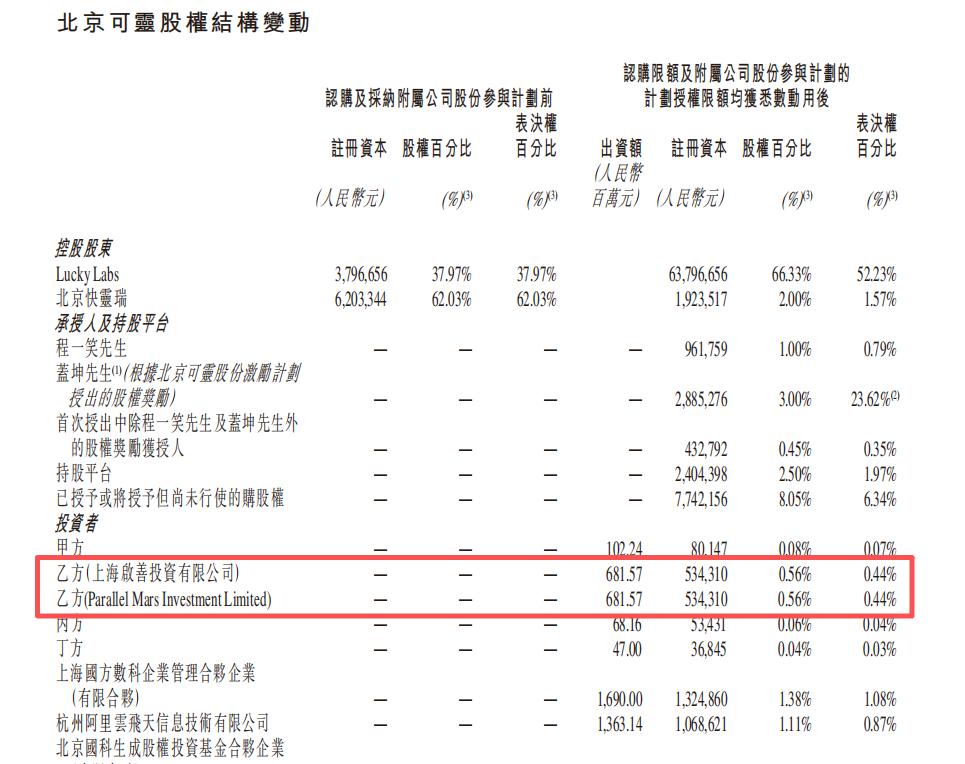
Leida Finance observed that Keling's capital increase also brought together the three internet giants BAT (Baidu, Alibaba, Tencent), a rare occurrence.
In addition to Tencent, Hangzhou Alibaba Cloud Feitian Information Technology Co., Ltd. contributed RMB 1.363 billion, acquiring a 1.11% stake; Beijing Baidu Netcom Technology Co., Ltd. contributed RMB 341 million, with a 0.28% equity ratio.
The announcement also disclosed corresponding equity repurchase terms: If Beijing Keling fails to complete its IPO within the agreed time or is unable to complete all regulatory procedures related to restructuring within 9 months, investors have the right to request a repurchase of equity at an annualized simple interest rate of 8%, with the repurchase price being the original investment cost plus an annualized 8% return.
Additionally, Kuaishou made a non-compete commitment to Beijing Keling: From the completion date of the proposed restructuring until Kuaishou no longer holds a controlling stake in Keling or up to 5 years, whichever comes first, Kuaishou will not directly or indirectly control any entity primarily engaged in video generation AI model business.
Impressive Commercialization Performance, but Keling Still Faces Fierce Competition
Leida Finance learned that Keling AI, independently developed by Kuaishou's AI team, was officially launched in 2024 and is positioned as a new generation video generation AI model.
After its launch, Keling AI quickly gained widespread attention and currently maintains a global leading position in the field of multimodal video generation.
Supported by a clear commercial strategy, Keling AI offers paid subscription membership services for professional consumers and API services for enterprise clients.
According to the latest data disclosed by Keling AI, as of June this year, Keling AI's global user base has surpassed 100 million, a ~67% increase from 60 million at the end of 2025, with registered users spanning 224 countries and regions worldwide; it has nearly 50,000 enterprise clients, a ~67% increase from 30,000 at the end of 2025.
In terms of performance, Kuaishou's annual report showed that in the fourth quarter of last year, Keling AI's business revenue reached RMB 340 million. Among them, the revenue in December alone exceeded $20 million, with an annualized revenue run rate (ARR) of $240 million.
Entering 2026, Keling further demonstrated its core potential as Kuaishou's second growth engine. In the first quarter of this year, Keling's revenue exceeded RMB 650 million, with a year-on-year growth rate exceeding 300%. In March, Keling's annualized revenue run rate approached $500 million.
Thanks to Keling AI's impressive performance, its other services also became the fastest-growing revenue segment for Kuaishou in the quarter.
In the first quarter of this year, Kuaishou's revenue from other services reached RMB 5.6 billion, a 15.9% increase from RMB 4.8 billion in the same period in 2025.
During the same period, Kuaishou's online marketing service revenue was RMB 19.6 billion, a 9.3% year-on-year increase; while its live streaming business revenue declined by 13.5% year-on-year to RMB 8.5 billion.
However, Keling's impressive commercialization achievements have come at a high cost from Kuaishou. The aforementioned capital increase announcement showed that as of December 31, 2025, Beijing Keling's total assets, total liabilities, and net asset value were RMB 244 million, RMB 253 million, and -RMB 9 million, respectively.
In 2024 and 2025, Beijing Keling incurred unaudited net losses (before and after tax) of RMB 500 million and RMB 1.9 billion, respectively.
In addition, at the industry level, Keling also faces competition from rivals such as ByteDance's Seedance and Alibaba's HappyHorse.
It is worth mentioning that in the Artificial Analysis text-to-video rankings, the aforementioned three domestic 'giants' have secured the top three positions.
However, in terms of market share, Seedance has the upper hand. Economic Observer quoted the chairman of a video technology company as saying that currently, Seedance occupies more than 90% of the domestic short drama market. It also holds a dominant position in other AI video revenue sectors such as gaming and advertising.
The chairman also stated that if Seedance were to open up for financing, investors would prioritize investing in Seedance. However, since Seedance has not opened up, Keling is currently the best target investors can find.
After shifting more resources from Kuaishou to its 'beloved progeny' Keling, will Tencent achieve more impressive returns? Leida Finance will continue to monitor.
-
![]()
Is Momenta’s “Physical AI” Premium Justified?
-
![]()
Memory Prices Soar, Budget Phones No Longer Just Watered-Down Flagships
-
Who Defines the Value of 'Office Environment' in the AI Era?
-
Why Did Insta360’s Market Cap Spike and Then Retreat After Taking on DJI as a Benchmark?
-
![]()
DeepSeek Interview Shatters the 'White Moonlight' Illusion of Former Huawei 'Genius Teen'
-
Four-Week Net Sales Reach $38 Billion: Institutions Flee En Masse as Retail Investors Continue Buying Spree
-
![]()
Dissecting 25 AI Startups with Over $50 Million in Series A Funding: The Top Three Areas Where Smart Money is Betting
-
![]()
Dissecting 25 Series A Financings Exceeding $50 Million: AI's Smart Money is Betting on These Three Directions