Dissecting 25 AI Startups with Over $50 Million in Series A Funding: The Top Three Areas Where Smart Money is Betting
 07/09 2026
 474
474
Over the past two years, the most talked-about topic in the AI industry has been large language models. OpenAI, Anthropic, Google, and xAI have captured nearly everyone's attention.
But if you follow the flow of capital, you'll notice something interesting:
The smartest money is already moving away from 'large models' themselves.
According to data from Crunchbase and corporate disclosures, the 25 AI companies globally with the largest Series A funding rounds in 2026 raised a cumulative total of over $6 billion.
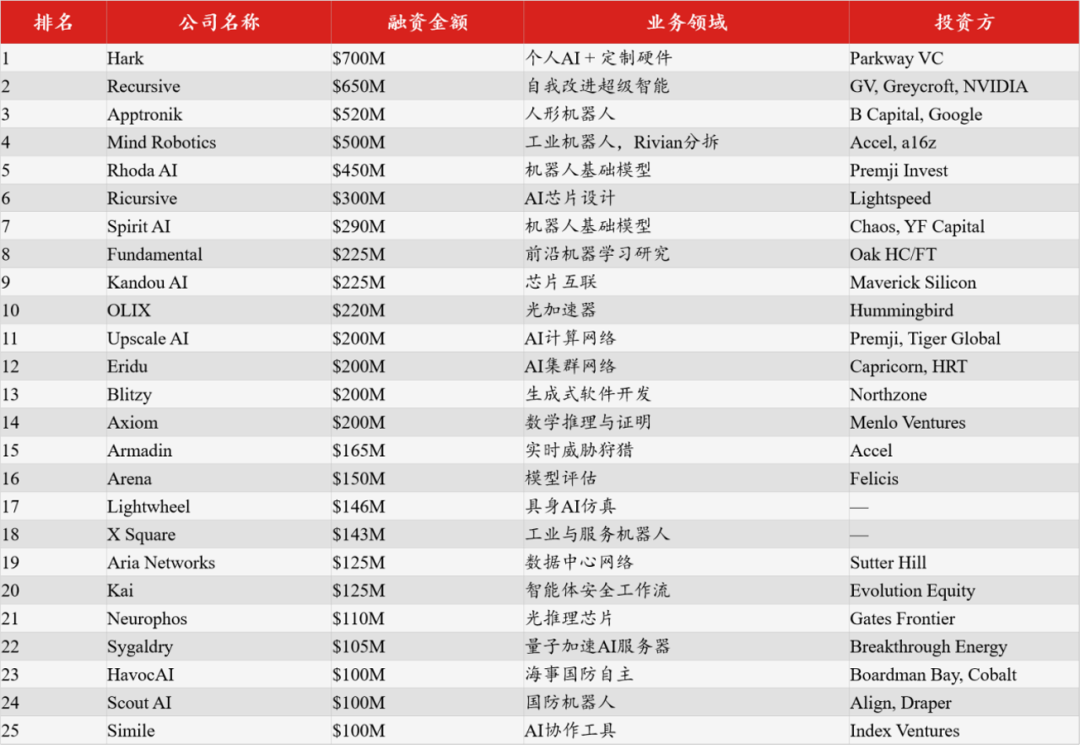
Data Source: Crunchbase and Corporate Disclosures
Among them, robotics and embodied AI secured over $2 billion in funding; AI infrastructure received nearly $1.5 billion; while the majority of the remaining funds flowed into autonomous intelligent systems for cybersecurity, defense, software development, and scientific research.
While the market is still debating whether Anthropic or OpenAI will come out on top, investors have already started betting on another question:
Where will AI create real value?
The answer is gradually emerging—robotics, computing infrastructure, and autonomous intelligent systems capable of directly solving real-world problems.
Next, Silicon-Based Gentleman will dissect these 25 AI startups with the highest funding amounts to see where the world's smartest money is placing its bets.
/ 01 / 6 Embodied AI Companies Raising Over $2 Billion
Among the top 25 in funding, six are robotics-related companies, with a total of $2.049 billion raised, making robotics the highest-funded segment in Series A financing in 2026.
(1) Apptronik
Apptronik announced in February 2026 the completion of a $520 million Series A extension round, co-led by B Capital and the Qatar Investment Authority, with participation from Google and Mercedes-Benz. The round valued the company at $5 billion.
Apollo Humanoid Robot
Apptronik focuses on developing general-purpose humanoid robots, with its core product being the Apollo humanoid robot—standing 1.75 meters tall and weighing 73 kg, it can carry a 25 kg load. Its 32 high-torque-density actuators form an advanced force control system, covering most industrial material handling needs. The company has partnered with Google DeepMind to integrate the Gemini Robotics AI model into Apollo.
Its business model primarily consists of robot sales and Robotics-as-a-Service (RaaS), targeting manufacturing, logistics, and retail giants with whole-machine sales and hourly leasing services.
Apptronik completed the construction of its Apollo production line in 2026, initiating small-batch production (100 units) in Q2 and scaling up to 1,000 units in Q4, with a target of 10,000 deliveries in 2027.
(2) Mind Robotics
Mind Robotics announced in March 2026 the completion of a $500 million Series A round, co-led by Accel and a16z, valuing the company at $2 billion. The company was spun off as an independent entity from electric vehicle manufacturer Rivian in November 2025.
Mind Robotics' core product is a general-purpose industrial robot platform that integrates AI models, dedicated hardware, and deployment infrastructure, offering a software-hardware integrated solution focused on automotive manufacturing, warehousing, logistics, and industrial automation.
Its business model primarily consists of robot sales and RaaS subscriptions, targeting automotive manufacturing, electronics assembly, and new energy industries with standardized industrial robots and customized production line solutions.
The company plans to deploy hundreds of intelligent industrial robots at Rivian's Normal, Illinois factory by the end of 2026.
(3) Rhoda AI
Rhoda AI announced in March 2026 the completion of a $450 million Series A round, led by Premji Invest with participation from Temasek, Khosla Ventures, and Mayfield, valuing the company at $1.7 billion.
Rhoda AI focuses on developing general-purpose robot foundation models, with its core product being FutureVision, capable of unified processing of visual, language, motion, and environmental perception information, enabling autonomous robot operations in real-world environments.
Its business model primarily consists of model licensing, targeting robot manufacturers, automation companies, and research institutions with foundation model licenses.
According to investor Mayfield's estimates, at a deployment scale of 1,000 units, Rhoda can generate approximately $100 million in annual recurring revenue, becoming a $1 billion ARR business at 10,000 units.
(4) Spirit AI (Qianxun Intelligence)
Chinese robot foundation model company Spirit AI (Qianxun Intelligence) announced in February 2026 the completion of nearly RMB 2 billion (approximately $290 million) in funding, with investors including Yunfeng Capital, Hundun Capital, and Sequoia China, valuing the company at over RMB 10 billion.
Spirit AI's core product is the Spirit v1 VLA (Vision-Language-Action) embodied large model, enabling robots to 'see' scenes, 'understand' instructions, and autonomously complete operations. It has demonstrated the ability to autonomously execute tasks in complex industrial environments. The model has been applied to CATL's battery production line, where one robot can replace 2-3 shifts of manual workstations, completing quality inspection processes such as high- and low-voltage testing.
Its business model primarily consists of model licensing and joint development, providing localized intelligent solutions to Chinese robot manufacturers and manufacturing enterprises. The company has established strategic partnerships with Bosch, JD.com, and other leading companies, with collaborations covering data collection, model training, and global channels.
Currently in the early stages of commercialization, the model's comprehensive success rate for new tasks is approximately 40-50%. Management believes large-scale commercialization is feasible only after reaching 60-70%, expected around 2028.
(5) X Square (Autonomous Robotics)
Chinese industrial and service robot company X Square announced in January 2026 the completion of a RMB 1 billion (approximately $140 million) Series A++ round, with participation from ByteDance, Sequoia China, and Shenzhen Capital Group.
X Square's core products include its self-developed general-purpose embodied AI large model, the WALL series, and matching robot hardware (such as the Quantum series wheeled dual-arm robot and five-finger dexterous hand), aiming to provide robots with an intelligent 'brain' to understand and manipulate the physical world, enabling end-to-end perception, decision-making, and operation.
Its business model primarily consists of robot sales, model licensing, and industry solutions, targeting advanced manufacturing, autonomous logistics, elderly care, and household service scenarios with end-to-end intelligent solutions.
In March 2026, X Square launched the world's first robot household cleaning service in Shenzhen in partnership with 58 Daojia, achieving large-scale deployment of robots in complex C-end environments.
(6) Lightwheel (Guanglun Intelligence)
Chinese physical AI simulation company Lightwheel announced in March 2026 the completion of RMB 1 billion (approximately $140 million) in Series A++ and A+++ rounds, led by Ant Group.
Lightwheel's core product is the Physical AI Simulation and Synthetic Data Platform, providing high-fidelity SimReady asset libraries, physically accurate simulation environments, and evaluation tools to generate large-scale synthetic data for robot and autonomous driving training, addressing the data scarcity problem in physical AI.
Its business model primarily consists of data subscriptions and project-based services, targeting robot, autonomous driving, and AI companies with simulation and synthetic data solutions. Clients include global leading companies such as NVIDIA, Google, Figure AI, ByteDance, and Zhiyuan Robotics.
In the first quarter of 2026, the company secured RMB 550 million in new orders, with quarterly revenue surpassing that of the entire year of 2025.
/ 02 / AI Infrastructure Accounts for 32%, Becoming the Hottest Early-Stage Segment
The AI infrastructure segment accounted for 8 of the 25 funding rounds, with a total of $1.485 billion raised, second only to robotics. Directions such as optical computing, quantum acceleration, network switching, chip interconnects, and AI chip design simultaneously attracted capital.
(1) Ricursive Intelligence (USA)
U.S. AI chip design company Ricursive Intelligence announced in January 2026 the completion of a $300 million Series A round, led by Lightspeed Venture Partners with participation from DST Global and NVIDIA's NVentures, valuing the company at $4 billion.
Ricursive's core product is an AI-driven chip design platform that shortens the chip design cycle from years to days. Its technology has been applied to the design of four generations of Google's TPU. The company has built a recursive feedback loop between AI and chip design, using AI to design better chips and better chips to train stronger AI.
Its business model primarily consists of an AI chip design automation platform, targeting chip manufacturers, cloud service providers, and AI companies with AI-driven full-process chip design solutions.
(2) OLIX
British optical computing company OLIX announced in February 2026 the completion of a $220 million Series A round, led by Hummingbird Ventures, valuing the company at $1 billion.
OLIX's core product is the OTPU (Optical Tensor Processing Unit), an optical digital processor optimized for AI inference, performing bit-level precise computations. The OTPU integrates SRAM architecture with photonic interconnect technology, completely bypassing HBM memory and advanced packaging, aiming to solve the 'memory wall' bottleneck restricting large-scale AI deployment.
Its business model primarily consists of photonic AI inference chip sales, targeting cloud service providers and AI infrastructure operators in data centers with software-hardware integrated inference acceleration solutions.
Olix expects its first commercial product to launch in 2027 and plans to expand its engineering teams in the UK and North America to scale R&D and prepare for mass production.
(3) Neurophos
U.S. optical inference chip company Neurophos announced in January 2026 the completion of a $110 million Series A round, led by Gates Frontier with participation from Microsoft M12 and Bosch Ventures, bringing total funding to $118 million.
Neurophos's core product is the Optical Processing Unit (OPU), chips that can be directly deployed in data centers as alternatives to GPUs. The company claims its OPU chips outperform NVIDIA's B200 AI GPU. Its chips operate at frequencies up to 56 GHz, with peak computational speeds of 235 POPS per second and power consumption of 675 watts, compared to the B200's 9 POPS per second and 1,000-watt power consumption.
Its business model primarily consists of OPU chip sales and software-hardware integrated inference solutions, targeting cloud service providers and edge computing nodes.
Neurophos expects to initiate real-world deployment testing in 2027 and launch commercial systems in 2028, initially targeting AI inference and data center module markets, with real-world testing in collaboration with Norwegian data center operator Terakraft.
(4) Sygaldry
U.S. quantum-accelerated AI server company Sygaldry announced in March 2026 the completion of a $105 million Series A round, led by Breakthrough Energy Ventures with participation from Y Combinator, the University of Michigan, and 468 Capital.
Sygaldry's core product is the quantum-accelerated AI server, which accelerates AI model training and inference by collaboratively deploying with existing GPU clusters in data centers, reducing operational costs and energy consumption.
Its business model primarily consists of quantum acceleration server sales and computational infrastructure services, targeting cloud service providers and AI data center operators.
The company is currently advancing R&D and testing of quantum-accelerated AI servers, aiming for commercial production before 2030.
(5) Kandou AI
Swiss chip interconnect company Kandou AI announced in March 2026 the completion of a $225 million Series A round, led by Maverick Silicon with participation from SoftBank, Synopsys, and Cadence, valuing the company at $4 billion.
Kandou AI's core product is copper-based high-speed connectivity chips designed to solve data transmission bottlenecks in AI systems. As AI clusters scale up, fiber optic solutions become costly, while copper connections suffer from severe crosstalk and power consumption spikes at extremely high frequencies—Kandou's solution converts crosstalk between cables into usable signal energy, transmitting 5 bits of data simultaneously over 6 lines with half the power consumption of comparable technologies.
Its business model primarily consists of IP licensing and chip sales, targeting hyperscale data center operators and AI infrastructure clients with high-speed interconnect IP and chips.
The company has shipped over 20 million units, with applications in data centers, AI, and consumer electronics.
(6) Upscale AI
U.S. AI computing network company Upscale AI announced in January 2026 the completion of a $200 million Series A round, co-led by Tiger Global, Premji Invest, and Xora Innovation, valuing the company at over $1 billion with total funding reaching $300 million.
Upscale AI's core product is the SkyHammer™ AI in-rack network chip and system, solving communication bottlenecks between chips in AI clusters and directly competing with NVIDIA's core interconnect chip, NVSwitch, used in its top-tier AI cabinets (e.g., the NVL72 integrating 72 GPUs).
Its business model primarily consists of chip sales, system integration, and software subscriptions, targeting cloud providers, supercomputing centers, and AI companies with AI-specific network solutions.
The company currently plans to begin shipping its first commercial product to the market in 2026.
(7) Eridu
U.S. AI cluster network company Eridu announced in March 2026 the completion of a $200 million Series A round, co-led by Socratic Partners, John Doerr, Hudson River Trading (HRT), and Capricorn, bringing total funding to $230 million.
Eridu's core product is the high-radix AI network switch, capable of replacing 30 traditional low-radix switches with a single unit, significantly reducing network hierarchy, cutting network power consumption by up to 70%, and saving up to 40% in capital expenditures, solving the 'network wall' bottleneck in AI clusters.
The business model primarily focuses on switch sales combined with software subscriptions, targeting cloud providers and supercomputing centers to provide AI-specific data center networking solutions.
The company is collaborating with TSMC to advance the development of switches based on custom chips. It has completed product definition validation with several leading hyperscale cloud service providers, with technical details and partnership plans set to be announced later in 2026.
(8) Aria Networks
US-based data center networking company Aria Networks announced in X month of 2026 the completion of a $125 million Series A funding round, co-invested by Sutter Hill Ventures, Atreides Management, Valor Equity Partners, and Eclipse Ventures.
Aria Networks' core product is the Deep Networking platform, an AI data center networking solution based on 800GbE/1.6T Ethernet switches designed to address communication bottlenecks in large-scale GPU clusters. The platform embeds microsecond-level telemetry and intelligent agents into switch ASICs, enabling automatic fault rerouting and improving Model Flops Utilization (MFU) by over 3%.
The business model centers on selling integrated hardware-software solutions comprising Ethernet switches, servers, and cloud components, targeting hyperscale cloud service providers and large-scale AI data center operators.
The company's products feature chip-agnostic design, allowing operators to freely switch between hardware from different vendors such as NVIDIA and Google. The CEO revealed that the company has secured multiple customer orders and is deploying products in early adopter networks.
/03/ From Defense Security to Human Behavior Simulation: AI Enters the 'Deployment Era'
While robots execute tasks in the physical world and infrastructure supports intelligent operations, these companies aim to directly build AI systems capable of autonomously completing complex work.
In terms of AI implementation, 11 companies that secured over $50 million in Series A funding have raised a cumulative total of $2.74 billion, covering areas such as autonomous software development, scientific reasoning, cybersecurity, defense decision-making, and human behavior simulation.
(1) Hark
US-based personal AI company Hark announced in May 2026 the completion of a $700 million Series A funding round led by Parkway Venture Capital, with participation from mainstream chip giants including NVIDIA, AMD, Intel, and Qualcomm, valuing the company at $6 billion. This marks the largest global AI Series A transaction to date in 2026.
Founded in late 2025 by Brett Adcock (serial entrepreneur and founder of Figure AI and Archer Aviation), Hark's core product is a personal AI assistant that deeply integrates a self-developed multimodal model with custom hardware devices, functioning as an intelligent assistant that operates 24/7 and proactively perceives user needs.
The business model primarily relies on hardware sales combined with subscription services, targeting C-end consumers by offering hardware products and monthly AI service subscriptions.
The company currently employs 70 people and has established a dedicated data center equipped with NVIDIA B200 GPUs. Former Apple product executive Abidur Chowdhury serves as Design Director. The first batch of multimodal models is set to launch in late summer 2026, with hardware devices to follow.
(2) Blitzy
US-based generative software development company Blitzy announced in May 2026 the completion of a $200 million Series A funding round led by Northzone, with participation from PSG, Battery Ventures, and others, valuing the company at $1.4 billion.
Blitzy's core product is a multi-agent autonomous software development platform capable of reading and understanding an enterprise's entire historical codebase (supporting over 100 million lines of code) in a single pass, automatically clarifying system business logic and module relationships. It then coordinates thousands of specialized AI agents to work in parallel, autonomously completing coding, testing, and validation. The company claims to accelerate enterprise engineering speed by over 5x, with over 80% of development work completed autonomously.
The business model adopts a two-stage pricing strategy: enterprises pay an assessment fee of up to $250,000, followed by pricing based on either $0.20 per line of code generated or annual project pricing ($500,000 to over $10 million), directly tied to usage volume and delivered value.
Targeting Global 2000 companies across 10 industries, the platform has already been adopted by dozens of enterprises, including QAD and State Street.
The company achieved a record-breaking score of 66.5% on the SWE-Bench Pro benchmark test, surpassing other major competitors. This round of funding will be used to expand the R&D team to 300 people and deepen customer collaborations in regulated industries such as government, financial services, and insurance.
(3) Axiom
US-based mathematical reasoning AI company Axiom announced in March 2026 the completion of a $200 million Series A funding round led by Menlo Ventures, valuing the company at $1.6 billion.
Founded in 2025 by Carina Hong (with MIT/Oxford/Stanford background), Axiom's core product is the AxiomProver system—based on the Lean formal verification language, it ensures 100% correctness of code and mathematical reasoning, fundamentally addressing AI hallucination issues.
The system has autonomously proven multiple mathematical conjectures that remained unsolved for decades: it achieved a perfect score in the Putnam Mathematics Competition; autonomously proved Problem 124 from the Erdős problem set (unsolved for ~30 years) and Problem 481 (unsolved for 45 years).
The business model centers on verifiable AI technology, targeting financial institutions, research institutions, and critical infrastructure enterprises by providing services ranging from mathematical proofs to code verification.
By 2026, the company had attracted multiple intention clients (potential clients) and employs over 20 people. The team includes former Meta AI Research Director Shubho Sengupta (CTO) and mathematical luminary Ken Ono, who resigned from his tenure-track position to join the company.
(4) Armadin
US-based cybersecurity company Armadin announced in March 2026 the completion of a $189.9 million Seed + Series A funding round led by Accel, with participation from GV, Kleiner Perkins, In-Q-Tel, and others. This marks the largest early-stage funding in cybersecurity history.
Armadin's core product is an autonomous AI attack agent platform that deploys thousands of AI agents to continuously simulate real-world hacker attacks 24/7, automatically discovering security vulnerabilities in enterprise networks, verifying their exploitability, and providing specific remediation plans.
The business model primarily relies on enterprise subscriptions and usage-based pricing, targeting critical industries such as finance, government, and technology to provide continuous AI-driven security validation services. In April 2026, the company formed a strategic partnership with Unit 42 under Palo Alto Networks to integrate its AI attack engine into the Frontier AI Defense service, enabling automated external attack surface assessment.
The company has initiated closed testing with multiple Fortune 500 companies, with its products validated in multiple financial institutions and large enterprise environments.
(5) Kai
US-based Agentic security company Kai announced in March 2026 the completion of $125 million in Seed and Series A funding rounds led by Evolution Equity Partners, with participation from N47 and multiple strategic investors.
Kai's core product is a unified Agentic AI security platform that deploys numerous autonomous AI agents to continuously monitor enterprise networks, cloud servers, endpoint devices, and various security tools. When abnormal behavior or security vulnerabilities are detected, the AI automatically analyzes, prioritizes risks, and executes defensive actions.
The business model primarily relies on enterprise subscriptions, targeting critical infrastructure, finance, energy, pharmaceuticals, and other industries to provide integrated AI security solutions.
During its stealth phase, the company collaborated with Chevron's Technology Venture Catalyst Program and secured customer orders across multiple industries including energy, pharmaceuticals, and automotive.
(6) HavocAI
US-based maritime defense autonomy company HavocAI announced in May 2026 the completion of a $100 million Series A funding round co-led by Cobalt Capital and Boardman Bay Capital, with participation from Lockheed Martin and others, bringing total funding to $200 million.
HavocAI's core product is a full-domain collaborative autonomy software stack that supports coordinated mission execution by maritime, aerial, and ground unmanned platforms in GPS/communication-denied environments, enabling a single operator to command thousands of unmanned assets. The software stack comprises three components: Havoc OS (real-time decision-making and hull control), Havoc Cloud (cloud interconnection), and Havoc Control (command interface), and has successfully integrated with the Link 16 military data link.
The business model centers on defense contracts, software licensing, and hardware integration, targeting the U.S. Department of Defense and allied forces to provide unmanned system autonomy solutions covering sea, land, and air domains.
The company has delivered dozens of autonomous surface vessels to the U.S. Department of Defense, participated in the U.S. Navy's "Silent Swarm" exercise and secured procurement, with plans to conduct large-scale collaborative combat demonstrations on the West Coast and Gulf of Mexico in Q4 2026.
(7) Scout AI
US-based defense robotics company Scout AI announced in April 2026 the completion of a $100 million Series A funding round co-led by Align Ventures and Draper Associates, bringing total funding to $115 million.
Scout AI's core product is the Fury unmanned combat foundation model, designed specifically for tactical edge environments to support multiple platforms including unmanned ground vehicles and drones, enabling autonomous navigation and mission execution even when GPS/communication is disrupted.
The business model primarily relies on defense contracts and software licensing, targeting the U.S. Department of Defense and allied forces to provide AI brains for unmanned systems.
The company has secured defense technology R&D contracts totaling $11 million from DARPA, the Army Application Laboratory, and other Department of Defense clients. It currently holds four DoD contracts and is supported by DARPA and the U.S. Army.
(8) Arena
AI model evaluation platform Arena (formerly LMArena) announced in January 2026 the completion of a $150 million Series A funding round co-led by Felicis and UC Investments, with participation from Andreessen Horowitz, Kleiner Perkins, Lightspeed, The House Fund, and others, valuing the company at $1.7 billion post-investment.
Arena's core product is a multimodal AI model evaluation platform that generates Elo rankings through anonymous blind testing and voting, covering all mainstream modalities including text, code, web development, images, and videos.
The business model centers on B-end evaluation services, targeting AI labs, cloud providers, and enterprise clients.
The platform boasts over 5 million monthly active users across 150 countries, generating approximately 60 million model comparisons per month. Leading AI companies such as OpenAI, Google, and xAI all use the platform for evaluation before publicly releasing their models. Just four months after launching its commercialized product in September 2025, the company achieved an Annual Recurring Revenue (ARR) exceeding $30 million.
(9) Fundamental
US-based structured data AI company Fundamental announced in February 2026 the completion of a $225 million Series A funding round led by Oak HC/FT, with participation from Salesforce Ventures and others, bringing total funding to $255 million and valuing the company at $1.2 billion.
Fundamental's core product is the Nexus large table model, which adopts a non-Transformer architecture optimized specifically for structured data (tables) and capable of processing billions of rows. Designed to replace traditional machine learning and data science workflows, the company claims superior accuracy to existing solutions across multiple use cases.
The business model primarily relies on enterprise subscriptions combined with data volume-based pricing, targeting industries such as finance, retail, and healthcare to provide enterprise-grade data analysis and prediction services.
The company has signed seven-figure dollar contracts with multiple Fortune 100 companies and formed a strategic partnership with AWS, allowing AWS customers to directly deploy Nexus models in their cloud environments.
(10) Simile
US-based human behavior simulation company Simile announced in February 2026 the completion of a $100 million Series A funding round led by Index Ventures, with participation from AI luminaries including Fei-Fei Li, Andrej Karpathy, and Adam D'Angelo. The valuation was not disclosed.
Simile's core product is a human behavior simulation platform that generates personal digital twins through interviews and data, constructing tens to hundreds of thousands of AI agents with authentic personalities, preferences, and decision-making logic to predict consumer, employee, or group behavioral responses in given scenarios while demonstrating the reasoning behind their actions. This technology applies to commercial scenarios such as product testing, market research, policy analysis, and advertising optimization.
The business model primarily relies on enterprise annual subscription fees, targeting consumer goods, finance, healthcare, government agencies, and other sectors to provide human behavior prediction services.
The company is currently collaborating with clients such as CVS Health and Telstra during testing phases, with product implementation progressing steadily. More clients and partnerships are expected to be announced following commercialization.
(11) Recursive (UK)
UK-based company Recursive announced in May 2026 the completion of a $650 million Series A funding round co-led by GV (Google Ventures) and Greycroft, with participation from chip giants including NVIDIA and AMD, valuing the company at $4.65 billion.
Recursive plans to launch its first-generation "Level 1" autonomous training system by mid-2026, focusing on recursive self-improvement superintelligence—building AI systems capable of autonomously optimizing their own code, training processes, and architectures.
The business model centers on technology licensing, cloud services, and joint R&D, targeting tech giants, research institutions, and government departments to provide AGI-related technologies and solutions. Recursive expects to announce its technology roadmap and preliminary research progress within the next year.
By Yuan Yuan
-
![]()
Emerging Leaders Surge Ahead, While Others Grapple with Challenges|Mid-Year Review ①
-
![]()
BYD Executive Sheds Light on Electric Vehicle Wading Prowess: Theoretical Edge Over Fuel Cars, Yet Battery Seal Integrity Is Key
-
![]()
Zhipu Stages a 'Deep V' Turnaround on Lock-up Expiry Day: Can the 'Pioneer Large Model Unicorn' Maintain Its Edge?
-
![]()
Switch Transition from Copper to Optical: From 500 Wafers to a $10 Billion Market
-
![]()
Fuel Vehicle Pricing System Undergoes Severe Stress Test: Unraveling the Root Causes
-
![]()
Xiaomi Steps into Car Manufacturing, Embracing 'Extended Range' Strategy
-
![]()
Next-Gen 13-inch Surface Pro Review: Huge Improvements in Performance and Energy Efficiency, Integrated Graphics Rival Latest X86
-
![]()
SpaceX: Space Computing Power - Musk's New Vision or Real Future?