Amazon Steps into the Direct-to-Device (D2D) Satellite Arena! But the Industry Needs a Reality Check
 08/03 2026
 339
339
Foreign media reports reveal that Amazon's satellite internet venture, Amazon Leo, has recently applied to the U.S. Federal Communications Commission (FCC) for permission to deploy up to 5,105 Low Earth Orbit (LEO) satellites. This move aims to establish a “Direct-to-Device” (D2D) communication network. The D2D system will work in tandem with Leo's first- and second-generation satellite broadband systems, as well as Globalstar's HIBLEO and C-3 satellite constellations. This integration will enable Leo satellites to directly connect with compatible mobile devices. If approved by telecom regulators, the network is poised to launch in early 2028.
D2D technology is emerging as a new competitive edge in the satellite communications sector. Unlike traditional satellite communications, which rely on specialized satellite phones or large ground terminals, D2D technology enables ordinary consumer smartphones, IoT sensors, and various connected devices to connect directly to LEO satellites. This eliminates the need for additional complex equipment or ground-based cellular relay stations. Consequently, satellites could serve as a crucial supplement to ground-based cellular networks in traditionally hard-to-reach areas, such as deserts, oceans, polar regions, mountains, and disaster zones. This brings the vision of “global seamless connectivity” one step closer to reality.
Amazon stated in a press release, “Billions of users worldwide reside in areas not covered by existing communication networks. The Amazon Leo core system will bridge this gap by providing high-speed, low-latency broadband services to consumers, businesses, and government customers.” Simultaneously, this move into D2D is seen by industry experts as Amazon Leo's significant effort to rival or even directly challenge SpaceX's Starlink satellite-to-phone strategy.
How Will the Amazon Leo D2D Network Function?
According to official sources, Leo will distribute its D2D satellites across five orbital shells, each optimized for different regions of the Earth. Three mid-latitude orbital shells will provide dense coverage for heavily populated areas, while higher-inclination shells will extend service to polar regions. The specific plans for the five orbital shells are as follows:
Mid-Latitude Coverage:
Shell 1: Orbital altitude of 580 km, inclination of 55.7°
Shell 2: Orbital altitude of 560 km, inclination of 58.2°
Shell 3: Orbital altitude of 510 km, inclination of 56.3°
High-Latitude Coverage:
Shell 4: Orbital altitude of 570 km, inclination of 73°
Near-Polar Coverage:
Shell 5: Orbital altitude of 540 km, inclination of 84°
These satellites will communicate with mobile devices via dedicated wireless frequency bands, including L-band and S-band spectrum links. These valuable radio spectrum resources were acquired by Amazon through its recent $11.6 billion purchase of Globalstar. Compared to traditional bands, MSS spectrum offers better penetration through buildings and obstructions, providing a natural signal coverage advantage for direct-to-phone scenarios.
Connections between satellites and Amazon ground stations will utilize independent high-capacity wireless links, including Ka-band and V-band spectrum. These links will carry aggregated data traffic between the satellite network and the internet, functioning similarly to backhaul connections in cellular networks, which transport data from end-user devices to the core network.
Unlike traditional satellites that merely forward signals to the ground, Leo's D2D satellites will process signals in orbit before forwarding them to enhance communication performance. Additionally, Leo's D2D satellites will be equipped with optical inter-satellite links, using lasers to connect satellites in orbit. This enables intelligent traffic scheduling and routing across the entire constellation.
These satellites will employ digital beamforming and beam-hopping technologies to precisely direct concentrated communication signals to the actual locations and times they are needed. This approach expands coverage while reducing ineffective power consumption and signal interference. Combined with the following advanced signal processing technologies, this solution achieves higher spectral efficiency compared to traditional satellite communication systems:
Tight Adjacent Channel Performance: Satellites confine signal energy within allocated frequency channels, minimizing leakage into adjacent bands to protect other operators while increasing available capacity.
Dual-Polarization Reception: Satellites receive signals from two directions simultaneously, increasing the amount of information captured from the same frequency band and improving signal quality for low-power mobile devices.
Adaptive Modulation and Coding: The system continuously adjusts data encoding based on real-time signal conditions, providing higher data rates under favorable conditions and maintaining reliable connections under adverse conditions.
Overall, the Leo D2D system will complement existing core broadband services by providing high-speed connectivity directly to compatible mobile devices. Previously, Amazon Leo announced an agreement with Apple to provide satellite services for supported iPhone and Apple Watch models. This includes emergency SOS, messaging, Find My, and roadside assistance via satellite. Amazon is also collaborating with Apple to develop future satellite services using the expanded network. Beyond personal use, D2D services will support various functions, such as uninterrupted communications for disaster response, global fleet management, remote operations across workplaces and supply chains, IoT connectivity for remote sensors, and emergency messaging when ground networks are unavailable.
The D2D Industry: Gaining Momentum but Still in Its Infancy
Before Amazon's announcement, satellite operators, traditional telecom operators, and mobile ecosystem companies had already set their sights on this emerging sector. According to a February report by the Global Mobile Suppliers Association (GSA), D2D services have been launched in 15 countries/regions. Additionally, 61 countries and regions are planning, evaluating, testing, or have already initiated satellite-to-smartphone collaboration projects.
For example, French telecom operator Orange announced a partnership with AST SpaceMobile and Satellite Connect Europe to pilot and roll out direct-to-device satellite services in Romania. This will provide users with mobile connectivity, including voice, SMS, and data. Orange CEO Christel Heydemann has been a vocal advocate for European autonomy in the satellite sector. She has called for enhancing the competitiveness of European networks, including the EU's planned IRIS2 project, to counter competitors like Elon Musk's Starlink and Amazon's upcoming LEO satellite network. Meanwhile, Telefónica is also exploring the launch of D2D services in Spain and Germany through its partnership with Satellite Connect Europe, aiming to extend traditional mobile coverage using satellite networks.
As an industry leader, Starlink unveiled the next phase of its direct-to-device satellite strategy at MWC26, rebranding it as Starlink Mobile. This service will operate on the company's second-generation LEO satellites, adopting the 3GPP Release-19 NR-NTN standard. This can improve connection quality by up to tenfold for users at the edge of satellite coverage.
Domestically, China's three major telecom operators have all obtained licenses for satellite mobile communication services. This allows them to legally offer services like direct-to-phone satellite connectivity. For instance, China Mobile is making steady progress in direct-to-phone satellite services. Its 02 satellite has completed uplink and downlink tests, and the next-generation experimental 03 satellite is expected to launch soon.
From these examples, it is clear that D2D is becoming a new competitive frontier in the satellite communications industry. Industry data shows that the global D2D satellite connectivity market was valued at $4.8 billion in 2025 and is expected to reach $34.6 billion by 2034, with a compound annual growth rate (CAGR) of 24.5% from 2026 to 2034. However, it is important to emphasize that despite the enthusiasm from capital and industry, D2D is still in the early stages of development.
Ookla, a testing firm, has mapped the progress of the D2D market using data from Android smartphones and satellite registration data from Starlink, Skylo, and Lynk. The data shows that while the prospects are broad, D2D services currently represent only a small fraction of the global mobile communications industry. Only a tiny percentage of mobile users are connected to D2D satellites in countries where the service is available. For example, in March 2026, only 0.46% of Speedtest® users in the U.S. were connected to D2D satellites (as shown below), with Chile having the highest proportion at 1.26%, Canada at 0.70%, and Japan at 0.11% (the lowest). 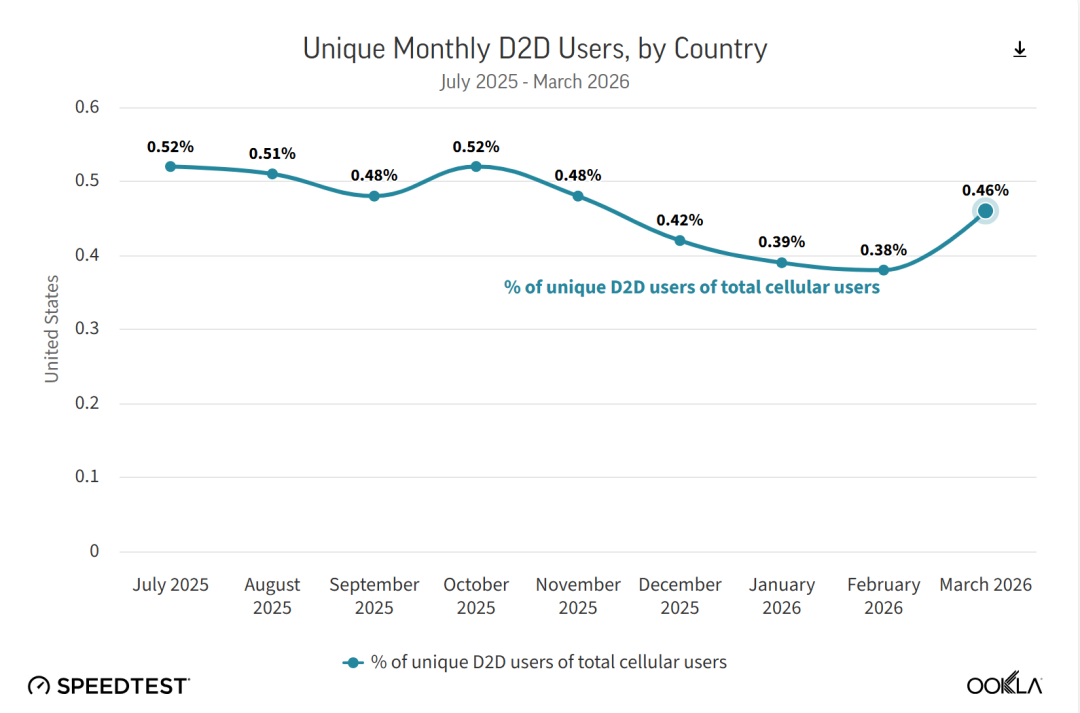
These results are not surprising, as GSMA Intelligence recently noted that ground-based networks already cover 96% of the global population. D2D connections can typically only be used outdoors, not indoors (where smartphones are most frequently used). “In reality, most mobile users do not frequently require D2D connections,” the company stated.
Furthermore, as D2D is still in its early commercial stages, costs are relatively high, and users are highly price-sensitive. Ookla's data shows that despite overall global growth, the number of D2D connections in the U.S. and Canada has recently declined. Analysts attribute this to T-Mobile in the U.S. and Rogers in Canada beginning to charge some users. Both companies have ended their free trial periods and now only include Starlink D2D in premium packages; other users must pay a separate monthly fee of around $10, with other carriers charging similar rates for the service.
In short, despite the significant investments in D2D by various companies, the industry cannot simply view it as a “sure winner” for the next generation of communication technologies. In the coming years, D2D will need to transition from a “technical showcase” to a “scalable operation.” Ultimately, the competition will be decided not just by the number of satellites but by who can first establish a viable business model.
Conclusion
The rise of D2D signifies that satellite communications are evolving from a “supplementary connection for select scenarios” to a global connectivity infrastructure for mass-market devices and vast IoT networks. All players are vying not just for a share of the satellite communications market but for a critical entry point into the future integrated space-terrestrial network. Of course, D2D still faces challenges in technology, cost, and business models before achieving widespread adoption. However, one thing is certain: as satellites, cellular networks, and IoT continue to converge, the global connectivity landscape is undergoing a profound transformation.
References: How Amazon Leo plans to connect mobile devices from space——Amazon; The D2D industry, still in its infancy, is showing steady progress.——OOKLA; Direct-to-Device Satellite Connectivity Market Research Report 2034——marketintelo; Amazon Plans to Deploy 5,105 Satellites, Entering the Direct-to-Phone Satellite Market——Communications World; SpaceX Unveils Starlink Mobile D2D Service——RCR Wireless
-
Financing and IPO: Is Ant Group a Financial Giant or a Pioneer in Cutting-Edge Tech?
-
![]()
Revenue Soars Twofold in Three Years! Optical Firm Reignites Bid for Hong Kong Stock Exchange Listing
-
![]()
Jiangsu LEAD Microelectronics Successfully Hands Over Its Inaugural 12-Inch Wafer-Level Optical Magnetron Sputtering System!
-
![]()
Domestic Computing Power Hits Breakthrough: Super Nodes as the Pivotal Force
-
![]()
Tongze Kangwei Secures IPO Registration on GEM: Broadband Terminal Equipment Provider Set for Imminent Share Issuance
-
![]()
Transforming Car Manufacturing into a 'Smartphone Launch' Frenzy: 5 Tips to Avoid Pitfalls When Purchasing a New Car
-
![]()
The Three-Way Battle Among AI Office Software: A Decade of War Among BAT
-
![]()
The Three-Way Battle Among AI Office Software: A Decade-Long War Among BAT