Chip Export Surge: Dominating the Japanese Auto Market
 04/10 2026
 484
484
Overseas Markets Warm Up to 'Chinese Chips'
Authored by: Chen Dengxin
Edited by: Li Wenjie
Formatted by: Annalee
In a surprising twist, China's automotive chips are now making waves overseas, with exports surging.
Several foreign media outlets have reported that Toyota and Suzuki will incorporate Chinese-made SoC chips into vehicles sold outside China, marking a significant shift from their traditional reliance on Japanese, U.S., and European suppliers.
This development signifies the first instance of Japanese automakers adopting Chinese system-level chips in international markets.
What's driving Japanese automakers to deviate from their longstanding chip procurement practices? How have domestic automotive chips evolved from relying on imports to expanding exports? How far have 'Chinese chips' come in terms of global recognition?
From Import Reliance to Export Boom
The journey of domestic chips has been remarkable.
Data from the General Administration of Customs reveals that in 2014, China exported chips worth $60.9 billion, totaling 153.5 billion units. By 2025, exports had skyrocketed to $201.897 billion, with 349.5 billion units shipped.
It's evident that domestic chips have witnessed explosive growth in both value and volume.
More significantly, domestic chips are not just competing on price but are excelling in value, capturing high-margin segments and transitioning from followers to leaders.
Domestic automotive chips exemplify this transformation.
Unlike consumer-grade and industrial-grade chips, automotive chips must adhere to stringent automotive industry standards, ensuring reliability, stability, and continuity in harsh conditions such as extreme temperatures, high voltages, and high humidity.
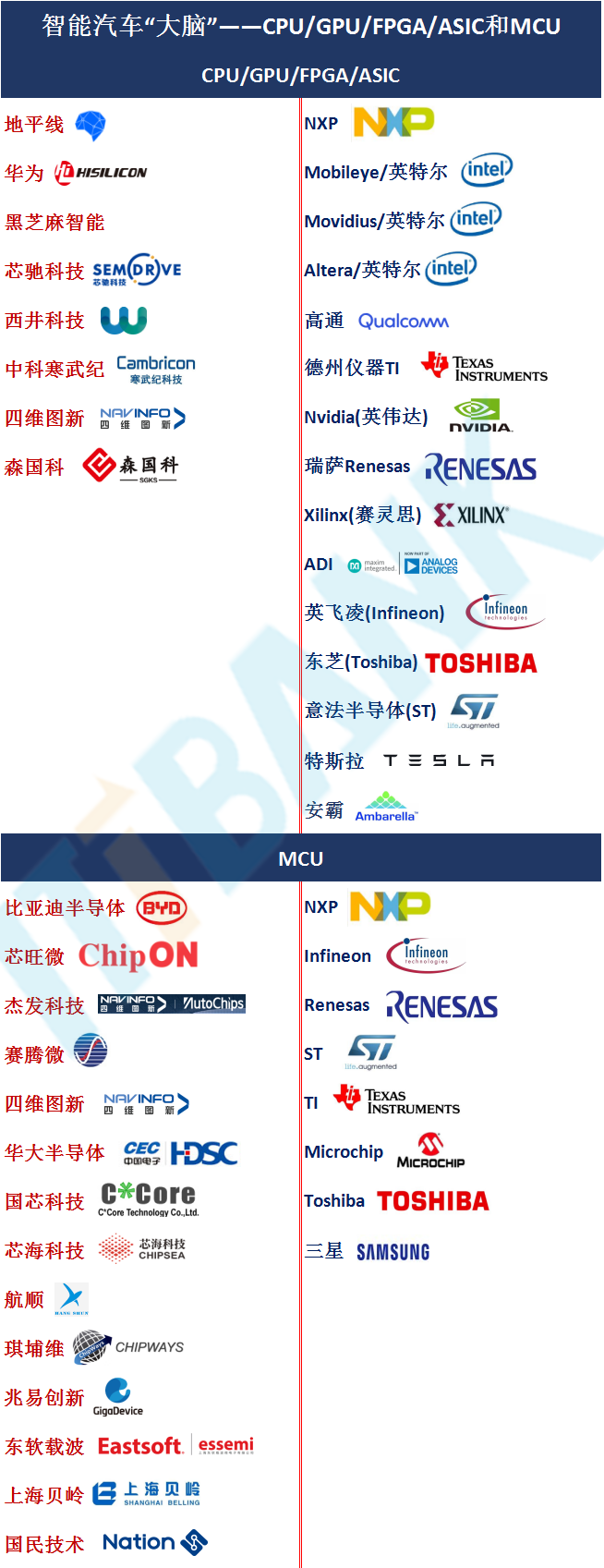
Source: TTBANK
Consequently, the market has historically been insensitive to price, with little enthusiasm for domestic alternatives, as no one wanted to risk being a 'guinea pig.'
As a result, the domestic automotive chip market was dominated by overseas giants like Infineon, NXP, STMicroelectronics, and Texas Instruments, with import dependence remaining a persistent challenge for the industry.
Zou Guangcai, Deputy Secretary-General of the China Automotive Chip Industry Innovation Strategic Alliance, emphasized, "Integrating domestic chips into vehicles is not merely a technical challenge but an industrial one, particularly an ecological hurdle. It necessitates collaboration across the supply chain—from design, manufacturing, packaging, and testing to standardization, certification, electronic controller development, and vehicle certification. We must share risks and rewards."
The turning point arrived in 2018, as geopolitical complexities underscored the need for self-sufficiency.
Especially after 'black swan' events, chip supply chains faced repeated disruptions, leading to structural mismatches between supply and demand. Coupled with the rise of new energy vehicles, automotive chips became a scarce commodity.
Data from the China Association of Automobile Manufacturers indicates that gasoline vehicles require 600-700 chips per unit, while new energy vehicles need approximately 1,600 chips.
Thus, domestic automotive chips took center stage.
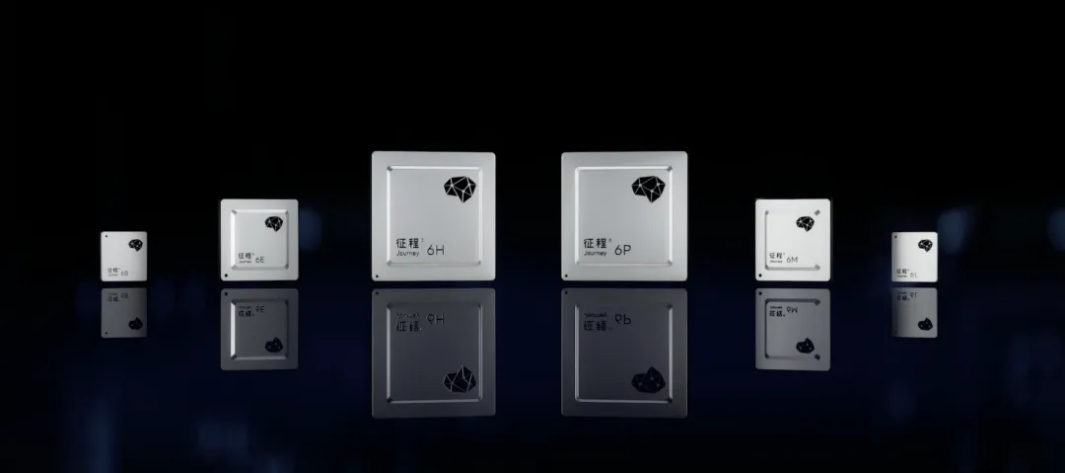
Against this backdrop, domestic automotive chips embarked on their global expansion: Horizon Robotics' Journey chips and Black Sesame's Mount Hua chips sought second-growth curves overseas; BYD's IGBT chips surpassed Infineon in installation volume, claiming the top spot in the domestic market with annual exports exceeding one million units; MCUs proliferated globally, eroding foreign market share...
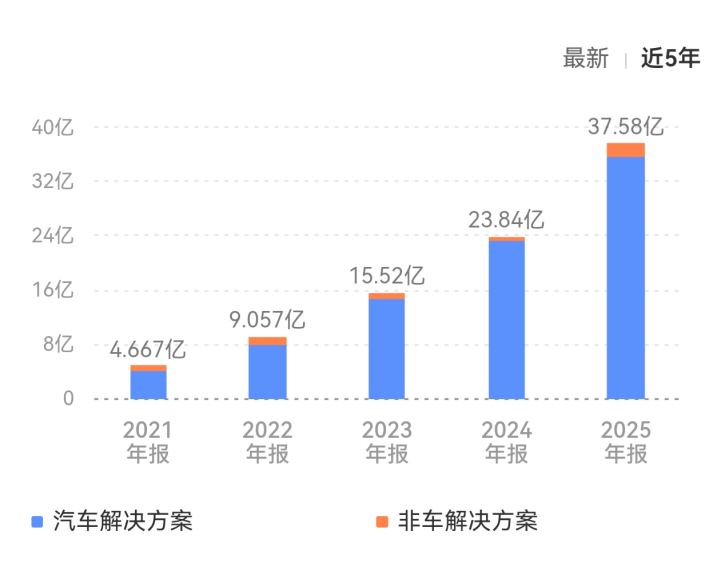
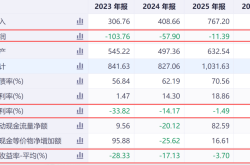
Horizon Robotics' Performance Trend
Clearly, the global expansion of domestic automotive chips is in full swing.
'Chinese Chips' Are Not Alone in This Journey
Three key factors explain the success of domestic automotive chips in their counterattack.
Firstly, vehicle-chip collaboration enables joint overseas expansion.
In 2025, global new vehicle sales by domestic automakers (excluding joint ventures) surpassed Japan for the first time since 2000, marking Japan's first loss of the top spot.
Notably, BYD and Geely outsold Nissan and Honda, respectively.
Tang Jin, Chief Researcher at Mizuho Bank's Business Solutions Department, remarked, "China surpassing Japan in total vehicle sales is not just a ranking change but a sign that the global automotive influence landscape is being reshaped."
In simpler terms, China's automotive industry now possesses the clout to expand overseas.
Data from the Australian Federal Chamber of Automotive Industries shows that in February 2026, Chinese vehicle sales in Australia reached 22,362 units, surpassing Japan's 21,671 units for the first time, making China Australia's largest source of new vehicles. Meanwhile, the European Automobile Manufacturers Association reported that EU imports of Chinese vehicles hit 1,006,188 units in 2025, exceeding one million for the first time and capturing a 7% market share...
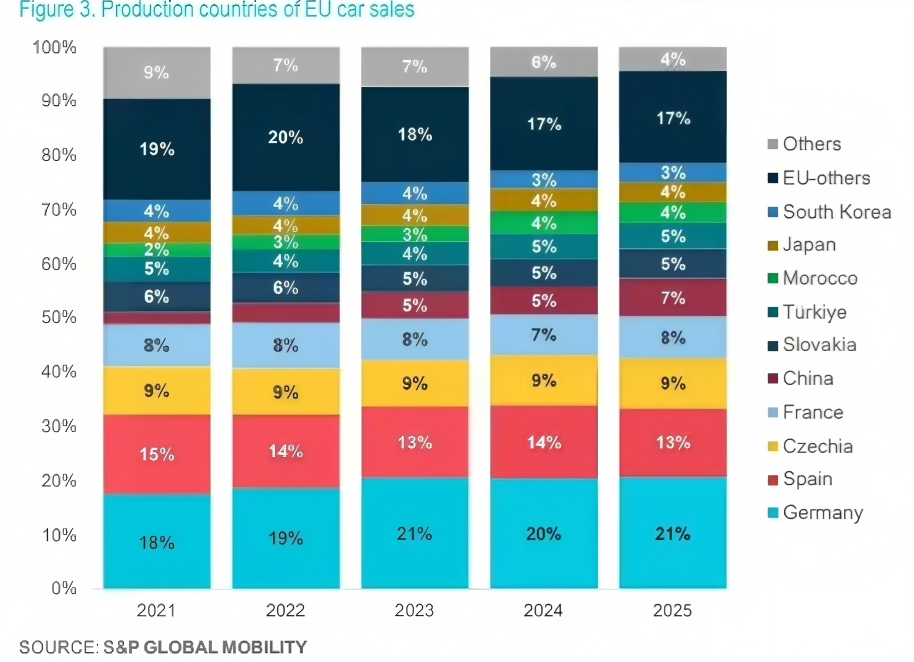
China's Rising Market Share in the EU, Source: European Automobile Manufacturers Association
This has facilitated vehicle-chip collaboration, with automotive chips expanding overseas through supply chain synergy.
Chen Shujie, Vice President of Chipsea Technologies, noted, "On one hand, as Chinese smart electric vehicles go global, Chinese automotive chips gain international market access. On the other hand, more international automakers are seeking local partners in China to ensure supply chain resilience, creating opportunities for Chinese chip firms."
Secondly, technological innovation enhances competitiveness.
Without localization, convincing overseas automakers like Toyota and Suzuki to adopt domestic chips requires real expertise.
Indeed, domestic chips have shed their 'budget alternative' label, transitioning from followers to leaders through innovation.
For instance, NIO developed multiple automotive chips through self-research and customization. Its self-developed Mach 100 chip, built on a 5nm process, delivers 1,280 TOPS of computing power. By deeply integrating dataflow architecture with compilers, it achieves superior performance and efficiency in AI inference scenarios. Its research paper was selected for the ISCA 2026 Industrial Track, making NIO the first automotive company globally to achieve this milestone.
Another example is NIO's first self-developed intelligent driving chip, Shenji NX9031, which takes a 'brute-force' approach. With computing power equivalent to four NVIDIA Orin-X chips, it processes over 6 trillion instructions per second, handling perception, computation, planning, control, data loops, and swarm intelligence tasks in parallel. This reduces Bicycle cost (per-vehicle cost) by around 10,000 RMB. NIO expects 35-40% of its vehicle semiconductors to be domestically sourced by 2027.
Critically, this comes without price hikes.
Due to geopolitical complexities disrupting supply chains, overseas chip giants like STMicroelectronics raised prices. In contrast, domestic automotive chips reduced overall costs through technological iteration and flexible support, boosting competitiveness and becoming a must-have for overseas automakers.
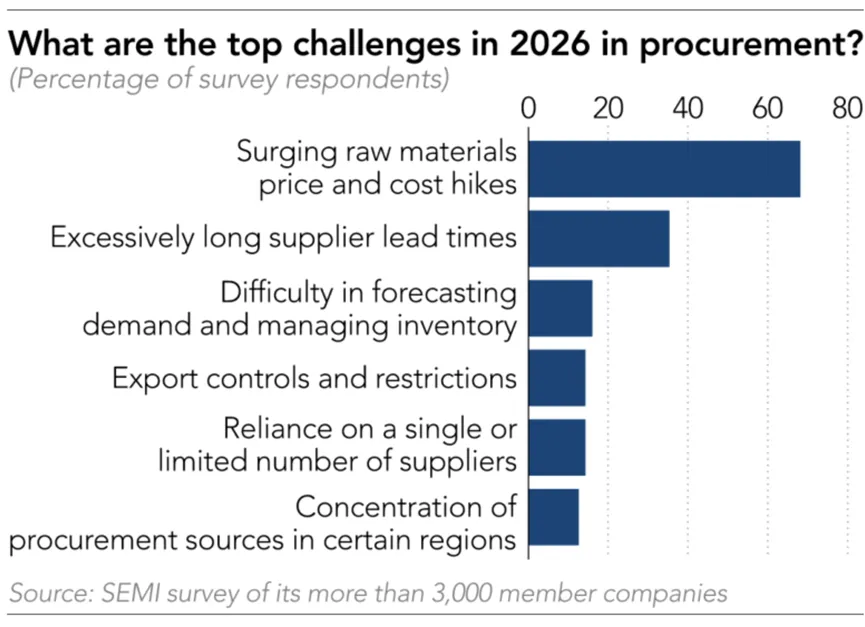
Reasons for Chip Price Hikes, Source: SEMI
Nikkei Asia stated, "As Chinese vehicle exports grow, competition with Japanese automakers intensifies. Toyota and Suzuki believe they cannot win without adopting Chinese chips."
Thirdly, tapping into new market segments.
The shift from gasoline to new energy vehicles has not only increased chip demand but also created new market segments, leveling the playing field for Chinese and foreign firms.
Cockpit-driving integration is a prime example.
Currently, intelligent driving and smart cockpits are pillars of new energy vehicle growth, raising concerns about system conflicts and computing waste between the two.
Cockpit-driving integration chips address these issues, representing the optimal solution for transitioning from distributed to centralized electrical architectures. This has made it a battleground for Chinese and foreign companies.
Currently, Horizon Robotics and Black Sesame lead the global cockpit-driving integration race.
Models from Li Auto, BYD, and other automakers use Horizon's cockpit-driving integration chips, while Dongfeng eπ and others adopt Black Sesame's solutions. Meanwhile, Arcfox, Buick, and other brands use Qualcomm's offerings...
Data from Zozo Auto Research shows that from 2026 to 2030, China's cockpit-driving integration market will grow at a 36% CAGR, with a 3.6x expansion potential by 2030.
In summary, domestic automotive chips have undergone a remarkable transformation, initiating large-scale overseas expansion. However, as a capital-intensive, long-cycle, and high-cost industry, full global success requires internal strengthening. Only by leading—not just following—can Chinese chip firms dismantle the ecological barriers erected by overseas incumbents.
"The business world is objective. It hinges on whether you genuinely help others and enhance their product competitiveness through collaboration. That is the core," said Yu Kai, founder of Horizon Robotics.
-
![]()
The Allure of 'Acquisition Spree': Li Shufu's Left Turn, Xu Jiayin's Right
-
![]()
Strategic Transformation Yields Results: Phoenix Optics Reports 10.9% YoY Rise in Core Net Profit for H1 2026
-
![]()
Three Key Growth Trajectories Synergize! Crystal-Optech Reports 3.478 Billion Yuan in Revenue for H1 2026
-
![]()
Semi-Annual Report Sparks XPENG Motors Buzz
-
![]()
1.6 Billion Big Order Secured! SeeYA Technology's Revenue Soars by 287.87% in the First Half of the Year
-
![]()
Baidu's Profits Plunge by 68%: Unraveling the Mystery Behind the Numbers
-
![]()
Baidu’s Profits Tumble by 68%! Where Has All the Money Gone?
-
![]()
Hynix’s Taobao Store Shuts Down Abruptly: What Should Customers Do About Warranty Services for Memory Modules?