Single-Month Exports Exceed One Million Units for the First Time; CAAM Points Out Prominent Issue of Insufficient Domestic Demand for Passenger Cars
 07/10 2026
 415
415
Market trends are akin to the ebb and flow of the Qiantang River tides, surging one moment and receding the next...
In a flash, half a year has flown by. On July 9th, the China Association of Automobile Manufacturers (CAAM) unveiled data on the automotive market for the first half of 2027 and for June. This biannual report presents a mixed bag, with the market's trajectory for the latter half of the year holding even greater significance.
The CAAM has distilled three key trends in the automotive industry market for 2027: Firstly, domestic demand is under considerable strain, with sales experiencing double-digit declines, while exports have surged beyond expectations, providing a steady pillar of support. Secondly, the passenger car market has underperformed, witnessing a slight downturn, whereas the commercial vehicle market has maintained its upward trajectory, with sales continuing to grow. Thirdly, the industry is undergoing a relentless transition from traditional to new growth drivers, with the market for conventional fuel vehicles shrinking further and new energy vehicles (NEVs) enjoying steady expansion.
Regarding the market outlook for the second half of the year, the CAAM's forecast is cautiously optimistic, yet it also underscores the challenges confronting the automotive market: The "two new" policies will persist in being implemented in an orderly fashion, and the automotive aftermarket is poised to witness fresh incremental opportunities. The influx of new products from enterprises will continue to diversify, market prices are expected to remain relatively stable, and the overall economic operation of the industry will further enhance. Nevertheless, it is crucial to acknowledge that the external environment remains intricate and volatile, with escalating uncertainties. The issue of insufficient domestic demand persists as a prominent concern, and the industry still grapples with significant operational pressures. There is a pressing need to stabilize policy expectations, bolster guidance and supervision, closely monitor shifts in the international landscape, effectively respond to risks and challenges, and steadily expand international markets.
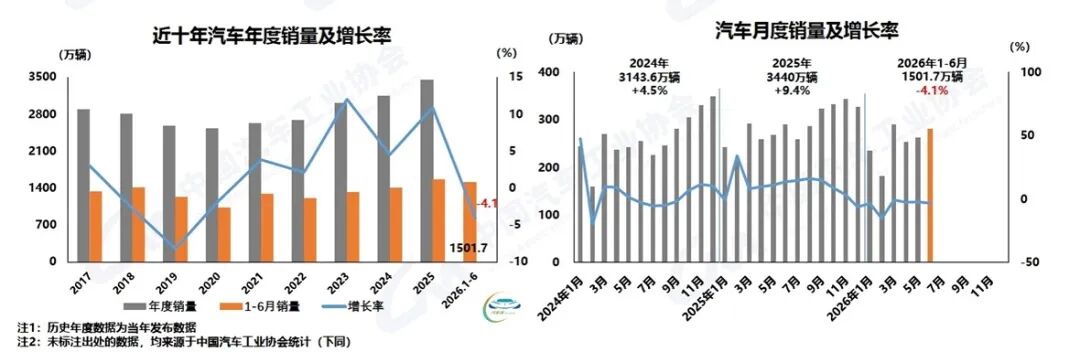
The road ahead is arduous, so let's first focus on the present. Although the passenger car market, the cornerstone of the automotive sector, is still experiencing a year-on-year decline, the silver lining is that the rate of decline has further narrowed. Overall market data reveals: In June, automobile production and sales reached 2.76 million and 2.81 million units, respectively, marking month-on-month increases of 5.5% and 6.9%, and year-on-year decreases of 1.2% and 3.2%.
From January to June, automobile production and sales stood at 14.993 million and 15.017 million units, respectively, representing year-on-year decreases of 4% and 4.1%, with the rate of decline narrowing further compared to the first five months. If the rate of decline can persist in narrowing until a rebound materializes, that would be the collective aspiration.
However, beneath the overall market trends lie two major segments: domestic sales and exports. Domestic automobile sales reached 1.773 million units, reflecting a month-on-month increase of 4.3% and a year-on-year decrease of 23.3%. From January to June, domestic automobile sales amounted to 9.921 million units, representing a year-on-year decrease of 21.1%. Thus, the overall market trend is still characterized by a double-digit decline, as succinctly summarized by the CAAM.
Is the "overall market trend of a double-digit decline" disheartening? Fear not; there's even more sobering news on the horizon.
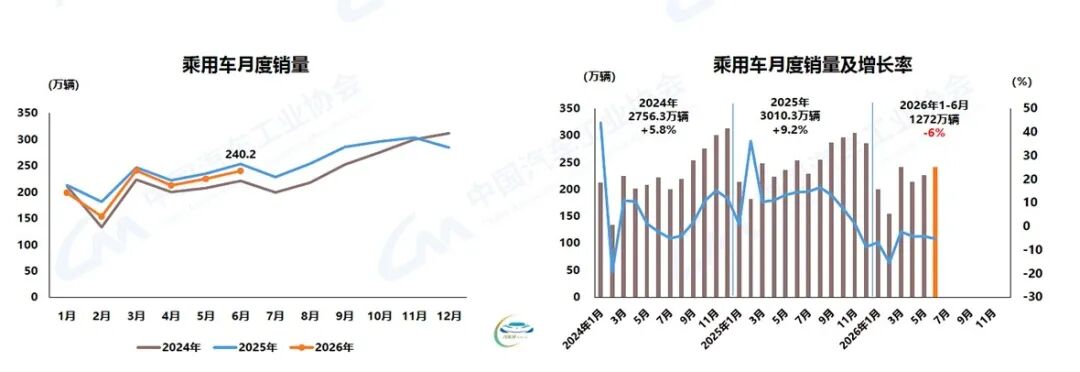
As the mainstay of the automotive market, passenger car production and sales reached 2.373 million and 2.402 million units, respectively, in June, marking month-on-month increases of 5.9% and 6.6%, and year-on-year decreases of 2.8% and 5.3%.
From January to June, passenger car production and sales stood at 12.721 million and 12.72 million units, respectively, representing year-on-year decreases of 5.9% and 6%. Do these two major figures seem acceptable? However, these figures encompass both domestic sales and exports. When dissected, domestic passenger car sales reached 1.497 million units in June, reflecting a month-on-month increase of 3.7% and a year-on-year decrease of 26.4%! From January to June, domestic passenger car sales amounted to 8.288 million units, representing a year-on-year decrease of 24.3%!
The editor attempted to find solace by considering the development status of the global automotive market: Could it be that the automotive market, akin to developed countries and international brands, is gradually globalizing, leading to a decrease in domestic sales? (But that's not entirely accurate, is it?)
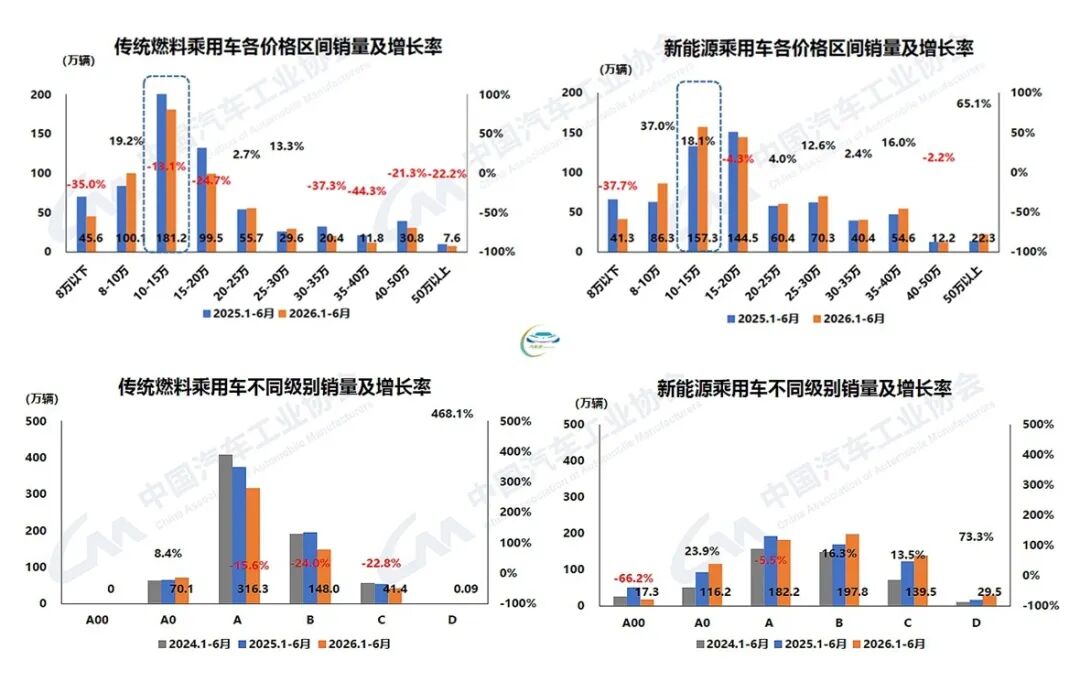
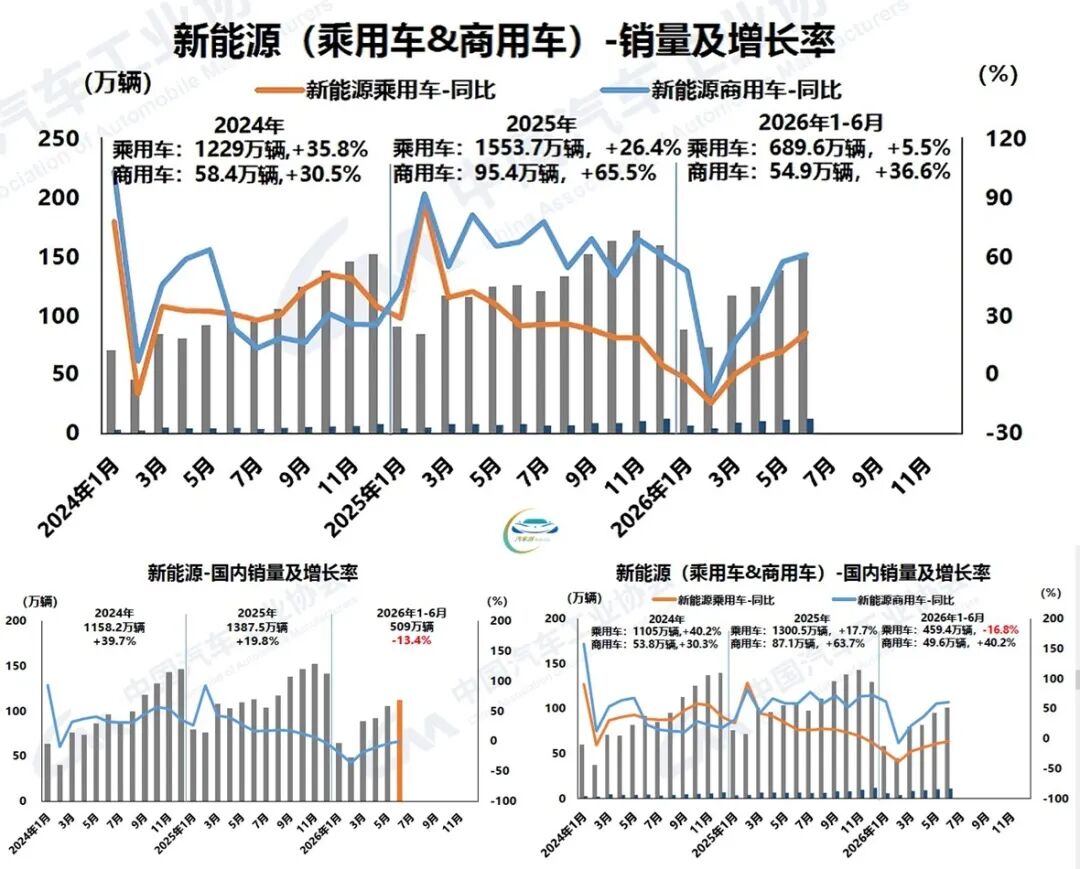
To jolt the nervous system, here's a "sweet treat": The new energy vehicle (NEV) market continues to surge. In June, NEV production and sales reached 1.598 million and 1.643 million units, respectively, marking year-on-year increases of 26% and 23.6%. NEVs accounted for 58.5% of total new vehicle sales.
From January to June, NEV production and sales reached 7.438 million and 7.446 million units, respectively, representing year-on-year increases of 6.7% and 7.3%, accounting for 49.6% of total new vehicle sales.
However, given the sluggish domestic sales trend, NEV domestic sales are not particularly impressive either. In June, domestic NEV sales reached 1.12 million units, reflecting a month-on-month increase of 6.7% and a year-on-year decrease of 0.4%. Domestic NEV passenger car sales reached 1.007 million units, marking a month-on-month increase of 6.3% and a year-on-year decrease of 4.5%.
From January to June, cumulative domestic NEV sales reached 5.09 million units, representing a year-on-year decrease of 13.4%. Among them, domestic NEV passenger car sales reached 4.594 million units, representing a year-on-year decrease of 16.8%.
It remains unclear how significant the impact of vehicle and vessel tax adjustments will be on plug-in hybrid models. According to CAAM data, among the overall NEV sales, battery electric vehicle (BEV) sales reached 1.142 million units in June, representing a year-on-year increase of 33%, while plug-in hybrid vehicle (PHEV) sales reached 500,000 units, marking a year-on-year increase of 6.5%. From January to June, cumulative BEV sales reached 4.987 million units, representing a year-on-year increase of 13%, while cumulative PHEV sales reached 2.457 million units, representing a year-on-year decrease of 2.5%.
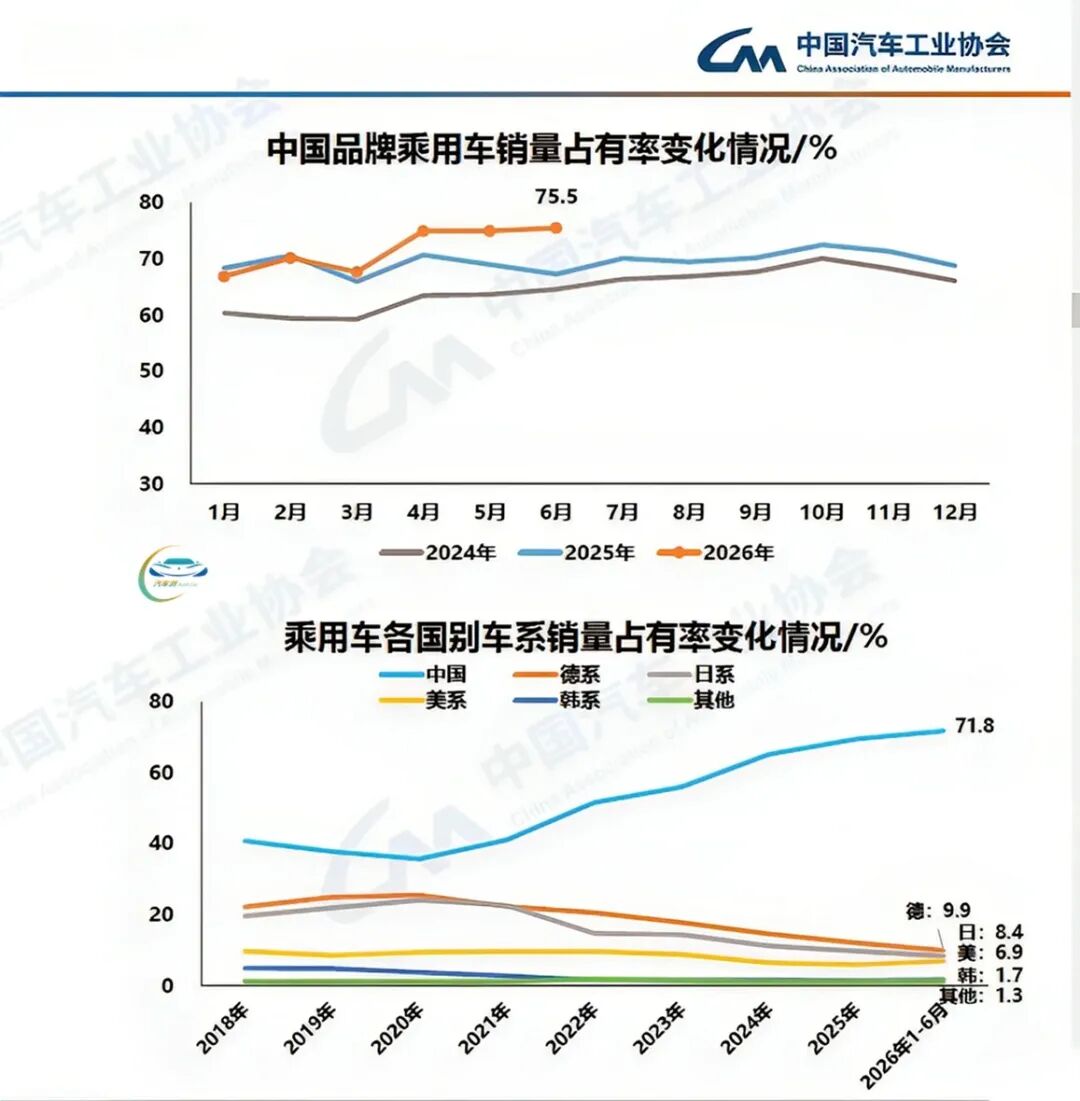
Overall, NEVs remain a significant growth driver that cannot be overlooked. Meanwhile, consumer preferences are increasingly leaning towards Chinese brands: In June, Chinese brand passenger car sales reached 1.812 million units, representing a year-on-year increase of 6.2%, with a market share of 75.5%, up 8.2 percentage points year-on-year. From January to June, cumulative Chinese brand passenger car sales reached 9.138 million units, representing a year-on-year decrease of 1.4%, with a market share of 71.8%, up 3.3 percentage points year-on-year.
The most thrilling aspect of the data released by the CAAM this time stems from vehicle exports, which surpassed one million units in a single month for the first time: In June, automobile exports reached 1.037 million units, marking a month-on-month increase of 11.6% and a year-on-year increase of 75.1%. From January to June, automobile exports reached 5.096 million units, representing a year-on-year increase of 65.3%.
Among them, NEV exports reached 523,000 units in June, marking a month-on-month increase of 17.2% and a year-on-year increase of 1.6 times. Traditional fuel vehicle exports reached 514,000 units, reflecting a month-on-month increase of 6.4% and a year-on-year increase of 32.7%. From January to June, cumulative NEV exports reached 2.355 million units, representing a year-on-year increase of 1.2 times. Traditional fuel vehicle exports reached 2.741 million units, representing a year-on-year increase of 35.5%.
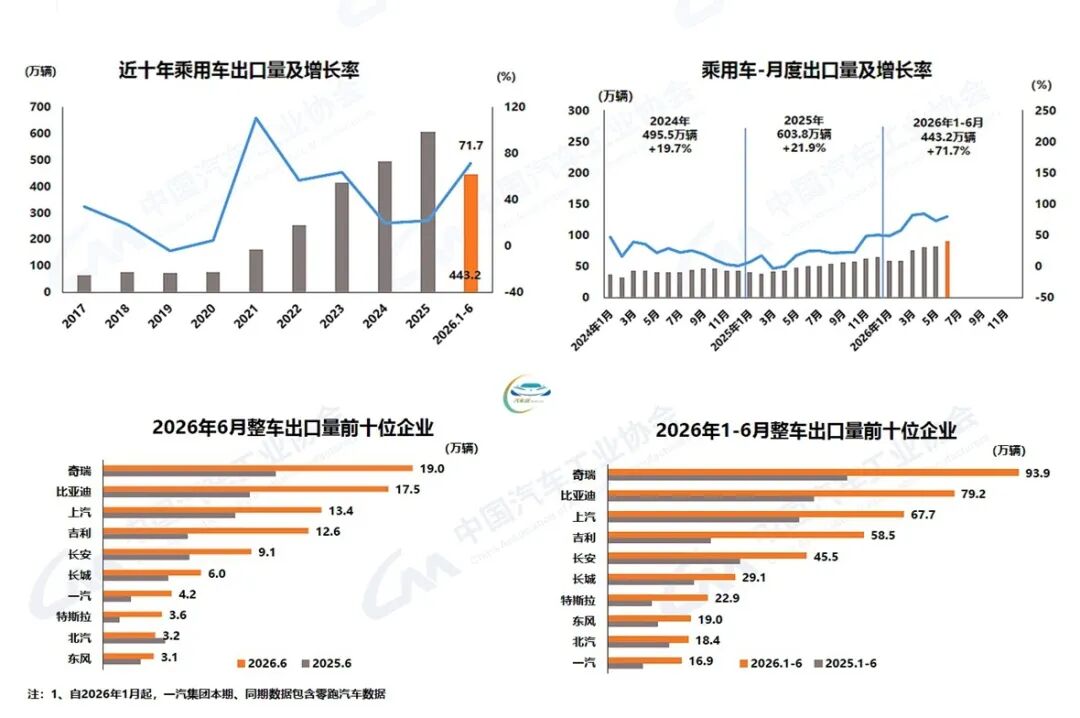
Although domestic passenger car sales are sluggish, in terms of exports, passenger car exports reached 905,000 units in June, marking a month-on-month increase of 11.7% and a year-on-year increase of 80.2%. From January to June, passenger car exports reached 4.432 million units, representing a year-on-year increase of 71.1%.
Automakers' enthusiasm for exports remains undiminished. The top three exporters, Chery, BYD, and SAIC Motor, all approached one million units in cumulative exports in the first half of the year. Other automakers also witnessed significant export growth, with Geely's cumulative export growth being the most notable, reaching 585,000 units, representing a year-on-year increase of 1.5 times. Of course, in June, foreign automakers also had outstanding export performances, with Tesla exporting 36,000 units, representing a year-on-year increase of 2.6 times.
-
Same Bloodline, Two Fates: How Two AI Giants Took Divergent Paths?
-
![]()
Combined Market Value Plummets by Nearly One Trillion Yuan: What’s Behind the Decline of Two AI Powerhouses?
-
![]()
Detailed Explanation of the Impact of Hikvision Guanlan Coding on Video Quality and Key Frame Quality
-
![]()
The Key Distinctions Between AI-Driven Smart Coding and Traditional Coding
-
![]()
Memory Prices Skyrocket, Becoming ‘Digital Black Gold’ as Shenzhen’s Huaqiangbei Spawns a Wave of Billionaires
-
![]()
Kuaishou Unleashes Its Secret Weapon: Kling
-
Copilot is Over, Industrial AI Enters the Autopilot Era (Part 1)
-
![]()
After the Removal of Purchase Tax and Vehicle and Vessel Tax Incentives, What 'Privileges' Remain for New Energy Vehicles?