After the Removal of Purchase Tax and Vehicle and Vessel Tax Incentives, What 'Privileges' Remain for New Energy Vehicles?
 07/10 2026
 529
529
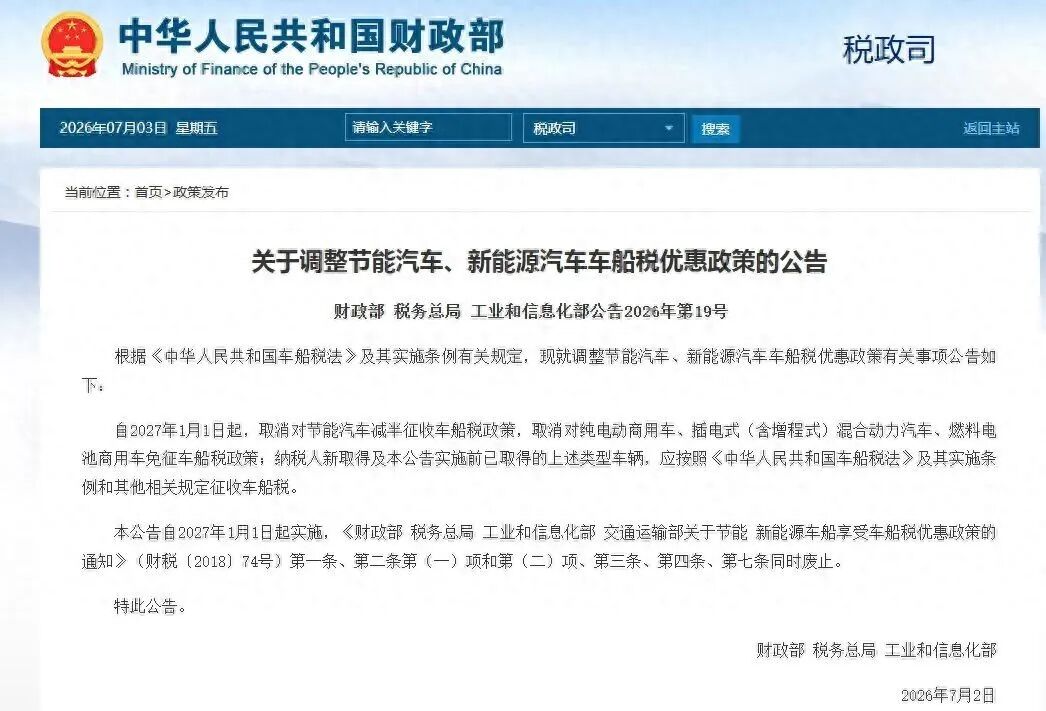
Several days ago, the Ministry of Finance, the State Taxation Administration, and the Ministry of Industry and Information Technology jointly issued an announcement. Starting from January 1, 2027, the policy of halving the vehicle and vessel tax for fuel-efficient vehicles will be abolished, along with the exemption policy for pure electric commercial vehicles, plug-in (including extended-range) hybrid vehicles, and fuel cell commercial vehicles from vehicle and vessel tax. Despite the brevity of the announcement, its message is unmistakable: the 15-year preferential policy for vehicle and vessel tax on new energy vehicles is officially entering its countdown phase.
Previously, the purchase tax for new energy vehicles was adjusted from full exemption to a 50% reduction at the beginning of this year, with the tax reduction per new energy passenger vehicle not exceeding 15,000 yuan. When considered alongside the removal of vehicle and vessel tax incentives, a clear trend emerges: the tax 'privileges' for new energy vehicles are being gradually phased out.
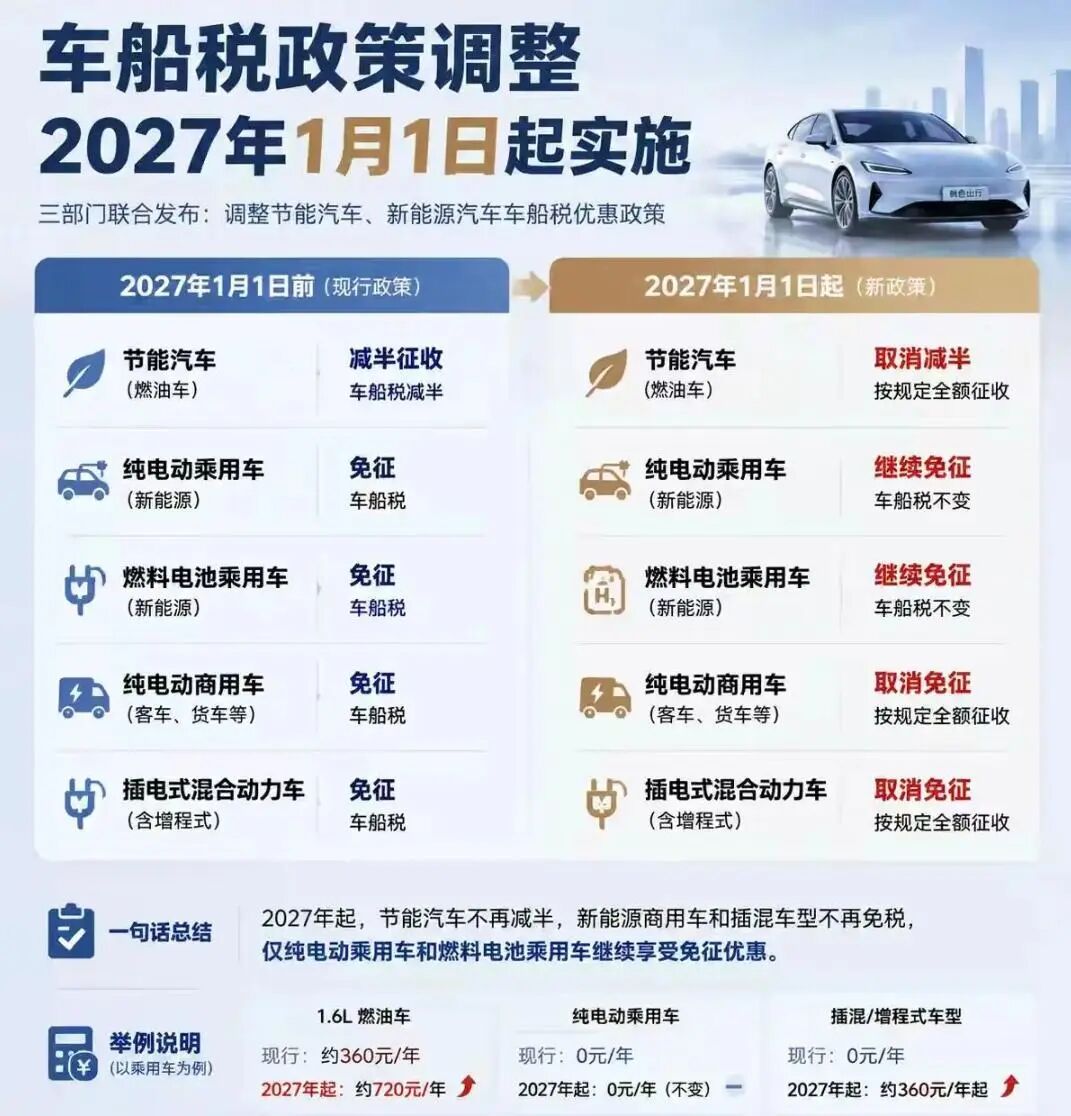
Many interpret this as the start of 'equal rights for gasoline and electric vehicles,' and from a taxation standpoint, this is indeed accurate. The tax and fee gap between hybrid models and traditional fuel vehicles is rapidly closing, and when consumers make purchasing decisions, 'tax exemptions' are no longer the primary consideration. This raises an intriguing question: If taxes and fees are no longer the decisive factor, what would be the outcome of a fair competition between hybrid and fuel vehicles?
Sales data provides some insight, and the results are not unexpected.
Ultimately, there may be no significant changes.
Data from the China Passenger Car Association reveals that in January 2026, domestic passenger car retail sales reached 1.8 million units, with new energy retail sales at approximately 800,000 units, representing a penetration rate of 44.4%. This figure saw a nearly 10-percentage-point decline from the peak at the end of 2025, largely due to normal fluctuations during the policy transition period.
However, by June, the situation had changed dramatically. In June, national passenger car market retail sales of new energy vehicles reached 1.037 million units, with a penetration rate of 62.8%, surpassing 60% for three consecutive months. In the first half of the year, cumulative retail sales of new energy passenger vehicles reached 5.923 million units, a year-on-year increase of 16.7%, with an average penetration rate of 57.4%.
The penetration rate soared from 44.4% in January to 62.8% in June, a remarkable increase over just half a year that cannot be solely attributed to policy incentives. Additionally, data shows that in May of this year, the penetration rate of pure electric vehicle models in the entire passenger car market reached 42.2%, surpassing fuel vehicles for the first time and ranking first among all powertrain types. In the first half of the year, pure electric models accounted for 67.1% of total new energy vehicle sales, meaning that nearly two out of every three new energy vehicles sold were pure electric.

The most crucial factor is undoubtedly the cost of vehicle usage. Taking a pure electric SUV as an example, for a daily commute of 40 kilometers round trip, if you have a home charging station and charge during off-peak hours at night, it costs just over a dozen yuan to fully charge, amounting to around a hundred yuan in electricity bills per month. In contrast, for a fuel vehicle, considering the recent increases in fuel prices, monthly fuel costs could reach six to seven hundred yuan. Calculating this, thousands of yuan can be saved annually in energy expenses alone. For ordinary households, this is a significant amount.

Of course, fuel vehicles have not disappeared. In the first half of the year, retail sales of fuel passenger vehicles reached 4.395 million units, still accounting for nearly 40% of the market share. Customers who frequently travel to rural areas or run individual businesses still prefer fuel vehicle models for their convenience in refueling and widespread coverage of maintenance outlets. Different vehicle usage scenarios correspond to different choices, a logic that remains unchanged.
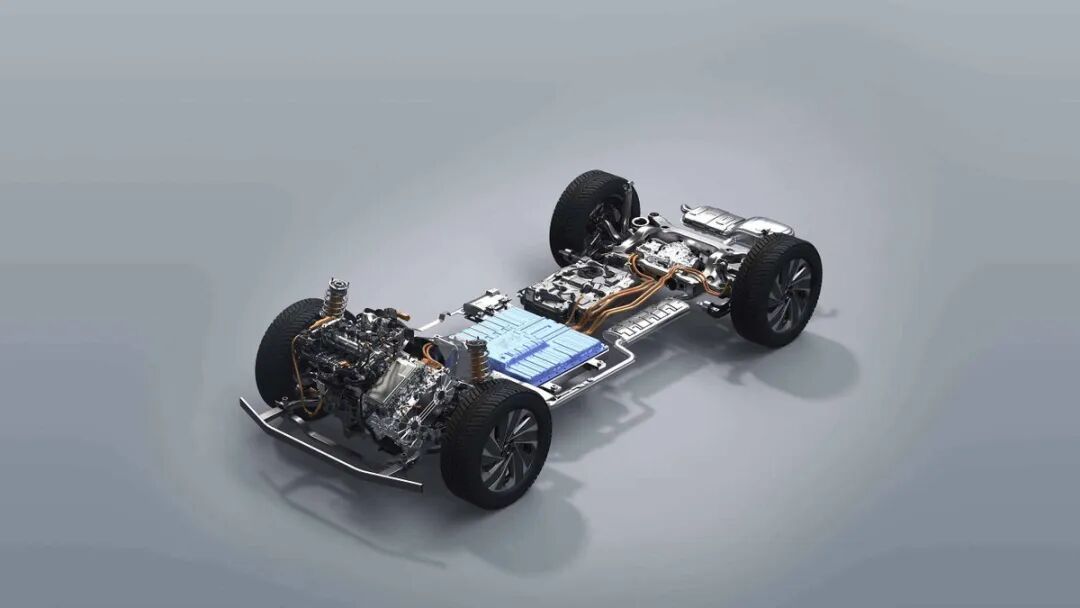
However, the crux of the issue lies in the precarious position of hybrid models caught in the middle. After the reduction in purchase tax, the tax and fee gap between hybrid and fuel vehicles has significantly narrowed; with the removal of vehicle and vessel tax incentives, this gap has narrowed further. Meanwhile, the cost advantages, technological maturity, and infrastructure completeness of pure electric vehicle models continue to improve. Mainstream pure electric models now commonly offer ranges exceeding 600 kilometers, with ultra-fast charging technology entering mass production and the continuous expansion of public charging stations nationwide. Range anxiety for pure electric vehicles is gradually being alleviated, naturally diminishing the appeal of hybrid models' core selling point of 'no range anxiety.'
Therefore, even if the so-called 'equal rights for gasoline and electric vehicles' are achieved at the tax level, allowing hybrid and fuel vehicles to compete on a relatively level playing field, the likely outcome is that fuel vehicles will maintain their core market share, while hybrid models will continue to struggle in the middle ground. The real impact may not be on fuel vehicles but on hybrid models themselves, as users who were originally considering hybrids may shift directly to pure electric models starting in 2027.
Next, the tightening of 'privileges' is inevitable.
The reduction in purchase tax and removal of vehicle and vessel tax incentives are just the beginning of the rollback of 'privileges' for new energy vehicles.
From a policy-making perspective, the tax incentives for new energy vehicles were initially a phased industrial support measure, not a permanent institutional arrangement. The timeline provided by the State Council in 2023 already clearly outlined the pace of a 50% reduction in purchase tax from 2026 to 2027 and the complete cancellation of reductions starting in 2028. The vehicle and vessel tax incentives, implemented since 2012, will be removed in 2027, spanning 15 years. Supporting an emerging industry for 15 years constitutes a long-term investment in any country's industrial policy.
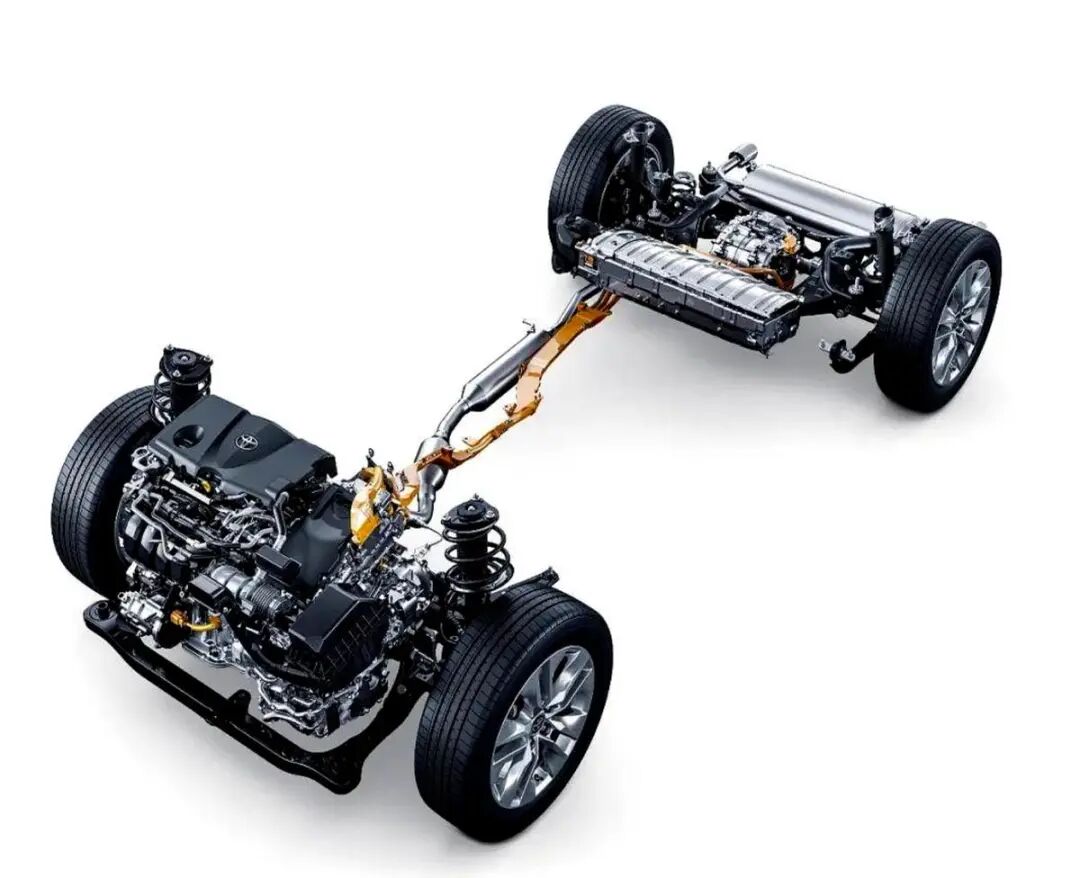
In response to this vehicle and vessel tax adjustment, the Tax Policy Department of the Ministry of Finance mentioned that the average selling price of plug-in (including extended-range) hybrid passenger vehicles was 218,000 yuan in 2025, with some models priced at over one million yuan. Restoring the vehicle and vessel tax for such vehicles promotes tax fairness. This statement clearly signals that the new energy industry has grown to a point where it no longer requires special treatment.

In the next 1 to 2 years, we can expect to see the tightening of 'privileges' extend to more dimensions. In terms of road rights, the preferential policies currently enjoyed by new energy vehicles in many cities regarding travel restrictions, license plate restrictions, and parking are likely to be gradually adjusted. In terms of fees, with the recurring discussions about the funding gap for road maintenance, the policy of exempting new energy vehicles from road maintenance fees is also expected to change. Although road maintenance fees were abolished in 2009 and replaced with a consumption tax on refined oil products collected through gasoline—meaning that roughly 1.52 yuan per liter of fuel goes toward road maintenance—electric vehicles do not consume fuel and thus do not bear this cost through the refueling process. This was one of the preferential policies introduced to support the new energy industry at the time. Now, experts have already proposed a shift from 'paying for fuel' to 'paying for road use,' which may gradually be implemented through mileage-based fees, charging surcharges, and other methods in the future.
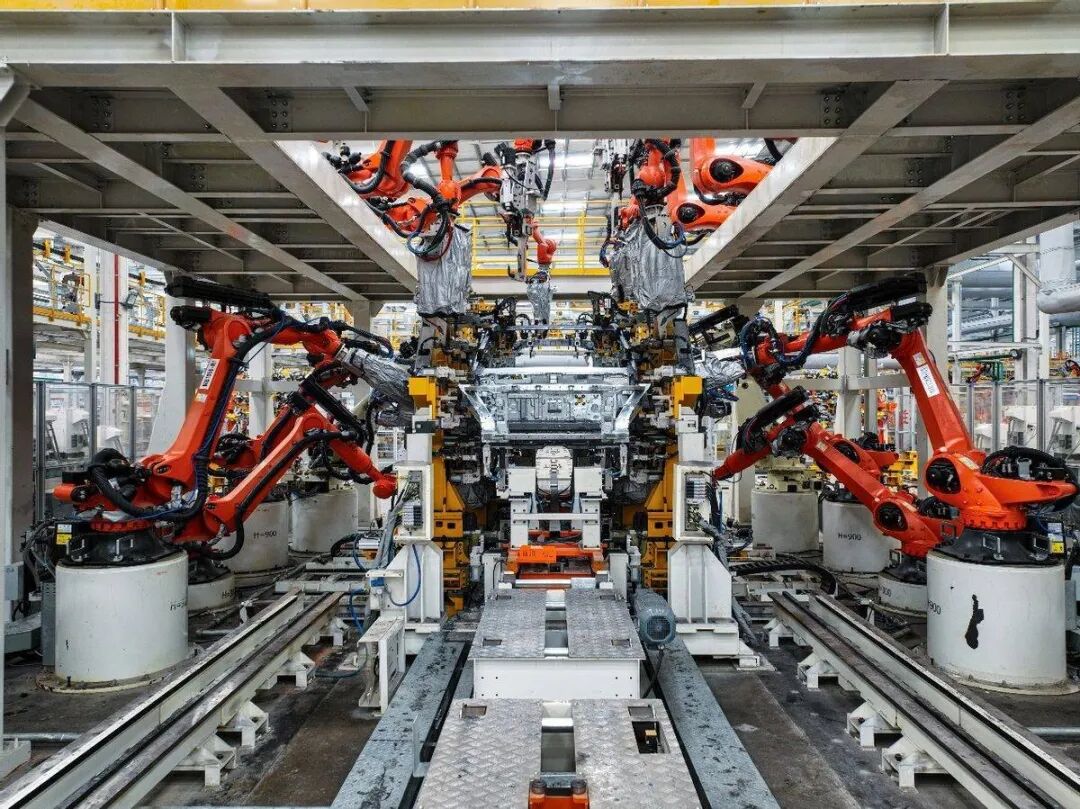
This is not a policy crackdown on new energy vehicles but rather an inevitable process of transitioning from policy-driven to market-driven growth for the industry. The penetration rate of new energy vehicles has surpassed 60%, and monthly sales of pure electric models have also exceeded those of fuel vehicles. Using tax incentives to stimulate demand now has a very low marginal effect. Policy resources should be directed toward areas of greater need rather than continuing to subsidize an industry that has already developed self-sustaining capabilities.
Conclusion
What does this mean for consumers? If you are currently considering buying a car, tax incentives are still a factor to consider, as the purchase tax reduction will last until the end of 2027, and you can still benefit from it if you buy now. However, a more crucial aspect may be to recognize the trend: the policy dividends for new energy vehicles are declining, while the product strength of pure electric models is rapidly maturing. It will not be long before the decision to buy a fuel vehicle or an electric vehicle is no longer a calculation of which is more cost-effective but rather a straightforward choice of which suits you better.
By then, 'equal rights for gasoline and electric vehicles' will truly hold meaning.
-
![]()
Li Bin Claims, 'Denying the Pure EV Trend is Like Ostrichism.' What's Li Xiang's Take?
-
Lenovo: Liu Jun Turns Left, Yang Yuanqing Turns Right
-
Lenovo: Liu Jun Goes Left, Yang Yuanqing Goes Right
-
![]()
MiniMax Shares Unlock: Cornerstone Shareholders Show Long-Term Optimism, Yet Stock Plummets Nearly 30% in Two Days; Zhipu Also Sees Nearly 20% Drop Today
-
![]()
Single-Day Plunge of 40%: The 'First AGI Stock' Faces More Than Just Share Price Concerns
-
![]()
Ricoh and Fuji Hike Prices on Legacy Edge; Insta360 Poised to Disrupt Mirrorless Camera Market
-
![]()
Ricoh and Fujifilm Raise Prices in Tandem, Relying on Established Reputations; Insta360 Poised to Disrupt Mirrorless Camera Market
-
![]()
Strategic Shift in Photoelectric Sensing: Maxvision Secures Controlling Stake in CAS Optotech