Global Auto Giants' Drastic Cuts Lead to Up to 100,000 Job Losses
 07/10 2026
 370
370
Reshaping the Competitive Dynamics of the Global Automotive Industry
On July 5 (local time), German publication Handelsblatt, citing insider sources, reported that Porsche is contemplating further layoffs of up to 4,000 employees at its Zuffenhausen plant, adding to its previous agreement to reduce 3,900 positions. The administrative and management sectors will be particularly hard-hit. Prior to this, international media outlets had disclosed that Volkswagen is planning a sweeping layoff initiative affecting up to 100,000 employees worldwide.
Layoffs and streamlining efforts by automotive behemoths are no longer surprising developments. Traditional automotive powerhouses from Europe, the United States, and Japan, including BMW, Mercedes-Benz, Toyota, and Nissan, are now all experiencing a phase of production capacity reduction.
In stark contrast to the survival strategies of these multinational corporations, Chinese automakers are aggressively expanding their global footprint. On July 3, Chery Automobile officially acquired Nissan's Rosslyn plant in Pretoria, South Africa. Earlier in June, Nissan announced that its Sunderland Plant Line 1 in the UK would commence contract manufacturing for Chery starting from the 2027 fiscal year.
Global Auto Giants Initiate Massive 'Slimming Down' Initiatives
The current wave of streamlining by overseas traditional automakers is unprecedented in its magnitude, with German brands leading the charge in making significant adjustments.
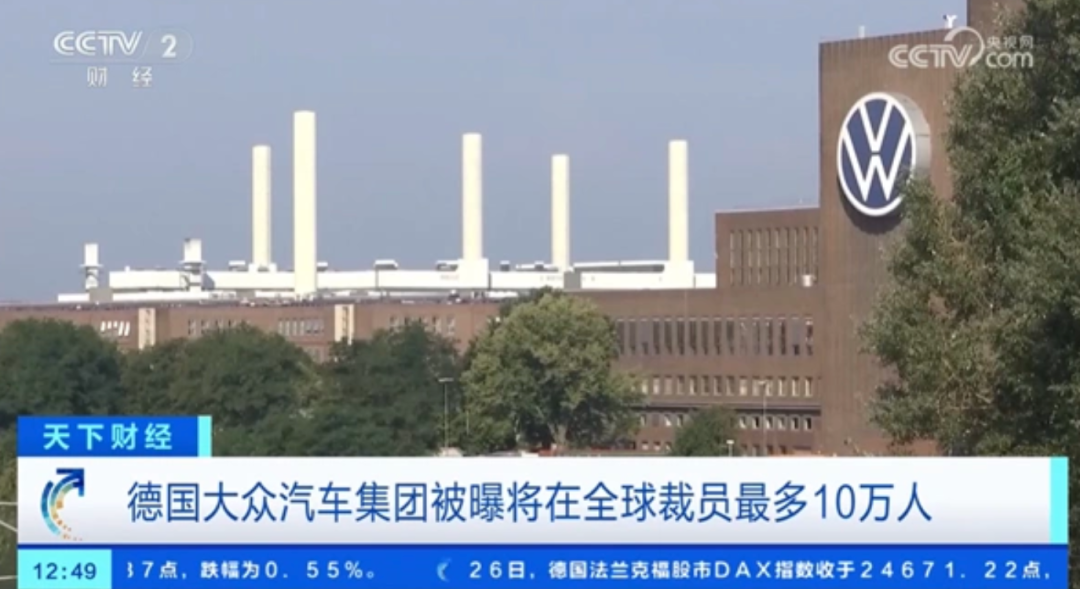
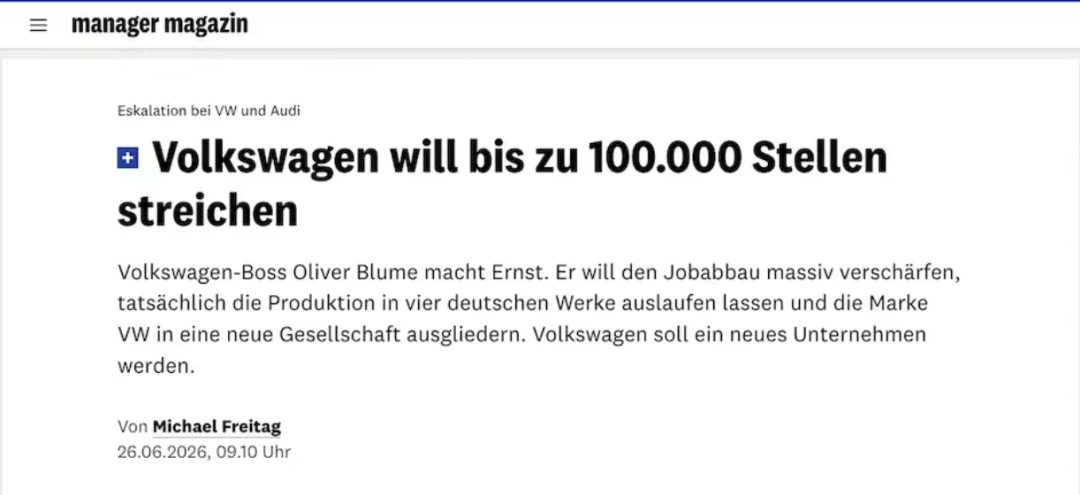
According to German business magazine Manager Magazin, Volkswagen Group is expanding its layoff program to encompass 100,000 employees. Volkswagen has introduced two workforce optimization strategies: a short-term plan to eliminate 19,000 positions in Germany by the end of 2026 and a total of 50,000 positions domestically by 2030; a long-term plan to reduce its global workforce by up to 100,000. Concurrently, Volkswagen intends to permanently shut down four German vehicle assembly plants in Hanover, Zwickau, Emden, and Audi's Neckarsulm facility. These closures and layoffs will set a new benchmark for restructuring in the automotive sector and have already sparked strong opposition from the German Metalworkers' Union.
Not only Volkswagen but also German luxury brands, Japanese automakers, and European and American automotive supply chain companies are simultaneously undergoing a period of profound adjustment.
BMW has finalized plans to lay off 7,700 employees globally by the end of the year, representing 5% of its total workforce. Simultaneously, it has significantly lowered its profit forecasts, with narrower ranges for automotive business EBIT margin and return on capital, and a shift from stable to declining delivery expectations. Management acknowledges that weakness in the Chinese and Asia-Pacific markets is the primary driver of profit pressure.
Mercedes-Benz has been consistently streamlining its workforce since 2025, relying on natural attrition to reduce research and development redundancies and cutting hundreds of positions in its Chinese sales team while tightly controlling new production capacity. Its latest cost-reduction plan proposes eliminating annual special bonuses for 90,000 German employees and extending working hours without additional compensation, potentially saving tens of millions of euros annually.
Japanese automakers are also boldly streamlining their product lines and production capacities. Toyota has halted mass production of the Lexus LF-ZC all-electric flagship model and slowed down high-end all-electric research and development with extended payback periods. Nissan has implemented the "Re:Nissan" global restructuring plan, explicitly proposing to reduce its global vehicle assembly plants from 17 to 10 by the end of the 2027 fiscal year, closing seven plants, laying off 20,000 employees, and cutting annual costs by 500 billion yen, aiming to achieve positive operating profit and free cash flow in its automotive business by the 2026 fiscal year.
The collective streamlining of traditional automakers is an inevitable outcome of the long-term structural contradictions within the industry and the growing pains associated with electrification transformation. Currently, the profit logic of the global automotive industry is undergoing a transformation. On one hand, the substantial investment in electrification and intelligent transformation continues to erode corporate profits, while traditional automotive giants are largely in a reactive stance in the competition within the intelligent vehicle sector. On the other hand, their traditional strategy of flooding the market with numerous models is ill-suited to the competitive rhythm of the new energy era, and redundant product lines have become a burden on business operations. Meanwhile, factors such as an unstable global chip supply, volatile metal raw material prices, escalating geopolitical conflicts, and increasing trade tariff barriers are also continuously driving up the production and manufacturing costs of traditional automakers.
The German Automotive Industry Association issued a statement in May of this year, stating that the employment crisis in the German automotive industry is more severe than anticipated. By 2035, the number of jobs at risk of being lost will be approximately 35,000 higher than previously estimated. A preliminary study released by the German Automotive Industry Association and the Prognos Economic Research Institute in 2024 estimated that in the process of transitioning to climate-neutral transportation, compared to the 2019 baseline, the German automotive industry may lose approximately 190,000 jobs by 2035.
Chinese Automakers Seize Opportunities for Breakthrough
It is noteworthy that while global traditional automakers are collectively contracting, Chinese automobiles are achieving remarkable progress in overseas markets.
According to the website of the Ministry of Industry and Information Technology, from January to May 2026, China's automobile production and sales reached 12.235 million and 12.207 million vehicles, respectively, down 4.6% and 4.2% year-on-year. However, automobile exports during the same period demonstrated significant growth. In the first five months, 4.059 million complete vehicles were exported, up 63% year-on-year. Among them, 1.833 million new energy vehicles were exported, up 110% year-on-year.
Data from the General Administration of Customs revealed that from January to May, the total cumulative import and export volume of automotive products nationwide was US$132.92 billion, up 23.4% year-on-year. Among them, the import value was US$15.86 billion, down 10.2% year-on-year; the export value was US$117.06 billion, up 30.0% year-on-year. "Going global is no longer an optional strategy but a mandatory one" has become a strategic consensus within the industry.
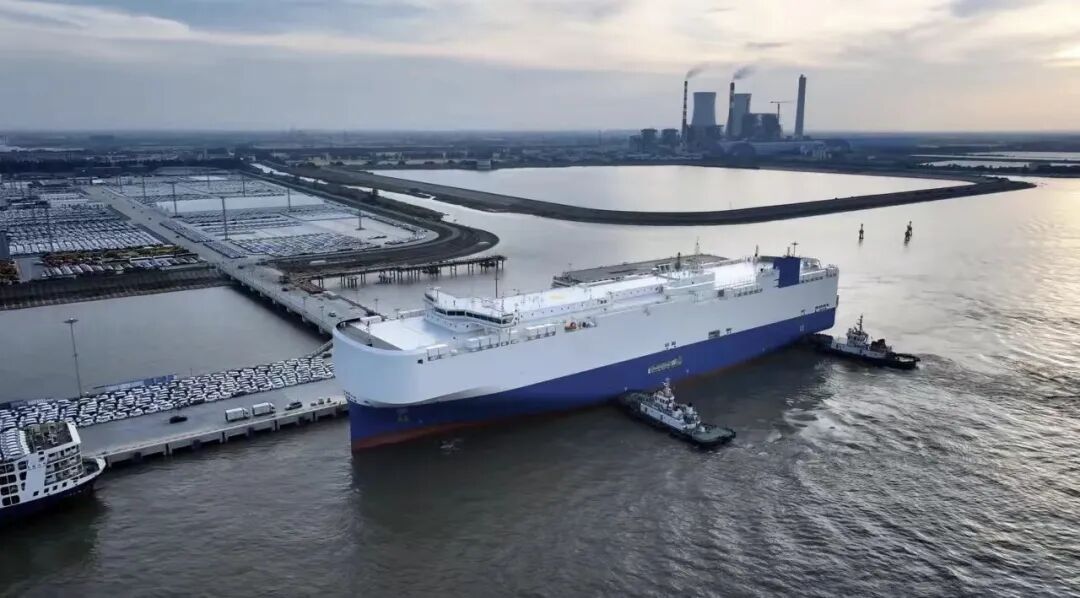
Ro-Ro ship loaded with Chery's export vehicles (Image source: Chery Automobile)
It is noteworthy that with the rapid expansion of overseas sales, the going-global model of Chinese automakers is evolving from simple "general trade export of complete vehicles" to a comprehensive "overseas localization plant construction and full industry chain output." Nissan's transfer of assets to Chery and the opening of contract manufacturing capacity is a microcosm of this qualitative transformation.
The Rosslyn plant in South Africa, which was officially handed over to Chery on July 3, was established in 1963 and was once Nissan's sole complete vehicle production base in South Africa, carrying half a century of local complete vehicle manufacturing heritage. As Nissan strategically contracted, Chery signed an agreement with it in early 2026 to take over all manufacturing assets, including the plant, stamping production lines, and supporting land. This veteran automobile manufacturing plant will embark on a new chapter under Chery's stewardship, marking Chery's transition from an importer to a local manufacturer in South Africa.
In the heart of Europe, multinational giants have even lowered their profiles and become "contract manufacturers" for Chinese brands. In June of this year, Nissan and Chery International UK signed a non-binding memorandum of understanding on cooperation, with Line 1 of its Sunderland Plant in the UK contract manufacturing complete vehicles for Chery starting from the 2027 fiscal year. This marks the first time a mainstream Japanese automaker has contract manufactured for a Chinese independent brand in Europe's core market, signifying a reversal in Sino-foreign production capacity cooperation.
Revitalizing overseas idle production capacity through diverse methods such as acquisitions, contract manufacturing, and strategic cooperation is becoming a shortcut for leading Chinese automakers to establish global production systems. From Great Wall Motors' acquisition of General Motors' Rayong plant in Thailand in 2020 to BYD's takeover of Ford's Brazilian base in 2023, from Chery's acquisition of Nissan's idle plant in Barcelona, Spain, in 2024 to XPENG Motors' acquisition of equity in an Indonesian electric vehicle manufacturing entity in 2025, Chinese capital is efficiently integrating automotive industry assets on a global scale.
According to a forecast by consulting firm AlixPartners in April this year, Chinese automakers plan to establish production layouts in at least 16 countries, with overseas production volume surging from 1.2 million vehicles in 2025 to 3.4 million vehicles in 2030. This deep production capacity布局 (layout) effectively circumvents increasingly severe trade tariff barriers and achieves true industrial capability going global.
After more than a decade of technological accumulation and industrial deepening, the Chinese automotive industry has shed its follow-the-leader development model, constructed a robust new energy full industry chain system, and formed advantages in areas such as three-electric technologies, intelligent cockpits, high-level autonomous driving, and vehicle cost-effectiveness. In the intelligent track, high-end configurations such as highway navigation, urban intelligent driving, and all-domain intelligent cockpits are now widely available in mainstream Chinese models priced around 200,000 yuan.
The leapfrog development of Chinese intelligent electric vehicles has not only rewritten the competitive rules of the global automotive industry but also reshaped the global industry chain division of labor model. For decades, cooperation between Chinese and foreign automakers has long adhered to the logic of "exchanging market for technology," with foreign automakers coming to China to build plants, output technology and brands, while China ceded the domestic market and provided manufacturing capacity. However, now the industrial roles of both sides are beginning to interchange. Chinese automakers, armed with self-developed core technologies and mature brands, are going global, while overseas traditional automakers and idle plants are transforming into contract manufacturing support points and localization carriers for implementing Chinese technologies. Under the global trend of capital, technology, and production capacity circulation, a new global automotive industry landscape of "Eastern technology, Western production capacity" is taking shape.
-
![]()
Optical Communication and Robot Vision: OFILM’s Bold Transformation Amid a 460 Million Yuan Loss
-
![]()
From 100,000-GPU Computing Might to Industrial Efficiency: The Logic Behind AI4S-Driven Intelligence
-
![]()
OpenAI, Grok, and Meta Release Three Major Models: Who is the King of Cost-Effectiveness?
-
![]()
Momenta’s Backers in the Auto Industry Crave Blockbusters More Than Stock Dividends
-
![]()
China’s AI Computing Power: Embracing a New Organizational Paradigm
-
Same Bloodline, Two Fates: How Two AI Giants Took Divergent Paths?
-
![]()
Combined Market Value Plummets by Nearly One Trillion Yuan: What’s Behind the Decline of Two AI Powerhouses?
-
![]()
Detailed Explanation of the Impact of Hikvision Guanlan Coding on Video Quality and Key Frame Quality