After Leapmotor’s Monthly Sales Surpass 100,000 Units, Netizens Ponder: Who Will Be the Next Newcomer to Achieve Both Scale and Profitability?
 08/03 2026
 409
409
On August 1, several emerging automakers unveiled their vehicle delivery figures for July, creating a mixed bag of celebrations and concerns. Dark horses surged ahead while established players held their ground, making the fierce competition in the market palpable.
Xiaomi Auto was likely the first to announce its data at 9 a.m., continuing to exceed 30,000 units. However, Leapmotor stole the spotlight by breaking through the 100,000-unit delivery barrier for the first time, setting a new delivery record. NIO and XPeng maintained steady sales within the 30,000 to 40,000 unit range, while Li Auto experienced year-over-year and month-over-month declines for three consecutive months.
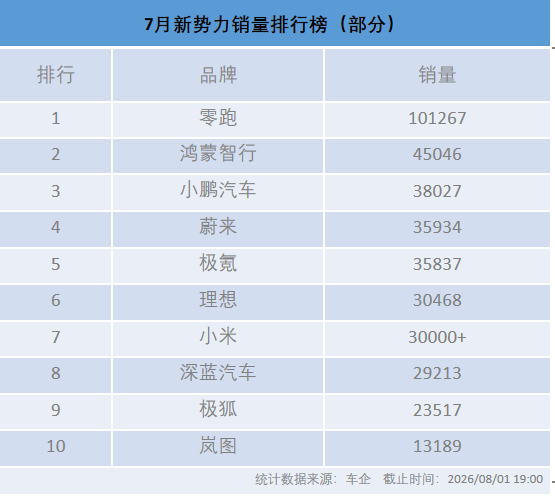
NIO delivered 35,934 new vehicles in July, marking a 71.0% year-over-year increase. In the first seven months of 2026, it delivered a total of 227,057 new vehicles, a record high and a 68.0% year-over-year surge. XPeng Group delivered 38,027 new vehicles in July, up about 4% year-over-year, with global cumulative deliveries exceeding 1.2 million units as of July. Li Auto delivered 30,468 new vehicles in July, bringing its cumulative deliveries to 1,764,155 units as of July.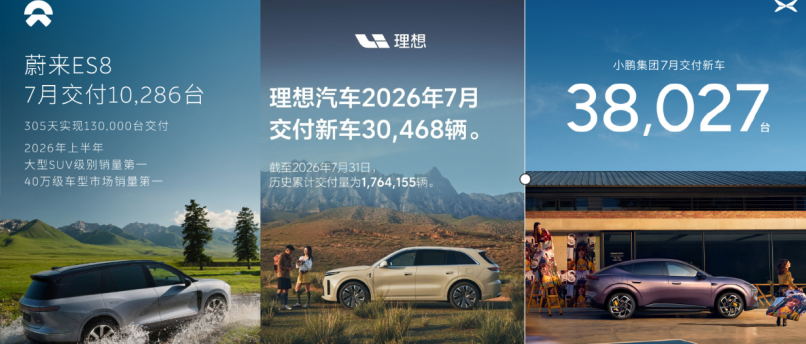
Leapmotor has emerged as the first new automaker to surpass 100,000 monthly sales, continuing to capture the mainstream market with its cost-effective strategy and officially cementing its scale advantage.
The sales growth is largely attributed to Leapmotor’s comprehensive product lineup across various price ranges. The A10 sold nearly 30,000 units monthly, the C10 maintained stable global monthly sales above 10,000 units, the B series sold over 20,000 units in July, and the D19’s deliveries exceeded 10,000 units in the same month.
Xiaomi Auto continued to exceed 30,000 units, maintaining a stable delivery threshold above this figure for four consecutive months, achieving normalized deliveries for a single model.
Whether it can subsequently reach CEO Lei's annual sales target will hinge on the success of the Pengcheng model, which will determine the upper limit of the Xiaomi brand's potential.
Harmony Intelligent Mobility delivered 45,046 units in July, a 5.66% year-over-year decrease and an 11.03% month-over-month decline, with cumulative deliveries of 286,000 units from January to July, up 13.7% year-over-year. Setting aside the sales controversy, Huawei's software prowess is truly unparalleled in China, with every company eager to ally with this tech giant, whether one likes it or not—that's the reality.
In July, Zeekr delivered 35,837 units, up 111% year-over-year, setting a new record high.
Despite the impact of the "going abroad" trend, Zeekr's high-end brand strength has indeed taken shape, as evidenced by its sales growth trajectory.
In July, Shenlan Auto's global sales reached 29,213 units, up 7.52% year-over-year; Arcfox delivered 23,517 units; Voyah delivered 13,189 units.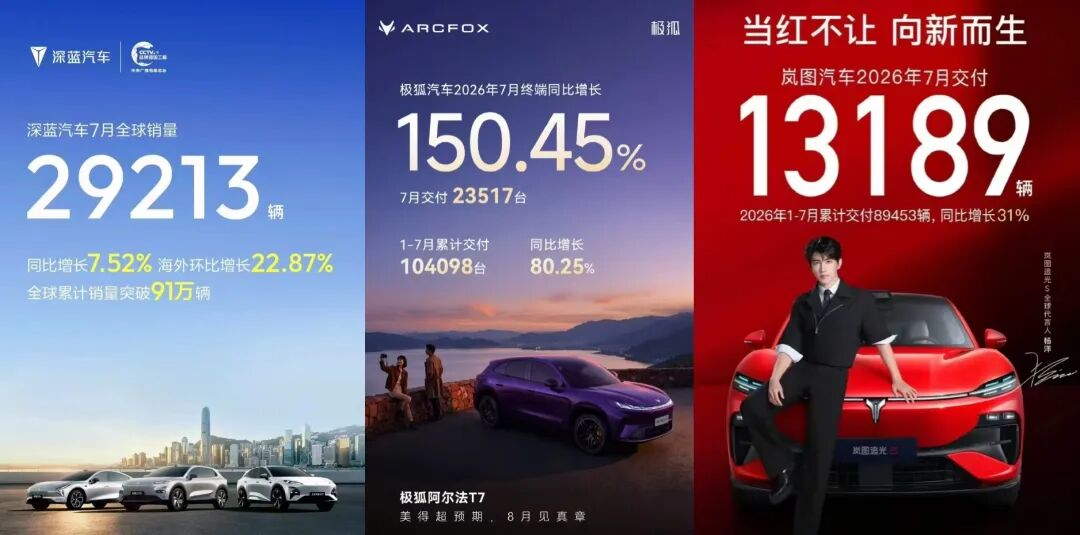
Apart from the stable performance of the 'unstoppable and innovatively reborn Voyah,' another Wuhan-based automaker, eπ Tech, achieved 139,919 deliveries from January to July. Especially with the delivery of the eπ M8 'Golden 6-Seater,' its online popularity rivals that of the 'Aito M8,' with orders exceeding 10,000 in just 4 hours after launch. Priced at 169,800 yuan, its configuration is particularly well-suited for middle-aged bloggers like me who lead practical lives, offering an excellent balance of affordability, prestige, and comfort.
However, beneath the lively delivery reports, industry concerns loom large. Today's new energy vehicle market is no longer in the early era of "burning money for scale." Monthly sales of 100,000 units are indeed cause for celebration, but scale is merely an entry ticket. For newcomers, only those who can achieve both scale and profitability after the tide recedes can truly stand the test of time. Do you think sales scale or profitability is more crucial in the next round of competition among new players? Feel free to share your thoughts in the discussion area...
-
![]()
Did the US Really Film Its Moon Landing in a Studio? 57 Years On, Doubts Persist, but the Irrefutable Evidence Lies Beyond the Photos
-
![]()
The Final Battle of Large Models
-
![]()
Battle of Defense and Offense Between Xiaomi and Li Auto in the Cooling Extended-Range Market
-
Top 10 AI Application Enterprises: Fast Growth & High Profitability
-
![]()
Thousands Rally as Audi’s Flagship Plant Faces Threat of Closure Amid Volkswagen Criticism
-
![]()
State-Owned Capital Makes Exclusive Foray into Bluetooth Satellite Sector, Propelling ‘Lanling Xingtong’ to Secure Key Financing for Large-Scale Network Deployment!
-
![]()
A Deluge of New Cars Leaves Consumers Overwhelmed
-
![]()
Analysis of Service Reputation Index in the First Half of 2026