3X Salary Poaching, 40 Executives Depart: Autonomous Driving Talent is Batch-Producing Embodied AI Leaders
 08/24 2026
 474
474
Introduction
Recently, a report by 36Kr mentioned that Sun Xinyang (pseudonym) was working steadily in intelligent driving at XPENG. However, since last spring, the people around his workstation have been changing faster than PPT slides. Last month, the colleague sitting here would post on WeChat Moments next month: “Joined Unitree, starting my embodied AI journey.” Headhunters called one after another: “If you don’t switch now, it might be too late.” “Staying here will make you less valuable over time.” This sounds harsh, but it’s not just a scare tactic. Over the past two years, the intelligent driving industry has seemed to lose its foundation, with waves of talent flowing to robotics companies. According to incomplete statistics from Late Auto, at least 20 core leaders and business heads from automakers and intelligent driving companies have switched to embodied AI in the past two years. Statistics from OFweek Mind AI Society show that nearly 40 core executives and technical leaders in China’s intelligent driving field have transitioned to the embodied AI sector. WLR (WeChat ID: WLR) believes this is no longer just individual job-hopping but a structural “talent migration.” (For further reading, click: “The Invisible People Behind Autonomous Vehicles: A Talent Gap in the Millions”)
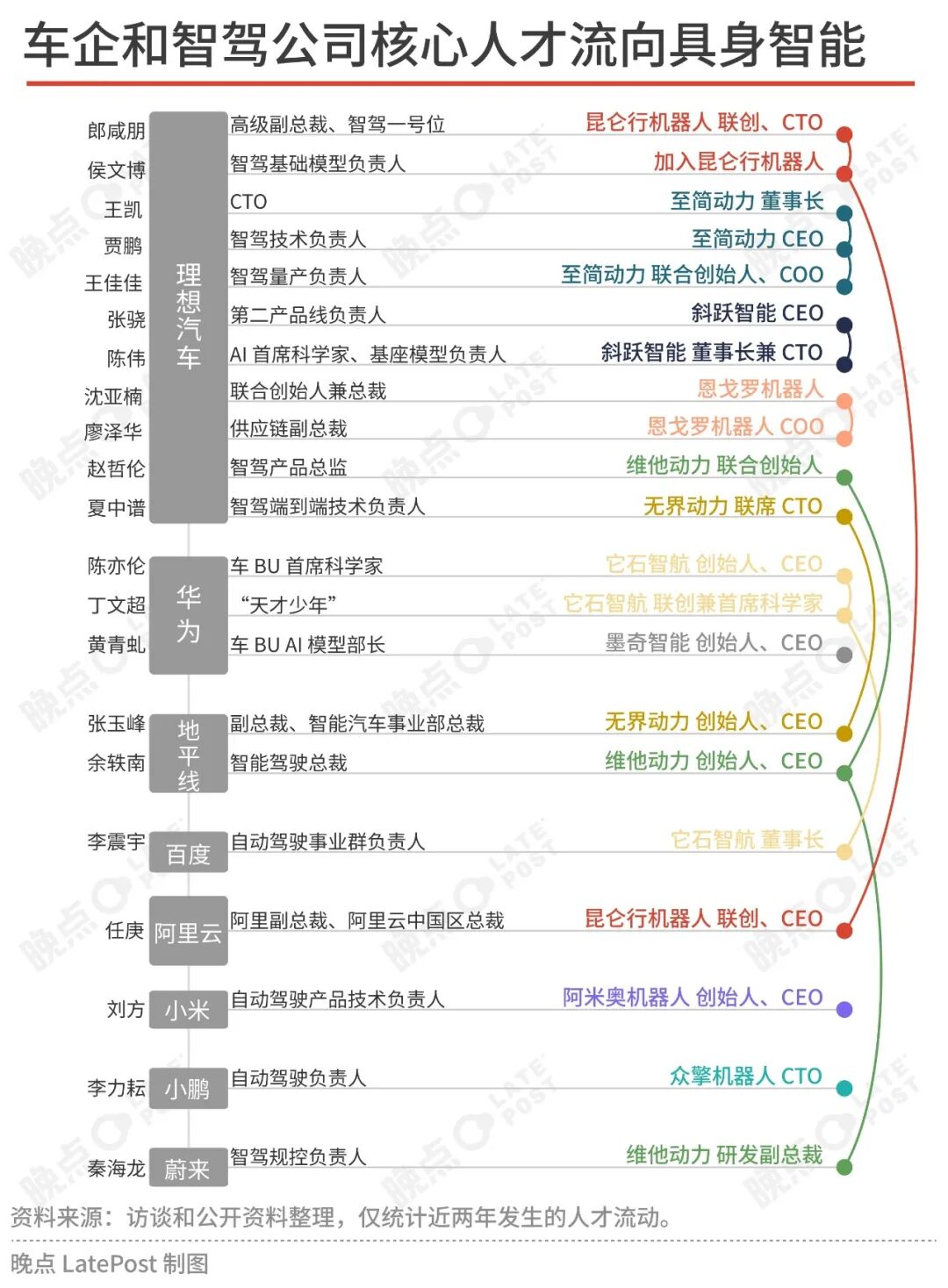
Image Source: Late Auto
I. Pushed and Pulled: Why Intelligent Driving Professionals Are Turning En Masse
Behind this migration lies the combined force of two trends.
The “push” comes from price wars in the automotive industry.
From 2024 to 2025, BYD’s slogan “Electric is Cheaper than Gas” ignited an industry-wide price war, reducing per-vehicle gross margins from double digits to just 3-4%.
Intelligent driving departments transformed overnight from “competitive moats” into “cost centers,” with budget slashes and team optimizations becoming commonplace.
The commercialization of L4 autonomous driving Robotaxi services has been repeatedly delayed, with long-tail challenges proving difficult to overcome and capital market patience running thin.
Ren Lihua, Deputy Director of the Talent Exchange Center at the Ministry of Industry and Information Technology, revealed at the 2026 China Auto Forum that the overall talent gap in the new energy vehicle industry reached 1.03 million in 2025, with a supply-demand ratio of just 0.38 for intelligent driving engineers—meaning three jobs compete for one qualified candidate.
However, at the same time, hiring for pure application-layer software development roles plummeted by 74% year-on-year in 2026, while job postings for perception algorithm-related positions dropped by over 40% within a year.
A talent gap and job reductions coexist—what’s lacking isn’t people but the “right people.”
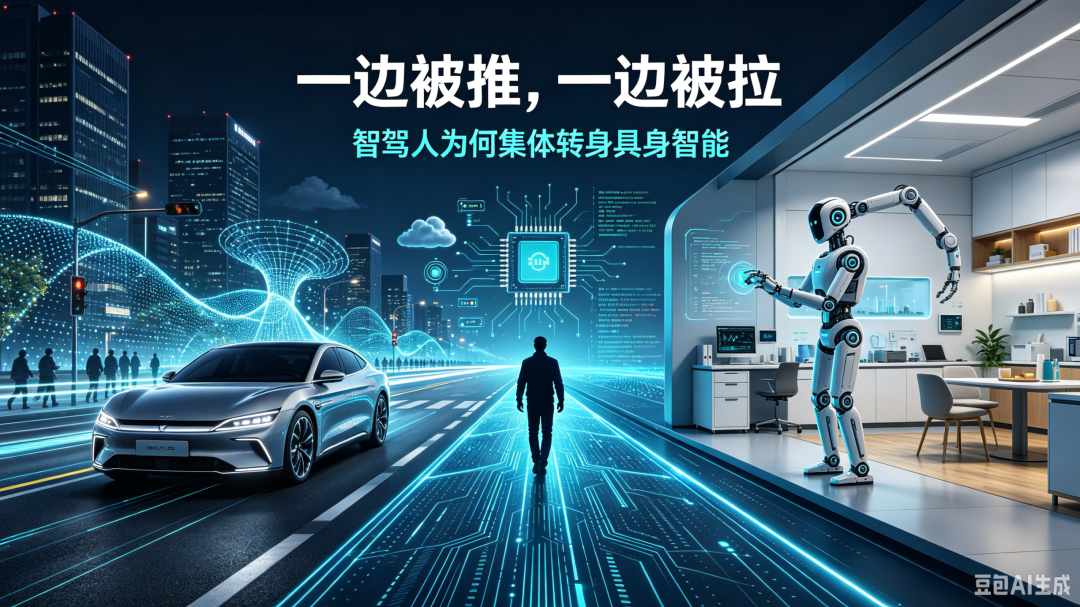
The “pull” comes from the boom in embodied AI.
In the first quarter of 2026, the domestic embodied AI sector disclosed over 50 financing deals, with cumulative funding reaching approximately 20 billion yuan, a nearly 60% year-on-year increase and an all-time high.
Unitree Technology went public on the STAR Market with an IPO valuation of approximately 61 billion yuan, its market cap briefly exceeding 440 billion yuan on the first trading day; Zhiyuan Robotics’ valuation surpassed 20 billion yuan. According to incomplete statistics, at least 26 embodied AI companies have joined the “10 billion yuan club.” Meanwhile, hiring in this field surged from a 2025 index of 36 to 579 from January to April 2026—a 15-fold increase—with average monthly salaries climbing to 62,000 yuan. One industry is shedding talent while the other absorbs it. These two groups happen to be the same: automotive professionals who understand the physical world, closed-loop control, and data flywheels.
II. Why Automotive Professionals, Not Internet Talent?
A great question! This involves the underlying logic of industry and talent.
At the height of the frenzy, robotics companies could poach automotive intelligent driving engineers with triple salaries.
Some robotics company CEOs personally approved offers, including solving mortgage loans to attract co-founders.
Today, such extreme stories are rarer, but a 50% salary increase remains the baseline. Staying in intelligent driving likely means only a 30% raise.
Technologically, autonomous driving and embodied AI share a vast amount of foundational technology.
Both rely on a closed-loop system of perception, decision-making, and execution, requiring real-time environmental modeling through massive sensor data.
Concepts like VLA (Vision-Language-Action models), world models, end-to-end large models, and data flywheels are already widely applied in autonomous driving, making their migration to robotics logically seamless.
On May 13, 2026, Li Xiang, founder of Li Auto, stated explicitly in a public interview with Luo Yonghao: “Autonomous driving is the first half of embodied AI; general-purpose humanoid robots are the second half.”
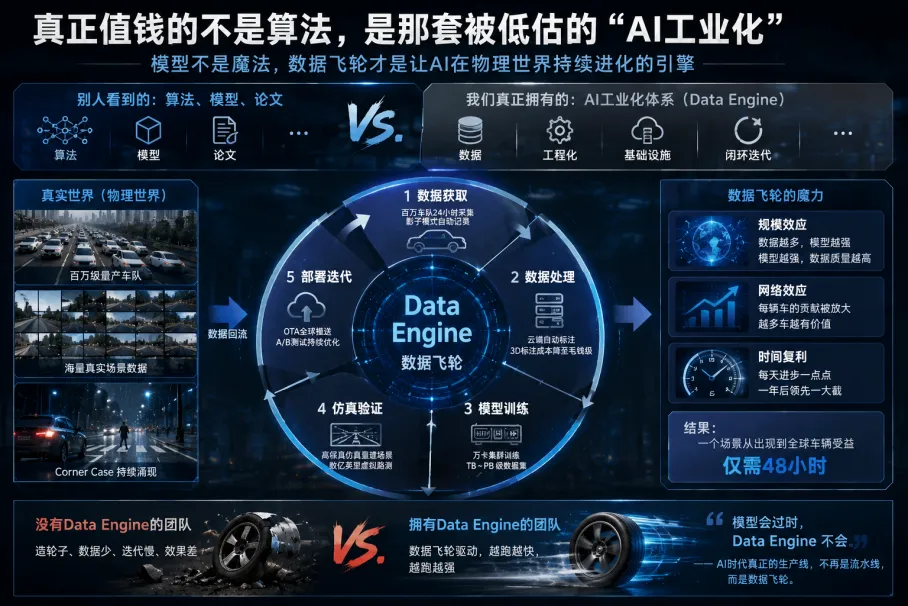
Image Source: Automotive Electronics & Software
A deeper difference lies in what they handle: Internet AI processes information, while Physical AI interacts with the physical world.
Mistakes in Internet AI carry minimal costs;
A single error in Physical AI could mean a human life or a destroyed device.
This extreme demand for safety, reliability, and real-time performance is deeply ingrained in every automotive engineer’s DNA.
What intelligent driving talent brings to embodied AI isn’t just reusable code but a complete methodology honed on the autonomous driving battlefield.
III. From Li Auto to Horizon Robotics: A Growing List
This list keeps expanding.
Li Auto has the largest contingent.
Former Li Auto Intelligent Driving President Lang Xianpeng founded Kunlunxing Robotics, completing three funding rounds within 90 days of registration and achieving a valuation exceeding $1 billion, joining the ranks of embodied AI unicorns. According to the Beijing E-Town official website, Lang is “the only AI leader in the embodied AI field to have successfully scaled autonomous driving from ‘0 to 1 to 100.’” Former Li Auto CTO Wang Kai and Intelligent Driving Head Jia Peng co-founded Zhijian Power, securing five funding rounds within six months, raising over 2 billion yuan, and reaching a valuation exceeding $1 billion. In the past six months alone, Li Auto has lost eight core executives, most of whom moved to the robotics sector.
Horizon Robotics also saw dense (intense) departures.
At least 14 core technical and management personnel from Horizon Robotics have left to start ventures, with 13 entering the embodied AI sector.
Employee #005, Yu Yinan, founded Vita Power; General Manager of the Intelligent Cockpit Product Line, Niu Jianwei, established Dingdang Power; and former Head of Visual Perception Technology, Huang Guan, founded Jijia Vision.
One investor put it bluntly: “People from autonomous driving have an easier time raising money in embodied AI than continuing in automotive.”
Huawei/Baidu alumni are also leaving decisively.
Former Huawei Car BU CTO for Autonomous Driving Systems Chen Yilun teamed up with former Baidu Intelligent Driving Group President Li Zhenyu to found Tasai Robotics, raising $120 million in its angel round—a domestic record for embodied AI angel funding.
Former XPENG Vice President Li Liyun became CTO of Zhongqing Robotics. Former WeRide COO Zhang Li also ventured into embodied AI, co-founding Zhuji Power.
IV. From 90 to 20: The Window of Opportunity Is Closing
An industry insider describes the current state:
Intelligent driving is stuck refining from 90 to 95 points, where every 0.1% improvement requires dozens of people working for half a year, with diminishing returns;
Embodied AI is racing from 20 to 60 points, where every increment represents massive progress.
This “shift from high scores to low scores” gives automotive professionals a natural head start.
Initially, anyone with autonomous driving experience could join a robotics company, doubling their salary and receiving stock options based solely on their automotive R&D background.
But the window is closing.
A year later, the criteria have changed: Robotics companies now only want technologists with VLA (Vision-Language-Action) experience or even hands-on robotics experience.
Chen Wei, former Chief AI Scientist at Li Auto, predicts the window will close by 2028.
One interviewer admitted preferring fresh graduates over “veteran intelligent driving professionals” because experience had become a burden. “They immediately want to build data flywheels and deploy thousand-card GPU clusters, but robots can’t even walk steadily yet.”
As one career switcher put it: He hasn’t left the automotive industry; it has simply sent him to the next stage in another form.
In conclusion, WLR (WeChat ID: WLR) believes:
As intelligent driving in the automotive industry shifts from a “star business” to a “cost center,” embodied AI is taking the baton as the next major battleground for physical AI.
And at the forefront of this battlefield stand those who have just stepped out of the automotive industry.
What do you think? References: Media reports from 36Kr, Late Auto, Automotive Electronics & Software, Mind AI Society, and Company Research Lab.
#WLR #AutonomousDriving #SelfDrivingCars #DriverlessVehicles
-
![]()
Can Domestic Autos Still Hold Their Own Against Joint Venture Brands?
-
![]()
Domestic Cars Priced Above 300,000 Yuan Are Gaining Ground in Chengdu
-
![]()
BBA Takes a Leap of Faith: No Sales, No Tomorrow
-
![]()
Chengdu Unfaded: BYD and Geely Vie for Championship While the Weak Exit
-
![]()
3X Salary Poaching, 40 Executives Depart: Autonomous Driving Talent is Batch-Producing Embodied AI Leaders
-
![]()
Apple’s Foldable iPhone and Huawei’s Straightened Pura X: Two Paths, One Vision
-
![]()
Dong Yuhui Departs with Traffic, Yet East Buy Crafts a Profit-Generating Engine
-
![]()
Did Alibaba Say AI Investments Would Pay Off in Three Years, Then Turn Around and Ask Shareholders for HK$80 Billion to 'Tide Over'?