CHN Energy Teams Up with Chery, Further Strengthening Green Power Alliance Between Power Generation and Auto Companies
 08/24 2026
 469
469
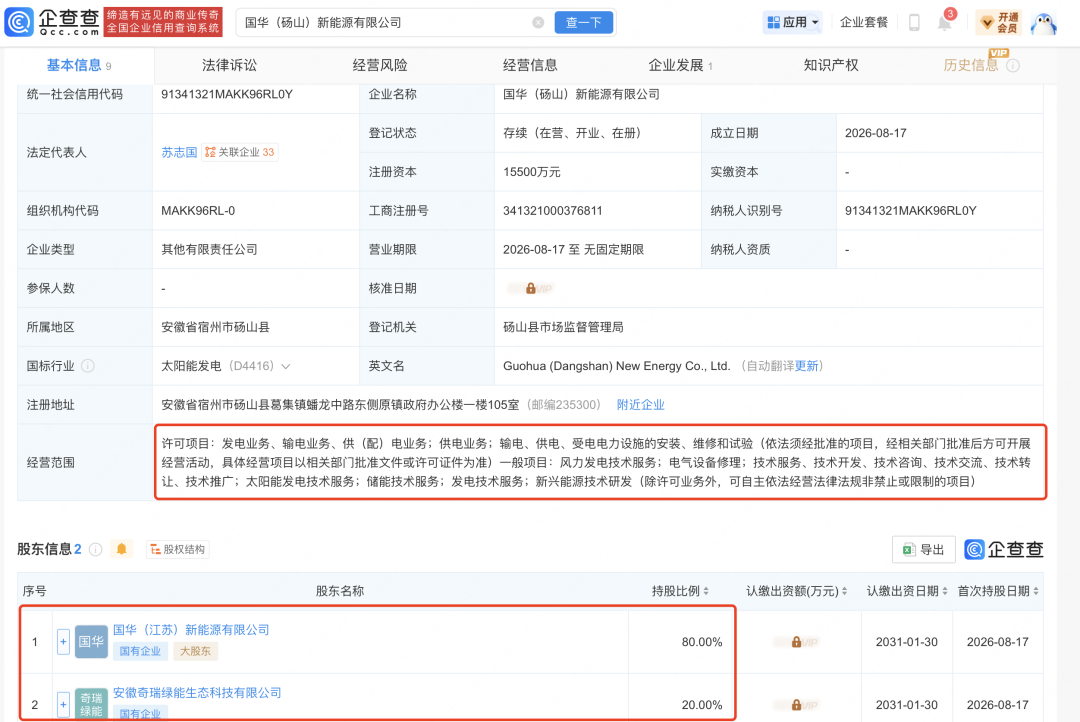
Recently, Guohua (Dangshan) New Energy Co., Ltd. was registered in Dangshan County, Suzhou City, Anhui Province, with Su Zhiguo as its legal representative and a registered capital of 155 million RMB. The company is jointly held by Guohua (Jiangsu) New Energy Co., Ltd., a subsidiary of China National Energy Group, and Anhui Chery Green Energy Ecological Technology Co., Ltd., a subsidiary of Chery Automobile, with shareholding ratios of 80% and 20%, respectively. Its business scope covers solar power generation technology services, wind power generation technology services, energy storage technology services, as well as power generation, transmission, supply, and distribution businesses, and the research and development of emerging energy technologies.
From the perspective of shareholder backgrounds, the controlling shareholder, Guohua (Jiangsu) New Energy Co., Ltd., was established in August 2025 with a registered capital of 1 billion RMB. It is a tertiary subsidiary 100% controlled by China National Energy Group through Guohua Energy Investment Co., Ltd., positioned as the new energy investment platform for China National Energy Group in Jiangsu and the five eastern provinces, with plans to invest 30 billion RMB in wind power, photovoltaic, and integrated smart energy projects within three years.
The other shareholder, Anhui Chery Green Energy Ecological Technology Co., Ltd., formerly known as Wuhu Ruisheng Energy Technology, was established in 2021 and expanded its business scope to include energy storage technology services, charging pile sales, and battery manufacturing after renaming in January 2024. Notably, just two days before the establishment of the Dangshan company, Chery registered Green Energy Smart Carbon Co., Ltd. in Shanghai with a registered capital of 20 million RMB, indicating an accelerated pace of Chery's energy sector layout (layout).
From an industrial logic perspective, the essence of this collaboration is a deep integration between the power generation and consumption sides. China National Energy Group possesses vast new energy installed capacity assets, but the current core challenge in the new energy power industry lies in the high pressure on grid peak shaving and the high risk of wind and solar curtailment. Relying solely on grid-connected transmission not only faces downward pressure on electricity prices but is also constrained by the capacity bottlenecks of transmission and distribution channels.
By establishing a joint venture with Chery, China National Energy Group can secure the massive electricity load from Chery's manufacturing bases, supply chain factories, and even future charging and battery swapping infrastructure at the source, forming a closed-loop system integrating power generation, supply, and consumption, and eliminating concerns about green power consumption. For Chery, with the rapid growth in production and sales of new energy vehicles, electricity demand continues to rise due to battery production, factory operations, and charging network expansion.
Leveraging China National Energy Group's expertise in wind and solar power plant construction, large-scale energy storage configuration, and grid-connected dispatching, Chery can obtain assured green power quotas and green power certificates at a lower cost, while upgrading its manufacturing bases into zero-carbon parks, providing low-carbon compliance support for product exports. From a location perspective, Dangshan, located in the northern Anhui plain, offers abundant space for agrivoltaic and distributed wind power development, enabling the provision of low-cost clean energy supplies to the densely distributed new energy vehicle industry clusters within Anhui Province.
Moreover, the fact that both companies share the same legal representative, Su Zhiguo, indicates a Collaboratively advance (synergistic advancement) between Guohua (Jiangsu) New Energy's new energy investment layout (layout) in the eastern China region and Chery's energy strategy. From a broader industry trend perspective, this collaboration reflects an accelerating industrial phenomenon: the competition in new energy vehicles has transcended the boundaries of traditional manufacturing, with auto companies shifting from mere 'heavy electricity users' to 'power generation participants'.
When power generation companies require stable consumption scenarios and auto companies need assured green power supplies, deepening their interests through equity cooperation is emerging as a new path distinct from traditional power purchase agreements. Whether this model can be replicated and promoted in more regions is worth keep following (continuous attention).
-
![]()
Exploring MiniMax Design: Can Video Editing Be as Simple as Speaking?
-
![]()
Why Can SenseTime Achieve Profitability While CloudWalk Still Faces Challenges, Despite Both Adopting Large Models?
-
![]()
Domestic Car Chassis Revolution Part 3: Suspension Systems Transform Vehicle Posture, from Vibration Absorption to Active Force
-
![]()
Hainan is Going on a Crazy Satellite-Building Spree
-
![]()
Optics Determines Success in the XR Era: Wafer Production Reaches Millions, Industry Giants Join the Fray!
-
![]()
Zhejiang’s AI Industry Surges Forward: Who Will Be the Next Wave of ‘Tech Rising Stars’?
-
![]()
Disappointing, Utterly Disappointing, Falling Short on All Fronts. Yet, Brighter Days Lie Ahead...
-
![]()
New Cars Launched at Chengdu Motor Show: Domestic Brands Ascend, Joint Ventures Concede, and Intelligent Driving Goes Rural