Splashing Out 1 Billion Yuan! Why is This 'Little Giant' Doubling Down on the Optical Film Track?
 02/03 2026
 728
728
On February 2, the Ningbo Qianwan New Area successfully introduced an optical film production base project with a total investment exceeding 1 billion yuan, funded by Changxin New Materials Technology (Shanghai) Co., Ltd. (referred to as 'Changxin New Materials').
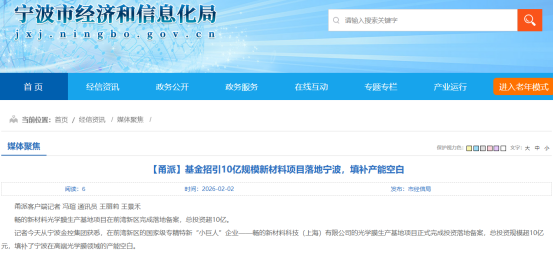
The project will be constructed in two phases, covering a total land area of 80 acres and a building area of nearly 100,000 square meters. Trial production of the thousand-layer film coating production line is expected to commence in the fourth quarter of 2026. Upon full operation, the project will achieve an annual production capacity of 13,000 tons of optical-grade films, with an estimated annual output value exceeding 1.5 billion yuan.
What kind of enterprise is Changxin New Materials? Why does it dare to invest over 1 billion yuan in capacity expansion?
Founded in 2017, Changxin New Materials is a national-level 'specialized, sophisticated, and innovative' little giant enterprise, focusing on the research and development, production, and sales of optical and electronic nanomaterials.
Changxin New Materials boasts a strong core team, with over 30 research and development personnel holding master's or doctoral degrees. The team comprises talents with composite backgrounds in industrial research. Led by founder and CTO Zheng Wen, the team has developed several core products, such as nano thermal insulation materials, electronic privacy films, PET thousand-layer films, and nano nickel pastes, successfully breaking foreign technological monopolies.
Leveraging nano-scale precision control technology and composite optical structure design capabilities, Changxin New Materials has created a high-end product matrix with composite characteristics, including nano thousand-layer films and electronic optical films. Currently, Changxin New Materials offers product lines such as MLCC electrode nano Ni paste, BOPET thousand-layer optical films, electronic privacy films, and nano thermal insulation materials. These products have been widely applied in strategic emerging industries, including MLCC, electronic displays, new energy, automotive, semiconductors, construction, packaging, apparel and textiles, and consumer electronics, gradually achieving import substitution across multiple domains.
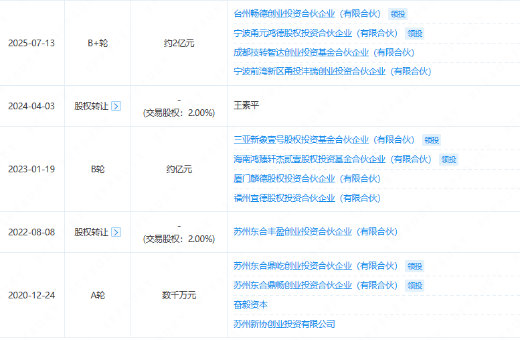
In July 2025, Changxin New Materials completed a new round of financing totaling nearly 200 million yuan, providing sufficient financial support for capacity expansion. This round of financing was led by the Ningbo Yongyuan Hongde Equity Investment Partnership (Limited Partnership) under Hongfu Assets and the Taizhou Changde Venture Capital Partnership (Limited Partnership). To date, Changxin New Materials has completed five rounds of financing.
In fact, Changxin New Materials' investment is not an isolated case. Recently, a wave of capacity expansions has emerged in the domestic optical industry, with multiple major projects progressing simultaneously.
In Hefei, Anhui, the Xinmei Materials Xinzhan Optical Functional Film Project successfully completed equipment relocation in December 2025 and is expected to commence trial production in April 2026.
In Jiangmen, Guangdong, the optical film material project invested by Delixi Group and operated by Jingzhi Irruo commenced construction in November 2025. The first phase of the project is expected to be completed and commence production in the first quarter of 2026.
In Neijiang, Sichuan, the Sichuan Guangsheng Special Optical Fiber and Supporting Optical Device Processing and Trade Base Project is under accelerated construction. Upon full operation, the project is expected to achieve an annual production capacity of 1.7 million meters of special optical fibers and deep-processed products, as well as 15,000 units of various optical devices, with an annual output value of approximately 2 billion yuan.
Behind this round of optical material capacity expansions lies the concentrated release of multiple industrial drivers. The global optoelectronic industry's shift toward China has become a clear trend, reflecting a structural reshaping of the industrial chain. With capacity expansions by enterprises such as Changxin New Materials and Xinmei Materials, the Chinese optical industry will transition from quantitative growth to qualitative enhancement, continuously improving technological autonomy.
The transformation of the optical industry has just begun. With the gradual release of capacity and the gradual breakthrough of technological bottlenecks, the Chinese optoelectronic industry will establish a more complete and high-end supply chain system, potentially seizing the initiative in the global industrial transfer and technological competition.
-
![]()
Alibaba's AI Offensive: Over Half of Investment Allocated, Time to Reap Returns
-
![]()
Alibaba’s AI Push: Over Half of Investments Made, Time to Harvest Returns
-
![]()
Chinese Enterprises Going Global 3.0: From World Factory to AI Infrastructure Builder
-
![]()
Honor RobotPhone Review: Half Movie Camera, Half Robot
-
![]()
AI-Driven Cheating Surges in Universities! Online Exams Reduced to Mere Formalities, Degree Credibility on the Line
-
Insta360’s Decade in Panoramic Imaging: Making Cameras ‘Invisible’ and Returning Creation to the Masses
-
![]()
Foreign Media Claims Apple is Concentrating Resources on AI Development: Vision Pro and Siri Teams Lay Off 200 People
-
Big News! Huaneng and Huawei Hold Talks in Shenzhen with Ren Zhengfei in Attendance; Huawei Emerging as the 'Second Brain' of China's Energy System