Up Over 13%! Memory Giant Boosts Buyback to as Much as 5 Billion Yuan
 11/04 2026
 354
This morning, an announcement from Changxin Technology more than doubled the upper limit of its buyback plan. Chairman Zhu Yiming proposed raising the buyback amount from "no less than 1 billion yuan and no more than 2 billion yuan" to "no less than 2.5 billion yuan and no more than 5 billion yuan." This is the second buyback plan delivered by the memory leader just over 100 days after listing.
It is worth noting that the 5 billion yuan upper limit is also a first in STAR Market history. Over the past few years, single buybacks by STAR Market companies have mostly ranged from 200 million to 800 million yuan. Changxin's move not only sets a new board record, but based on the upper limit, it also accounts for 2.9% of the company's current circulating market value, placing it in a relatively high tier among tech stocks.
Looking back at the first plan, the board approved the buyback proposal on the evening of October 30, intending to use own funds or self-raised funds to repurchase shares through centralized bidding, with a price ceiling of 72.69 yuan per share. About half of the repurchased shares are intended for equity incentives and employee stock ownership plans, while no less than half of the remainder is intended for cancellation and reduction of registered capital. The latter directly reduces share capital and is more substantive for existing shareholders.
Most A-share buybacks ultimately flow to employee incentives, which, aside from implicit dilution, are hardly a return. Changxin locks the cancellation ratio at more than 50%. This ratio means that if the buyback is carried out at the maximum 5 billion yuan, at least half will genuinely be removed from share capital rather than returning to employee accounts under another name.
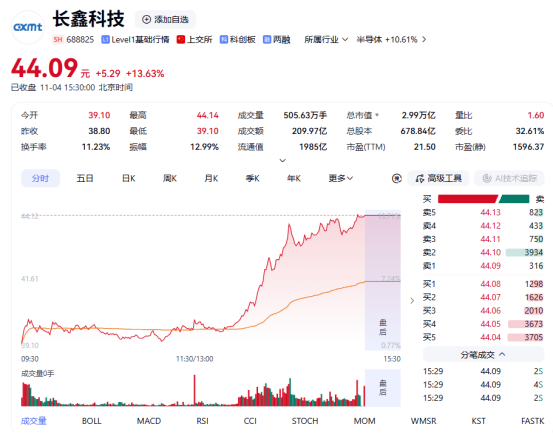
This increase occurred at the lowest point for the share price. On November 3, Changxin closed at 38.80 yuan, down 7% in a single day, hitting its lowest close since listing on July 27. Total market value fell back to about 2.63 trillion yuan, while on its first day of listing it briefly reached 3.3 trillion yuan. In just 100 days, more than 1 trillion yuan in market value had evaporated from the peak.
The next morning, as soon as the announcement came out, the share price rebounded nearly 2% during the call auction and rose more than 13% at one point during the session. By the close, it was at 44.09 yuan per share, and total market value was close to returning to 3 trillion yuan.
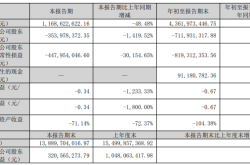
The confidence behind Changxin's buyback mainly comes from its performance. In the third-quarter report disclosed on October 31, the company achieved revenue of 269.024 billion yuan in the first three quarters, a year-on-year increase of 738.51%. Net profit attributable to the parent was 132.04 billion yuan, compared with a loss of 5.28 billion yuan in the same period last year, directly turning positive. In the third quarter alone, revenue was 118.714 billion yuan, a year-on-year increase of 613.18%, and net profit attributable to the parent was 54.435 billion yuan. Gross margin was about 89.53%, and R&D investment in the first three quarters was 11.071 billion yuan, a year-on-year increase of 73.03%.
Two controlled subsidiaries were the main drivers of this round of growth. In the third-quarter report, both Changxin Xinqiao and Changxin Jidian saw quarter-on-quarter revenue and profit growth of more than 50%, but the group's relatively low shareholding ratios in them somewhat dragged down the growth at the attributable-to-parent level. In August this year, Changxin Technology increased its capital contribution to Changxin Jidian, raising its equity ratio.
The root of the performance surge lies in DRAM supply and demand, and this round of demand has been almost entirely driven by AI computing power. The company judges that global memory remains in short supply, with major products such as DDR5 notably tight in server and enterprise markets. It has negotiated long-term supply agreements with multiple leading customers to lock in medium- and long-term demand. The company expects this cycle of prosperity has not yet ended, gross margin in the fourth quarter is expected to remain stable, and revenue will continue to grow.
Policy is also supportive. Regulators recently introduced a package of measures to stabilize the market and expectations, explicitly calling for optimizing the buyback system and making it easier for listed companies to use buyback tools. The effects have already appeared. As of November 4, 42 STAR Market semiconductor companies had disclosed buyback plans during the year, with a combined upper limit of 13 billion yuan, of which 24 were newly disclosed since October, totaling 10.65 billion yuan and crossing the 10 billion yuan threshold.
Chairman Zhu Yiming has also tied his personal interests closely to the company. The prospectus shows that he holds about 1.59 billion shares and has also provided 768 million shares free of charge for future employee incentives, with a three-year lock-up period. Two employee stock ownership plans cover 6,760 employee instances. Now, raising the buyback ceiling to 5 billion yuan is equivalent to using the dual credit of the company and its founder to absorb the sharp valuation pullback during the first 100 days after listing.
Today's 5 billion yuan is more like an attitude written into an announcement. How much the market is willing to buy into it will depend on how long the DRAM boom can last.
-
![]()
Baidu AI Redraws Its Battle Lines
-
![]()
Memory Prices Are Soaring, and Better Days Are Coming for Longcheer Technology and Its Peers
-
![]()
Audi's North-South Split: Volkswagen Can't Afford to Wait
-
![]()
Doubao Phone Hits the Market: ByteDance's Bigger Game on the Phone Ecosystem
-
![]()
OpenAI's Mysterious Ghost Model Briefly Appears, API Pulled Within Minutes
-
![]()
Shenzhen Computing Power Chip Company Secures Nearly 2 Billion Yuan in Back-to-Back Financing
-
![]()
Najing Technology Secures Series A+ Funding in the Tens of Millions of Yuan!
-
![]()
Q3 Net Profit Plunges 30,154.65%: Lianchuang Electronics' Cracks Can No Longer Be Hidden