Baidu AI Redraws Its Battle Lines
 11/04 2026
 539


Now that AI has grown into a substantial business, Baidu has begun to tackle the problems left behind by running multiple product lines in parallel.
On August 29, reports emerged that Baidu Smart Cloud had completed a round of organizational restructuring across its product and R&D teams. The former Platform Product Business Unit was renamed the Agent Business Unit, while some businesses were spun out. The MaaS and Qianfan-related product systems were moved into the Infrastructure Business Unit; Dazi, Miaoda, and Famo were placed under the Agent Business Unit; and the data team was transferred to the Intelligent Applications Business Unit.
The restructuring came as Baidu's AI business scale expanded significantly. On August 18, Baidu had just announced its second-quarter financial results: core AI business revenue reached 12.5 billion yuan, up 25% year on year, accounting for 50% of general business revenue. Baidu founder Robin Li said that AI has become Baidu's core business, further confirming Baidu's transformation toward an "AI first" strategy.
But as AI grew into a substantial business, the problems Baidu faces also changed. Over the past few years, Baidu rolled out model services, Agents, and AI applications one after another, continuously improving its AI products and capabilities across different layers. This year, more and more adjustments began to point to another question: how to reconfigure the products and businesses already rolled out to improve overall operational efficiency.
In early August, Baidu merged the R&D personnel and related resources of its internal office agent dodo into Dazi; at the end of the month, Smart Cloud redrew the business boundaries of MaaS, Agent, data, and industry applications. This represents two solutions Baidu has offered: consolidating products and capabilities that have already begun to overlap, and reallocating responsibilities for increasingly differentiated businesses according to business objectives. This is also a round of "addition and subtraction" occurring simultaneously at the product and operational levels.
01 Products first do subtraction
Baidu does not lack AI products.
In its first-quarter financial report this year, Baidu disclosed progress on several AI products, including the general productivity Agent Dazi, the AI application development platform Miaoda 3.0, the self-evolving Agent Famo 2.0, and Agent GenFlow 4.0. Each of these products had its own role.
But at this point, the cost of running multiple products in parallel also began to show. Some products produced by different teams began to overlap in capabilities and scenarios, leading to duplicated development and dispersed resources. Baidu therefore began to do subtraction on its AI products.
dodo is a typical example. It mainly served Baidu's internal employees, covering meetings, documents, enterprise knowledge, and R&D processes. Dazi launched in March this year, and in June its enterprise edition began entering scenarios such as enterprise knowledge, system integration, workflows, permissions, and team collaboration. One product was mainly internal, while the other began facing external users, but the knowledge, systems, and workflows they needed to handle overlapped. In early August, dodo-related R&D personnel and resources were merged into Dazi, after which Dazi continued to expand into professional workflows. On August 27, Dazi launched industry suites and skills for roles including finance and accounting, business and legal, product R&D, and operations and HR. dodo and Dazi were not a simple project merger, but rather a concentration of mature capabilities and R&D resources into a clearer external-facing product.
Baidu made more than one such adjustment. In June, Baidu merged scattered entry points such as the Ernie Bot web version, the Ernie App web version, and the Baidu Ernie Assistant web version into the unified Baidu Ernie website. On June 25, Baidu also announced that Qianfan Coding Plan would stop renewing subscriptions and gradually migrated AI coding-related packages to the more general Token Plan personal edition.
Similar consolidation of product capabilities also occurred at other major tech companies. In July, Alibaba integrated QoderWork, Wukong, and MuleRun; Tencent also adjusted QClaw-related businesses and teams into the department where WorkBuddy is located; in August, ByteDance merged the TRAE and Coze teams into the Doubao system. The products the companies kept were not exactly the same, but the direction was similar: after multi-line trial and error, concentrate overlapping office capabilities into clearer main entry points.
Data shows that in June 2026, the monthly active user scale of China's AI-native apps reached 499 million, up 85.4% year on year; Doubao, Qwen, and DeepSeek reached 382 million, 167 million, and 129 million MAU, respectively. Competition in AI applications has entered a market with hundreds of millions of users. Baidu's subtraction is also a choice after AI applications entered scale competition: continue to keep products with clear divisions of labor, while concentrating overlapping entry points, capabilities, and R&D resources into main products.
02 Operations do addition
Inside Baidu Smart Cloud, the direction of adjustment was completely different.
Baidu Smart Cloud undertakes most of Baidu Group's cloud computing and enterprise AI businesses. This adjustment took place inside Smart Cloud and dealt with how to redivide responsibilities among model services, Agents, and industry applications. To understand this change, one must first answer a question: if it is now time to split, why did the past few years consistently emphasize integration?
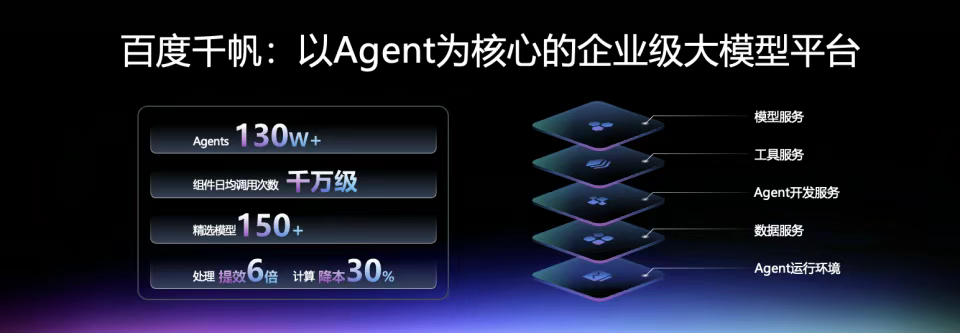
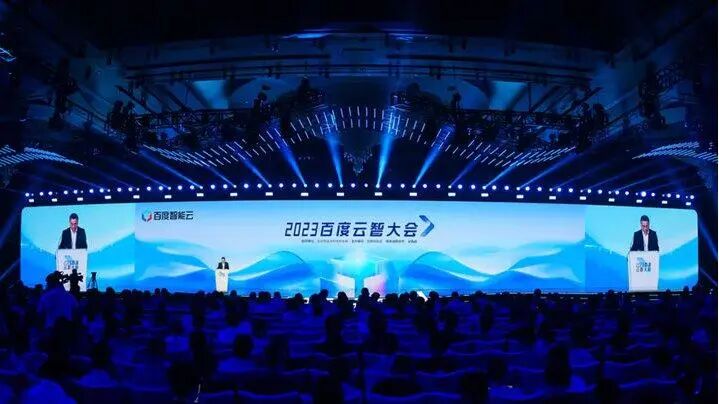
When the Qianfan large model platform was released in 2023, the main obstacle to large models entering enterprises was not just model capability. Enterprises also needed to connect their own data and knowledge bases, and needed tuning, deployment, tool calling, as well as development of Agents and specific applications. Therefore, Qianfan consistently emphasized "one-stop," putting model services, data, tools, and application development into a single platform. By the end of 2025, Qianfan had served more than 460,000 enterprises, and more than 1.3 million Agents had been developed on the platform.
The past few rounds of change mainly addressed how to put model, data, and application capabilities into the same product system. As the platform scale expanded, Baidu began to further divide the technical layers and product roles within this system.
At Create 2026 in May, Baidu Vice President Hou Zhenyu proposed rebuilding AI cloud infrastructure with Agent Native, further organizing capabilities such as computing power, models, sandboxes, and gateways into infrastructure oriented toward Agents. The technical architecture began to layer: upper-layer Agents are responsible for completing tasks, while the lower layer needs a stable, low-cost model and runtime environment. Baidu also disclosed that over the past year, China's average daily Token calls increased 13-fold. Model services increasingly face inference costs, resource utilization, and deployment scale directly.
In June, Qianfan launched the Token Plan enterprise edition. Enterprises can uniformly purchase and manage model invocation resources and view usage, permissions, budgets, and costs. Qianfan remains a one-stop enterprise AI platform, but its MaaS and model services increasingly show the characteristics of standard resources: enterprises need unified procurement, allocation, and accounting, while Baidu needs to continuously control inference costs and resource efficiency.
Financial data also shows that infrastructure and application businesses have already demonstrated different scales and growth states. In the first quarter of this year, Baidu AI Cloud Infra revenue was 8.8 billion yuan, up 79% year on year; second-quarter revenue was 7.3 billion yuan, up 50% year on year, of which GPU Cloud grew 283% year on year. During the same period, AI Applications revenue was around 2.5 billion yuan in both the first and second quarters, with second-quarter year-on-year growth of 3%.
By the end of August, this division of labor was further reflected in the organization. MaaS and Qianfan-related model services entered the Infrastructure Business Unit, focusing more on resources, cost, and scale; Dazi, Miaoda, and Famo entered the Agent Business Unit, focusing on DAU, MAU, retention rate, paying customers, and end-to-end task completion rate. The data team entered the Intelligent Applications Business Unit, placed together with Yijian, Hogee, Shengsuan, and industry applications such as transportation and finance. Take Baidu Yijian as an example: it has now accumulated more than 1,000 AI skills across more than 20 industries and more than 60 sets of scenario-based production lines. For such businesses, data ultimately needs to enter specific industry scenarios and be consolidated into reusable solutions, so the data team was placed closer to applications and customers.
The three businesses are still on the same AI chain, but their operational objects are already different. MaaS looks at cost and scale, Agent looks at users and payment, and industry applications look at customers and reuse. Baidu Smart Cloud's addition this time is to reallocate responsibilities for several types of businesses formerly concentrated in the Platform Product Business Unit according to different business objectives.
03 Collaboration becomes a new problem
But after responsibilities are clearly divided, a new problem emerges: these businesses originally depended on each other. If the three business units are separated, will overall efficiency be affected?
At least at the product level, Baidu did not split the customer experience into three parts along with the organizational structure. Qianfan remains a one-stop platform. Enterprises can still invoke models, use data capabilities, develop Agents, and access tools within the same platform. Dazi can also invoke Miaoda, Famo, and other Baidu services through mechanisms such as Skill.
What is truly difficult is internal collaboration. In Baidu's recent public recruitment for solution architect positions, the responsibilities simultaneously cover GPU, MaaS, Agent, and large model applications, and also require coordinating teams such as sales, product, R&D, and operations. This shows that even if the back end is divided into different business units, the delivery side still needs horizontal roles to reassemble these capabilities.
Internal management has not been completely separated either. After this adjustment, the Infrastructure Business Unit, Agent Business Unit, and Intelligent Applications Business Unit are led by Hou Zhenyu, Yin Dawei, and Ruan Yu, respectively, and all three ultimately report to Shen Dou, executive vice president of Baidu Group and president of the Smart Cloud Business Group.
From public information, Baidu has retained at least several layers of collaboration: at the product level, there is a unified entry point such as Qianfan; on the delivery side, there are cross-product solution roles; and the three business units ultimately converge on the same management line.
But such collaboration does not mean the new architecture will necessarily be more efficient. How will the three business units coordinate, and who decides the priority of requirements? After each has independent business objectives, will local efficiency improve while overall delivery actually slows down? Public information so far has not provided an answer.
Baidu's two adjustments in August are not contradictory: at the product level, subtraction consolidates duplicate capabilities; at the operational level, addition redraws responsibilities. This round of organizational adjustment has already been implemented, and it is now up to actual performance to determine whether this round of addition and subtraction is meaningful.
(The images and public data materials in this article come from the internet and public industry platforms. If there is any infringement, please contact us for timely modification.)
-
![]()
Baidu AI Redraws Its Battle Lines
-
![]()
Memory Prices Are Soaring, and Better Days Are Coming for Longcheer Technology and Its Peers
-
![]()
Audi's North-South Split: Volkswagen Can't Afford to Wait
-
![]()
Doubao Phone Hits the Market: ByteDance's Bigger Game on the Phone Ecosystem
-
![]()
OpenAI's Mysterious Ghost Model Briefly Appears, API Pulled Within Minutes
-
![]()
Shenzhen Computing Power Chip Company Secures Nearly 2 Billion Yuan in Back-to-Back Financing
-
![]()
Najing Technology Secures Series A+ Funding in the Tens of Millions of Yuan!
-
![]()
Q3 Net Profit Plunges 30,154.65%: Lianchuang Electronics' Cracks Can No Longer Be Hidden