Q3 Net Profit Plunges 30,154.65%: Lianchuang Electronics' Cracks Can No Longer Be Hidden
 11/04 2026
 417
Recently, the Q3 2026 report disclosed by Lianchuang Electronics brought the structural cracks in the automotive optics track to the surface.
In the first three quarters, the company's main business revenue was 4.362 billion yuan, down 32.78% year-on-year; net profit attributable to the parent company was -712 million yuan, down 1,498.13% year-on-year; net profit after deducting non-recurring gains and losses was -819 million yuan, down 2,346.99% year-on-year. Single-quarter Q3 revenue was 1.169 billion yuan, halved by 48.48% year-on-year; net profit attributable to the parent company was -354 million yuan, and net profit after deducting non-recurring gains and losses was -448 million yuan, with year-on-year declines reaching 1,419.52% and 30,154.65%, respectively.
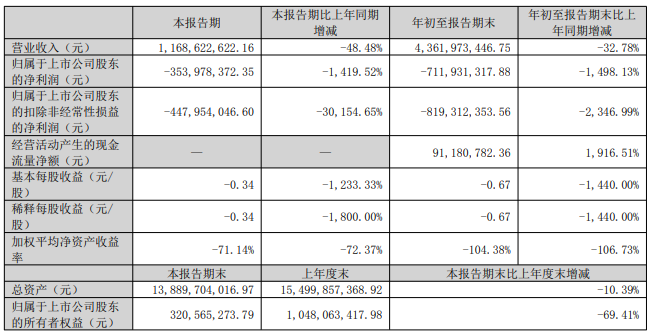
The company attributed the loss to a relatively high asset-liability ratio. To safeguard cash flow, it scaled down its overall business—compounded by rising memory chip prices, weakening downstream terminal demand, and fierce competition in consumer electronics.
But the real source of pressure lies within the automotive optics business: in 2025, Lianchuang Electronics' automotive optics revenue was still 3.072 billion yuan, up 49.1% year-on-year, but gross margin had already slid from 18.39% to 6.24% in the first three quarters of 2026. The overall gross margin in Q3 alone was only 2.87%, and the actual gross margin of the automotive business in the second half of the year is very likely below 10.15%.
The industry generally regards around 20% as the reference threshold for sustainable profitability in automotive lenses—and Lianchuang Electronics' automotive gross margin is not only far below this range, it is not even close.
When insufficient capacity utilization and rigid fixed depreciation act in tandem, it is only a matter of time before gross margin falls below the survival line. The utilization rate of the Hefei automotive industrial park was still below 70% in mid-2026, even though the company had projected in 2025 that it would reach full production by early 2026. The capacity ramp-up is far slower than expected.
Lianchuang Electronics is not without customer advantages. The company's automotive business has entered the automotive supply chains of Horizon, DJI, and Li Auto, and has formed a technology co-creation relationship with BYD spanning 4.0 to 5.0 optical solutions. The lens capacity of the Hefei automotive industrial park is configured according to customer demand. The problem is that an impressive customer structure has not translated into an improvement in the profit structure.
Lianchuang Electronics has product reserves in areas such as glass-plastic hybrid and high-pixel front view, but the depreciation burden from large-scale capital expenditure has become a reverse leverage on the income statement during the order contraction period. The company's proposal to "raise the utilization rate of automotive production lines and dilute fixed depreciation costs" essentially amounts to waiting for scale to cover costs once again—rather than relying on product premiums to emerge from losses.
Actions on the asset side are also worth noting. In 2025, the company made inventory write-down provisions of 227 million yuan and intangible asset impairment of 92 million yuan; in Q3 2026 alone, inventory write-down provisions of 154.8912 million yuan were reversed, with the company explaining that "based on actual inventory sales, the excess provision was reversed."
Reversal itself is a normal part of the accounting cycle for inventory write-down provisions, but against the backdrop of halved revenue, the need to clean up the books through reversal points to inventory turnover having slowed to the point where it is difficult to rely on a normal sales rhythm to digest the earlier buildup. The pace of impairment provisions and reversals is itself a mirror of declining operating visibility.
Lianchuang Electronics' Q3 report is a clear industry signal: the high-growth narrative of automotive optics is over, replaced by differentiation. Leading manufacturers with healthy gross margins and diversified product matrices can use technological upgrades to hedge against declining unit prices in price wars; while participants with tight capital structures and rigid fixed costs will find that contraction itself becomes an amplifier of losses.
The 10.15% automotive gross margin is not a single-quarter fluctuation; it marks that Lianchuang Electronics, in its transition from "scale expansion" to "profit repair," has not yet found a fulcrum sufficient to support valuation reconstruction.
-
![]()
Baidu AI Redraws Its Battle Lines
-
![]()
Memory Prices Are Soaring, and Better Days Are Coming for Longcheer Technology and Its Peers
-
![]()
Audi's North-South Split: Volkswagen Can't Afford to Wait
-
![]()
Doubao Phone Hits the Market: ByteDance's Bigger Game on the Phone Ecosystem
-
![]()
OpenAI's Mysterious Ghost Model Briefly Appears, API Pulled Within Minutes
-
![]()
Shenzhen Computing Power Chip Company Secures Nearly 2 Billion Yuan in Back-to-Back Financing
-
![]()
Najing Technology Secures Series A+ Funding in the Tens of Millions of Yuan!
-
![]()
Q3 Net Profit Plunges 30,154.65%: Lianchuang Electronics' Cracks Can No Longer Be Hidden