Has Qualcomm Secured Its Second Growth Curve in AI by Partnering with Amazon?
 09/10 2026
 403
403
On September 8th, Qualcomm announced a multi-generational collaboration with Amazon. The two companies will jointly provide scalable, custom chips for large-scale AI data centers and collaborate on AI inference.
Additionally, the two companies will co-develop optical interconnect solutions supporting speeds up to 1.6T, as well as next-generation technologies for the future.
During its Investor Day on June 24th, Qualcomm disclosed that it had secured hyperscale customers in both custom ASIC chips and connectivity. The announcement of its collaboration with Amazon has led the market to largely attribute this hyperscale customer to Amazon. Let's delve into the details of this partnership.
I. Qualcomm's Collaboration with Amazon
1.1 Business Collaboration:
① Custom ASICs: The two parties will jointly develop customized AI inference chips, with Qualcomm providing custom AI chips for Amazon.
② High-Speed Optical Interconnects: They will co-develop optical interconnect products with speeds up to 1.6Tbps and higher generations, involving Qualcomm's SerDes (serial transceivers) and optical DSP technologies.
③ Software Synergy: Qualcomm will apply Amazon Bedrock EDA to its own workloads, compressing the chip design cycle and achieving bidirectional synergy.

1.2 Equity Binding Mechanism:
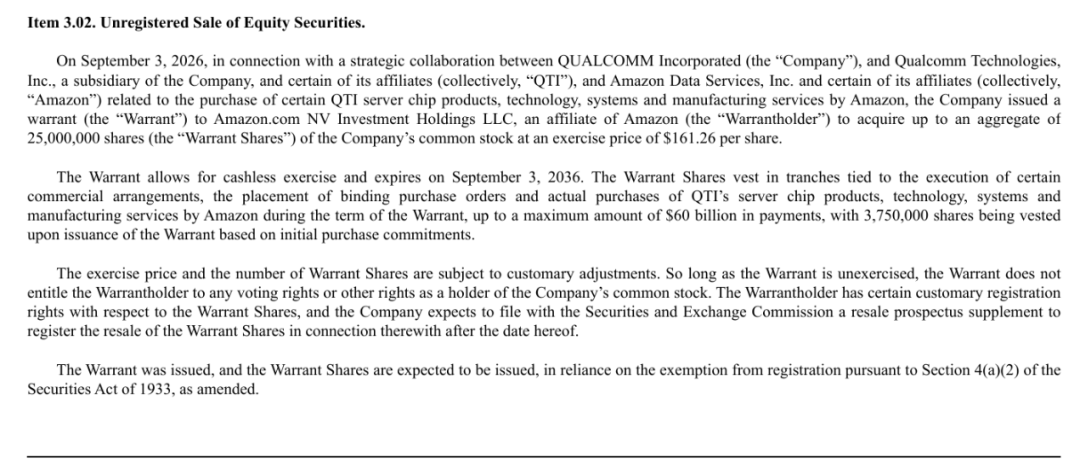
Following the approach previously used by Marvell, Qualcomm has also provided 'warrants' in this instance. The company has granted warrants for 25 million shares of Qualcomm stock at an exercise price of $161.26 per share (giving Amazon the right to purchase at this price), corresponding to a value of $4 billion, expiring on September 3, 2036.
Similar to Marvell's proposal for Google, Amazon can also opt for a 'cashless exercise' in this plan, with the warrants vesting in batches. The procurement cap is set at $60 billion.
The batch vesting is also linked to Amazon's procurement from Marvell, primarily involving revenue from Qualcomm server chips and related technologies.
II. Qualcomm's Data Center Strategy
Amidst the booming AI market, Qualcomm, a veteran in the mobile phone era, has prioritized data centers for incremental revenue growth.
The company has outlined four main business segments for data centers: custom ASICs for single clients, standardized AI accelerators for general clients, server CPUs, and connectivity (optical DSP/SerDes). The goal is to create a comprehensive data center computing solution.
To realize these business plans, the company first acquired two companies to acquire three capabilities—custom ASICs, optical DSP/SerDes, and server CPUs. Its only truly in-house developed product is the AI inference accelerator.
Currently, in terms of AI revenue, aside from the revenue brought in by the acquired companies, the inference accelerators developed by the company itself have clients and orders but have not yet generated revenue.
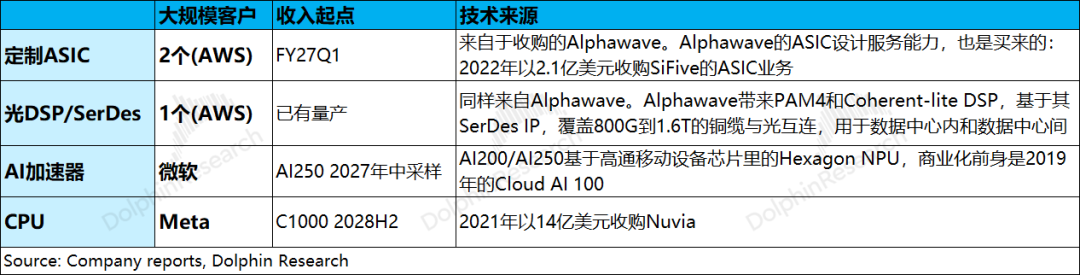
From a client perspective, the company's current clients across the four segments are primarily CSP vendors. Company management previously disclosed in earnings reports that there are 'two large-scale clients for custom ASICs and the first large-scale client for connectivity products.'
In light of this collaboration, the market largely speculates that Amazon is the client referred to here, marking the company's first announced collaboration with Amazon in the data center space.
a) In the data center space, connectivity products are the quickest to contribute revenue. The acquired Alphawave already has the capability to produce SerDes IP, 800G optical DSP, and related products, with subsequent 1.6T products expected to be launched between 2026 and 2027.
b) The company's custom ASIC business, also acquired through Alphawave Semi, is expected to start launching custom ASIC products in the first quarter of FY2027, which is one of the key focuses of the agreement with Amazon.
Considering that the time from project initiation/signing to revenue recognition is less than a year, Dolphin Tab believes that the first products to be shipped (in the first phase) are likely to be peripheral chips for custom ASICs (likely I/O die, SerDes chiplets, retimers, network peripheral silicon, etc.).
Given that fully custom ASICs (second phase) will take at least around two years, mass production and shipping of these products are expected to commence in 2028 and beyond.
c) AI Accelerators and Server CPUs: The company has previously clearly identified Microsoft and Meta as major clients for these two business segments.
The AI accelerator is more of a standard product, with the next HBC/AI250 expected to be commercially sampled in mid-2027. The server CPU (C1000) acquired from Nuvia is expected to enter mass production in the second half of 2028.
Compared to its traditional mobile phone business, the company believes that the data center blueprint, consisting of these four segments, will present a potential market opportunity (TAM) of $1 trillion by 2029, which is also the company's primary future growth direction.
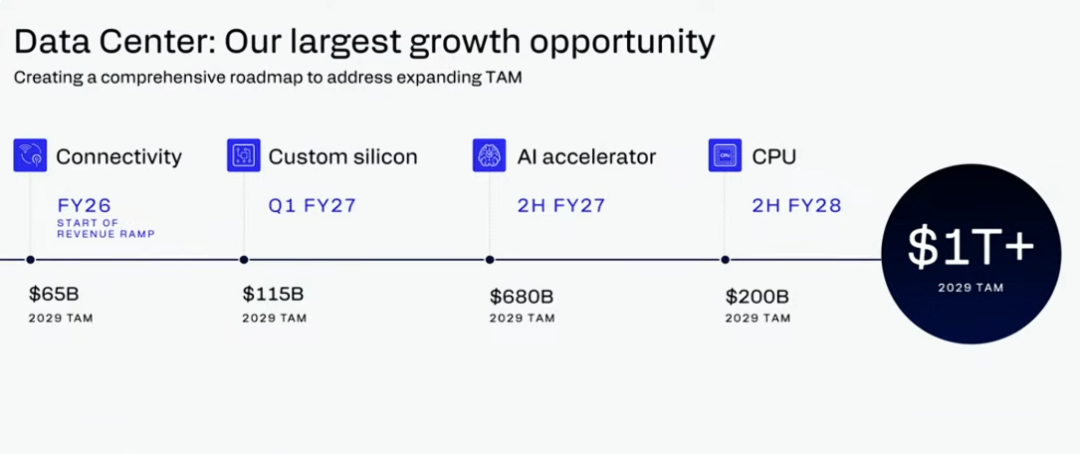
In the data center space, through a series of acquisitions, Qualcomm has transformed from having zero AI revenue to having connectivity products in mass production and shipping. The remaining revenue contributions are largely expected next year and beyond, but the company still provides a high-growth outlook. It forecasts that data center revenue will grow from $5 billion in FY2027 to $15 billion in FY2029, with a compound annual growth rate of 73%.
The company has already signed letters of intent with three of the top four major CSP vendors (Microsoft, Meta, Amazon). The announcement of this agreement with Amazon, in particular, will further boost market confidence in the company's data center guidance.
III. The Impact of This Collaboration
So, what are the respective impacts of this collaboration on Amazon, competitors in custom chips, and Qualcomm?
1) Amazon
Currently, Amazon's Trainium is primarily led internally by its self-developed chip studio, Annapurna, which was acquired by the company, with Marvell and Alchip serving as design partners.
With the introduction of Qualcomm, Amazon's chip supply chain will involve 'multi-party interactions': Annapurna (acquired in 2015, architecture owner) will lead the work progress and scheduling, with Alchip (Trainium3/4) + Marvell (Trainium, optical DSP, NIC/storage controllers) + Qualcomm (new entrant) serving as three outsourcing partners.
AWS switched Trainium3 from Marvell to Alchip last year and introduced Qualcomm this year, adopting a strategy of 'making design partners compete with each other.' This approach not only drives down prices but also reflects the company's position in the supply chain.
As Amazon itself needs to procure data center chips, 'introducing Qualcomm' not only diversifies its supply chain but also allows it to benefit from the 'warrants' provided by Qualcomm.
2) Competitors (ALAB, Marvell, Alchip)
① ALAB: This is one of the entities adversely affected, primarily because the product lines of Alphawave, acquired by Qualcomm, are most similar to those of ALAB.
Alphawave's core offerings include SerDes IP, PAM4/optical DSP chips, UCIe connection subsystems between packaged internal chiplets, and connection port chiplets. Its overall solutions lean more towards IP services and the delivery of submodule chiplets in interconnect chips.
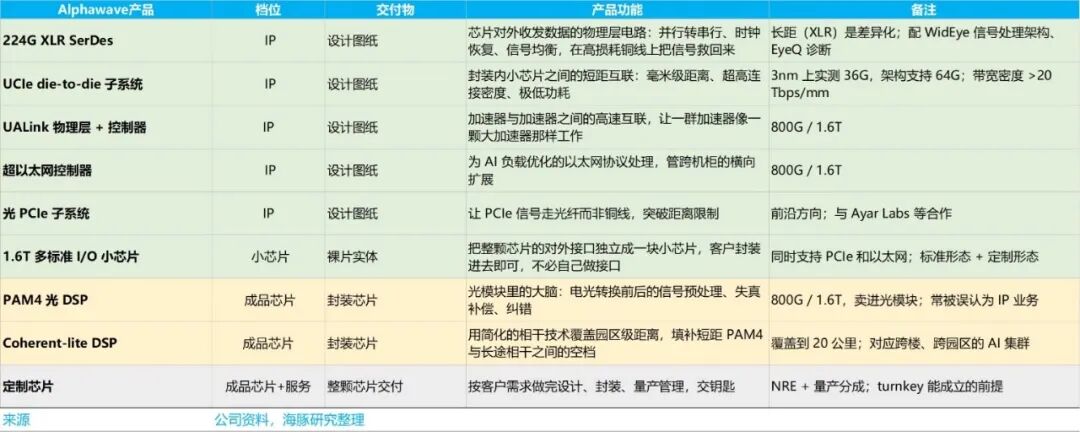
ALAB, on the other hand, offers similar ready-to-use, packaged chips and overall functional modules. For example, its PCIe retimer chip (a chip product encapsulating SerDes IP), Taurus as an intelligent cable module SCM, and the Scorpio product series as PCIe switching chips between Scale-up and CPUs and other devices.
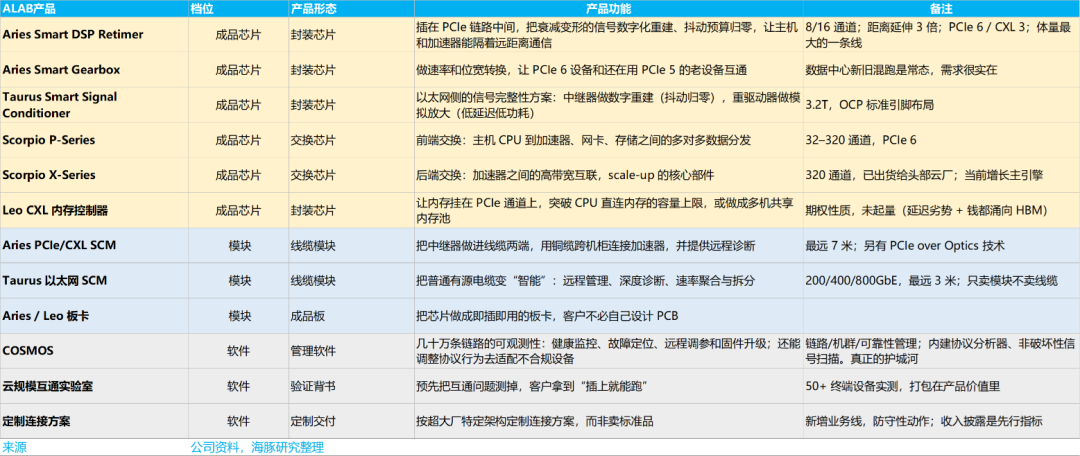
ALAB's product solutions are sold to NVIDIA as well as other XPU solution providers in the market. If Qualcomm offers AWS a turnkey solution—packaging finished chips + SerDes IP + optical chips + manufacturing services together—it means that orders and clients originally belonging to ALAB will be taken over by Qualcomm.
② Marvell: The immediate market impact
The 'loss of orders' has already had an impact once, as Amazon previously awarded Trainium3/4 orders to Alchip, leaving only Trainium's existing product range, NIC/storage controllers, and optical DSP to Marvell.
Notably, Alphawave, acquired by Qualcomm, already has the capability to mass-produce optical DSPs, with 1.6T products expected to be mass-produced and shipped between 2026 and 2027. It has now also secured a collaboration with AWS.
The initial impression is that this is not favorable for Marvell, but Dolphin Tab believes that this is more of an emotional impact. Custom interconnect products still require time, and among standalone DSP third-party sellers, the market competition is already fierce.
③ Alchip: Short-term risk is low, but medium to long-term risk is significant
Alchip primarily holds orders for Amazon's Trainium3/4. As mentioned earlier by Dolphin Tab, 'Qualcomm will mainly provide custom ASIC supporting chips and connectivity products in the short term, with fully custom ASIC products expected in 2028 and beyond.' Currently, the Trainium supplied by Alchip is in the ramp-up phase, so the short-term impact is low, but the medium to long-term impact is significant.
3) Qualcomm
Currently, Qualcomm's performance is still concentrated in traditional areas such as mobile phones, and the company is eager to transition to high-growth areas like data centers. Qualcomm has successively acquired Nuvia and Alphawave to build its four segments in the data center space: custom ASICs, connectivity, AI accelerators, and server CPUs.
Currently in its infancy, Qualcomm must offer 'incentives' to secure orders from major vendors, which is also the mainstream approach in the market for 'capturing' market share. The agreement with Amazon this time also follows 'Marvell's approach.'
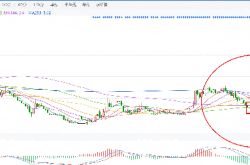
Previously, when Qualcomm announced its foray into the data center space, its stock price once surged to over $250. Subsequently, even though the company's management provided data center revenue guidance for FY2027-2029, its stock price still fell back to around $150-160.
After all, the company's data center business has not yet made a significant revenue contribution, and the market remains 'skeptical' about it. The announcement of the company's agreement with Amazon (including procurement commitments) will undoubtedly increase the 'certainty' of growth in its data center business.
Overall, market confidence in the data center business has been somewhat restored, but for further breakthroughs, more major vendor orders and company deliveries are needed, rather than just the current product collaboration development and equity bundling.
- END -
// Reprint Authorization
This article is an original piece by Dolphin Research
// Disclaimer and General Disclosure Notice
This report is intended for general comprehensive data purposes, designed for general reading and data reference by users of Dolphin Research and its affiliated institutions. It does not take into account the specific investment objectives, investment product preferences, risk tolerance, financial situation, or special needs of any individual receiving this report. Investors must consult with independent professional advisors before making investment decisions based on this report. Any person making investment decisions using or referring to the content or information mentioned in this report does so at their own risk. Dolphin Research shall not be liable for any direct or indirect responsibilities or losses that may arise from the use of the data contained in this report. The information and data in this report are based on publicly available sources and are for reference purposes only. Dolphin Research strives to ensure but does not guarantee the reliability, accuracy, and completeness of the information and data.
The information or opinions mentioned in this report shall not, under any jurisdiction, be considered or construed as an offer to sell securities or an invitation to buy or sell securities, nor shall they constitute recommendations, inquiries, or endorsements of relevant securities or related financial instruments. The information, tools, and materials contained in this report are not intended for or intended to be distributed to jurisdictions where the distribution, publication, provision, or use of such information, tools, and materials contradicts applicable laws or regulations, or to citizens or residents of jurisdictions where Dolphin Research and/or its subsidiaries or affiliated companies are required to comply with any registration or licensing requirements in that jurisdiction.
This report only reflects the personal views, insights, and analytical methods of the relevant creators and does not represent the stance of Dolphin Research and/or its affiliated institutions.
This report is produced by Dolphin Research, and the copyright is solely owned by Dolphin Research. No institution or individual may, without the prior written consent of Dolphin Research, (i) make, copy, reproduce, duplicate, forward, or distribute in any form any copies or reproductions in any way, and/or (ii) directly or indirectly redistribute or transfer them to other unauthorized persons. Dolphin Research reserves all relevant rights.

Writing articles is not easy. Click 'Share' to give me a boost!~
-
![]()
The Loss Conundrum and the High-End Wager: Xiang Xingchu Declares, 'JAC Embarks on Its Third Trailblazing Journey'
-
![]()
'Problematic Stock' Plummets for a Decade, Then Suddenly Surges to Limit Up for Two Straight Days! Is the Auto Sector Making a Resurgence?
-
Value and Cost: Validations from Anthropic and Zhipu
-
![]()
Eliminating Set-Top Boxes: A Panacea for the TV Industry’s Woes?
-
Who Defines 'AGI' Defines the Future
-
![]()
What Unfolded Following Tesla's Substantial Price Reduction?
-
![]()
4-Minute Surge: 10,000 Orders Secured for Xiaomi Pengcheng, Sparking Hot Search Trend. Lei Jun: Extended-Range Vehicles Hold Immense Promise
-
The Future Trajectory of AI Large Models