Meta’s Market Value Rockets by Nearly $200 Billion Overnight, Cloud Town Conference Takes the Lead: AI Applications Begin to Boom, Six Key Beneficiaries Unveiled
 09/23 2026
 461
461
Demand, supply, and revenue generation lines start to converge
Produced by | Meigang Detective
On September 22, 2026, two significant AI trends converged in the market landscape.
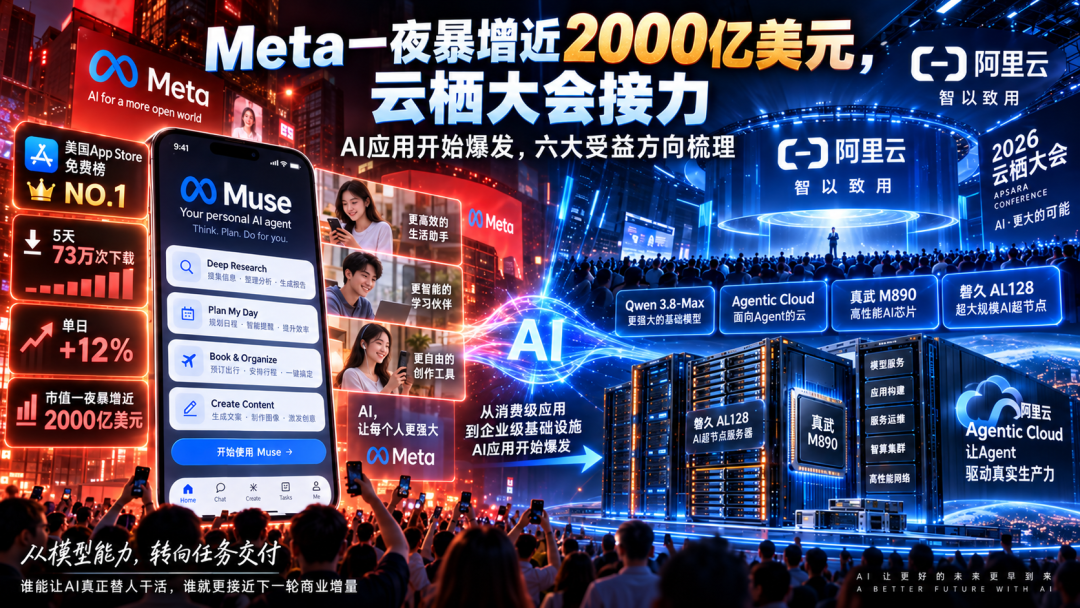
Across the ocean, Meta’s personal AI agent, Muse, soared to the top of the U.S. App Store free chart in less than two weeks post-launch, with 730,000 downloads in just five days, outpacing ChatGPT’s performance during the same period. Consequently, Meta’s stock price surged by over 12% in a single day.
Simultaneously, at the Hangzhou International Expo Center, the 2026 Cloud Town Conference commenced under the theme of “Intelligence for Practical Use.” Alibaba Cloud unveiled Qwen 3.8-Max (boasting 2.4 trillion parameters), the Zhenwu M890 chip, the Panjiu AL128 super-node server, and introduced the “Agentic Cloud” strategy.
One trajectory originates from consumer applications and progresses downward, while the other builds upward from foundational infrastructure. These two trajectories converged in the same week, marking a pivotal shift in AI competition from model capabilities to task execution: the entity that can make AI genuinely functional for people will be closer to harnessing the next wave of commercial growth.
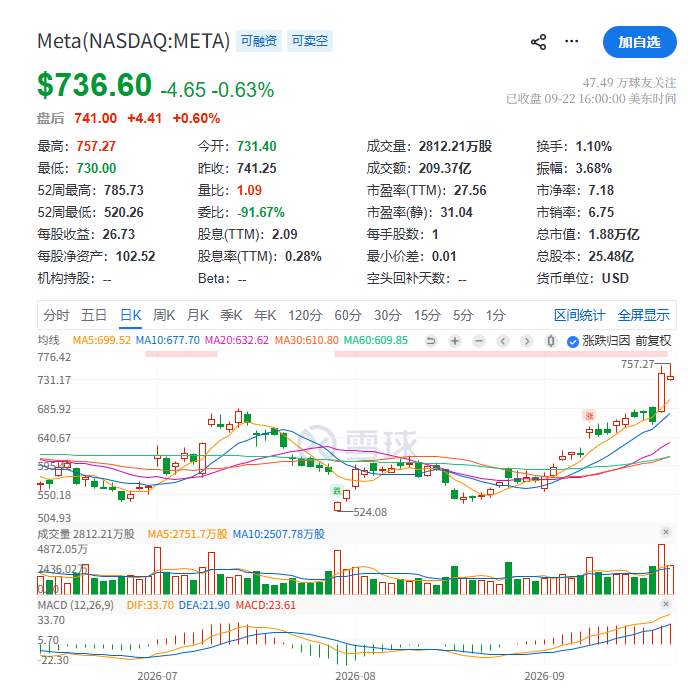
From a capital flow perspective, the market has already provided its initial response.
On September 22, major A-share indices experienced a significant upswing. Nanwei Software achieved two consecutive daily limits, while Zhidu Co., Ltd. and Xinju Network also hit their daily limits. Sectors such as cultural media, software services, and edge AI strengthened concurrently. Previously, tech market sentiment had predominantly focused on chips, optical modules, and servers. Now, capital is beginning to diversify toward application-end sectors.
So, as AI transitions from the model layer to the application layer, which beneficiary directions are undergoing revaluation?

Demand, supply, and revenue generation lines start to converge
On the demand side, Muse validates user acceptance of “task-oriented AI.”
Muse’s ascent to the top of the U.S. App Store free chart in less than two weeks post-launch underscores its appeal. Its allure lies not in answering more questions but in its ability to send emails, book travel, fill out forms, and execute tasks continuously. AI’s rapid rise to the top of app charts at least validates one direction: when AI begins to handle real tasks, user engagement willingness significantly increases.
On the supply side, the Cloud Town Conference is finalizing the infrastructure required for agents to operate in production environments.
Deploying agents in enterprises necessitates the seamless integration of models, data, permissions, tool invocation, and runtime environments. Alibaba Cloud’s Agentic Cloud initiative aims to construct a production environment where agents can be developed, executed, and managed. If Muse demonstrates that users are willing to delegate tasks to AI, then the Cloud Town Conference addresses how enterprises can safely and stably delegate those tasks.
On the revenue generation side, AI is beginning to penetrate business processes that already possess budgets.
On the consumer side, revenue can be generated through subscriptions, transactions, and value-added services; on the enterprise side, AI directly interfaces with marketing, sales, finance, and customer service budgets. If agents can enhance conversion rates, save labor hours, or generate incremental revenue, enterprises will be incentivized to continue purchasing and expanding orders.
Thus, demand has been validated, deployment conditions are maturing, and revenue paths are becoming clearer. As AI applications transition from showcasing capabilities to delivering tangible results, the capital market will naturally reassess the value of application companies.

AI’s Transition from Models to Task Execution: Six Key Beneficiary Directions for Applications and Infrastructure
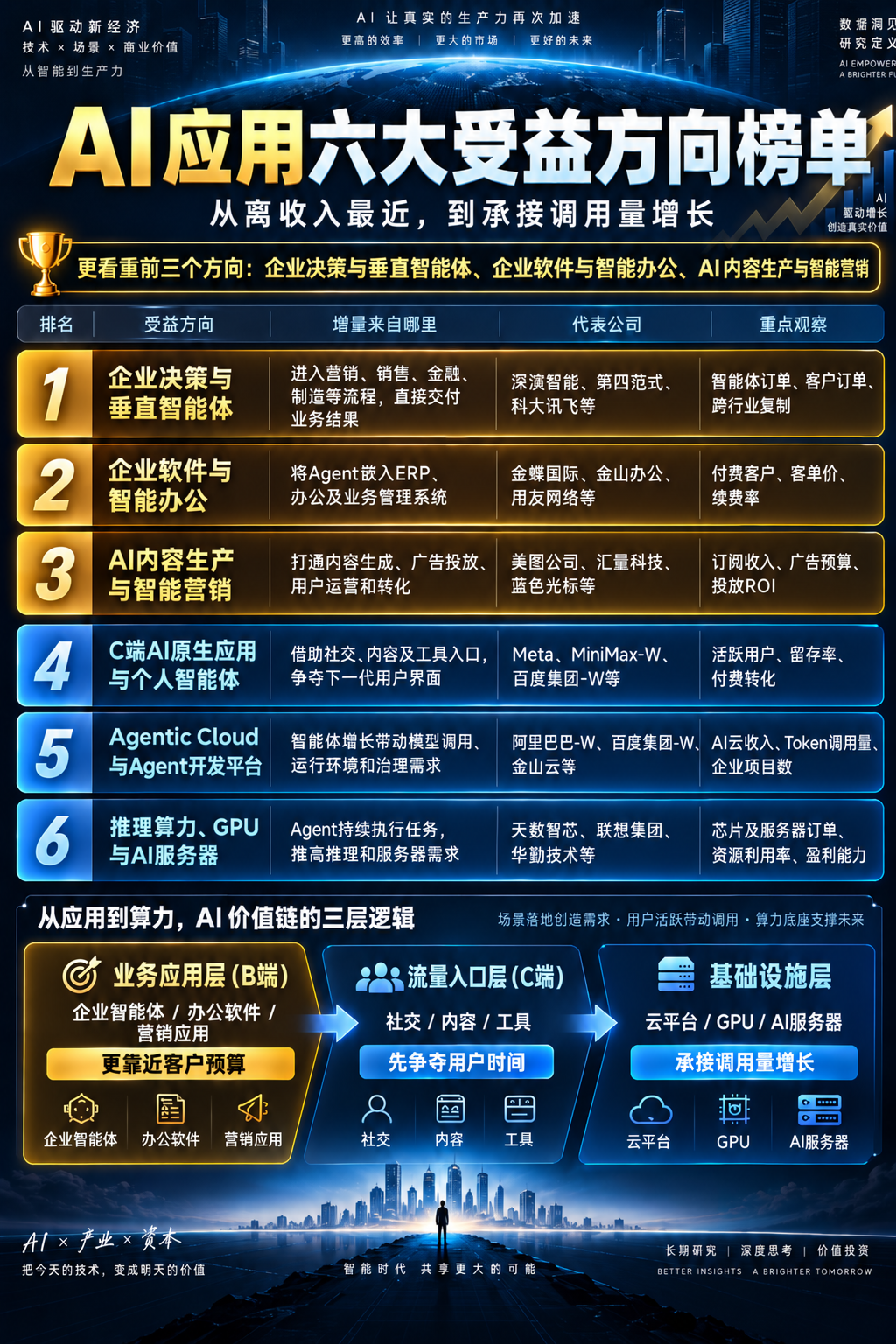
Enterprise agents, office software, and marketing applications directly tap into customer budgets; consumer applications initially compete for user time; cloud platforms, GPUs, and servers handle increased invocation volumes. The closer to revenue generation, the shorter the distance for market trends to translate into performance.

So, who is poised for growth?
I place greater emphasis on the first three directions: enterprise decision-making and vertical agents, enterprise software, and AI content and marketing. The rationale is straightforward: currently, they are already positioned adjacent to customer budgets.
Enterprise decision-making and vertical agents rank first.
When enterprises procure AI, their ultimate objective is to address specific challenges such as sales growth, marketing conversion, operational analysis, and customer operations. Only when results can be quantified and a single scenario proves effective can opportunities arise to expand into more departments within the same client.
In the first half of the year, DeepActor witnessed over a 300% year-on-year increase in signed orders for its new agent products and services, boasting more than 20 AI agent products and corresponding service capabilities. Fourth Paradigm has accumulated experience in enterprise-grade AI platforms and industries such as finance, energy, and manufacturing. The commonality between these two types of companies is evident: models are merely the starting point; what determines customer retention is industry data, workflows, and delivery capabilities.
Enterprise software ranks second because Kingdee, Yonyou, Kingsoft Office, and Fwei Network already control enterprise access points.
They do not need to seek new customers; agents can seamlessly integrate into financial, procurement, HR, and collaborative office systems. Kingdee has launched an agent matrix encompassing finance, supply chain, HR, and other areas; Kingsoft Office is also advancing its Office Agent.
The third line is AI content production and intelligent marketing. The outcomes of such businesses are more straightforward to quantify: how much production cost is saved for a batch of materials, how much conversion rate is improved for a single campaign, and how much incremental sales are generated by a user operation plan—all can be ultimately quantified.
Meitu dominates image and video production tools, Mobvista specializes in overseas advertising technology, and BlueFocus connects with a vast array of brand clients and global media resources. Whoever can propel content generation further into delivery and conversion will more readily form a complete revenue loop.

A Final Word
First, Meta ignited the consumer side, and then the Cloud Town Conference expanded the enterprise side. AI applications are transitioning from “can they be used” to “can they deliver.”
The focus has shifted from the model layer to the application end. While enthusiasm can surge rapidly, the companies that will ultimately prevail are those that genuinely make AI functional and convert results into revenue.
Disclaimer: This article is based on the public company attributes of listed companies. Meigang Detective strives to ensure the objectivity and fairness of the content and views presented but does not guarantee their accuracy, completeness, or timeliness. The information or opinions expressed in this article do not constitute any investment advice, and Meigang Detective assumes no responsibility for any actions taken based on the use of this article.
-
![]()
More Than 50 Crashes: A Chinese Farmer Takes Flying Cars to the Emirates Palace in Abu Dhabi
-
Enterprises Embracing AI Truly Miss the 'Contextual' Mark
-
![]()
Chinese Brands Ascend to Dominance in Global Handheld Smart Camera Rankings: DJI and Insta360 Command 93% Market Share
-
![]()
Meta’s Market Value Rockets by Nearly $200 Billion Overnight, Cloud Town Conference Takes the Lead: AI Applications Begin to Boom, Six Key Beneficiaries Unveiled
-
![]()
World Model: The First Year of AGI for Robots
-
![]()
Is the Second-Generation Doubao Smartphone a Wise Purchase?
-
![]()
Is the Second-Generation Doubao Smartphone a Worthy Purchase?
-
Zhou Jingren Steps Down from Center Stage