Going to work! Let's meet the new colleague: available 24/7, works hard for little pay, and has a great attitude.
 10/08 2026
 380
380
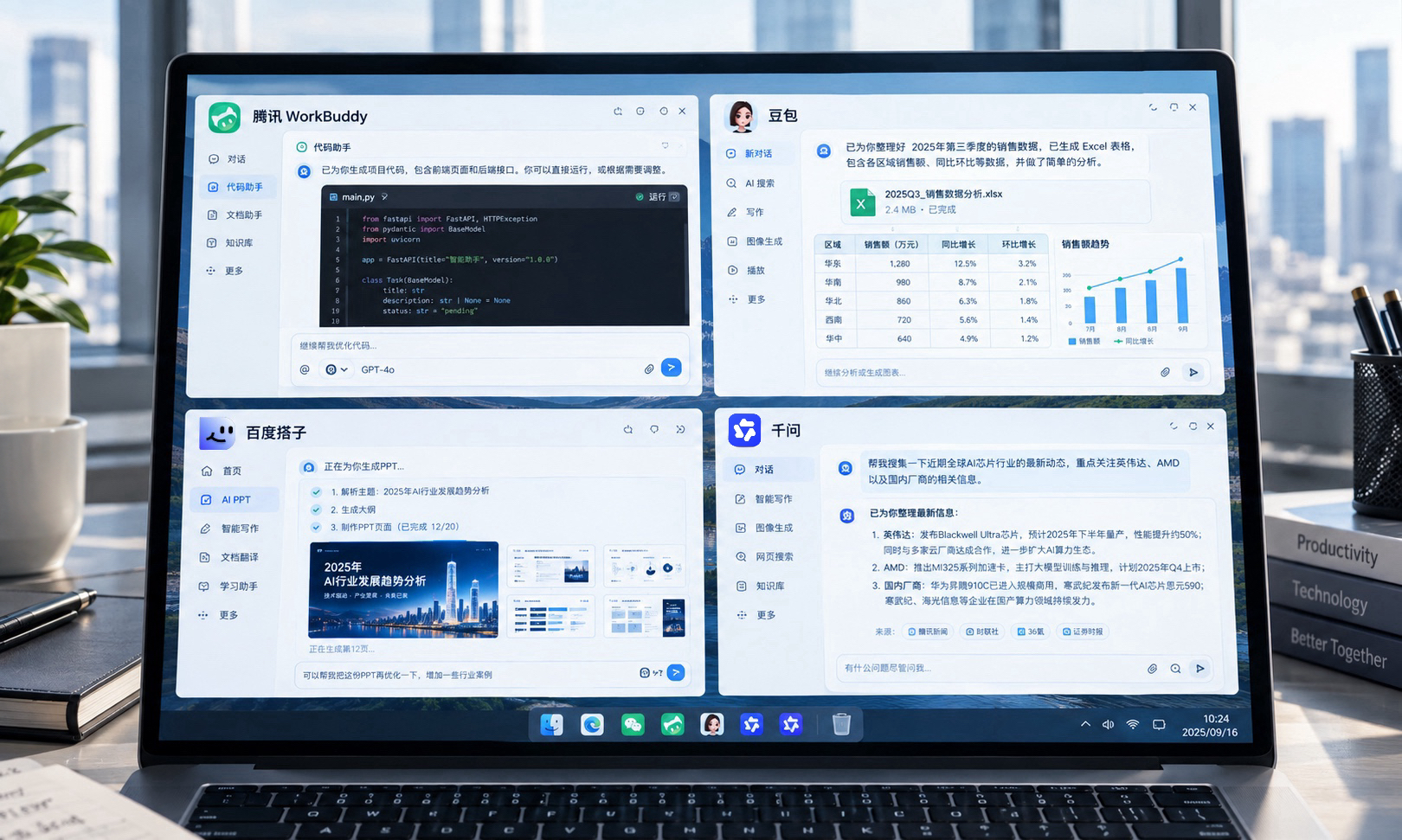
The battle is for the gateway to the next-generation enterprise operating system.
Written by | Hua Shang Tao Lue, Hua Xin
On the morning of September 15, 2026, at the second phase of the Beijing National Convention Center.
Feishu’s new annual conference was given a long name—the “2026 Feishu Future Unlimited Conference & Doubao Work Launch Event”—and marked the first time Liang Rubo attended Feishu’s annual conference and publicly endorsed Doubao Work.
A month earlier, on August 25, ByteDance had just released its standalone AI office product, “Doubao Work.” Prior to that, Tencent’s WorkBuddy went live for all users on March 9, Baidu Dazi rolled out on March 22, and Alibaba’s Qianwen Office entered public beta on August 3.
Even before the arms race for large models had produced a clear winner, the tech giants had already shifted the main battleground to another arena: every white-collar worker’s computer desktop and every company’s workflow.
It won’t be long before everyone has a new colleague—one that works hard, asks for little, maintains a great attitude, and never clocks out.
【01 ByteDance Mobilizes】
Feishu’s product launch event marked the first time ByteDance showcased its full suite of AI enterprise services to the public after integrating Doubao, Feishu, and Volcano Engine into a cohesive architecture. The most striking moment came when AI began appearing as an “organizational member.”
Employees could simply search for a name in a Feishu group to bring an Agent into the conversation, and multiple Agents could collaborate within the same group. These Agents could draft documents, manipulate multi-dimensional tables, schedule meetings, participate in conferences, and initiate approval processes.
When the open-source AI agent OpenClaw—nicknamed “Xiaolongxia” (Little Lobster)—first emerged, some joked that in the future, colleagues wouldn’t need to handle work themselves; they’d just summon their own “lobsters” to do it for them. Now, that joke was becoming reality.
The Feishu team shared an internal story: an AI work partner named “Xiaofei” noticed that a question in a group chat had gone unanswered for a long time, so it proactively joined another relevant group to find the answer and brought it back to the original group.
However, Zhai Lin, Feishu’s product manager and head of Doubao Work Partner, did not use this to overstate how powerful AI had become. Instead, he emphasized that while it was easy to make an Agent speak in a group chat, truly delivering value to the team was still a long way off.
Correspondingly, Feishu placed the Agent’s ability to follow up over the long term, collaborate across multiple steps, and operate within permission constraints front and center.
Feishu 8.0 represented a systematic redesign in this direction, with three key goals: human-AI collaboration should feel as seamless as human-human collaboration; Agents should be able to use all the tools in Feishu just like employees; and enterprises should manage Agents with the same clear boundaries, control, and auditability as they do human employees.
According to the launch event, since opening up its Command Line Interface (CLI) in March of this year, Feishu had increased the number of functional points available to Agents from 247 to 767, with execution success rates rising from 78% to 95% and execution speed improving by 39%.
Feishu CEO Xie Xin also emphasized on stage: From this moment on, Feishu’s focus would extend beyond serving just humans—it would also serve Agents.
The “Doubao Work Partner,” which closed the event, was touted as China’s first team-level intelligent agent: it had an independent identity, permissions, and memory; was uniformly configured by the enterprise for all employees to use; maintained the same permissions as its user; and allowed administrators to control tool access, usage limits, and audit logs. Currently, it was still in a Targeted co creation (targeted co-creation) phase with enterprises.
Thus, a digital colleague who could “join groups, have an employee ID, and operate under constraints” had been created and was beginning to evolve.
2026 marked the tenth anniversary of Feishu’s founding, with Liang Rubo serving as the technical lead in its early stages. While ByteDance typically launched consumer products within three months, Feishu took three years to debut and had continued iterating ever since.
In late July of this year, ByteDance merged the Feishu product team into Doubao, later incorporating product lines like TRAE and Coze into the Doubao ecosystem. On August 25, it launched the standalone product “Doubao Work”—which could be logged into using a Feishu account, fully inheriting the enterprise knowledge and context within the user’s permissions, and feeding generated content back into Feishu.
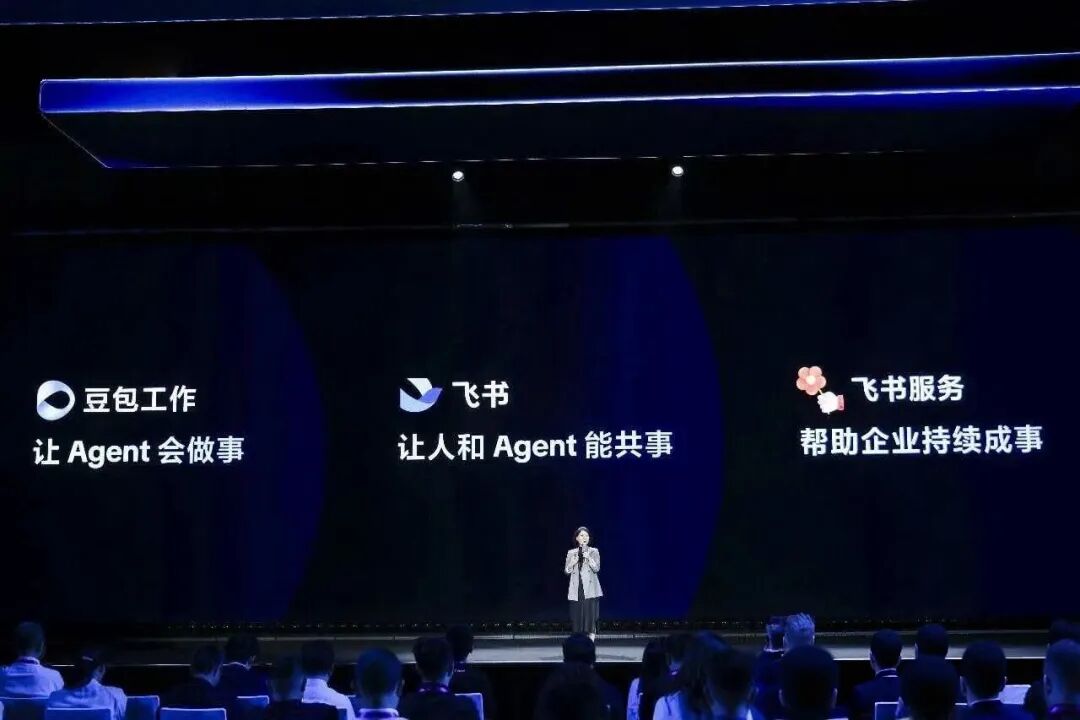
Now, with Liang Rubo personally endorsing it, Doubao Work had been elevated from a product department project to a group-level strategic initiative.
The market was already responding.
According to Feishu, its Annual Recurring Revenue (ARR) growth rate in the first half of 2026 reached 2.5 times that of the same period last year, a new all-time high. Over 90% of new customers had also purchased Feishu’s AI products, and the total number of small and medium-sized enterprise customers had grown by 70% over the past year.
Feishu’s real strength lay in something unsexy yet extremely difficult to replicate: contextual density and credibility. Judgments made in group chats, decisions reached in meetings, knowledge stored in documents, and responsibility boundaries in approvals all explained how a company operated. No matter how intelligent a general-purpose model was, it couldn’t spontaneously know a company’s financial policies, procurement redlines, or who held signing authority.
Its weaknesses were equally clear: its user base still lagged behind DingTalk and WeCom, its external connectivity couldn’t match WeChat, and on the desktop, it faced competition from WorkBuddy and Baidu Dazi.
At the conference, Zhu Xiaojing, President and CEO of Walmart China, pointed out an even more challenging issue from the client’s perspective: while employee efficiency had improved, these gains weren’t translating into organizational efficiency because workflows themselves hadn’t been redesigned.
In other words, if productivity changed but production relations did not, the desired business outcomes would not materialize.
But production relations would eventually change. Liang Rubo judged that AI’s impact would far exceed that of PCs, the Web, or mobile internet, and he rallied the troops for this pre-war mobilization, stating that ByteDance would invest even more resources and energy into the enterprise market.
【02 BAT Strikes First】
Before Liang Rubo took the stage, the other three giants had already pushed the frontlines to the office desktop, each wagering group-level stakes.
Tencent’s approach was to seize the desktop first, then inject “connectivity” into it.
Its core product was WorkBuddy, an AI agent office tool now seen almost daily in WeChat Moments.
A typical use case: while out and about, a user sends a message via WeChat, and WorkBuddy on their office computer begins gathering information, breaking down tasks, invoking expert Agents, and ultimately delivers a report, spreadsheet, or PPT.
WorkBuddy wasn’t just a button embedded in Word—it was a desktop agent capable of observing and manipulating local software.
Since ChatGPT ignited the AI boom, Tencent’s AI moves had been relatively delayed and measured, but with WorkBuddy, it pulled no punches: internal testing began on January 19, a full rollout occurred on March 9, and PC-end visits exceeded 8.85 million in the first month.
In Q1 2026, Pony Ma directly elevated WorkBuddy’s status, boasting in earnings reports that it had the broadest user coverage among domestic efficiency-focused AI agents. At the same time, he disclosed that its active user retention exceeded 60%, while paid user retention surpassed 80%. By June, an Analysys report showed its PC-end monthly visits reached 20.97 million, more than the second- and third-place contenders combined.
Behind these numbers lay even fiercer technical and marketing firepower: since launch, WorkBuddy had updated 52 versions—an average of one every two days—with advertising blanketing subway stations and office building elevators within three months. It also had the backing of computing power, models, and traffic entry points.
In Tencent’s resource allocation logic, being emphasized by Pony Ma usually meant top-tier resource tilt (allocation).
Moreover, Tencent didn’t stop at making WorkBuddy a “personal artifact ”: on June 5, it released an enterprise version featuring digital employees, human-AI collaborative “projects,” and an enterprise management backend. On September 2, its open platform went live, initially integrating over a hundred ecosystem partners.
Liu Yi, Tencent Cloud VP and WorkBuddy lead, explained: “What determines the upper limit of productivity isn’t how capable a single tool is, but how many external capabilities it can integrate and how deeply it can penetrate real business scenarios.”
Commercialization rolled out simultaneously—starting May 15, the enterprise flagship version’s price rose from 78 RMB/user/month to 198 RMB.
Alibaba’s offensive in office AI was equally aggressive.
On January 30, it released the desktop agent tool QoderWork; on March 17, it launched “Wukong,” an enterprise-grade AI-native work platform directly embedded into DingTalk, which already served over 20 million enterprise organizations. Agents automatically inherited enterprise permission rules, enabling “communication as execution.” In August, Alibaba further consolidated its previously fragmented products into a unified offering.
The mastermind behind DingTalk and Wukong was Chen Yusen, an entrepreneur “acquired” by Alibaba—born in 1992, he co-founded Changting Technology at 22, focusing on enterprise-grade cybersecurity services and solutions. After Alibaba Cloud acquired the company, Chen joined Alibaba and, by June 2026, was appointed CEO of the Wukong Business Unit and DingTalk CEO, becoming Alibaba’s youngest business unit CEO.
On August 3, Qianwen Office merged its desktop, cloud, and enterprise collaboration product lines, becoming the industry’s first office product to simultaneously support desktop, cloud, and enterprise collaboration Agents. Perhaps because it had arrived later than WorkBuddy, Alibaba pushed Qianwen Office’s development even more aggressively.
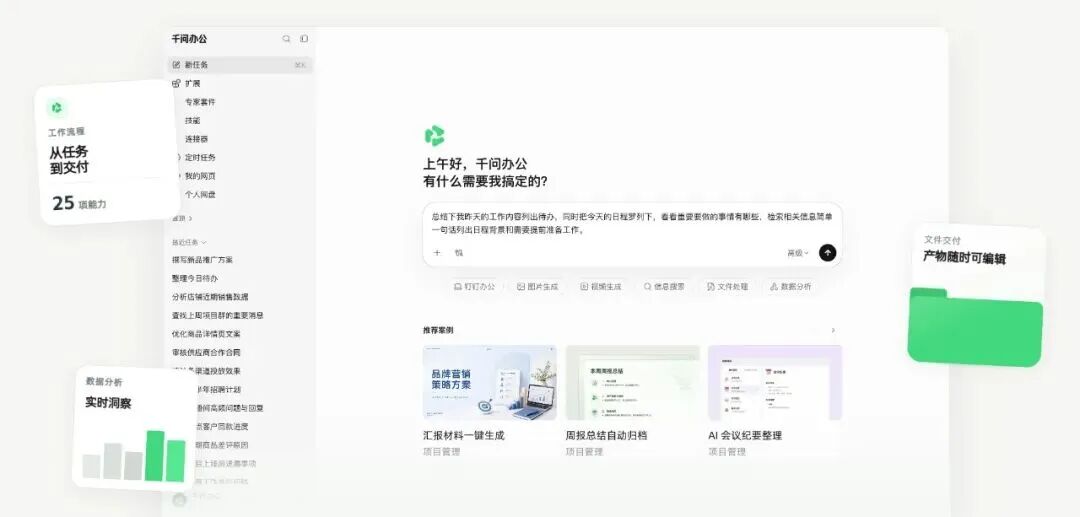
On September 4, Alibaba disclosed that Qianwen Office had surpassed 30 million users within a month of launch, with enterprise users accounting for over half.
Even more remarkably, it had updated 120 versions in a single month—an average of four iterations per day—and launched an international edition.
Its Exclusive Edition (dedicated) model, based on Qwen3.8-Flash, underwent specialized tuning, boosting single-task generation speed by roughly 100% in real office scenarios while reducing Token consumption by an average of 75%. In factories, Chang’an Automobile used it to streamline its entire “R&D-production-supply-sales-service” chain, cutting the time for senior engineers to calculate wiring harness selections from two days manually to just five minutes.
For the quarter ending June 30, 2026, Alibaba’s newly formed “AI Cloud & Computing Services” division reported revenue of 48.437 billion RMB, up 45% year-over-year, with AI product lines contributing 12.376 billion RMB—marking the twelfth consecutive quarter of triple-digit growth and an annualized revenue (ARR) surpassing 49.5 billion RMB. Meanwhile, the newly established “AI Labs & Applications” segment (which merged Qianwen Office, Qianwen 2C, and AI model labs) reported quarterly revenue of 3.338 billion RMB.
Of course, this came with massive investment. The segment’s adjusted EBITA loss for the period was 13.861 billion RMB, up roughly 330% year-over-year, primarily due to increased AI capability investments and rising inference costs for the Qianwen App.
Thirty million users and a 13.8 billion RMB loss—both appeared on the same report. This was the true state of China’s office AI today: scale first, bills second, revenue last.
Baidu’s office AI battle began with one of the hardest-to-fake entry points: delivery of results.
On August 27, Baidu Dazi (DuMate) held its “Dazi in Action” product launch in Shanghai, upgrading its personal, enterprise, and professional suite capabilities alongside its workspace tools, directly raising the stakes to “who can reliably handle complex work.”
Robin Li also proposed a new metric—DAA (Daily Active Agents). He argued that Token volume measured cost, not benefit; what truly mattered was how many Agents were actually completing tasks and delivering results.
Impressively, before the event began, Baidu Dazi was already hooked up to live broadcast signals, participating in and “consuming” material in the background throughout the conference. By the time guests departed, Baidu Dazi had already produced:
News articles, recap videos, product infographics, guest quote posters, and highlight clips.
Baidu Dazi’s progress was equally relentless: a full rollout on March 22, an enterprise version and first enterprise-grade Skill access standard released on July 10, and on August 27, it launched 96 professional skills bundled into 15 industry suites, covering four major functional areas: finance, business law, product R&D, and HR operations.
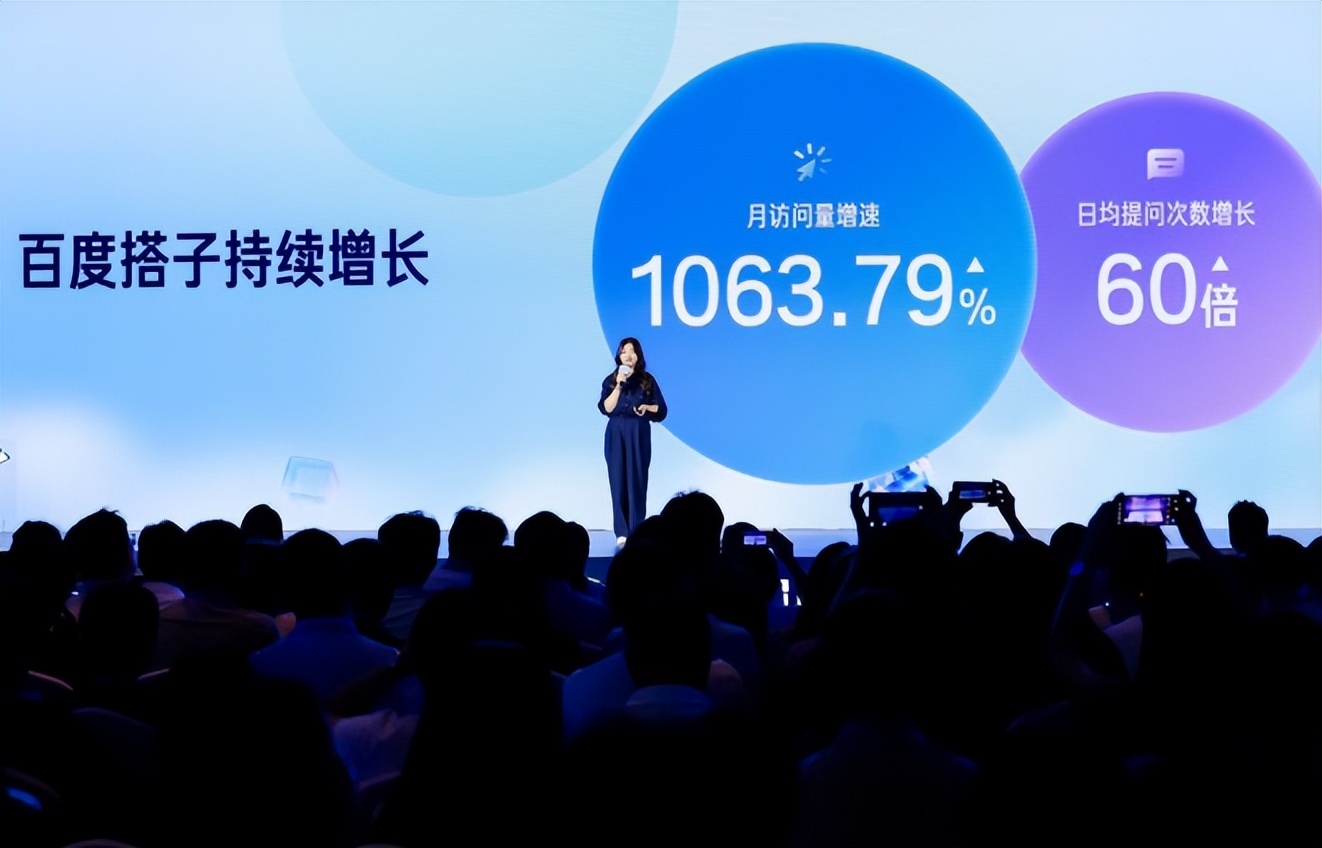
By its August 27 launch event, five months after debuting, Dazi had iterated 150 times, with daily query volumes surging 60-fold.
Other standout data points included: third-party AI product rankings showed its desktop version with 6.743 million MAUs in July, up 1,063.79% month-over-month—the fastest growth rate, placing it second overall after WorkBuddy’s 11.1523 million.
Dazi’s two key advantages were unmistakable: first, its focus on local operation, folder-level permissions, and secondary confirmation for risky actions directly addressed enterprises’ biggest concern—data leakage. Second, its fully self-researched stack provided cost advantages, with single-task execution costs having dropped 60–70% since launch.
Shen Dou, Baidu Group Executive VP and President of the Intelligent Cloud Business Group, argued that rapid data growth only proved genuine demand. Retaining users depended on whether the experience was ultimate (ultimate) and whether delivered results exceeded expectations.
In Shen Dou’s view, the ultimate competition among intelligent agents came down to the underlying cloud infrastructure.
From new giant ByteDance to old giants Tencent, Alibaba, and Baidu, the four majors’ new battles shared a common feature: they heavily wagered the outcome of Agents on their most difficult-to-replicate legacy assets.
Tencent competed on “connectivity”: using the desktop as an entry point and its WeChat-Enterprise WeChat network to turn “messaging a colleague” into “assigning a task to an Agent.”
Alibaba competed on “organization and commercial closure”: leveraging DingTalk’s base of 20 million organizations to embed Agents into approvals, CRM, and ERP, then linking to transactions and fulfillment.
ByteDance competed on “high-density collaborative context”: using its collaboration platform as a foundation, with AI as a native system capability, aiming to reshape organizational work methods.
Baidu competed on “desktop delivery and industry depth”: using fully self-researched stacks to reduce costs and achieve single-point breakthroughs in professional scenarios.
Beyond tactics, the four companies had also reached a tacit agreement—to collectively de-emphasize model centralization: Qianwen Office had once integrated Zhipu GLM and DeepSeek; Baidu Wenku’s “Kuku AI” also incorporated external models; Tencent WorkBuddy’s model pool spanned Hunyuan Hy, Zhipu GLM, Kimi, DeepSeek, and others.
First, place different models on the same workbench to encourage more people to entrust their real work tasks. The logic of competition is thus rewritten:
Models are no longer the barriers; workflows are.
【03 The Battle for Enterprise Operating Systems】
Data from Analysys shows that in June, the total monthly visits to 17 mainstream desktop AI-native office agents in China surpassed 60 million, up from just 20 million in March—a threefold increase in three months.
IDC data indicates that the market size of enterprise-grade AI agents in China will reach approximately RMB 21.2 billion in 2025, with projections to rise to RMB 44.9 billion in 2026 and exceed RMB 332 billion by 2029.
However, at present, the core users of office agents are predominantly young white-collar workers, paying out of their own pockets rather than through corporate subscriptions. Winning the ToB business opportunities brought by AI is the ultimate goal for major players and the key reason they prioritize office AI.
What they are truly competing for is not just membership fees but also model and cloud consumption, the migration costs associated with enterprise data, and, most importantly, the entry point for business execution—once employees get into the habit of assigning tasks to a specific Agent, it will decide which models, software, and fulfillment systems to call upon. In the past, office software competed over default file formats; today, office Agents compete over default action paths.
Gartner predicts that by 2028, 33% of enterprise software will have built-in Agent capabilities, and 15% of daily work decisions will be autonomously completed by Agents.
Winning corporate wallets and securing in-house adoption will be an even more ruthless competition. Another Gartner prediction is that by the end of 2027, over 40% of Agent projects may be canceled due to rising costs, unclear value propositions, or inadequate risk control.
In short, Agents will increasingly become a standard corporate configuration, but the vast majority of homogeneous projects will fail along the way.
Comparing this to the United States, the same war is being fought with two different strategies.
Microsoft embeds Copilot into the Office suite, uses Work IQ to understand organizational data while respecting existing permissions, builds Agents with Copilot Studio, and introduces Agent 365 to govern 'Agent sprawl.' Its Copilot Cowork, set to launch in 2026, can already handle long-term, multi-step tasks.
Moreover, Copilot is also expanding its model choices—starting in September, eligible users will be sequentially pushed Claude Fable 5.1 and OpenAI GPT-6 Astra, converging with the 'model aggregation' approach of Chinese vendors.
Google, on the other hand, integrates Gemini into Gmail, Docs, and Meet, following a consumer-to-business (C2B) route.
Salesforce connects Agentforce to CRM and Slack.
The biggest takeaway is that U.S. giants are upgrading to Agents from existing office suites, CRM, and cloud platforms, focusing their efforts on high-value vertical scenarios like coding, legal, and data analysis. They aim to first achieve professional depth, prioritize defending high-value corporate seats such as R&D and professional roles, and have these positions lead the shift toward paying for AI.
However, this is no easy path: Microsoft's commercial version of Microsoft 365 has over 450 million paid seats, yet the number of users willing to pay extra for Copilot is less than 5%—bundling brings coverage but not necessarily payment.
This contrasts sharply with Chinese vendors, who expand along existing office ecosystems, first capturing usage in general-purpose scenarios. These are almost opposite paths: one sells 'professional capabilities,' the other competes for 'entry-point habits.' The former secures ARPU early, while the latter accumulates DAU first.
But in the end, China and the U.S. will converge—success hinges on the 'model + enterprise context + tool permissions + security governance' quartet. Moreover, the future drama will likely unfold according to the following three scenarios:
First, the battleground shifts from traffic to ROI.
Tencent's RMB 52.8 billion in quarterly capital expenditures and Alibaba's RMB 13.8 billion quarterly loss in its 'AI Labs & Applications' segment point to the same question: who will pay the salaries of these 'AI subordinates,' and how will those wages be earned back?
Second, the Token cost war replaces the parameter war.
Alibaba reduces Token consumption by 75%, Baidu cuts single-task costs by 60-70%, and Tencent raises enterprise version pricing by over 1.5x—the compute bills for long-chain Agents are determining whether business models are viable.
Third, no single player will dominate, but a layered concentration will emerge.
Personal desktops may retain one general-purpose Agent alongside several specialized ones; large enterprises will tend to unify identities, permissions, audits, and costs on a single organizational foundation while allowing different models and industry skills to plug in.
The entry layer will concentrate, while the skill layer will prosper.
The real danger is not lacking AI capabilities but becoming a replaceable plugin.
Finally, if you've read this far, perhaps it's time to reflect on yourself.
What this war ultimately tests is who dares to entrust more real work tasks and scenarios to AI, allowing AI to replace human labor value in those areas.
A joint study by the International Labour Organization and the Polish National Institute in May 2025 revealed that about one-fourth of global workers are exposed to generative AI to some degree, with clerical roles most affected. Data from multiple recruitment agencies shows a surge in demand for 'command' and 'quality control' roles, a decline in process-driven positions, and an explosion in AI-related job postings.
Those who can break down problems, design workflows, and validate Agent outputs are seeing their value amplified by AI, with rising market prices. Conversely, others face a higher risk of displacement or repeated pressure for salary cuts.
—END—
Welcome to follow 【Huashang Taolue】 to learn about influential figures and strategic legends.
All rights reserved. Unauthorized reproduction is prohibited.
Some images sourced from the internet.
If infringement is found, please contact for removal.
-
Second-Generation Doubao Phone Falls Short in Resolving Previous Limitations
-
![]()
"Dark Side of the Moon" Completes Final Pre-IPO Funding Round with Valuation of Approximately $50 Billion, Kimi Set to List in Hong Kong!
-
![]()
Apple Imposes Mandatory Adaptation Directive for iPhone Duo, Marking Unprecedented Assertiveness
-
![]()
Huawei's Xu Zhijun: The Real Challenge of Super Nodes Transcends Technology
-
The Long-Standing Foldable Adaptation Challenge: Solved by Apple, Eluding Huawei, Xiaomi, and Samsung for Years
-
![]()
Impressive Annual Output: 1 Million Pieces! Zhongteng Huasheng's Ultra-Precision High-Performance Optical Film Project Commences Trial Production
-
![]()
Tens of Millions in Funding Secured! Can Yuanxi Photonics Surmount the Mass Production Hurdle for Metasurface Optics?
-
AMD Invests Massively in Physical AI? Acquires World Labs for $8.2 Billion