AI-Powered Alternatives Offer Free Substitutes, Posing Threat to Adobe's 'All-in-One' Suite
 10/16 2026
 353
353
Source: SourceSight
Is a Trillion-Dollar Tech Behemoth on the Verge of Being Overturned by AI?
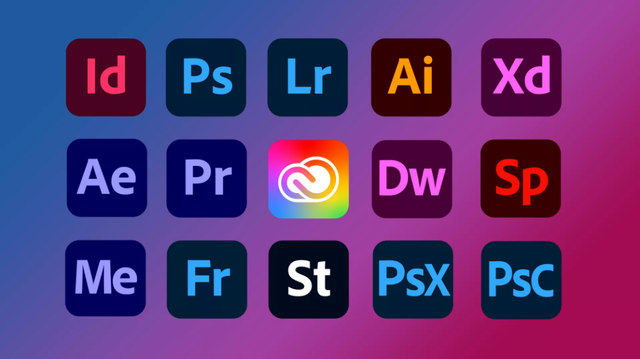
Whether you're a seasoned professional creator or an enthusiastic amateur, the name Adobe is likely familiar to you. Over the years, Adobe has constructed a robust ecosystem in the creative domain, encompassing image, video, and text layout. With its diverse and professional array of tools such as PS, PR, and AE, Adobe has established itself as an unassailable force in the global creative industry.
Source: Adobe
However, Adobe's long-standing 'all-in-one' product suite, developed over decades, is now encountering its most formidable 'alternative crisis' yet.
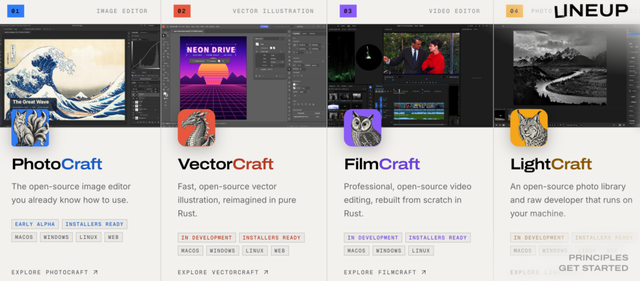
The controversy erupted when international creators, disgruntled by Adobe's persistently high subscription fees and overbearing regulations, employed AI reverse engineering to replicate seven of Adobe's flagship products—including Photoshop, Illustrator, Premiere, and Lightroom—within mere days. These 'pixel-perfect' alternatives were subsequently released as complimentary, open-source tools on GitHub.
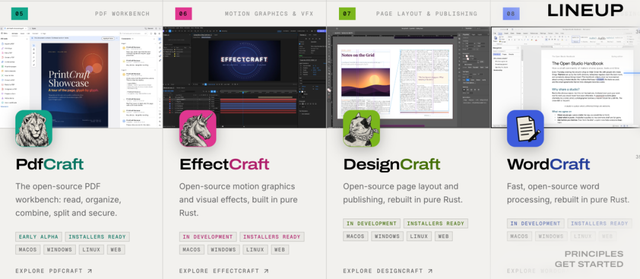
Source: ArtCraft
Unlike conventional code replication or piracy, Adobe is now grappling with an 'AI attack' akin to REA (Reverse Engineer Anything). Engineers can now dissect a software's functionality using specialized AI agents—without requiring its source code—and efficiently develop a new tool with nearly identical capabilities.
Despite being in the early testing phase, these alternatives have already garnered significant attention. The GitHub project has amassed over 30,000 developer followers and exceeded 100,000 likes, emerging as one of the hottest topics within the community.
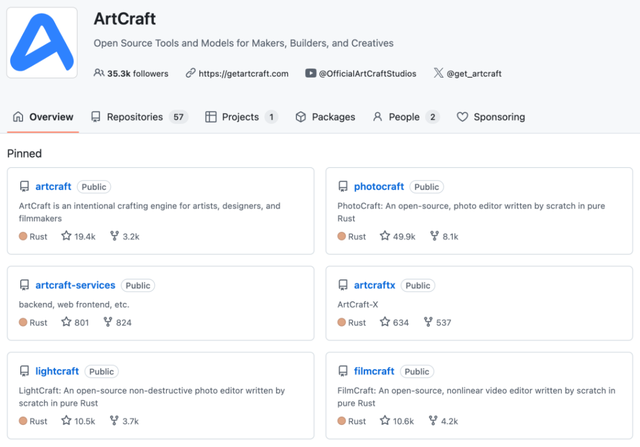
Source: GitHub
For Adobe, this incident encapsulates its recent struggles against AI disruption. As AI increasingly permeates creative fields with simpler, more efficient solutions, this legacy software behemoth—which once relied on professional features to construct technical barriers—now confronts a daunting AI-driven transformation crisis.
01
Long-Standing User Frustrations
The allure of Adobe's 'all-in-one' alternatives stems from deep-seated frustrations with its subscription model.
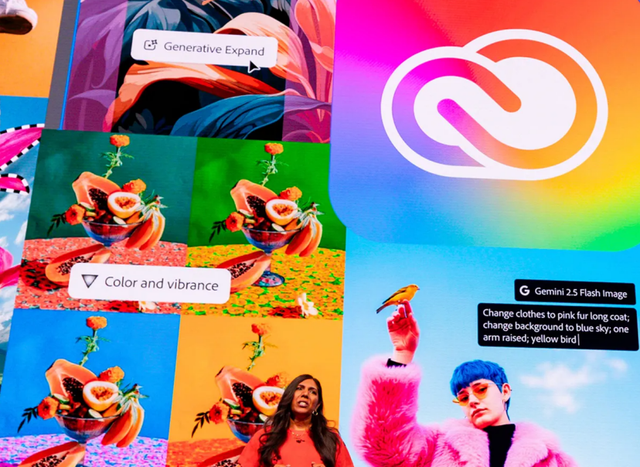
In 2013, Adobe transitioned from perpetual licenses to a subscription-based model, introducing Creative Cloud—a bundled suite of creative tools. This move was initially hailed as a paradigm shift for software-as-a-service (SaaS) within the industry.
For over a decade, this model provided Adobe with a stable revenue stream while solidifying its ecosystem's dominance and industry standards. Competitors found it arduous to challenge Adobe's position, and users faced steep learning and migration costs to switch platforms.
Source: Adobe
However, users increasingly perceive the bundled subscription ecosystem as a means for Adobe to impose recurring costs.
In the third quarter of last year, Adobe hiked its 'all-in-one' subscription fees, with individual annual plans surging from $55 to $70 per month—a nearly 27% increase. Analysts suggest the hike aimed to offset the declining market share for its core creative products.
Yet, what infuriated users even more than the rising costs were the hidden, unfair contract terms (overbearing terms) embedded in Adobe's subscriptions.
As early as 2024, the U.S. Department of Justice filed a lawsuit against Adobe over its cancellation policies. Previously, users who canceled subscriptions after two weeks were required to pay 50% of the remaining contract value as a penalty. Adobe allegedly concealed these terms, leading to widespread outrage and class-action lawsuits when users discovered the fees.
In March, users achieved a partial victory.
Adobe agreed to pay $75 million in civil penalties and offer $75 million in free services to affected customers, settling the two-year dispute at a total cost of $150 million. This legal battle paved the way for the rise of Adobe alternatives.
Brandon Thomas, the project lead for the replication effort, stated in an interview that Adobe's overbearing subscription model was long overdue for disruption. Advances in AI programming now enable small teams to reconstruct software that once demanded massive developer resources and time.
The team noted that while still in the early testing phase, the project will rapidly iterate based on community feedback. Leveraging AI programming, these alternatives aim to match 99% of Adobe's original functionality within months.
02
AI Is Revolutionizing the Creative Landscape
This is not Adobe's inaugural encounter with AI disruption.
In November 2021, propelled by accelerated digital transformation and SaaS growth, Adobe's stock price approached $700 per share, valuing the company at $327.5 billion (approximately RMB 2.2 trillion)—an all-time high. Through proactive transformation, Adobe evolved from a creative software provider into the world's largest SaaS company.
However, this marked its last peak before the generative AI boom.
Public data reveals that Adobe's stock plummeted by approximately 25% in 2024 and by around 21% in 2025. By June of this year, shares had dropped to approximately $190, pushing its market capitalization below $100 billion (approximately RMB 669.2 billion). In under five years, Adobe lost over RMB 1.4 trillion in value.
Investor anxiety stems from two primary factors.
Firstly, competition from AI-native companies.
Canva, a lightweight graphic design platform, has swiftly emerged as Adobe's direct competitor with its user-friendly interface, rapid output, and comprehensive collaboration capabilities. It boasts 265 million monthly active users, including over 31 million paying customers, with annual revenue nearing $4 billion.

Source: Canva
Also noteworthy is the AI design platform Figma, which features a vibrant open-source community and AI integration. Its real-time multiplayer collaboration and cross-platform design align seamlessly with AI-era workflows.
In 2022, Adobe attempted to acquire Figma for approximately $20 billion to bolster its collaborative design portfolio, but antitrust regulators thwarted the deal. Adobe ultimately paid Figma $1 billion in termination fees.
Domestically, Wondershare—often dubbed 'China's Adobe'—has accelerated its AI transformation. Pursuing a global cost-effective strategy, it's rapidly narrowing the gap with Adobe. Tianyancha data indicates that Wondershare went public on China's A-share market in January 2018, reporting RMB 1.533 billion in annual revenue in 2025.
Secondly, AI is fundamentally altering the design creation process itself.
For non-professionals and small teams, 'processing an image' or developing a usable design no longer necessitates opening Photoshop and manually adjusting layers and masks for half an hour.
AI platforms and native tools now enable users to articulate design needs in natural language, generating commercial-grade designs through AI-powered templates. These can then be refined through direct dialogue.
For over 40 years, Adobe's business model has hinged on the scarcity of professional design skills and software proficiency. AI's ascent is rapidly eroding this scarcity—posing a genuine threat to Adobe.
03
Adobe's Struggle to Navigate the AI Era
Adobe is embracing AI, but for this near-trillion-dollar behemoth, the AI era presents the challenge of 'a large ship hard to turn.'
In March 2023, Adobe unveiled its in-house Firefly model and commenced commercialization in September. Trained on legally sourced Adobe Stock images and public domain data, Firefly integrates seamlessly with Adobe's professional design ecosystem, including Photoshop and Illustrator.
Source: Adobe
The issue lies in Adobe's AI strategy: it still primarily focuses on enhancing existing tools with AI features to lower entry barriers and boost efficiency. However, as lightweight, software-agnostic, and collaborative trends emerge, Adobe's prized design suite now partially impedes its transformation.
Fundamentally, AI is reshaping the design value chain. The core content-creation engine is shifting from software tools to more potent, user-friendly generative AI models, diminishing the application layer's former significance.
In March, Adobe CEO Shantanu Narayen abruptly announced his departure after 18 years. Many attribute this to Adobe's AI-driven transformation struggles.
In its Q3 earnings report last month, Adobe reported 'AI-first' annual revenue growth exceeding 150%, driven by Firefly and other AI features across creative, productivity, and customer experience tools. Meanwhile, its freemium model expanded user access, with monthly active users for creative and productivity solutions surpassing 1 billion.
However, the market reacted tepidly. Despite raising full-year guidance post-earnings, Adobe's stock fell 2% after hours due to Q4 revenue projections falling short of analyst expectations.
Though Adobe's revenue continues to grow, earlier this year, Goldman Sachs, Citibank, and other institutions highlighted its challenging operating environment amid AI transitions, citing sluggish and decelerating revenue growth. Analysts downgraded Adobe's consensus rating to 3.91/5—the lowest since 2013.
While Adobe has long faced AI transformation skepticism from investors, it now confronts another 'all-in-one' alternative crisis stemming from AI programming. For this 40-year-old design software giant, the real AI challenge may just be commencing.
Some images sourced from the internet. Please notify us for removal if infringement occurs.
-
![]()
Thousand-Kilometer Range BMW i3, Ioniq V Priced Under RMB 100,000: Chinese Automakers Must Guard Against Joint Venture Encroachment in Global Expansion
-
![]()
Competition Among Cities Enters the Second Half: The Outcome Lies Beneath the Surface
-
![]()
AI-Generated Comic Drama Concept Stocks Surge: Is ByteDance the Sole Profit-Maker?
-
iPhone 18 Pro Series Sees Price Reductions—Apple Can't Afford to Stay Idle During Double 11
-
![]()
A Whopping 550 Million Yuan Investment! Fanchuangwei’s High-Transparency Optical AR Lens Project Takes Root in Taizhou
-
![]()
Domestic Triumph in Glass Substrate Lithography! Optical Firm Lands Major Orders
-
![]()
AI-Powered Alternatives Offer Free Substitutes, Posing Threat to Adobe's 'All-in-One' Suite
-
![]()
McKinsey Report: AI Inference to Account for 60% of Computing Power by 2030