Token Hits Tmall: A Stone’s Throw Away from Pinduoduo
 10/23 2026
 570
By | Huang Mengyu
Edited by | Hao Xin
On the eve of Double 11, MiniMax, a prominent large model provider, made its debut on Tmall, launching its inaugural official brand flagship store to offer Token subscription packages. Currently, the store features M Plan subscription packages in three tiers—Go, Explore, and Build—available for monthly or annual purchase.
(Image Source: Tmall Platform)
This strategy of offering Token subscription packages on e-commerce platforms mirrors the early days of e-commerce, when mobile data packages and phone top-ups were sold. Operators quantified and packaged intangible resources into prepaid products that could be purchased monthly and deducted as used. The only difference is that the transaction subject has shifted from communication data to large model computing power.
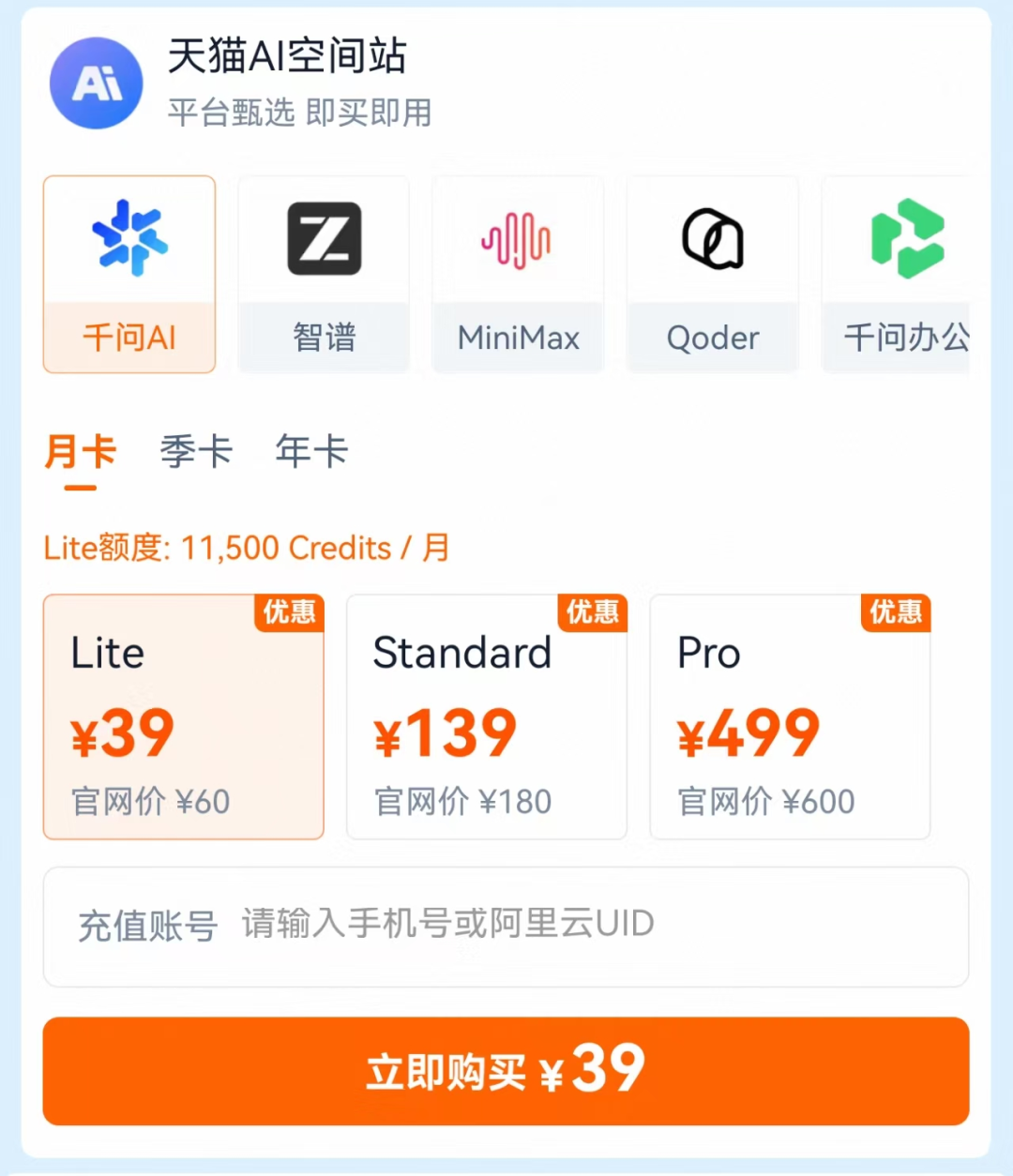
In addition to MiniMax, other large model vendors such as Zhipu, Alibaba Cloud BaiLian, and QianWen Office have also opened flagship stores on Tmall this September. Tmall simultaneously introduced the 'AI Space Station' recharge center, consolidating subscriptions from various large model vendors into a single portal.
The bustling entry of AI vendors into e-commerce platforms signifies the transformation of large model API call quotas from back-end technical interfaces into standardized digital commodities.
Over the past two years, technological capability has been a key competitive indicator among large models, with vendors focusing more on serving B-end clients and professional developers for privatized deployment. However, today, beyond specialized customer channels, sales channels for AI model call services are gradually opening up.
Currently, Tmall officials have confirmed discussions with large model companies, primarily regarding the combination packages available for Double 11, tailored to different user needs—learning, family, solo studio, etc.—aiming to cover as many distinctive user groups as possible.
Selling Tokens: Echoing the Data Package Model
Token serves as the unit of measurement for large models to process information and the billing unit for AI services.
Every step—model reading demands, reasoning, and generating responses—consumes Tokens, akin to how mobile data is consumed when sending messages or streaming videos. When large model vendors sell packages on e-commerce platforms, they are essentially bundling and selling Token call quotas.
On September 2, Zhipu officially launched its flagship store on Tmall, offering subscription packages such as the Coding Plan. On September 3, Tmall introduced the 'AI Space Station (Token Recharge Center),' initially connecting domestic large model vendors like Alibaba Cloud, Zhipu, Kimi, MiniMax, and DeepSeek.
As of now, Zhipu, Alibaba Cloud, and MiniMax have all established official flagship stores, while Kimi and DeepSeek are represented by Luquan Flagship Store.
The two sales models reflect the vendors' development pace.
Vendors using the agency model only need to authorize distribution without handling pricing, delivery, or peak-time maintenance. In contrast, opening a self-operated flagship store means vendors are independently responsible for product listing, customer service, pricing strategies, and marketing activities, while also completing platform qualification reviews, which places new demands on their brand communication capabilities. Media reports indicate that in recent months, multiple model vendors have been actively recruiting brand communication teams, with Zhipu recently starting to hire a 'Brand Narrative Manager.'
At the product level, the packages offered by major vendors share many commonalities.
In terms of pricing, vendors with official flagship stores all offer three or more price tiers, with personal and team versions available for monthly, quarterly, and annual subscriptions.
Computing power solutions from different large model vendors will be centrally displayed in Tmall's AI Space Station, allowing consumers to compare and choose packages based on their needs.
In terms of product rules, these subscription packages generally retain a 5-hour rolling window and a dual throttling mechanism with weekly quotas to alleviate peak computing power pressure.
Essentially, by moving Token subscription packages from their official websites to e-commerce platforms, large model vendors aim to replicate the internet-era data package model and the entire rich media ecosystem derived from it.
In the early days of mobile internet development, mobile data was billed per KB, with high costs and no caps, making it easy for users to incur hefty fees when loading rich media content like images and videos, which constrained data consumption.
As communication infrastructure was completed, the marginal cost of transmitting data dropped significantly. Operators successively introduced various data packages, allowing users to obtain data quotas by subscribing. The data package model offered personal, family, and targeted, off-peak, and general-purpose data plans to meet differentiated needs across scenarios, achieving efficient allocation of data resources.
This package model capped data consumption, reduced unit data costs, and spurred demand for graphic content and short videos, giving rise to mobile internet application ecosystems like WeChat and Douyin.
A similar transformation is now unfolding in the large model computing power market.
Back then, when major operators moved data package sales from offline stores to e-commerce platforms, their core logic was to capture new users and network subscriptions. Today, when large model vendors move Token packages from exclusive official channels to e-commerce platforms with massive C-end consumers, their primary goal is also to establish cognitive reach and brand perception with C-end users.
For large model vendors, e-commerce platforms are not just transaction channels but also marketing windows for C-end consumers.
As an e-commerce platform, Tmall boasts hundreds of millions of C-end consumers. Model companies' user bases have traditionally leaned more toward B-end companies, G-end governments, and D-end developers. By entering e-commerce platforms, they can more precisely reach C-end users, with every shopping search and page view offering an opportunity to occupy consumer mindshare.
In terms of package segmentation, Token packages are divided similarly to data packages, catering to 'learning, family, solo studio' types, etc.
Take MiniMax's M Plan subscription packages, divided into Go, Explore, and Build tiers, available for monthly or annual purchase. This product segmentation meets varying C-end needs, from light to high-frequency usage.
When model computing power becomes a standardized, easily purchasable, and self-subscribable digital commodity, large model computing power will permeate our lives like electricity and water. What follows is more people using and exploring applications and ecosystems in the Token world.
Large Models Descend into E-commerce
As large models accelerate their deployment across industries, domestic Token call volumes have surged. By June 2026, China's daily average Token call volume exceeded 500 trillion, up over a thousandfold from 100 billion in early 2024.
This massive incremental demand is fueling fierce market competition.
In March this year, Alibaba announced the establishment of the Alibaba Token Hub (ATH) business group, with 'creating, delivering, and applying Tokens' as its core objectives, directly overseen by Group CEO Wu Yongming. That same month, Tencent Cloud upgraded its MaaS platform to Token Hub. In May, the three major telecom giants also entered the fray, launching Token packages for both individual and government/enterprise users.
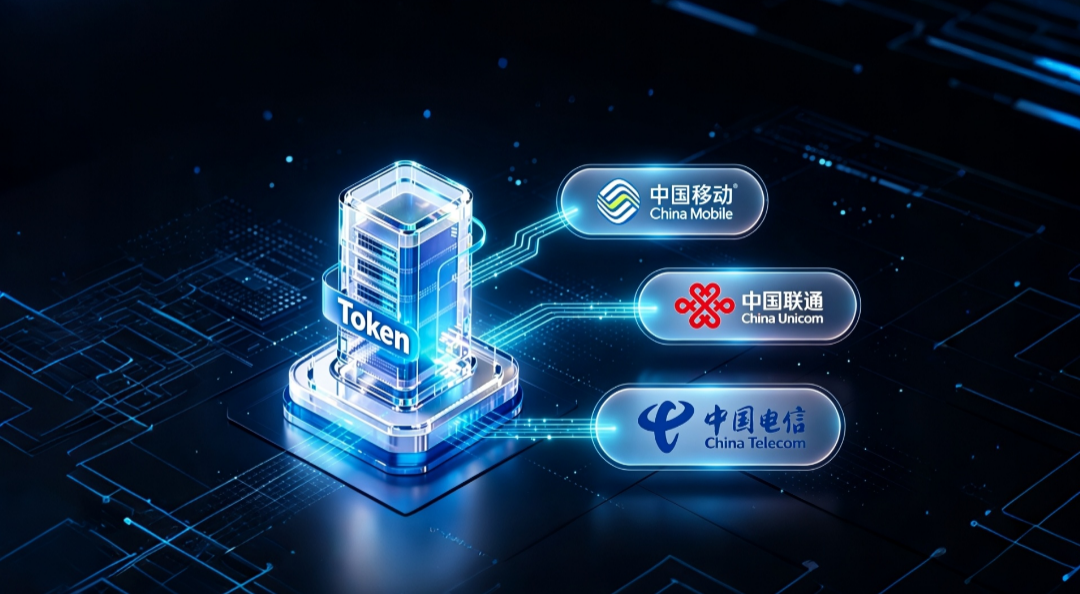
From cloud vendors to telecom giants to independent large model vendors like Zhipu and MiniMax, Token has become the hottest business in the AI industry chain.
Zhipu's H1 2026 financial report shows Token call revenue at RMB 825 million, up 2735.7% year-on-year, accounting for 86.5% of total revenue, up sharply from 15.2% in the same period last year. Token call business has become Zhipu's revenue engine.
With most large model vendors still in the red and investments far exceeding returns, the capital market increasingly values real revenue.
Developing Token business allows vendors to generate direct cash flow, proving their commercialization potential to the capital market. Meanwhile, large model vendors also hope to leverage e-commerce platforms to introduce more diverse Token package usage scenarios and create a larger commercial pie.
However, given the current situation, large model vendors' participation in this Double 11 event seems more of a marketing gimmick than actual sales, and whether it can unlock greater potential remains questionable.
On e-commerce platforms, to meet C-end needs, large model computing power services are evolving towards standardized, mass-market product forms.
The first transformation is lowering usage barriers.
Previously, Token purchases targeted professional developers, requiring users to understand terms like API Key and control panel.
Take MiniMax as an example: users needed to log in to the MiniMax open platform, complete real-name authentication, register a developer account, securely store their API Key and Group ID, then input the keys into code, local CLI tools, or third-party AI clients before calling the model.
This usage model split 'buying Tokens' and 'using Tokens' into two separate steps, filtering out non-technical users at every stage.
After vendors set up shop on Tmall, users only need to select a package, complete payment, and log in to bind their personal account.
In terms of purchase channels, users no longer need to navigate multiple platforms but can shop directly on their everyday e-commerce platform. Technically, concepts like API Key are replaced with universal terms like monthly, annual, and continuous subscriptions. Overall, Token packages are evolving towards lower barriers, shifting from professional developers to C-end consumers on e-commerce platforms.
Although purchase and usage barriers have lowered, sales data from major vendors' official flagship stores is underwhelming. Zhipu's official flagship store lists six products, with the highest selling over 200 units and the lowest just one.
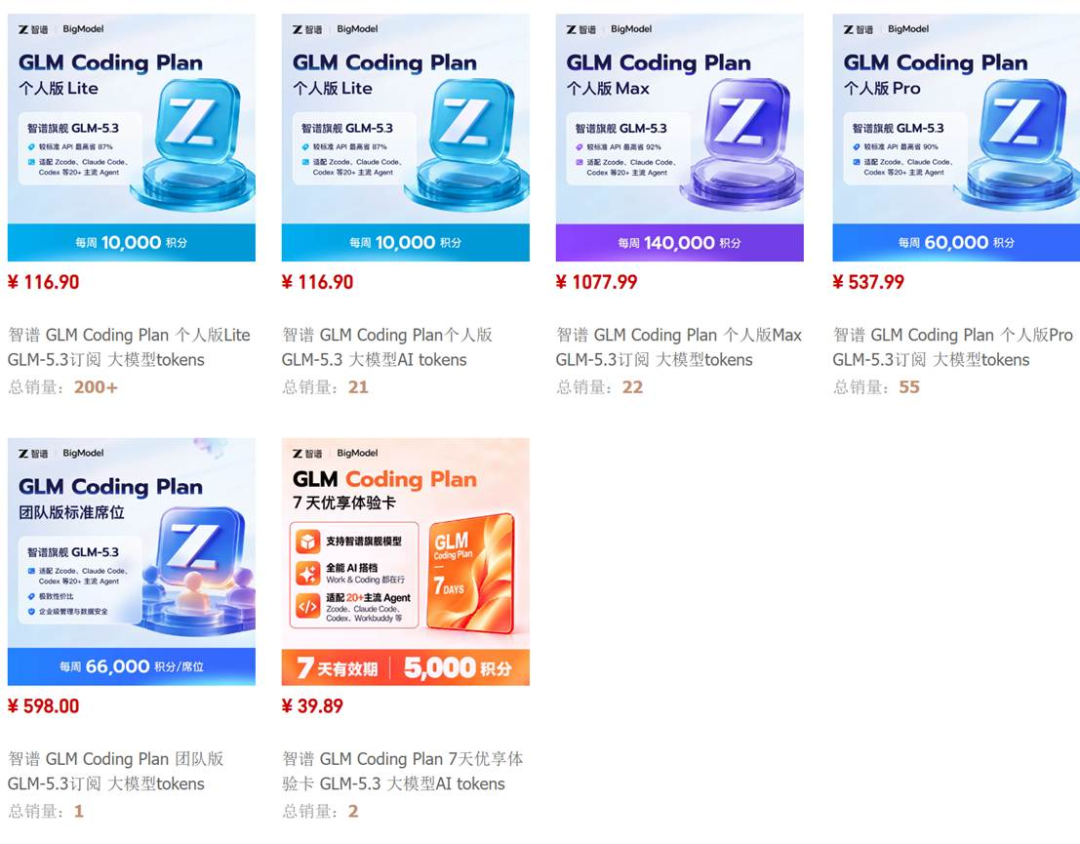
(Image Source: Tmall Platform)
The second transformation is greater standardization of Token packages.
After listing their Token packages on e-commerce channels like Tmall and JD, large model vendors must adhere to the platforms' mature commodity trading rules. In this e-commerce sales scenario, Token packages become standardized digital commodities with transparent terms and clear rights and responsibilities.
Pre-sale, e-commerce platforms must first vet vendor qualifications to ensure delivery links are authentic and controllable. After listing, vendors must also clearly disclose product-related information as required.
For example, Alibaba Cloud's Token Plan packages display complete product descriptions, supported models, supported Agent tools, package usage, redemption processes, and precautions on the product detail page for user reference. During sales, customer service is available to answer consumer questions, and product prices can participate in platform promotions.
Compared to post-sale support on official websites, Token packages listed on e-commerce platforms follow the e-commerce post-sale system, with built-in rights like order retention and post-sale consultations. Additionally, 'user reviews' on e-commerce platforms provide timely feedback on real package usage experiences.
Currently, official flagship stores from various vendors have recorded user experiences, good or bad, which may influence public brand perception.
Moreover, as a new e-commerce category, the measurement standards for Token packages listed by vendors are not unified.
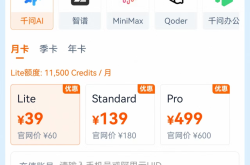
On Tmall's AI Space Station, for the lowest-tier packages, QianWen's Lite version costs RMB 39 for 11,500 Credits/month, Zhipu's Lite version costs RMB 118 for 10,000 points weekly, while MiniMax's Go version costs RMB 49, with 'more usage' indicated but no specific quota. For C-end users, this remains a technical black box.
Token packages are still niche products within professional circles. While vendors have launched products for e-commerce C-end channels, C-end sales volume has not yet scaled, and Double 11 store sales have fallen short of expectations.
Whether large model vendors' descent into e-commerce is a C-end trial or a sustained commercial structural transformation remains to be seen.

-
Lei Jun Triumphs Once More! Xiaomi Smart Speaker Secures 62.8% of Domestic Market Share!
-
Supor Witnesses Steady Revenue Growth, with Profitability Anticipated to Rebound Gradually | Q3 Report Analysis
-
![]()
Token Hits Tmall: A Stone’s Throw Away from Pinduoduo
-
Wang Hao’s Departure from BAIC: A Transition Defined by Transformation and Performance
-
![]()
Will Doubao Mobile Trigger a New Round of 'Soul Theory' Debate?
-
![]()
Doubao Phone: Will It Spark a Fresh Wave of 'Soul Theory' Controversy?
-
![]()
When AI Creates Problems but No One Is Held Accountable: It Gave the Police a False Tip
-
![]()
From Doubao Mobile Phone to OPPO’s Partnership with Manus, and the Gradual Rise of Startups like Jieyue Xingchen: Who’s Riding the Wave of Opportunity?