Bloom Energy: Strong Performance vs. Plunging Stock Price—What Lies Behind the AI Power 'Meme Stock's' Fears?
 10/23 2026
 371
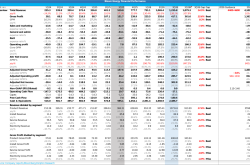
On October 22, 2026, after market close, Bloom Energy announced its Q3 2026 results. Amid concerns over Q2 revenue's heavy reliance on a single customer (Nebius) and potential delays in Oracle's Project Jupiter gas supply affecting delivery timelines, Bloom Energy delivered a better-than-expected earnings report, raising full-year guidance for the third time this year. Key highlights include:
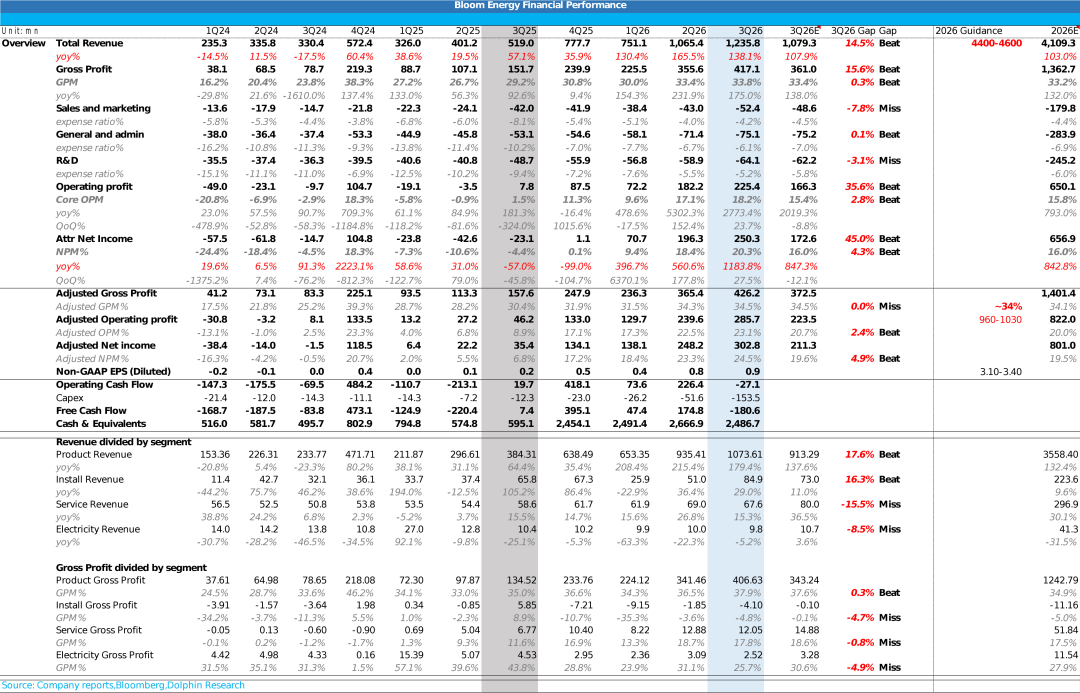
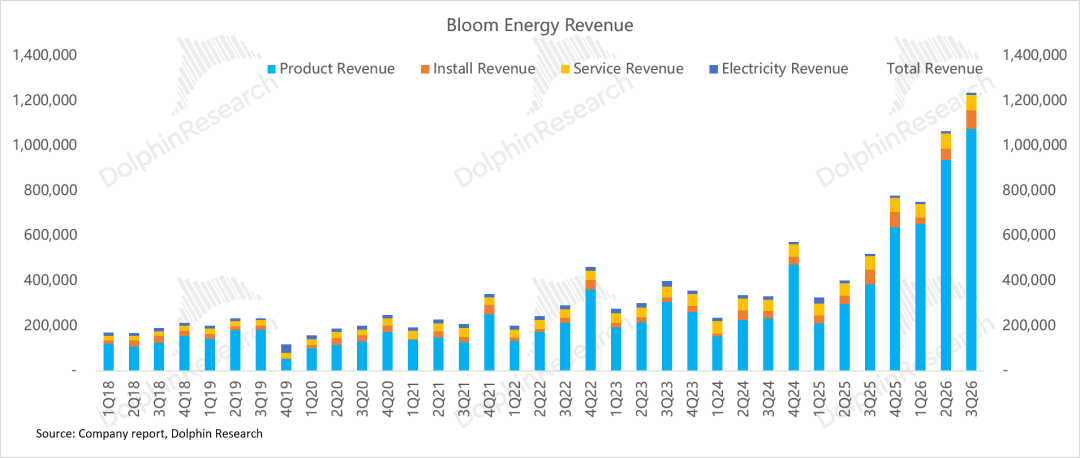
① Revenue far exceeded expectations, with deliveries surging post-major orders: Total revenue for the quarter reached $1.24 billion, up 138% YoY and about 15% higher than market expectations. Product revenue (direct sales of SOFC fuel cells) hit $1.07 billion, a 179% YoY increase.
Assuming an ASP of $3,000 per kW, shipments reached approximately 356 MW this quarter, up about 16% QoQ. While around 70% of Q2 revenue came from a single customer, market fears of a Q3 drop-off proved unfounded as other data center customers' sites became operational, resulting in higher-than-expected relay (handover) deliveries. Even without contributions from Oracle's Jupiter project, revenue remained unaffected.
The ability to sustain deliveries stems from BE's 'sign-and-deliver' capability. Management cited examples: the first Oracle project in Utah achieved power supply in under two months; the New Jersey Nebius project secured planning approval within three months of signing, with the first block operational two months after approval. For power-hungry data centers, this speed itself generates orders—once customer sites are ready, revenue recognition follows swiftly.
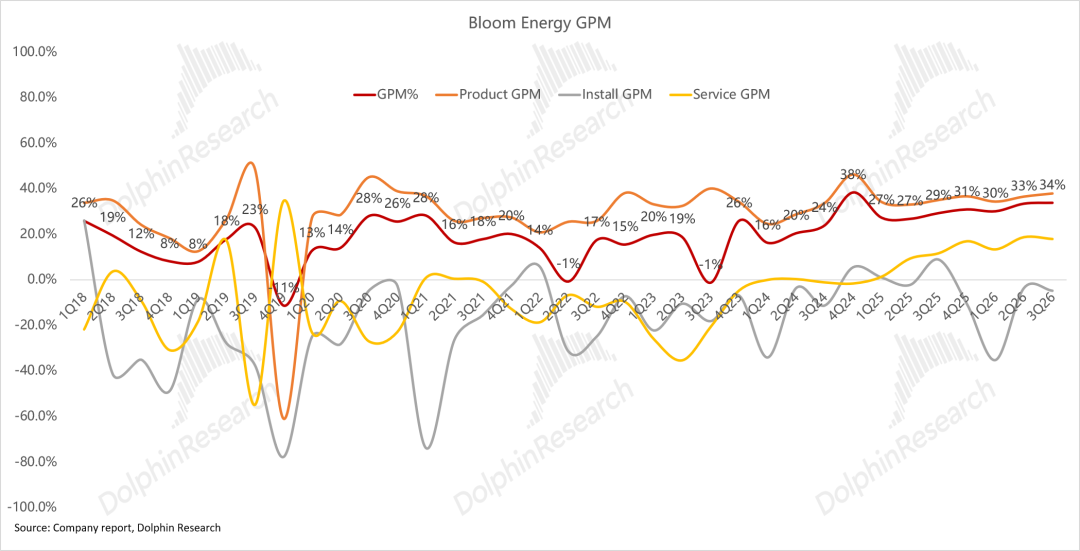
② Gross margin improved steadily, with pricing and cost reductions offsetting expansion expenses: GAAP gross margin reached 33.8% this quarter, up 0.4 percentage points QoQ, driven by continued improvement in product business margins, which offset the drag from service (-4.8%) and installation margins.
a. Product business margins continued to rise: Product gross margin expanded 1.4 percentage points QoQ to approximately 37.9% (vs. market expectations of 37.3%), supported by strong product pricing and ongoing cost reductions in materials and manufacturing, which offset short-term cost increases from new production line ramp-ups and expedited deliveries.
Management emphasized that the company delivers 'time to power' value rather than a commodity, with SOFC pricing remaining sticky amid doubled gas turbine prices and extended delivery lead times in recent years.
b. Service business margins declined slightly: Service gross margin dipped from 18.7% in Q2 to 17.8% this quarter (vs. market expectations of 18.0%), still marking the sixth consecutive quarter of double-digit service margins.
Service revenue grew with installed capacity, but product performance warranty costs (up ~$8.3 million YoY) eroded service revenue and margins.
Extended stack lifespans remain critical for service margin improvement—stack replacement cycles have improved from nine months in 2018 to about five years, with related durability issues not expected to emerge until 2028–2029 at the earliest.
③ Significant operating leverage unleashed, with quarterly profit surpassing last year's total: Revenue more than doubled while operating expenses grew only 33%, as R&D and infrastructure costs remained largely fixed, and sales, administrative, and service operations expanded through automation, with incremental costs primarily from employee compensation (including equity incentives).
Automation is key to cost control: Stack production lines required ~600 people at 100 MW annual capacity and remain at ~600 people at 1 GW, with management projecting this level to persist at 5 GW. This implies limited cost increases from future capacity expansions, leaving room for margin improvement.
Profit growth far outpaced revenue: Operating profit reached $230 million, exceeding initial market expectations of $170 million, with operating margin rising another 1 percentage point QoQ to 18.2%.
④ Cash flow turned negative as growth began 'consuming cash': Operating cash flow saw a slight net outflow (-$20 million) this quarter, and combined with capital expenditures (-$150 million), free cash flow reached approximately -$180 million, turning negative again.
The driver was working capital: Product revenue is recognized upon delivery and transfer of control, but invoicing and collections follow contract milestones. Faster revenue growth led to increased contract assets and accounts receivable, which together tied up about $600 million in cash this quarter.
Meanwhile, the company stockpiled inventory (~$170 million increase) for Q4 deliveries and expansion, while capital expenditures accelerated to ~$150 million in the quarter, already quadrupling the full-year 2025 total in the first three quarters.
Management stated the single-quarter outflow was 'not the start of a trend,' with free cash flow remaining positive in the first three quarters. Dolphin Research believes this is normal for high-growth stages as long as collection rhythms remain healthy. Ending cash stood at ~$2.5 billion, roughly flat YoY, with no financing pressure as expansion can be funded by internal cash flow.
⑤ Full-year guidance raised for the third time this year: The company lifted its full-year revenue guidance from $3.9–4.2 billion to $4.4–4.6 billion (vs. market expectations of ~$4.1 billion), implying ~122% YoY growth at the midpoint ($4.5 billion). Non-GAAP operating profit guidance was raised from $800–900 million to $960–1.03 billion, with gross margin guidance maintained at ~34%.
Based on the guidance, Q4 revenue is expected to reach $1.35–1.55 billion, continuing QoQ growth and significantly exceeding previous market expectations of $1.23 billion. Management explained that the guidance comprises two parts: backlog orders assessed by customer site readiness timelines and probability-weighted estimates of urgent power-supply customers in the quarter, with final placement within the range determined by year-end delivery timelines.
Markets widely expected Jupiter delays to prevent further guidance hikes, yet the midpoint rose by ~$450 million, indicating other customers' deliveries sufficiently filled the gap.
However, the company did not provide 2027 guidance, with details on backlog growth framework to be clarified in the Q4 earnings call. On capacity, management did not disclose post-expansion figures or timelines for Fremont, only stating expansions prepare for beyond 5 GW, with capacity increases following demand gradually.
At the profit level, Non-GAAP operating profit reached ~$660 million in the first three quarters, implying ~$300–370 million in Q4 per the guidance, with Non-GAAP operating margin at ~22%–24%, in line with Q3, indicating no sacrifice of margins for revenue growth.
Dolphin Research's View:
Dolphin Research notes that despite such strong results, the stock plummeted alongside the market, reflecting capital's extreme fear of low-margin, small-cap, high-valuation (10X PS) AI upstream equipment stocks amid market beta and sentiment headwinds. When risk appetite returns, it will likely be among the most explosive AI energy stocks.
Overall, amid Q2 revenue's heavy reliance on a single large order and Jupiter gas supply delays, markets expected a 'smooth transition with maintained full-year guidance' in Q3. Instead, Bloom Energy delivered a better-than-expected report: revenue, gross margin, and operating profit all exceeded expectations, with full-year revenue and profit guidance raised for the third time this year, implying continued QoQ revenue growth in Q4.
The 'fly in the ointment' was cash flow—working capital occupy (tie-up) combined with accelerated capex pushed free cash flow negative for the quarter. Additionally, the company did not disclose backlog amounts or capacity expansion details, nor provided 2027 outlook.
As previously emphasized by Dolphin Research, BE's investment thesis has fundamentally shifted—from 'technology validation' to 'capacity ramp-up validation.'
Q3 progress further validated this view: on the demand side, another hyperscaler (Google) adopted BE's SOFC through a utility PPA structure, with new scenarios opening in military, power utilities, and overseas markets; on the supply side, the company leased a new facility in Fremont to prepare for capacity beyond 5 GW (raising the capacity ceiling from 5–6 GW to 10–12 GW).
Bloom Energy's core advantages over alternatives were further validated this quarter:
① Time to Power: Temporal arbitrage
Nebius signed a 328 MW order in May but switched to BE due to reciprocating engine air permit delays. BE delivered ~260 MW that quarter (partially via air freight, incurring high expedited costs), yet product gross margin still reached 38%, indicating customers' willingness to pay a premium for speed.
For a 1 GW AI data center, while BE's solution requires hundreds of millions in electricity and equipment premiums, early commissioning by one year can generate $12–24 billion in additional computing revenue (even higher for short-term leases). According to Jensen Huang, each quarterly delay in a 1 GW project costs ~$10 billion in revenue.
② Avoiding NIMBY effects, moving toward grid-scale
BE's non-combustion technology features low emissions, low noise, and minimal water consumption (~1.4 million gallons over a 1 GW lifecycle, vs. ~25 billion gallons for wet-cooled gas combined cycle), easing permitting and community approval. This quarter, SOFC officially entered utility power planning:
a. Google/AEP: AEP invested ~$4 billion in a 702 MW fuel cell project in Cheyenne, Wyoming, using BE technology with CCS, signing a 20-year PPA with Google for commercial operation by end-2028. This marks another top cloud provider endorsing BE via PPA after Oracle.
Management stated all hyperscalers are inquiring about CCS, which the company can deliver at a 10%–15% cost increase (CSPs are willing to pay premiums for low carbon), viewing CCS as a multi-trillion-dollar opportunity.
b. Ameren: Ameren Missouri included ~500 MW of fuel cells in its 20-year Integrated Resource Plan (IRP) by 2030, with BE currently the only supplier capable of such scale.
Management called utility business a 'massive growth area': utilities can include Bloom servers in rate bases as grid-scale assets deployed front-of-meter, procuring per IRP plans. This shifts BE's orders from 'customer-by-customer negotiations' to 'batch purchases per utility plans,' with larger deal sizes and more predictable timing—management expects major orders to materialize.
③ Native 800V DC compatibility
BE naturally outputs 800V DC. The company estimates 1 GW data center direct DC supply can reduce 5-year total ownership costs by ~9% (~$5.5 billion). NVIDIA will require 800V DC starting with Rubin Ultra in 2027, giving BE a first-mover advantage, with solid-state transformers (SSTs) as the main competitive threat.
Orders: 'Steady' growth, but amounts remain undisclosed
The company only stated that backlog growth outpaced revenue, without specific guidance, though order structure continues to improve:
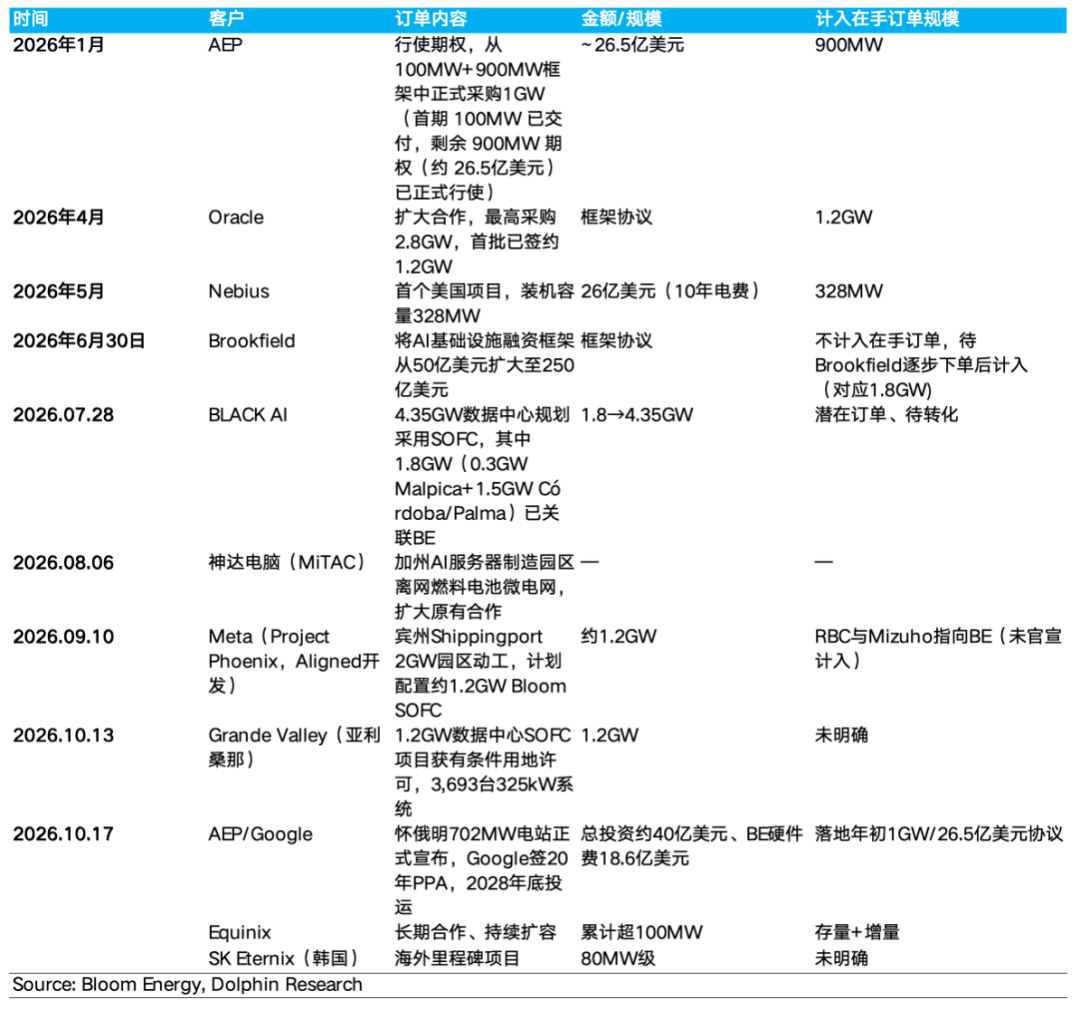
a. Customer base expanded from 'one cloud provider' to 'multiple cloud providers': After Oracle (framework agreement for up to 2.8 GW, with 1.2 GW signed), Google became the second top cloud provider to adopt BE via AEP's PPA structure; management said all major U.S. hyperscalers and over ten neoclouds, AI labs, and third-party data center operators have validated its solutions.
b. Repeat orders from existing customers: AEP exercised options from a 100 MW framework to 900 MW, while MiTAC continued to expand orders;
c. However, quarterly customer concentration remained high: Management explained that large campus deliveries see significant quarterly fluctuations, with concentration reflecting delivery timelines rather than order structure—any quarter's revenue may be dominated by 1–2 customers.
In Q3, two customers contributed ~43% and 26% of revenue (the latter a related party), totaling ~69%, slightly less concentrated than Q2's ~73% from a single customer, but still high.
Given repeat orders from existing customers, Dolphin Research views this risk as controllable, though quarterly revenue volatility will persist.
Thus, with AI data center power demand remaining robust and CSPs not significantly cutting capex, market focus has shifted from 'is demand real?' to 'can supply keep up and deliveries stay on time?'
Supply-side risks: Three concerns are easing
a. Oracle's Jupiter project: Affects revenue timing, not orders
Oracle's planned ~2.45 GW hyperscale AI data center (primarily serving OpenAI) saw gas supply pipeline rerouting delay gas availability from August 2026 to February 1, 2027. However, this affects rental obligations under its lease (if the data center cannot commission on time, rent commencement can be postponed) without altering BE's order contract.
BE's shipments hinge on New Mexico air permits (expected by November 23), with minimal gas usage during commissioning solvable via tankers. Jupiter was set to contribute ~$400 million in 2026 revenue, likely delayed to 2027, but the company's raised guidance indicates short-term impacts have been absorbed, with other customers' deliveries filling the gap; even if the site delays further, the MSA framework does not bind to a single site, allowing equipment redeployment to other Oracle data centers.
b. Project Tembo (formerly Jade): Concerns largely resolved
Last quarter, markets feared infrastructure partner Crusoe's exit would stall the project, but Q3 brought clarity: Google replaced Crusoe as project lead, with BE's contract still with AEP (which signed a 20-year PPA with Google). The ~700 MW scale makes it BE's largest single-site project to date.
c. Supply chain and capacity:
Management did not address supply constraints nearing 5 GW, but current raw material supply suffices for demand and orders. Critical components like hot boxes have multiple external suppliers (MTAR, Kaori) expanding capacity, collectively supporting ~2.5 GW annual delivery by 2028.
On capacity, BE leased a new Fremont facility with floor space comparable to its existing plant, raising the capacity ceiling from 5–6 GW to 10–12 GW (per Dolphin Research's estimates). Management did not disclose post-expansion capacity figures, only stating expansions prepare for beyond 5 GW, with capacity increases following demand without overinvestment; automation keeps headcount nearly unchanged from 100 MW to 5 GW, minimizing marginal expansion costs.
Therefore, Dolphin Research believes that the overall supply and execution risks faced by Bloom Energy are currently manageable. Under a neutral assumption—where CSPs maintain high capital expenditures, AI data center power shortages persist, and production bottlenecks for core gas turbine components remain difficult to resolve quickly (delivery cycles stay elevated)—SOFC will continue to gain a market window.
Value Analysis
Last quarter, based on the company's projected annual production capacity of 5GW by 2030, we identified upside potential for BE. Subsequently, the stock price recovered steadily from a low of approximately $167 at the end of July, fueled by MiTAC's expanded orders, Fremont's capacity expansion, and inclusion in the S&P 500, reaching around $296 at one point. It later declined to approximately $218 (market capitalization of about $64.2 billion) due to a broader tech stock correction, slightly surpassing the upper limit of our neutral valuation.
New developments in the third quarter are raising the valuation 'ceiling':
a. Faster-than-expected profit realization: The full-year revenue guidance was raised for the third time this year, with the median 2026 revenue growth rate projected at approximately 122% and the Non-GAAP operating margin at around 22%.
b. Physical basis for expansion: The second Fremont factory brings the total production capacity ceiling to 10–12GW, providing a foundation for the optimistic scenario of 8–10GW shipments by 2030.
c. More diversified demand sources: Demand is expanding from behind-the-meter power solutions primarily for Oracle to include more cloud providers like Google and front-of-the-meter utilities like Ameren, with progress also being made in military and overseas markets (some still in planning or negotiation stages).
Overall, these earnings provide support for the short-term stock price, but upside potential is constrained by two factors: first, the current market capitalization slightly exceeds the neutral valuation, with capacity realization expectations already well reflected in the stock price; second, order transparency remains limited, leading some investors to await further details in the fourth-quarter earnings call before making decisions.
In the medium term, Dolphin Research maintains a 'neutral to moderately bullish' stance on BE: given continued outperformance in fundamentals and earnings against a backdrop of persistent AI data center power supply shortages, once market sentiment improves and risk appetite increases, such undervalued, high-beta AI energy plays often demonstrate strong upward momentum.
Key catalysts to monitor include: (1) Backlog and 2027 guidance disclosed in the fourth-quarter earnings call; (2) Whether the second Fremont factory commences production on schedule and substantively confirms the expansion path beyond 5GW.
However, significant contraction in CSP capital expenditures, substantial delays in revenue recognition for major projects like Jupiter, or material substitution by competitors' new low-cost technologies (e.g., metal-supported SOFC, SST + grid integration solutions) could trigger sharp corrections in the elevated stock price.
- END -
// Reprint Authorization
This article is an original work by Dolphin Research. Unauthorized reproduction is prohibited without explicit permission.
// Disclaimer and General Disclosure
This report is intended for general reference and data analysis purposes only, serving users of Dolphin Research and its affiliates for informational use. It does not consider the specific investment objectives, product preferences, risk tolerance, financial conditions, or unique needs of any individual recipient. Investors must consult independent professional advisors before making investment decisions based on this report. Any investment decisions made using or referring to the content herein are undertaken at the investor's own risk. Dolphin Research assumes no liability for any direct or indirect losses arising from the use of data contained in this report. The information and data herein are based on publicly available sources and are provided for reference only; Dolphin Research strives to ensure but does not guarantee their reliability, accuracy, or completeness.
The information and opinions expressed in this report do not constitute, under any jurisdiction, an offer to sell or a solicitation of an offer to buy securities, nor do they constitute investment advice, price quotations, or recommendations regarding securities or related financial instruments. The information, tools, and materials provided herein are not intended for distribution to, or use by, any person or entity in any jurisdiction where such distribution, publication, availability, or use would contravene applicable laws or regulations or subject Dolphin Research and/or its affiliates to registration or licensing requirements in that jurisdiction.
This report reflects the personal views, insights, and analytical methods of the contributing researchers and does not represent the official stance of Dolphin Research or its affiliated institutions.
This report is produced by Dolphin Research, with all copyrights reserved. No institution or individual may, without prior written consent from Dolphin Research: (i) reproduce, copy, duplicate, reprint, forward, or create derivatives in any form; or (ii) redistribute or transfer the content directly or indirectly to unauthorized third parties. Dolphin Research reserves all related rights.
-
![]()
Bloom Energy: Strong Performance vs. Plunging Stock Price—What Lies Behind the AI Power 'Meme Stock's' Fears?
-
Will All Domestic Mobile Phone Brands (Excluding Huawei) Encounter a Collective Slump by 2026?
-
Lei Jun Triumphs Once More! Xiaomi Smart Speaker Secures 62.8% of Domestic Market Share!
-
Supor Witnesses Steady Revenue Growth, with Profitability Anticipated to Rebound Gradually | Q3 Report Analysis
-
![]()
Token Hits Tmall: A Stone’s Throw Away from Pinduoduo
-
Wang Hao’s Departure from BAIC: A Transition Defined by Transformation and Performance
-
![]()
Will Doubao Mobile Trigger a New Round of 'Soul Theory' Debate?
-
![]()
Doubao Phone: Will It Spark a Fresh Wave of 'Soul Theory' Controversy?