SpaceX Secures $40 Billion in GPU Financing, Wagering on Market Growth Over the Next Five Years
 10/27 2026
 399
What Will Be the Value of Today's Cutting-Edge GPUs in Five Years?
On October 26, SpaceX announced a significant GPU financing deal worth $40 billion. Entities associated with Apollo Global Management will acquire NVIDIA GPUs and related equipment, leasing them to SpaceX for approximately five to five and a quarter years per batch.
Both parties have executed binding commitment letters, although formal lease agreements are still pending finalization. The delivery of equipment is scheduled for the first half of 2027.
The $40 billion sum, roughly equivalent to RMB 280 billion, closely aligns with SpaceX's projected total capital expenditures for the fourth quarter. The financing payment period will span five years, during which GPUs are expected to undergo multiple rounds of technological upgrades.
NVIDIA is continually releasing more advanced AI chips, with evolving models and computing architectures. While a batch of GPUs may be in high demand and function effectively for years, their market value for computing power may not remain at current levels.
Technological advancements occur rapidly, while capital recovery takes several years. The $40 billion financing reflects a clash between these two time cycles.
01 How Long Can GPUs Remain Profitable?
The asset lifespan of traditional data centers is relatively predictable. Servers, networking equipment, and power supply facilities can operate for extended periods, enabling companies to gradually recoup their investments as long as customer demand remains steady.
However, AI data centers face unique challenges. The scale of GPU investments continues to grow, and the rate of chip upgrades is accelerating.
From Hopper to Blackwell, NVIDIA has consistently enhanced GPU computing performance, memory bandwidth, and cluster interconnect efficiency. Algorithm optimizations are also reducing the computational resources needed for the same tasks, ultimately affecting the production cost per token.
Thus, even if new GPUs come at a higher price, their efficiency advantages may make them a more cost-effective option for computing power. Older GPUs can still perform tasks like inference and batch processing, but as newer devices become more prevalent, their rental prices may drop.
The most significant challenge with GPUs is that their revenue-generating potential may decline before the equipment becomes obsolete.
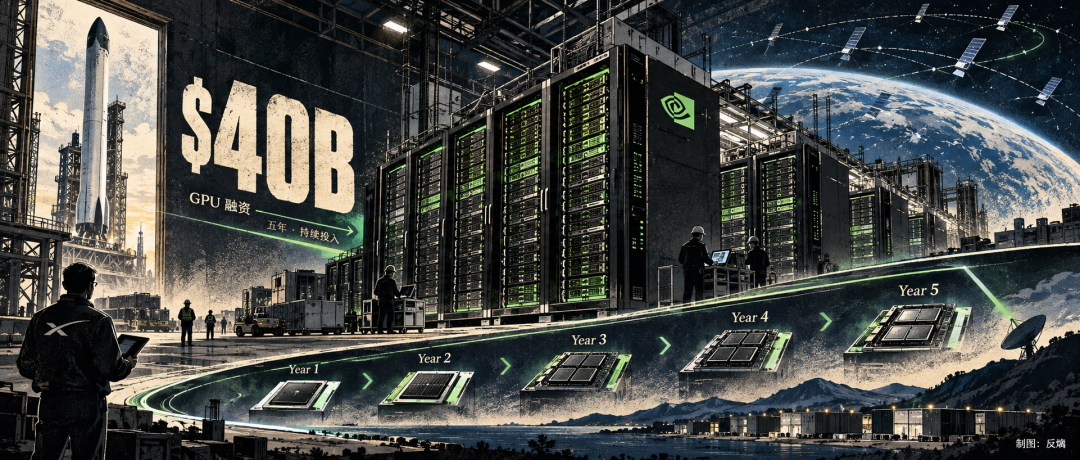
SpaceX plans to repay the GPU equipment financing over approximately five years, a period during which several generations of chip updates may occur. According to the disclosed arrangement, rental and financing fees will be paid in installments, with established payment obligations not automatically adjusting to market price fluctuations for computing power.
02 GPUs Emerging as Financial Assets
SpaceX is not the first company to secure substantial financing using GPUs.
In August of this year, U.S. AI cloud service provider CoreWeave secured a $2.6 billion delayed-draw term loan for GPU and related infrastructure construction. The loan, maturing in September 2031, carries an annual interest rate of Term SOFR plus 5.5 percentage points when SOFR is used as the benchmark.
With a loan term of about five years and an average customer contract duration of only around three years, financial institutions must evaluate the equipment's re-leasing potential after contract expiration and whether future cash flows can cover debt repayments.
SpaceX intends to utilize a finance lease structure, with asset financing logic similar to CoreWeave's but with structural differences. Under the current arrangement, Apollo-affiliated entities will purchase the equipment, with SpaceX assuming lease payment obligations.
Unlike companies primarily reliant on computing power service revenue, SpaceX also owns Starlink. In the third quarter, the Connectivity segment, which includes Starlink, generated $5.248 billion in revenue and $2.367 billion in operating profit. Ongoing satellite internet service revenue and proceeds from public offerings form a crucial foundation for SpaceX's financing capacity.

However, finance leases do not automatically remove related liabilities from the company's balance sheet. Some of SpaceX's previous GPU sale-and-leaseback transactions saw financing debts remain consolidated in financial statements due to failure to meet sales recognition criteria.
As AI infrastructure investment scales up, GPUs are becoming increasingly important financing assets for financial institutions, with their market value beginning to influence capital allocation and pricing.
GPU computing efficiency determines its technological competitiveness, while customer demand and financing costs further affect its commercial value and investment returns.
03 Musk Bets on Increasing Computing Power Demand
In the third quarter, the company's Superintelligence (SI) segment generated $7.56 billion in revenue, accounting for 51.9% of total group revenue. However, this segment also includes businesses like Grok, Cursor, and X, so not all revenue comes from GPU leasing.
SI capital expenditures reached $16.444 billion in the quarter, accounting for about 84% of the group total. In the first three quarters of this year, SpaceX generated approximately $13.1 billion in operating cash flow while incurring about $48.1 billion in capital expenditures, a difference of about $35 billion. Despite holding substantial cash and short-term marketable securities, SpaceX still requires external financing to support continuous expansion.
Musk remains optimistic about the returns from newly purchased GPUs. During the third-quarter earnings call, he stated that at current computing power prices, the payback period for newly deployed computing power is less than one year. However, as complete measurement and calculation conditions have not been disclosed, this prediction cannot be directly equated with the cash payback period for the entire data center project.
SpaceX tends to flexibly allocate computing power between internal use and external leasing, reserving the ability to adjust prices through relatively short contract terms. Currently, SpaceX has signed substantial computing power service agreements with clients like Anthropic and Google, with some contracts including early termination clauses.
During periods of computing power shortages, shorter contract terms benefit operators by allowing them to seek higher renewal prices. However, if new-generation GPUs are delivered en masse or model efficiency improvements reduce the computing power required per task, rental prices may face downward pressure.
Under the current financing arrangement, SpaceX must continue paying equipment rentals for about five years, while some computing power contracts allow early termination. Musk hopes to achieve higher returns through flexible pricing but also assumes risks between long-term payment obligations and future revenue uncertainty.
04 Who Will Thrive in the Next Generation of GPUs?
SpaceX's $40 billion financing arrangement still has one critical undetermined factor: the interest rate.
According to the October 26 disclosure, the finance lease plan will use a fixed interest rate, but final pricing remains to be determined. For financing of this scale, even a one-percentage-point difference in interest rates could affect annual financing costs by hundreds of millions of dollars.
For SpaceX, GPU financing represents only part of the capital needed for continuous expansion. The company also plans to collaborate with Tesla on the Terafab chip manufacturing project, potentially increasing future R&D and manufacturing investments.
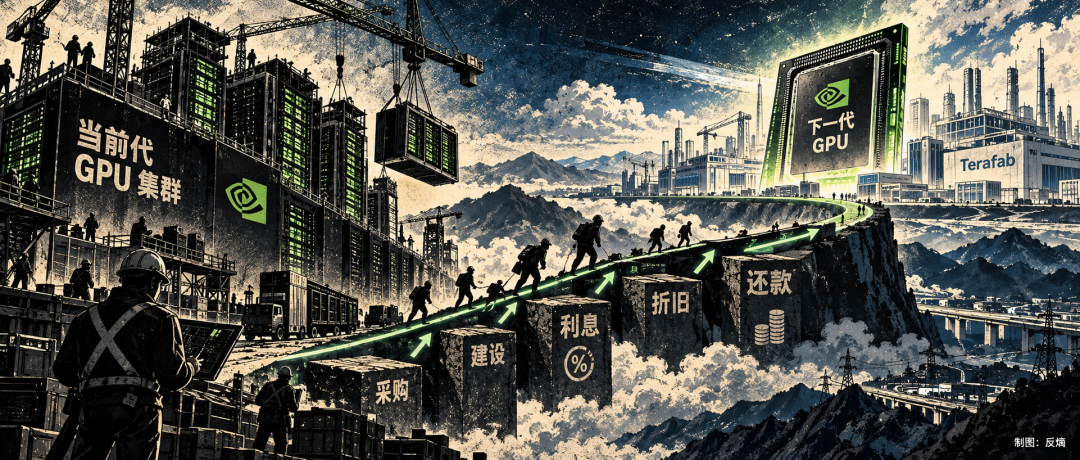
For Chinese smart computing centers, GPU asset financing also holds research value. Whether obtaining funds through bank loans, finance leases, or other channels ultimately relies on actual computing power demand to generate sustained cash flows covering equipment investment and financing costs.
Acquiring GPUs determines how much computing power a company has today, while recovering investments determines whether it can afford the next generation of GPUs.
SpaceX has secured $40 billion in financing for a new round of expansion. Musk believes computing power demand still has enormous growth potential, and market changes over the next five years will determine how much return this batch of GPUs can generate.
-
![]()
"The New Generation of PayPal Mafia"? Young Chinese Are Seizing Silicon Valley
-
![]()
Can SAIC Audi, a Brand Yet to Excel in Gasoline Cars, Find Success in the New Energy Vehicle Market?
-
![]()
Why Has the Underestimated HDD Become the 'Data Terminal' for AI?
-
![]()
Survey | With Shanghai Factory Nearing Completion, Lexus Embarks on Electric Redemption
-
![]()
The Largest IPO Ever: Anthropic’s Prospectus Reveals a Valuation Nearing $2 Trillion, Blending Cutting-Edge Tech with Business Strategy
-
![]()
The Spectacle of the Flying Car Can't Rescue Tesla's Core Operations
-
![]()
Seagull vs. Starwish: A Clash of Titans in the Electric Compact Car Market
-
Capital Reevaluation of the 'Battery King'