The Spectacle of the Flying Car Can't Rescue Tesla's Core Operations
 10/27 2026
 542
Introduction
Introduction
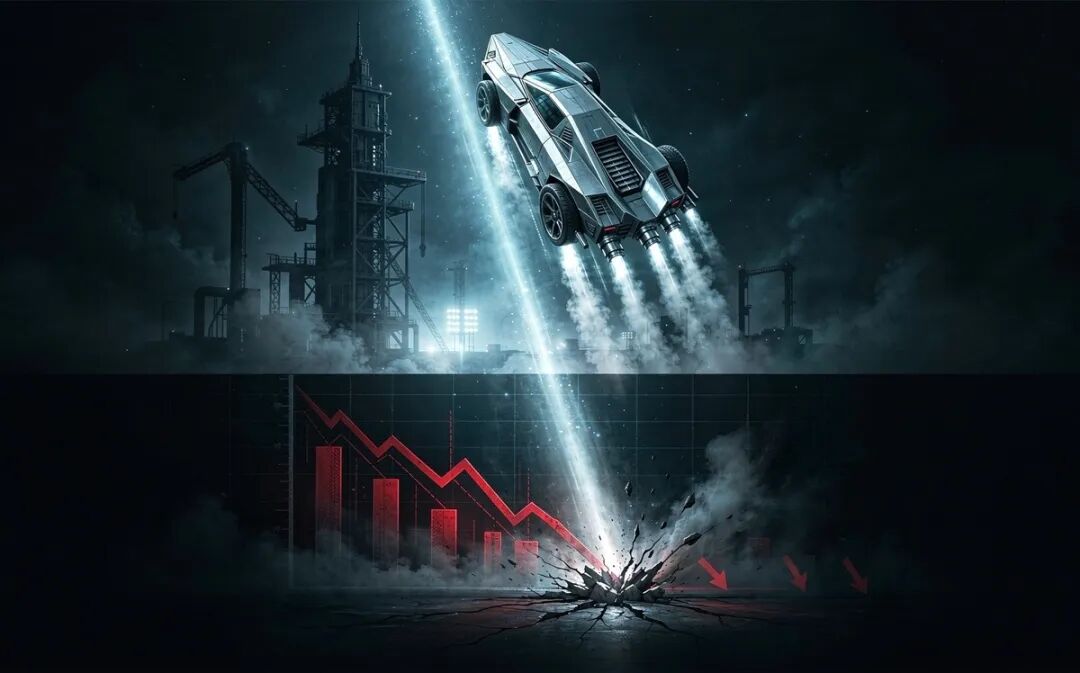
Just a week after Tesla's car "took to the skies," the company released its quarterly financial report, bringing it back down to earth with a thud.
After pulling off such a spectacular stunt, does this mean Tesla's upcoming Q3 financial report will "underperform"?
On October 15, 2026, at SpaceX's rocket test site in McGregor, Texas, Tesla's second-generation Roadster soared up a curved ramp. Utilizing negative pressure generated by undercarriage fans, it adhered to the slope and drove upside down. Then, ten cold gas thrusters ignited, lifting the entire vehicle into the air, where it flipped and landed steadily back on the ground.
The day's spectacle was undoubtedly impressive. However, when discussing it with friends, this sentiment was my strongest impression.
There are three noteworthy points about the second-generation Roadster. First, its mass production is scheduled for 2028, more than a decade after the prototype's 2017 debut. Musk himself admitted that from a revenue perspective, this model will not have a significant impact. Second, during the demonstration, the driver's seat was occupied not by a human but by an Optimus robot.
The fact that a company would stage a non-mass-producible, non-road-legal flight demonstration that doesn't affect revenue to draw attention just a week before its financial report release suggests the answer is already clear.
Showmanship can be dazzling, and marketing can put on a show, but financial reports rarely lie. Sure enough, six days later, on October 21, Tesla's Q3 2026 earnings call "underperformed"—revenue reached $28.046 billion, a slight 0.2% year-on-year decline. GAAP net profit came in at just $787 million, down 43% year-on-year.
Reviewing the subsequently disclosed annual Q3 financial report, I can conclude that this is undoubtedly Tesla's worst Q3 performance in six years and may also be its best-looking Q3 report for the next few years...
01 Tesla: No Longer Just an "Automaker"
If we examine Tesla's eight Q3 financial reports from 2019 to 2026, the trajectory becomes very clear.
Revenue surged from $6.303 billion in Q3 2019 to $28.095 billion in Q3 2025, a 3.45-fold increase over eight years.
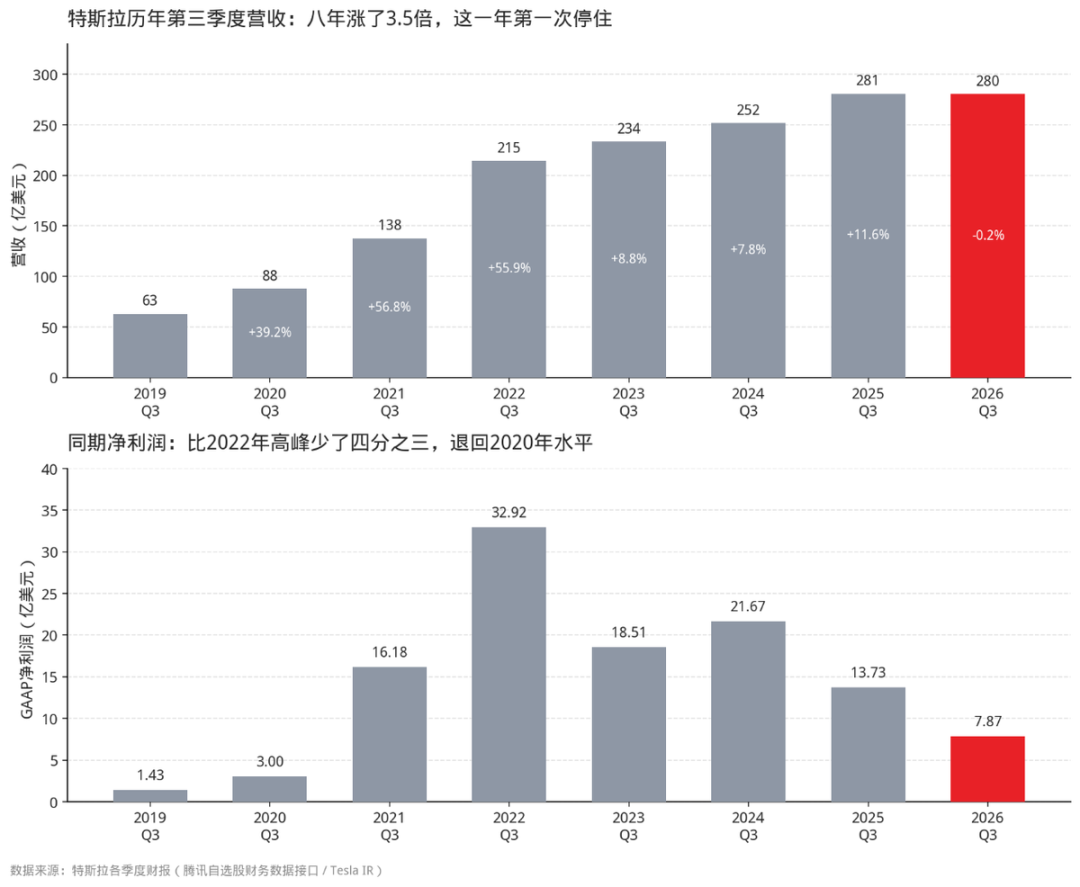
The fastest growth occurred from 2020 to 2022, with year-on-year increases of 39.2%, 56.8%, and 55.9%, respectively. Growth then plummeted to 8.8% in 2023, 7.8% in 2024, 11.6% in 2025, and turned negative for the first time in 2026 at -0.2%. The net profit curve looks even worse.
Q3 2022 marked a historic peak at $3.292 billion, dropping to $1.851 billion in Q3 2023, rebounding slightly to $2.167 billion in Q3 2024, then falling to $1.373 billion in Q3 2025, and finally reaching just $787 million in Q3 2026.
This figure has regressed to a level between $300 million in Q3 2020 and $1.618 billion in Q3 2021, three-quarters less than the peak four years ago.
Automotive business revenue for the quarter stood at $20.560 billion, down 3% year-on-year, accounting for 73.3% of total revenue. Undoubtedly, this remains Tesla's largest revenue stream and will continue to be the key business supporting cash flow for the foreseeable future. However, its growth has clearly peaked.
The product lineup issue is glaring—no standout models have emerged since the Model Y, while the Cybertruck has proven to be a flop over time. Of the 486,532 new vehicles delivered this quarter, 478,237 were Model 3 and Model Y units, accounting for 98.3%. All other models combined totaled just 8,295 units.
Considering that the final Model S/X units rolled off the Fremont factory line on May 10, these "other models" likely refer solely to the Cybertruck. The failure of this product needs no further debate.
In Tesla's original future plans, the Cybertruck held a lofty position. Musk had set an annual sales target of 250,000 units, and initial market enthusiasm seemed to validate this product's potential. However, the prolonged development and mass production process, coupled with performance far below initial promises, completely exhausted user patience and enthusiasm—38,965 units were sold across the U.S. in 2024, with deliveries halving to 20,237 units in 2025.
As for 2026, believe it or not, amid this situation, the vehicle's price was actually raised in the second half of the year! The dual-motor version jumped from $59,990 to $74,990 in August. This was certainly not a commercial adjustment driven by strong demand but a necessary move to maintain gross margins amid severe U.S. inflation.
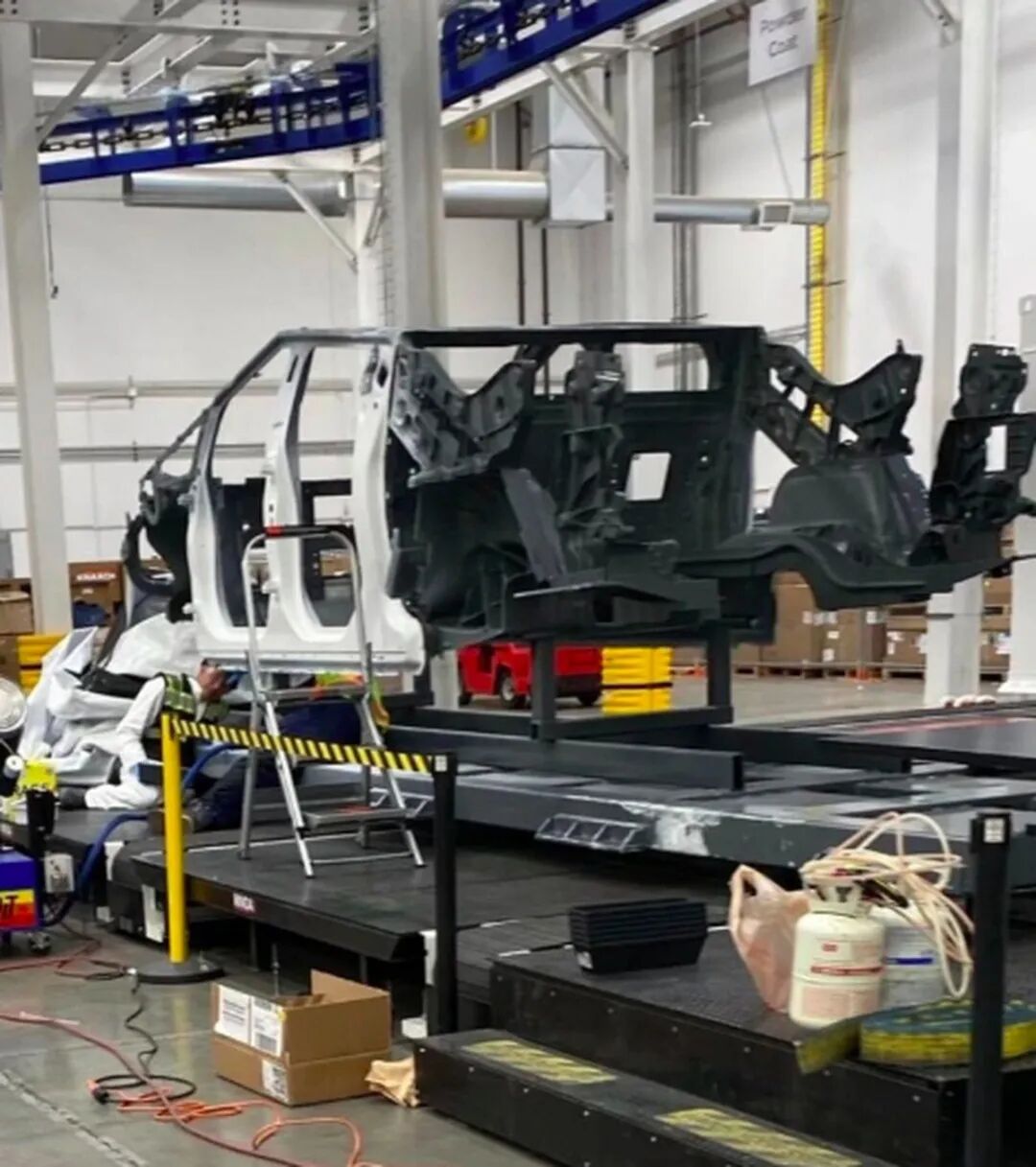
Figure: The fundamental reason for the Cybertruck's prolonged delay from concept to mass production was the shift from the initially claimed "exoskeleton" design to a conventional structure with large-scale die-casting processes.
The much-anticipated affordable Model 2—the $25,000 model revealed during Battery Day on September 23, 2020, internally codenamed Redwood—was reportedly canceled in April 2024, according to Reuters. Although Tesla publicly denied this the same day, the complete silence over the past six years since 2020 strongly suggests the report's validity.
However, automaking remains crucial for Tesla today. This business contributes over 70% of corporate revenue, provides billions in operating cash flow, and funds $2.761 billion in quarterly R&D expenses. Yet with flagship products discontinued and new model projects terminated, this business now merely maintains the status quo.
The 2030 target of 5 million annual deliveries, compared to 1.3247 million units delivered in the first three quarters of 2026, would require nearly tripling production capacity—more of a capital market statement than a production plan. Automaking has become Tesla's cash cow but is clearly not its future.
02 FSD's Q3 Entry into China Now Completely Unlikely
Since domestic testing began late last year, FSD's entry into China hasn't exactly stalled, but progress remains limited. On May 21, 2026, Tesla's official website listed China among regions where FSD was available. However, Chinese customer service quickly clarified that availability didn't mean immediate open access, with actual gray-market testing involving only about 5,000 vehicles.
To date, no large-scale rollout has occurred, no subscription model has launched, and the $64,000 buyout price remains unchanged.
While FSD's rapid entry into China could serve as stable insurance for Tesla's cash flow and revenue amid its "exit from automaking," disappointing delays have turned official statements into a collection of broken promises.
In November 2025, Musk predicted full Chinese approval by February or March 2026. In January 2026, he revised this to "as early as next month." By April 2026, CFO Zachary Kirkhorn shifted the target to Q3 during the Q1 earnings call. Now that Q3 has concluded, the October 21 call featured only vague commitments like "working hard" and "cooperating with regulators."
No new timeline has been provided. More notably, Musk this time self-assessed that Chinese automakers present fierce competition in autonomous driving, with Tesla yet to establish a clear lead. This stands in stark contrast to his earlier claim that FSD faces no real competitors among current models.
This statement carries three implications: first, admitting Tesla is no longer the technological benchmark in China; second, providing a buffer for FSD's delayed entry; third, quietly shifting its competitive moat from technological leadership to regulatory approval. To its credit, Musk didn't attempt to forcefully save face like many of his fans might have expected.
Several factors contribute to this situation, starting with hardware limitations. All newly sold Chinese vehicles now come equipped with 720TOPS HW4.0, but many older models run on 144TOPS HW3.0, which cannot support the latest edge models. While global FSD mileage has surpassed 16.1 billion kilometers, China accounts for only about 3 billion kilometers locally—a five-fold gap—and data export restrictions prevent this data from feeding into global training pools.
The primary bottleneck remains safety-related, particularly national security concerns. However, Tesla remains resolutely commercial in its approach. To address well-known risks akin to "pagers that can explode," the company independently built a data center and AI training center in Shanghai's Lingang. These efforts proved effective, securing official safety certification for "four data categories," albeit at the cost of isolating the Chinese model from North America's primary version.
A more fundamental issue lies in the system's architectural principles.
From a regulatory standpoint, China's new GB 47955-2026 national standard for L2 autonomy will take effect on January 1, 2027, while GB 44721-2022 for L3/L4 will follow on July 1, 2027. New regulatory reviews now focus on full-chain safety demonstrations rather than mere compliance, requiring every steering and braking decision to be traceable and auditable. FSD struggles here because its monolithic perception-planning-control architecture inherently complicates official compliance. In contrast, domestic competitors like Huawei and XPeng use hybrid end-to-end architectures with rule-based fallbacks, retaining white-box logic that makes regulatory approval far easier.
Additionally, after last year's fatal Xiaomi vehicle crash, authorities now mandate advance reporting and complete safety assessments for all major driving assistance updates. While North America enjoys weekly OTA updates, China offers no such flexibility. Consequently, even with gray-market testing underway, the domestic FSD version (V13 base) now lags significantly behind North America's V14.3.3, with vast differences in parameter counts.
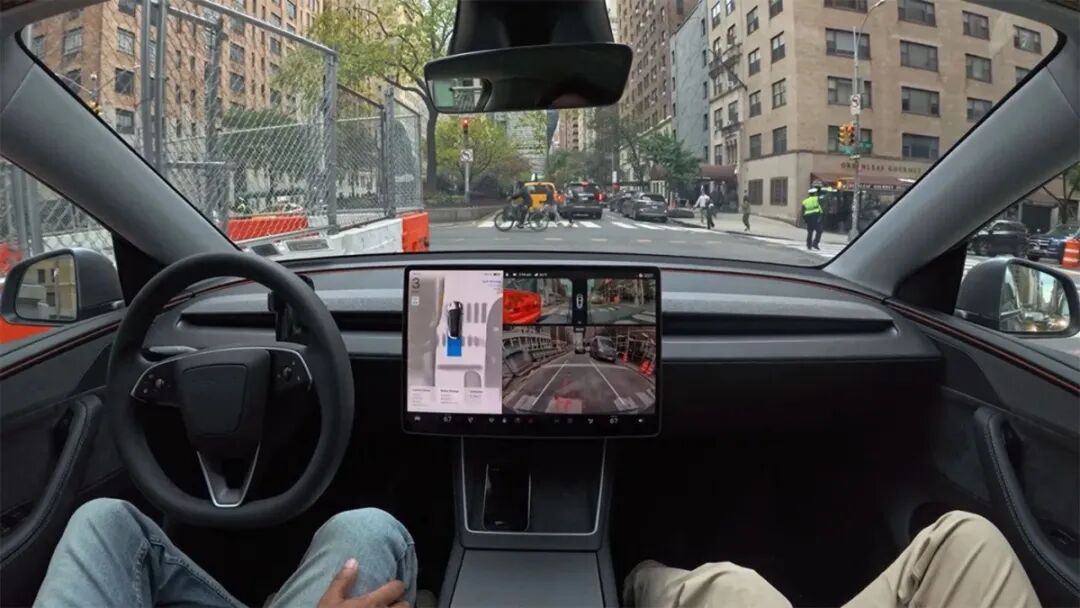
Figure: When V14 launched, Musk boasted about AI achieving "consciousness"...
Unless Tesla addresses these issues, even if FSD eventually launches in China, it will struggle to compete against local rivals.
That said, FSD has achieved substantial growth in other markets. Global paid users now number approximately 1.74 million, up 67% year-on-year, with over 75% of North American new vehicles activating paid FSD upon delivery—subscriptions now account for more than half of revenue. Nine European countries have approved its rollout, with this income now factored into automotive gross margins, which rose from 16.3% last quarter to 18.1%.
Undoubtedly, FSD represents Tesla's only AI business generating scalable cash flow and the only narrative with concrete numbers during the Cybercab/Optimus transition. However, it cannot shoulder the entire $1.52 trillion market cap alone. Being locked out of the world's largest EV market inherently lowers Tesla's growth ceiling—a bridge missing its most crucial section leads not to the future but a dead end.
03 Cybercab and Optimus Can't Carry the Load Yet
Tesla closed at $385.80 per share on October 22, 2026, with a $1.52 trillion market cap and 425x P/E ratio. A company with zero revenue growth and a 43% net profit decline commanding such a valuation clearly isn't valued for its vehicle sales.
For Tesla, both Cybercab and Optimus saw progress this quarter, but neither is remotely ready to lead the company.
In Robotaxi operations, Tesla reported that Cybercab's cumulative unsupervised mileage neared 2 million miles by Q3's end, growing eightfold quarterly. The Austin fleet expanded tenfold in a month, with operating hours extended from 9:00 AM-9:00 PM to 6:00 AM-12:00 AM. Tesla announced pilot expansions to Dallas next month and more U.S. cities by year-end.
Musk projected that operational revenue would scale up starting Q2 2027, becoming "significant" by Q3 or Q4 2028, with a per-mile cost target of $0.30.
While these numbers are growing, the base remains tiny. The eightfold increase corresponds to a total of just under 2 million miles by quarter-end. For comparison, Waymo operates in 15 U.S. cities with about 4,000 vehicles, handling 500,000 paid weekly orders. Tesla's Robotaxi remains an Austin-based pilot with hundreds of vehicles and undisclosed order volumes/revenue.
The greatest risk for Tesla's Robotaxi business currently lies in regulation. The U.S. National Highway Traffic Safety Administration (NHTSA) has a public safety review process for Cybercab certification, with Tesla's requested 30-day extension expiring on October 30. Musk clarified that most Cybercabs will be Tesla-operated under a "Transportation-as-a-Service" model, with potential external sales remaining small-scale through year-end.
As for Optimus, Musk unusually tempered expectations during the earnings call.
High-volume production has begun at the Fremont factory, with the first mass-production-quality robots rolling off the line. However, external customer deliveries won't begin until late 2027. Officials emphasized initial deployment in dangerous, repetitive factory tasks. Regarding scale-up to 20,000 units weekly (1 million annually), Musk stated this would take "at least another year." When explaining bottlenecks, he listed specifics: dexterous hand design, AI reliability, component lifespan, and training data—with training data being the hardest constraint, as AI5 chip integration into Optimus isn't scheduled until April 2027.
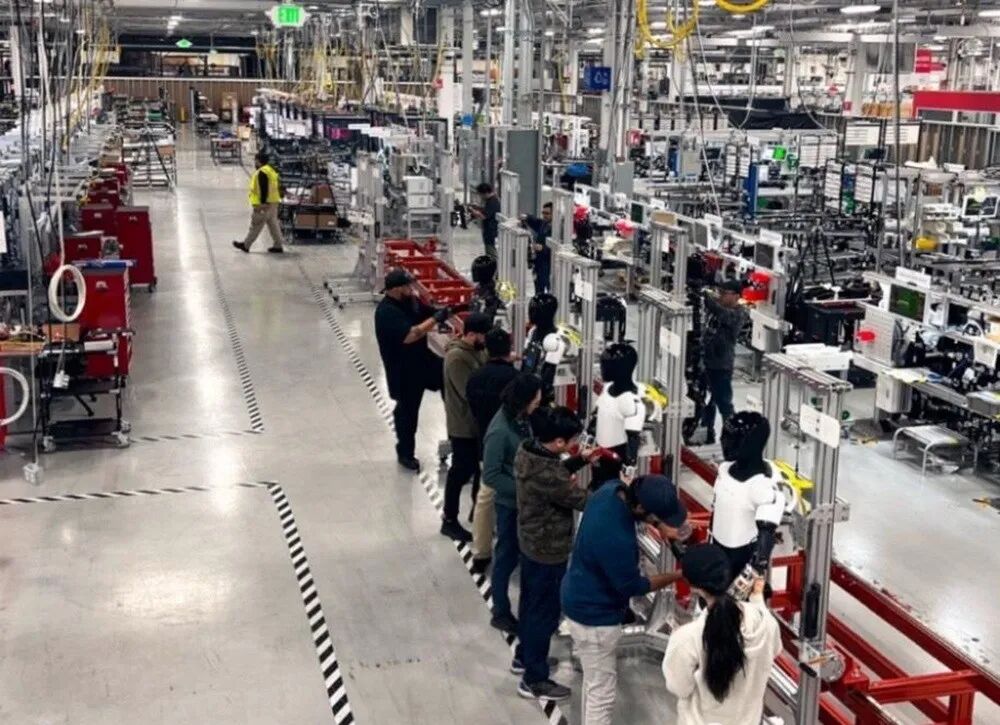
Don't laugh, there really isn't a fully automated production line available for embodied intelligent robots at present. Perhaps in the future, robots could be used to produce other robots.
He even made a judgment that doesn't quite align with his usual style of making grandiose promises: “(Optimus') production ramp-up will be quite bumpy. There are ten thousand things that must be done correctly, and progress depends on the slowest one among them.”
This cautious strategy, which markedly diverges from Musk's typical bold approach, is, in the author's view, well-justified. The Terafab chip factory project, a cornerstone of this endeavor, will necessitate hardware equipment investments exceeding $10 billion, with long-term total investments anticipated to surpass $100 billion. The first test chip is projected for mid-2027, with mass production not anticipated until the end of 2028.
A ride-hailing service that won't yield profits until 2027, a robot that won't be commercially available until the end of 2027, and a wafer fabrication plant that won't commence mass production until the end of 2028—none of these three ventures will generate substantial revenue in 2026, yet they are projected to underpin the majority of the valuation behind a market capitalization of $1.52 trillion.
The market's response has been notably direct.
Following the earnings announcement, the stock price plummeted by more than 3% in after-hours trading that evening, not due to disappointing profits but because the full-year capital expenditure guidance was revised downward from over $25 billion to approximately $20 billion. The company attributed this to efficient capital deployment management, but the market perceived it as a postponement. The stock closed at $385.80 the next day, nearly rebounding from the drop, but that 3% decline in after-hours trading accurately reflected market sentiment.
Taking a broader perspective, the overall financial performance for the first three quarters of 2026 actually reveals more than just the third quarter's results:
In the first three quarters of this year, Tesla's total revenue reached $78.669 billion, a 12.5% year-on-year increase; it delivered 1,324,681 vehicles, an 8.8% rise; and net profit was $2.38 billion, a 19.4% year-on-year decrease.
Sales ended two consecutive years of decline, and revenue continued to climb, but profits fell, with the decline significantly outpacing revenue growth. By the third quarter alone, revenue turned negative year-on-year, with automotive revenue down 3%, and the growth engine stalling.
Tesla's current situation can be summarized in three sentences:
It possesses $45.447 billion in cash and investments, with free cash flow turning positive at $1.531 billion this quarter, indicating no short-term survival concerns. The automotive business's gross margin, excluding regulatory credits, recovered to 18.1%, meaning car sales remain profitable, and the core business is intact. However, R&D expenses surged 69% year-on-year to $2.761 billion, with all additional gross profits reinvested in autonomous driving, robots, and chips—businesses that won't contribute profits until at least 2027.
According to Musk himself, this year is purely an investment phase for Tesla, with returns not expected until the end of 2027 at the earliest. Under this premise, three key milestones are set on the timeline.
First, whether FSD can secure approval across the EU; second, whether Cybercab can generate verifiable revenue after the second quarter of 2027; and finally, whether Optimus can be commercially available by the end of 2027. If all three, or at least two, are achieved, the current valuation logic should remain valid. However, if only one is achieved or delays persist, the company's stock price will require reassessment.
Objectively speaking, Tesla is not a company in crisis. After all, since its inception, it has been a company priced for the future, with that future repeatedly postponed. The issue for the former is survival, while for the latter, it's credibility. Two recent variables worth monitoring are the response deadline set by the NHTSA for October 30 (details can be found in the previous Gongshe C Dimension article, "Tesla: The Knife Is at Its Throat") and the annual shareholder meeting on December 3.
The method for evaluating Tesla is clear: focus not on what it demonstrates, but on what it delivers.
Those who proclaim "the future is here" after watching promotional videos have become mere background noise in the current capital market. After all, in today's capital market, there's a type of loss that's inevitable: mistaking demonstrations for deliveries and teasers for financial reports.
These individuals aren't being misled by Musk; they need someone to fulfill their vision of the future, and Musk happens to charge for providing that service.
Editor-in-Chief: Li Sijia Editor: He Zengrong

THE END
-
![]()
Lula Wins Election! His Policies Helped a Bricklayer’s Daughter Become an Engineer at BYD
-
![]()
"The New Generation of PayPal Mafia"? Young Chinese Are Seizing Silicon Valley
-
![]()
Can SAIC Audi, a Brand Yet to Excel in Gasoline Cars, Find Success in the New Energy Vehicle Market?
-
![]()
Why Has the Underestimated HDD Become the 'Data Terminal' for AI?
-
![]()
Survey | With Shanghai Factory Nearing Completion, Lexus Embarks on Electric Redemption
-
![]()
The Largest IPO Ever: Anthropic’s Prospectus Reveals a Valuation Nearing $2 Trillion, Blending Cutting-Edge Tech with Business Strategy
-
![]()
The Spectacle of the Flying Car Can't Rescue Tesla's Core Operations
-
![]()
Seagull vs. Starwish: A Clash of Titans in the Electric Compact Car Market