What Did Alibaba Really Gain by Putting Qwen on the iPhone?
 11/02 2026
 513
Linking iPhone user requests to its own transaction services
Author | Xin Jian
Editor | Xiaobai
Image | AI-generated
Produced by | Emphasize Next
On October 31, Apple officially announced Apple Intelligence for the China market, opening for developer beta testing on November 4 and set to roll out with iOS 27.3 in December. Qwen will be integrated into Siri, writing tools, and visual intelligence.
Most of the first batch of features are those that have already rolled out overseas since 2024; the next-generation Siri AI is not among them.
The prevailing market interpretation has been: with more than 200 million existing devices, default system invocation, and zero-cost reach, Alibaba Cloud's token revenue will scale up accordingly. When the filing news broke in July, Alibaba's U.S. shares briefly rose more than 7%, and brokerages raised their revenue forecasts for Alibaba Cloud.
But the product arrangement announced in October makes one thing clear: Qwen is an optional extension that users must choose to enable. How many existing iPhones it can cover, how many of those users will actually use it, and how these invocations will be billed are all unknown.
At list prices, this business is worth only a few hundred million to a few billion yuan a year
Start with the brokerage numbers. Because of this partnership, SDIC Securities International raised its FY27 revenue forecast for Alibaba Cloud by 4%, corresponding to a 47% growth rate in cloud intelligence revenue. Alibaba Cloud Intelligence FY26 revenue was 158.1 billion yuan; based on a 47% growth rate and a 4% upward revision, the implied increment is roughly 9 billion yuan. But without the breakdown from the original research report, this 8.9 billion yuan cannot all be attributed to the Apple partnership.
Now consider devices. The first batch only supports iPhone 15 Pro and later models. IDC data shows that Apple shipped 46.2 million units in China in 2025, up 4% year over year, implying about 44 million units in 2024. The two years together total about 90 million units; adding the installed base of 15 Pro and new phones in 2026, the eligible models at the December launch will be around 100 million units. To gauge the order of magnitude, this article temporarily uses 100 million eligible in-use devices for scenario estimates.
A single invocation is calculated as 1,500 input tokens and 400 output tokens, already including the cost of image understanding. The list price for the Qwen Plus tier is about 2 yuan per million input tokens and 12 yuan per million output tokens, equivalent to about 0.8 cents per invocation. The flagship Max tier is 12 yuan for input and 36 yuan for output, equivalent to about 3 cents per invocation. For tasks such as summarization, rewriting, and image recognition on Apple devices, the Plus tier is more reasonable, with the Max tier used as an upper-bound reference. The annual inference amounts under the three scenarios are as follows: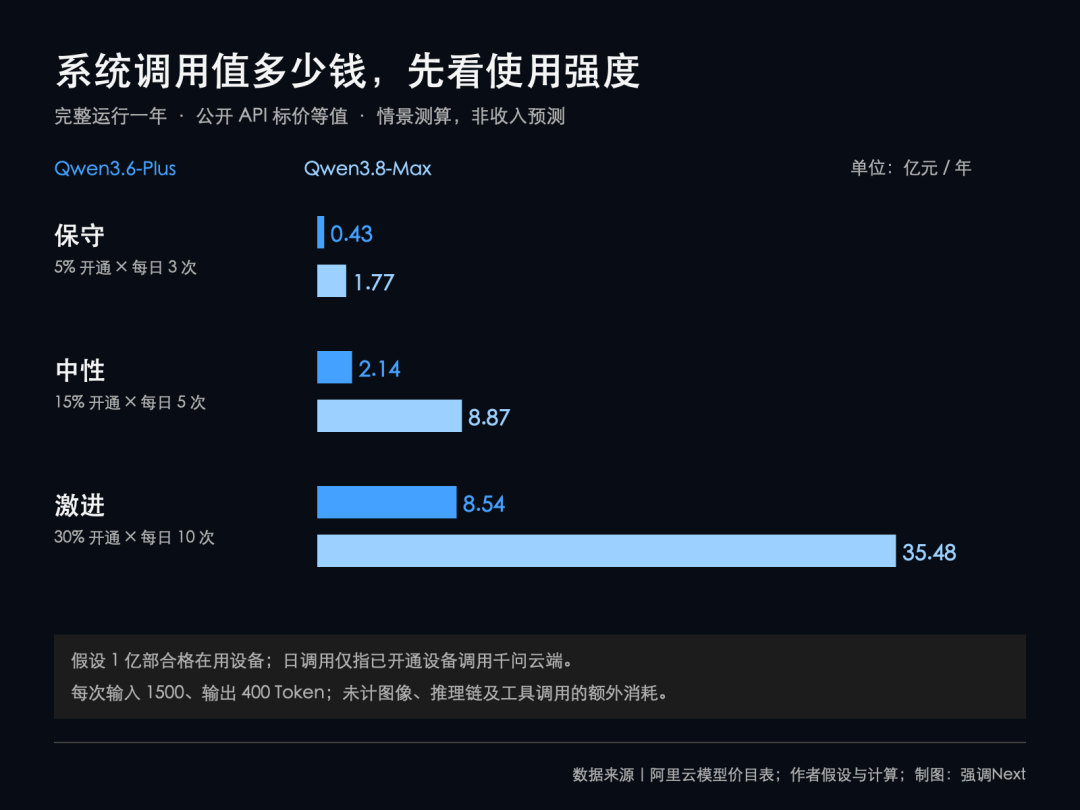
Even under the aggressive scenario at Max-tier list prices, it is only about 3.5 billion yuan—still 2.6 times short of the 9 billion yuan implied by the brokerage. To match that number, one would have to simultaneously assume 30% activation, 10 uses per day on average, all using flagship models, and token consumption magnified by another 2.6 times. For comparison, Alibaba's AI cloud and computing power service revenue in the June quarter was 48.4 billion yuan, and quarterly capital expenditure was 67.7 billion yuan. List prices are retail prices; Alibaba's own internal costs are lower.
Whether recorded as revenue or cost, this inference layer falls within the rounding error of Alibaba's financial statements. The earlier claims of "zero-cost reach" and "scaling up" need to be reframed: if this partnership is not worth much money, why is Alibaba still doing it?
The money most likely flows in the opposite direction
Look at how Apple's past two AI bills have worked. According to Bloomberg, Apple pays Google about $1 billion a year to use a customized Gemini with 1.2 trillion parameters to power the new Siri, with the model running on Apple's own private cloud. In January 2026, the two sides officially confirmed a multi-year partnership: the next generation of Apple foundation models will be based on Gemini models and cloud technology, continuing to run on Apple devices and the private cloud computing system, but financial terms were not disclosed. Money flowing in the opposite direction is much larger. Court documents show that Google paid Apple $20 billion in 2022 for default search in Safari, and a Google witness also disclosed that Google shares 36% of search advertising revenue with Apple (Apple has a similar partnership with Baidu in China).
When ChatGPT was integrated into Siri in 2024, Bloomberg reported that Apple did not pay OpenAI, believing that putting the latter in front of hundreds of millions of devices was worth no less than cash, and it planned to charge commissions in the future from AI partners that monetize on Apple platforms. Apple's price list is very clear: for a "brain" it cannot build itself, it pays. For a "gateway" that brings traffic, it charges.
Qwen's current position is that of a gateway: the first batch of features is driven by Apple's own models, Qwen is an optional extension that users must enable, and users also need to log in to a Qwen account. In this position, money is more likely to flow from Alibaba to Apple. Among the three revenue paths inferred by brokerages, fixed licensing fees and per-token payments both require Apple to pay, which goes against its usual practice.
Only the e-commerce revenue-sharing path aligns with its usual practice, and the counterparty to that revenue sharing is precisely Apple. Apple currently has no incentive to pay on behalf of partners either. Its guidance for fourth-quarter gross margin is 47% to 48%, below market expectations, and Cook said it is evaluating all options to ease cost and supply pressure. The background is the continued sharp rise in prices of NAND and LPDDR (flash memory and memory chips).
Letting partners bear cloud inference is Apple's most convenient choice. Even if Qwen someday takes the position of the "brain" of China-market Siri, it will not be a big sum of money. Greater China accounts for about 17% of Apple's total revenue ($18.8 billion out of $109.4 billion). Converting Google's $1 billion price tag at that ratio gives about 1.2 billion yuan a year.
What Alibaba is buying is the qualification to have both the "brain" and the "hands" present
The money is not worth much, so why is Alibaba still doing it? The answer lies in Doubao Phone. On October 14, Doubao Phone Assistant disclosed a rejection list of 155 apps, covering WeChat, Taobao, Alipay, Meituan, and others, including 66 Tencent apps and 23 Alibaba apps; Taobao, Alipay, Amap, Hema, and even Qwen itself were all on the list. Some analysts believe that high-barrier areas such as social networking and payments are more likely to refuse to hand control to system-level agents, and instead build app-level agents within their own apps. Doubao therefore had to switch to partnership interfaces; it has now integrated services willing to open up, such as Caocao Mobility, and has also launched its own "Doubao Shopping."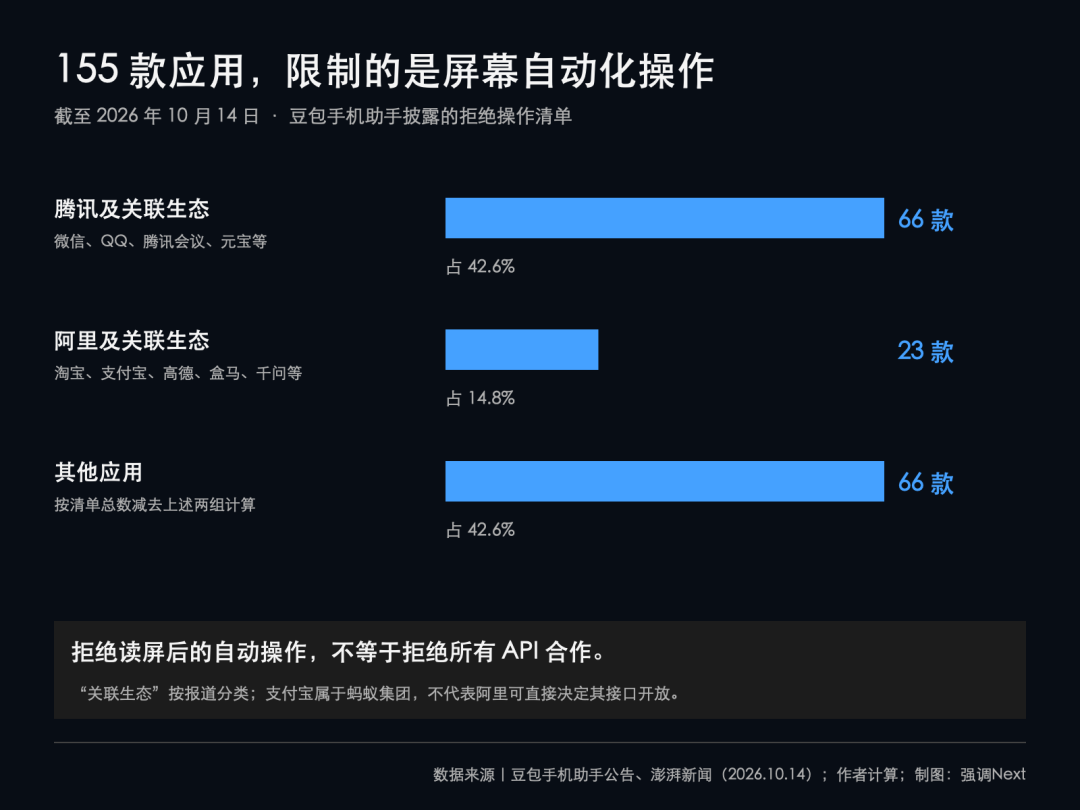
On phones in China, the scarce resource for agents is not models, but permission granted by high-frequency apps. Models can be swapped; the doors of apps must be opened by the apps themselves. Alibaba has a position in Apple's candidate list that others do not have: it simultaneously holds Taobao, Alipay, Amap, and Ele.me—an entire group of transaction, payment, map, and local life apps. Tencent holds WeChat, but in currently public information Apple's partner is only Alibaba (and the rumored Baidu).
For China-market Siri AI to be truly useful, it must let people complete ordering, buying, paying, and navigation in one sentence, and most of these actions fall within Alibaba's apps. If Qwen becomes the brain behind Siri, the way these apps open to it is through partnership interfaces, rather than having to break in through screen-reading and simulated clicks like Doubao. However, this is this article's inference; no party has mentioned any interface arrangement between Siri AI and Taobao or Alipay in public information.
This is also needed for Alibaba's own defense. In the June quarter, Alibaba's customer management revenue fell 7% year over year, and this segment mainly relies on in-site search advertising. If an assistant directly answers shopping questions, users bypass Taobao's search box. Alibaba disclosed that since the Qwen App launched, 250 million users have experienced agent-based shopping, indicating that it has already run this chain through within its own apps. Integrating into the iPhone's system layer is equivalent to guarding the first entry point of shopping intent in front of the highest-value user group.
This card cannot be played today
Alibaba has the card, but Apple has no reason to rush to bid. Counterpoint data shows that in the quarter ending in June, Apple's iPhone sales in Greater China grew 23%, with share rising from 13.9% to 18.1%. This growth happened during the two years when China-market Apple Intelligence was absent, although Greater China revenue was below analyst expectations. Apple does not rely on this feature to sell iPhones; China-market AI is a defense line, not a growth engine.
The less anxious Apple is, the less bargaining power Qwen has, which explains why Qwen only received an optional extension slot. On the user side, there is the lesson ChatGPT has already paid for. In a court filing on September 22, OpenAI stated that after ChatGPT was integrated into Siri, it started slowly in January 2025 and by March 2026 was still described by it as continuing to underperform expectations, with specific numbers redacted.
Reports pointed out that one reason was that the integration was off by default. Qwen's integration method is almost the same template. Qwen likewise needs to cross the distance from "can be used" to "continuously used." System coverage scale is only the starting point; whether users enable it, how many times they invoke it each month, and whether they come back determine the actual value of this entry point. Now look at the denominator.
With 100 million eligible models, assuming 10% to 30% activation, that is 10 million to 30 million people. In September, Qwen's monthly active users were 158 million, down from 167 million in June. Over the same period, Doubao rose from 382 million to 419 million, a net increase of about 37 million in three months. Even at its best, the iPhone channel would only equal one quarter of Doubao's net increase and would not change the landscape between Qwen and Doubao.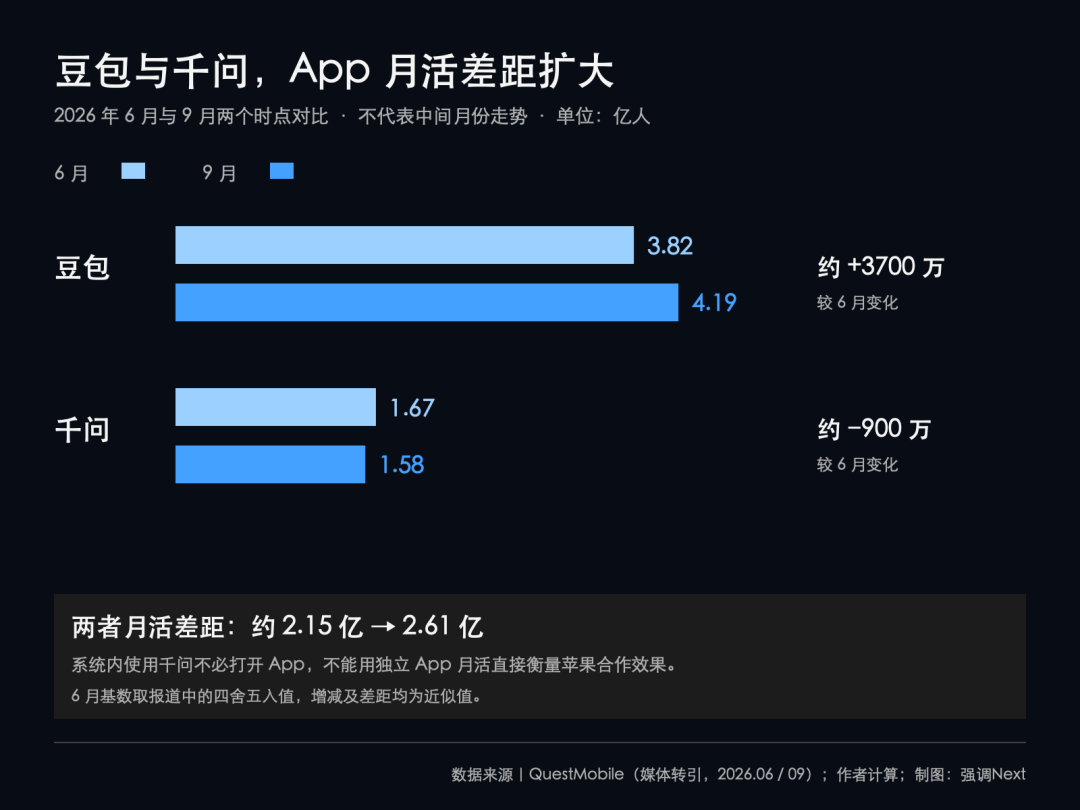
Structural erosion is still ahead. Apple's approach prioritizes on-device processing, keeping basic tasks on the device and having partners handle only the parts that cannot be handled locally. With each improvement in on-device models, partners are invoked fewer times. The biggest variable is who owns the Siri brain. Apple said back in 2024 that it hoped users could choose among different models and named Gemini; two years later, the foundation of the new Siri was handed to Google.
Who will be the brain of the China-market version is expected by the industry to wait until 2027 or even later. Qwen's current position is exactly the position ChatGPT occupied in 2024. China has fewer eligible compliant partners than the United States; Alibaba has filings, cloud computing power, and a group of apps, so its chances are greater than ChatGPT's were at the time, but no one has signed yet.
On November 3, Apple will hold its earnings call, and Ternus and management's remarks on China-market AI deserve attention. After the December rollout, the more valuable data will be the actual activity, invocations, and retention of the Qwen system extension. If transaction interfaces are subsequently announced, completion rates and conversion should also be examined, not just the integration list.
Note: The data in this article comes from public materials and public reports; the estimation parts are the author's estimates and do not constitute investment advice.
- END -
-
![]()
AI Office Track Head-to-Head: After the Battle for Entry Points, the Renewal Period Is the Real Test
-
![]()
Why Is the Eyebox Always "Bright in the Center, Dark at the Edges"? — The Polarization Multiplexing Solution
-
![]()
Why Can't the Smartest Coding Assistant Reply to Your Messages Instantly?
-
![]()
Half of Domestic Tokens Used to Make Wish-Fulfillment Dramas? Large Models Face a Compute Bloat Bubble
-
![]()
Apple Picks Qwen — and There's More to It Than Meets the Eye
-
No Blackening, No Fanning—Xiaomi Auto's Goal of Delivering 550,000 Vehicles This Year Is Easier Said Than Done
-
![]()
Automakers' KPI Collapse
-
![]()
The All-New Xiaomi SU7 Ultra Laps the 'Ring Undisguised — Can Chinese Performance Cars Earn a 'Seat at the Table'?