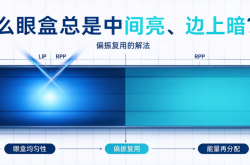
Why Is the Eyebox Always "Bright in the Center, Dark at the Edges"? — The Polarization Multiplexing Solution
 11/02 2026
 435

Abstract: The root cause of eyebox non-uniformity is that light is gradually extracted as it propagates through the waveguide—bright near the incoupling end and dim at the far end.
Conventional PVGs respond only to a single circular polarization, wasting nearly half the energy. Polarization multiplexing puts orthogonally polarized light to work as well, giving the outcoupling region a more continuous and uniform energy supply. In one experiment at Fuzhou University, eyebox uniformity improved by 48.8%.
Almost everyone working in AR optical waveguide R&D has encountered this classic phenomenon: when the eye stays at the center of the eyebox, the image is clear and bright; when the line of sight shifts slightly to the side, the image brightness drops noticeably.
Many people mistakenly attribute this to poor optical design, but it is actually a physical law arising from energy distribution. As light propagates forward through the waveguide, each time it passes through an outcoupling region, a portion of the light is split off and projected to the human eye, while the rest continues forward.
With extraction occurring along the way, the farther toward the far end the light travels, the weaker the remaining light intensity becomes. So is there a way to boost the brightness of the far-end image? Polarization multiplexing is a currently promising solution.
The root cause of eyebox non-uniformity: energy is "extracted away, less and less"
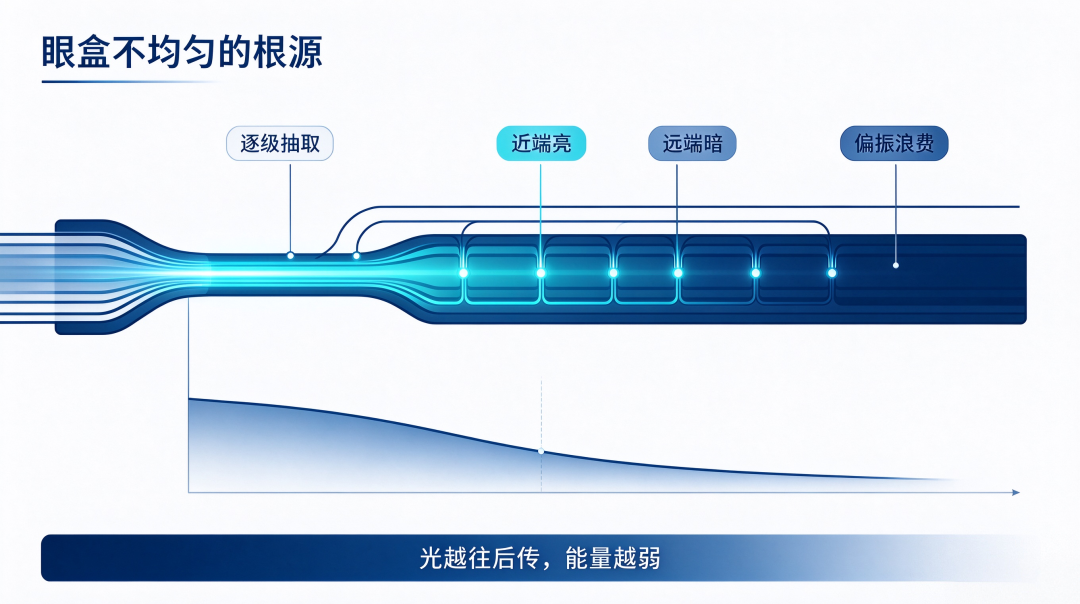
Optical waveguides achieve exit pupil expansion through multiple diffractions in the outcoupling region. Each diffraction extracts a portion of light out of the waveguide and into the human eye, while the rest continues to the next outcoupling position.
The farther the light propagates toward the far end, the more energy is lost, creating a phenomenon where it is brighter near the incoupling end and darker at the far end—this is the fundamental cause of eyebox brightness non-uniformity.
A more troublesome point: conventional polarization volume gratings (PVGs) act on only a single circular polarization. Orthogonally polarized circularly polarized light can pass directly through the grating and cannot participate in outcoupling.
Nearly half of the light energy, due to polarization state mismatch, cannot be outcoupled and utilized by the PVG at all after entering the waveguide.
Solution 1: left-handed + right-handed dual-channel multiplexing
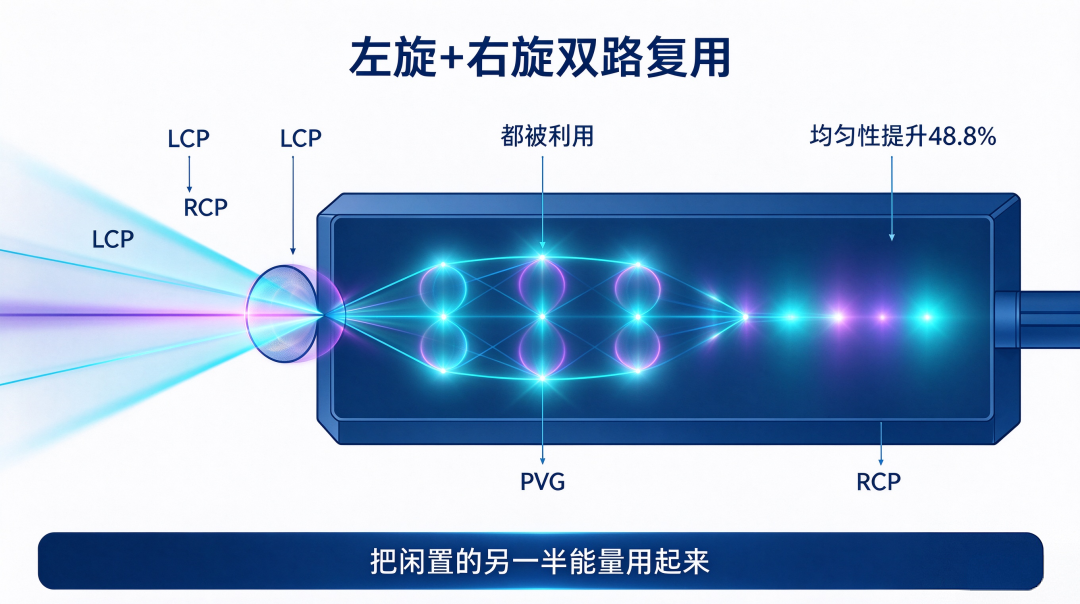
The team of Chen Enguo at Fuzhou University proposed a PVG waveguide scheme with dual-channel multiplexing of left-handed and right-handed circularly polarized light.
The core idea is simple: enable both orthogonal circular polarizations to be utilized by the waveguide, rather than using only one of them. The experimentally fabricated PVG waveguide has an exit pupil size of 45mm×25mm and a diagonal field of view of 32.86°.
Compared with conventional schemes that support only a single circular polarization, nine-point testing shows: uniformity improved by 48.8%, overall uniformity improved by 34.1%, and waveguide optical efficiency reached 1.2 times the original.
The underlying logic of this scheme: conventional schemes use only half of the available light, while polarization multiplexing puts the previously idle other half of the energy to use.
The total light input remains unchanged, but the energy available to balance brightness increases.
Solution 2: PVG's "anomalous polarization conversion," making the leaked light turn back on its own
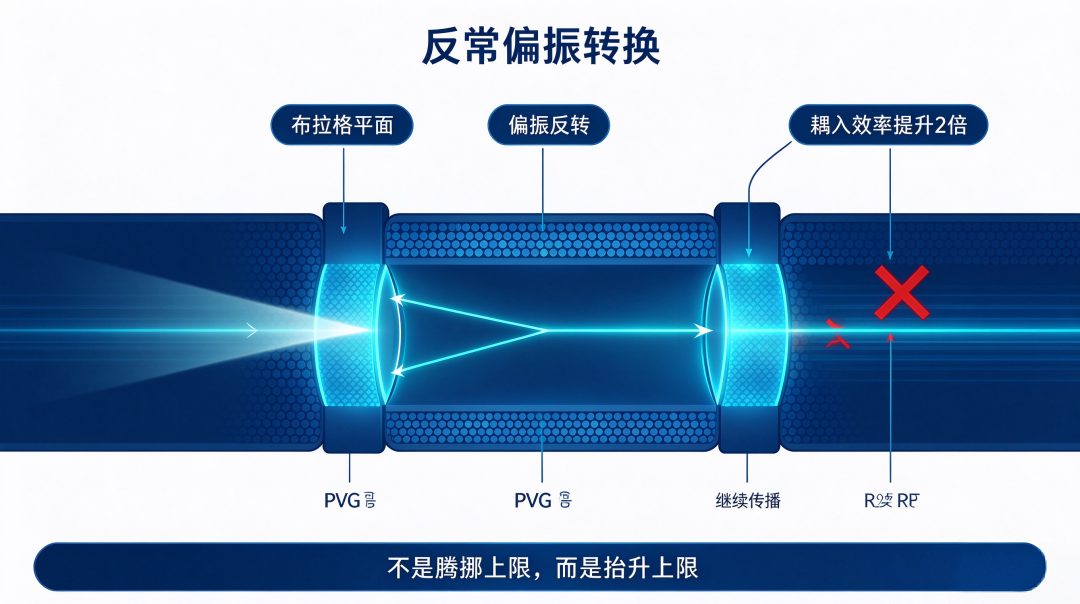
Research in Light: Science & Applications revealed a counterintuitive optical effect.
When the light incidence angle approaches the Bragg plane, the PVG no longer acts as a grating but resembles a wave plate, achieving polarization state conversion.
After total internal reflection inside the waveguide, the polarization state reverses (LCP converts to RCP); when it reaches the incoupling PVG again, it is not directly transmitted and lost, but converted into a usable polarization state and continues propagating within the waveguide.
Relying on this mechanism, the waveguide incoupling efficiency for a 50° field of view is improved by 2 times, field-of-view uniformity is improved by 2.3 times, while good eyebox continuity is retained.
With a polarization compensation film, almost all incident light can be successfully coupled into the waveguide.
This confirms the earlier judgment: polarization management is not about moving within the ceiling, but about raising the ceiling itself.
Uniformity is not just a "brightness" issue: angular uniformity is equally critical
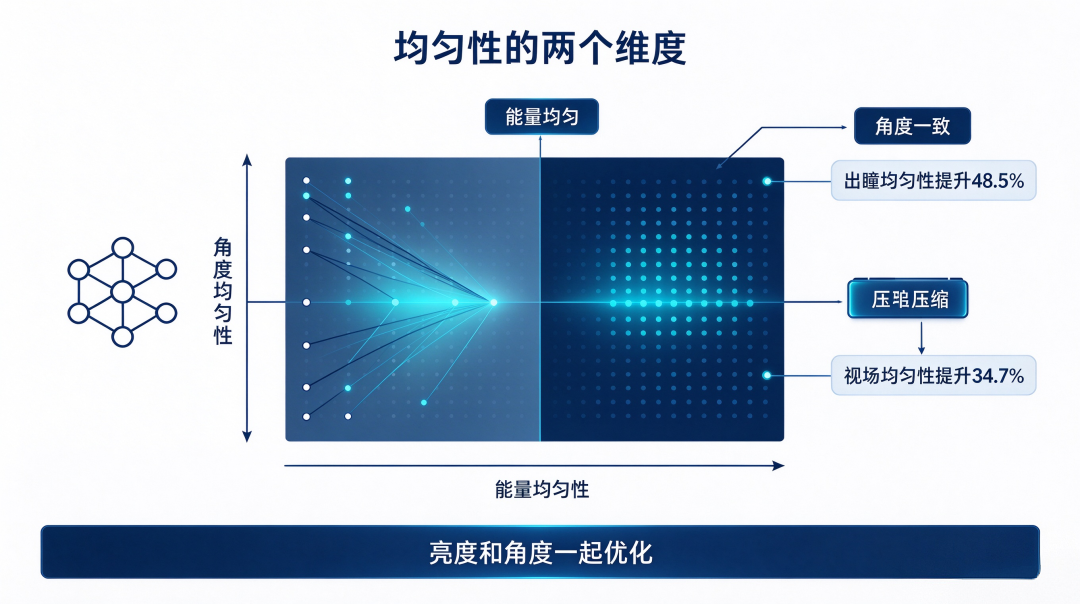
Research by the team of Wang Baoping and Zhang Yuning at Southeast University further breaks uniformity into two dimensions: energy uniformity and angular uniformity.
For the Cross-PVG two-dimensional exit pupil expansion structure, the team built a neural network optimization framework to simultaneously optimize both metrics.
Test results: exit pupil uniformity improved by 48.5%, field-of-view uniformity improved by 34.7%; RCWA and ray-tracing simulation calls were reduced to 30% of conventional schemes, and optimization time was shortened from 74 hours to 3 hours.
In other words, polarization multiplexing not only improves brightness differences but also optimizes angular response. Light from different fields of view will image more stably at different positions in the eyebox.
What does this mean for AR glasses? Eyebox uniformity directly determines the viewing experience when users turn their heads or move their eyes.
If the brightness variation within the eyebox is too large, users can clearly perceive flickering brightness with slight head movement, greatly diminishing the immersive experience.
The biggest advantage of polarization multiplexing: without increasing light engine brightness or power consumption, it fully taps the existing light energy inside the waveguide. PVGs inherently have polarization conversion characteristics, requiring no additional manufacturing cost. Compared with approaches such as changing substrates or upgrading light engines, polarization multiplexing has a shorter path to industrialization.
The "Yunque" AR glasses developed by the Southeast University team have verified the practical effect of PVG optical waveguides on uniformity—compared with SRG schemes, optical efficiency improved by 300% and forward light leakage reduced by 80%.
Closing: the eyebox is bright in the center and dark around the edges; the root cause is not that "the light is not bright enough," but that the light is not fully utilized.
Conventional PVGs waste nearly half of the light energy corresponding to one polarization; polarization multiplexing reuses this idle energy, providing a continuous and balanced energy supply to the outcoupling region.
Without increasing light source brightness or device power consumption, merely changing the light distribution logic—this is the most pragmatic value of polarization multiplexing.
Discussion topic: In your optical waveguide design, is the eyebox uniformity problem solved through polarization multiplexing, or through grating efficiency zoning design? Feel free to leave a comment about your solution.
[Risk note] This article is industry popular science. Data such as uniformity, optical efficiency, and field of view in this article all come from the experimental standards of public papers and are results under specific device and experimental conditions, not representing mass-production specifications; the benefits of PVG polarization multiplexing are affected by materials, coating systems, light engine matching, and processes, and actual results are subject to device-level and complete-machine measurements.
—— AR Andy | Focused on optical waveguides and the AR microdisplay track, deeply deconstructing the underlying logic of the optical industry
-
![]()
AI Office Track Head-to-Head: After the Battle for Entry Points, the Renewal Period Is the Real Test
-
![]()
Why Is the Eyebox Always "Bright in the Center, Dark at the Edges"? — The Polarization Multiplexing Solution
-
![]()
Why Can't the Smartest Coding Assistant Reply to Your Messages Instantly?
-
![]()
Half of Domestic Tokens Used to Make Wish-Fulfillment Dramas? Large Models Face a Compute Bloat Bubble
-
![]()
Apple Picks Qwen — and There's More to It Than Meets the Eye
-
No Blackening, No Fanning—Xiaomi Auto's Goal of Delivering 550,000 Vehicles This Year Is Easier Said Than Done
-
![]()
Automakers' KPI Collapse
-
![]()
The All-New Xiaomi SU7 Ultra Laps the 'Ring Undisguised — Can Chinese Performance Cars Earn a 'Seat at the Table'?