AI Office Track Head-to-Head: After the Battle for Entry Points, the Renewal Period Is the Real Test
 11/02 2026
 534
In 2026, China's domestic AI office sector reached a landscape-level turning point. Multiple product lines that had once been run in parallel as internal trial-and-error experiments within major internet companies completed consolidation one after another in less than two months. The years-long "internal horse racing" mechanism was halted, and computing power, traffic, and team resources accelerated their concentration around AI office entry points. Coupled with Kingsoft Office, which had long since written AI into its financial reports, five heavyweight players—Baidu, Alibaba, Tencent, and ByteDance among them—crowded onto this track.
Market data also confirms the explosive speed of the track. IDC predicts that China's enterprise-level AI agent market will grow from 212 billion yuan in 2025 to 332 billion yuan in 2029. CITIC Securities estimates that the global AI office potential market size is between 300 billion and 1.56 trillion US dollars, with potential users expanding from tens of millions of programmers to 1 billion general white-collar workers. Behind these numbers lies a comprehensive contest of capital, models, ecosystems, and organizational capabilities.
As AI moves from "being able to answer" to "being able to get things done," a hundred-billion-level battle over the "next-generation productivity entry point" is moving from technical groundwork into a head-to-head racing phase. Whoever can turn an assistant into a workbench and a tool into an operating system will hold the "ticket" to enterprise core processes. No giant is willing to be absent.
Concentrating and Closing Ranks, Each Reveals Its Cards
On October 31, Alibaba reached a cooperation with Apple to integrate Qwen into Apple Intelligence. Chinese users can directly invoke Qwen's text and image understanding, content generation, and other capabilities in Siri, writing tools, and visual intelligence. These features will open for testing with the latest iOS developer Beta starting November 4 and will be released to Chinese users with the official launch of iOS 27.3 in December.
Some market analysis believes that Qwen is expected to become the first domestic large model implemented in Apple's China ecosystem, pushing light office capabilities such as writing, polishing, and summarization down to the native system level. At the same time, in the competition of "model as entry point," relying on Apple's terminal distribution channels, Alibaba is expected to make up for its shortcomings in C-end reach. However, this cooperation is not exclusive, and there remains the possibility of introducing other large models into the Apple ecosystem later, so the competitive landscape of the track still has variables.
On the card table that has already been set, the five players' entry methods, resource endowments, and strategic paths are completely different, but the timelines are highly concentrated.
On July 20, Tencent merged QClaw into WorkBuddy. On July 30, ByteDance issued an internal letter integrating Feishu and Doubao; on August 24, ByteDance consolidated the TRAE and Coze product lines. On August 3, Alibaba's Qwen Office opened public beta, fully integrated from three products: QoderWork, MuleRun, and Wukong. Baidu, meanwhile, merged dodo into Baidu Dazi on August 6.
Tencent was the first player to launch consolidation and places the strongest emphasis on desktop entry points. Public information shows that WorkBuddy opened for internal experience within Tencent in January 2026; on February 6, it opened internal testing, positioned as a workplace AI agent desktop workbench; on March 3, it officially launched across all scenarios, fully compatible with OpenClaw skills and supporting remote control via WeCom, QQ, Feishu, DingTalk, and others.
According to media reports, WorkBuddy was described internally as "Tencent's third strategic-level product after QQ and WeChat." Tencent founder Pony Ma personally participated in product meetings, and most project requirements were approved quickly. Tencent's Q1 2026 report stated that, by daily active accounts, WorkBuddy is currently China's most widely used productivity AI agent service.
On September 2, the WorkBuddy open platform officially launched, bringing in more than 100 ecosystem partners in the first batch. It supports free switching among five major models: Hunyuan, DeepSeek, GLM, Kimi, and MiniMax. Its path is "individual first," that is, first making a desktop assistant for each person and then penetrating enterprises from the bottom up, following Tencent's long-held "open ecosystem" route.
Alibaba, by contrast, bets its core chips on the enterprise-level track. Qwen Office relies on DingTalk's accumulated millions of enterprise customers and organizational management data, and is officially positioned as the industry's first product simultaneously covering three types of agents: desktop, cloud, and enterprise collaboration.
The organizational skill library launched by Qwen Office on August 12 allows employees to encapsulate work methods as Skills and share them within the organization after review; on August 18, it officially connected to WeCom. It had previously connected to DingTalk and Feishu, and by then all three major domestic collaborative office platforms supported it.

On September 4, Qwen Office announced that its user count exceeded 30 million in its first month, more than half of whom were enterprise users. By comparison, Microsoft disclosed in its earnings report at the end of July that paid seats for Microsoft 365 Copilot exceeded 30 million, relying on a base of more than 400 million commercial M365 users and taking nearly two years.
ByteDance's consolidation was the most aggressive. On July 30, ByteDance issued an internal letter merging the Feishu product team and the Doubao product team to establish a new Doubao product team, uniformly managed by Doubao head Zhao Qi. This was an important organizational adjustment for ByteDance's B-end business since it established six major business units in 2021.
On August 24, the TRAE and Coze teams were fully merged into Doubao; on August 25, the "Doubao Work" brand was officially released, deeply connected with Feishu. In less than a month, all of ByteDance's AI products for productivity scenarios were gathered under Doubao.
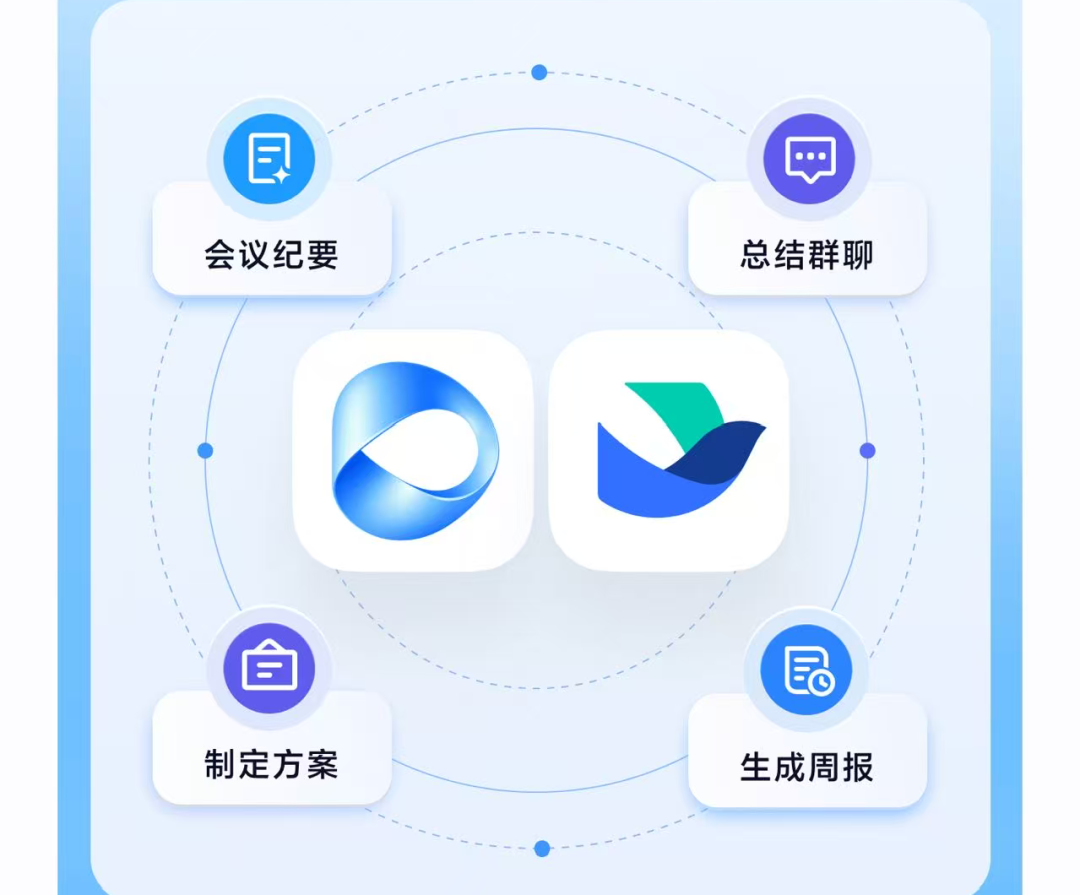
Doubao Work integrates Doubao's naturally accumulated C-end interaction capabilities and multimodal generation advantages with Feishu's B-end organizational collaboration, document accumulation, and permission systems. It has listed more than 200 skills and connectors and has intensively updated functions such as remote computer control, Windows virtual desktop, and cloud computers. On September 2, Doubao Work launched multi-agent parallel functionality and computer operation under the Mac system; on October 28, it further upgraded its computer operation capabilities.
Baidu took a dual-line path of "internal integration + vertical new brand." Baidu Dazi launched fully on March 22 and completed a package upgrade of personal edition, enterprise edition, professional suite, and workbench on August 27. As of October 26, Baidu Dazi's user scale had grown 9 times quarter-on-quarter, enterprise customers had grown 83%, demand for deliverables had surged 4.3 times, and month-over-month active user growth had reached 1063.79%, firmly ranking first on the growth chart.
On August 14, Baidu Wenku Netdisk's general agent GenFlow, running in parallel with Baidu Dazi, officially announced its Chinese name "Kuku AI," launching a full set of independent office products including PC client, web version, mini program, and enterprise edition. Kuku AI focuses on cross-device, cross-time-and-space device-cloud task relay, allowing tasks to continue processing in the mini program even when the computer is off. In its first phase, it is specially optimized for financial scenarios, with built-in databases for global listed company quotes, financial reports, and research reports, and it connects Baidu Netdisk and Wenku's 1.8 billion professional documents.
Baidu's another move was to send agents into the home. On September 8, Baidu announced that Baidu Dazi was fully connected to Xiaodu hardware, with Baidu agents entering home spaces, and simultaneously launched four new products: Tiantian Guimi Ji Ultra, Smart Screen X9 Ultra, Smart Camera C1500, and Smart Speaker Pro Max. Xiaodu has entered more than 55 million households nationwide, providing Baidu Dazi with a ready-made home-scenario entry point. Baidu Dazi thus moved from "workflow" into "life flow," and the battle for entry points is spreading from a desktop to a speaker and a screen.
Unlike the internet giants' logic of "building entry points from 0 to 1," Kingsoft Office chose to grow AI capabilities on top of its existing office software foundation. In the first half of 2026, it explicitly proposed a strategy of transforming from "Office AI" to "AI Office."
In mid-July, Kingsoft Office released two AI office agents in succession: "Lingxi Professional Edition" for individuals and "WPS Comate" for organizations. The former is positioned as a professional personal office assistant, and the latter as an organizational-level AI office entry point.
Kingsoft Office's Q3 2026 report showed that in the first three quarters it achieved operating revenue of 5.08 billion yuan, a year-on-year increase of 21.57%; net profit attributable to the parent company was 2.637 billion yuan, a year-on-year increase of 123.77%. Among that, in the third quarter, WPS personal subscriptions achieved revenue of 1.05 billion yuan, a year-on-year increase of 16.78%; WPS 365 achieved revenue of 270 million yuan, a year-on-year increase of 33.83%. As of September 30, WPS Office had 678 million monthly active devices worldwide.
The Competitive Dimension Is Shifting
Behind the intensive product launches is a more fundamental change: the core competition of office agents is shifting from basic generation capability to task implementation and result delivery capability.
CITIC Securities pointed out in a research report that office agents are evolving from content generation tools to complex task execution platforms, and the core of industry competition has shifted from basic generation capability to task implementation and result delivery capability.
Industrial Securities' research report also believes that the core qualitative change in AI office is the shift from "assistance tools" to "end-to-end work result delivery," and delivery implementation capability directly determines enterprises' willingness to pay and user retention levels.
Currently, competition in the AI office field is at a stage where basic capabilities have been leveled up and differentiation has not yet opened up. As the general capabilities of mainstream large models continue to converge, the gaps among players in basic functions such as content generation and information Q&A are constantly narrowing, and the overall degree of homogenization is relatively high.
At the same time, market analysis also points out that most products have not yet deeply embedded into real work processes or established strong user stickiness. This also means that what is being contested now is no longer "whether it can write," but "whether it can get things done for you."
Evaluation data confirms this. In May, Baidu Dazi topped the PinchBench agent evaluation benchmark and occupied 3 of the top 5 spots. PinchBench covers 147 tasks across 23 real work scenarios and evaluates agents' multi-step reasoning, tool invocation, and task closed-loop capabilities. Two versions of Baidu Dazi took the top two spots with 93.3% and 93.2%, while Anthropic and OpenAI native frameworks scored 89% and 91.6% respectively in the same scenarios.
In July, according to AI Product List · Desktop List (PC) data, WorkBuddy and Baidu Dazi ranked first and second on the overall AI office agent list with 11.1523 million and 6.743 million monthly active users, respectively; ByteDance's TraeWork ranked third with 2.6599 million monthly active users; Coze ranked fourth with 2.1733 million monthly active users.
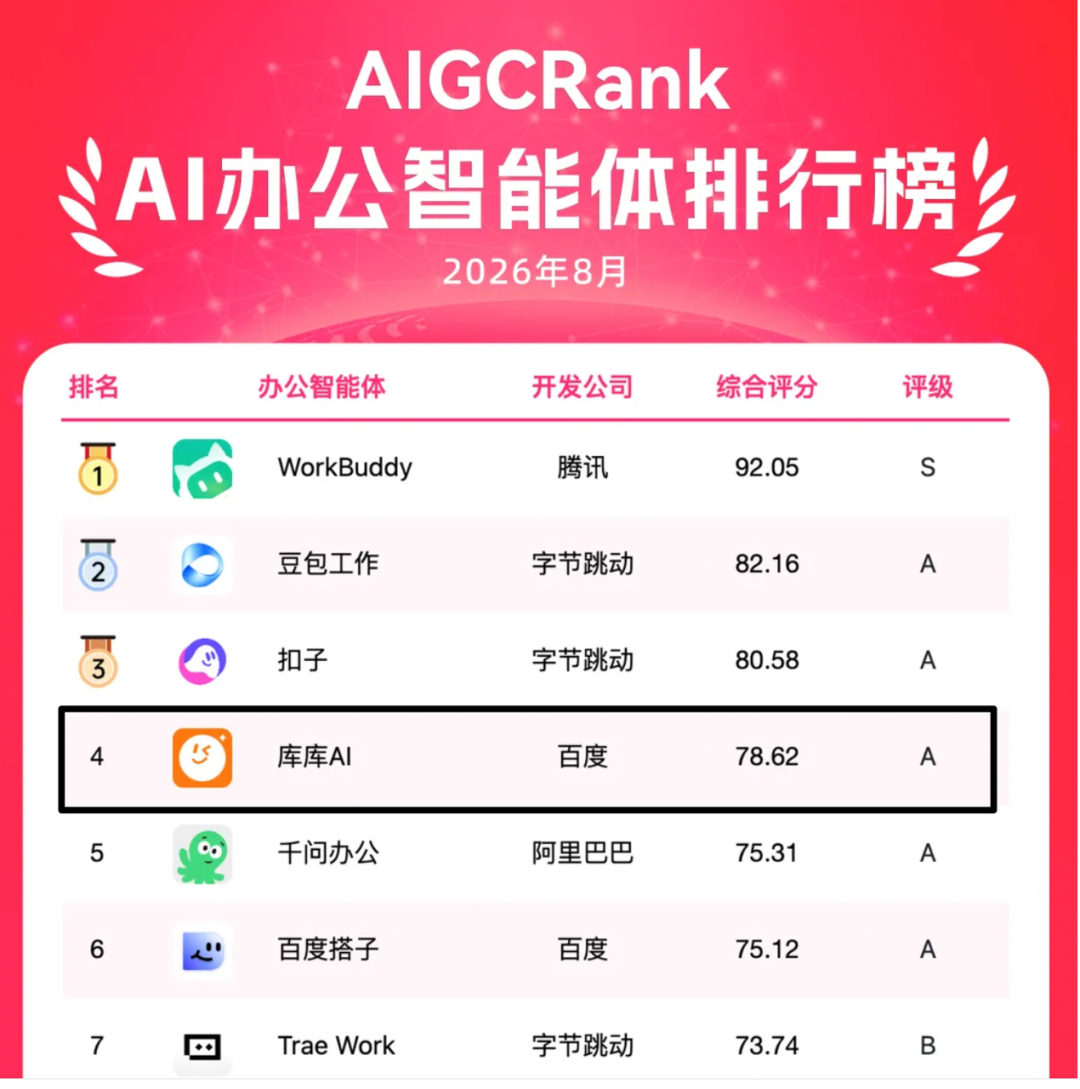
In August, in the "AI Office Agent Ranking" released by AIGCRank, Tencent WorkBuddy led with 92.05 points, followed by Doubao Work (82.16 points) and Coze (80.58 points), while Kuku AI, less than a month after launch, surged into the top four with 78.62 points, even surpassing Qwen Office and Baidu Dazi.
On October 20, QuestMobile released its Q3 AI application market report. In September, the AI office track's total active users reached 142 million, a year-on-year increase of 50.6%. The top three on the typical office agent list were Tencent WorkBuddy, Baidu Dazi, and Alibaba Qwen Office, with active user scales of 32.353 million, 9.77 million, and 7.905 million, respectively.
The frequent changes at the top of evaluation rankings precisely show that the new battlefront of "delivery capability" is far from decided.
Cost control for long-horizon tasks is another watershed. On June 15, Baidu Dazi completed a core engine upgrade. Through its self-developed Harness engine and multiple engineering optimizations, it reduced Token consumption during long-horizon task execution by 75%. This was the first time among domestic general agent products that such a large reduction in consumption was achieved through engine optimization.
On August 26, Alibaba released the Qwen3.8-Flash model, and Qwen Office, together with the model team, launched an exclusive edition. Official data shows that in real office scenario tests, single-task generation speed increased by about 100%, and Token consumption decreased by an average of 75%. Cost reduction is the prerequisite for scaled user adoption of AI office.
Users can achieve full-link office work with a single phone, continue processing tasks in a mini program even when the computer is off, and remotely operate multiple computers in parallel. For products that need to put agents into real workflows, cost and connectivity are closer to the essence of "whether it can be used" than parameter scale.
At Baidu's Dazi product launch on August 27, Baidu introduced a new AI office benchmark: "delivery is stunning." Shen Dou, Executive Vice President of Baidu Group and President of Baidu Smart Cloud Business Group, laid out the concept, arguing that the yardstick for evaluating AI office tools should shift from raw generation speed to the quality of the final delivered result.
Qwen Office, by contrast, treats "context" as the key to practicality. On August 17, Qwen Office open-sourced MyContext, a context infrastructure technology that turns massive, heterogeneous work data into context that agents can invoke directly. Within weeks of release, it surpassed 3,000 stars on GitHub. Coupled with deep integration into IM platforms such as DingTalk, Qwen Office can convert information scattered across business processes—messages, documents, approvals, emails, and knowledge bases—into organizational context that agents can understand and call upon.
In a deployment at Changan Automobile, electrical engineers used Qwen Office to build a wire harness selection calculation tool, cutting what once took roughly two days of item-by-item verification down to about five minutes. A 55-year-old logistics packaging administrator broke a review process involving hundreds of suppliers into automated scripts, reducing workload by more than 90%.
Kingsoft Office's Lingxi Professional Edition generates editable, reviewable, traceable, and collaborative documents directly, closing the loop from requirement comprehension to result delivery.
At the same time, Kingsoft Office's enterprise-focused WPS Comate builds a four-layer trust mechanism through TrustHub—covering identity permissions, data classification, device authentication, and agent behavior control—to address enterprises' core concerns about data security. It has been deployed across 11 major fields and 26 typical expert scenarios, serving hundreds of medium and large enterprises.
As AI moves from "offering suggestions" to "delivering usable outcomes," the standard for evaluating products has shifted from "capability demonstration" to "business results."
Commercialization and Moats
Despite rapid user growth, the AI office industry has yet to cross the threshold of large-scale paid adoption. Every player faces the same question: how can efficiency gains felt at the employee level be converted into a sustained willingness to pay at the enterprise level?
Today, AI office products have settled into a composite structure of "individual subscriptions + enterprise seats + usage-based billing." Alibaba's Qwen Office Personal Standard Edition, for instance, costs 98 yuan per month, with the Enterprise Standard Edition at 198 yuan per person per month. ByteDance's Doubao Professional Edition offers three monthly tiers at 68, 200, and 500 yuan. Tencent WorkBuddy charges 99 yuan per month for Standard, 199 yuan for Advanced, and 999 yuan for Flagship. Baidu Dazi's Personal Pro Edition costs 59 yuan per month, and the Max Edition 129 yuan per month.
More noteworthy is the underlying shift: billing logic is moving from "per-person billing" to "per-task/usage billing." Kingsoft Office stated in its 2026 semi-annual report that its personal AI products are exploring a hybrid model of "subscription + AI usage," while on the enterprise side, WPS 365 is advancing "seats + AI usage," with tiered pricing based on task complexity and actual AI resource consumption.
The migration of billing units is essentially a shift from "selling features" to "selling results." Behind this transformation in billing models lies the high computing cost of long-horizon tasks.
But transparent pricing and falling costs do not equal a greater willingness to pay or large-scale paid adoption. For many users, the core experience across platforms is similar, and the cost of switching between products is low—a landscape that directly constrains willingness to pay and has become a core factor suppressing paid conversion across the industry.
Market analysis further points to a deeper contradiction: the misalignment between "employee efficiency" and "enterprise payment." The industry widely confronts the dilemma that "employees find it useful, but the one who actually pays is the boss"—employee efficiency gains do not automatically translate into enterprise cost reduction and efficiency improvement. Only when efficiency ultimately becomes headcount reduction, business growth, or shortened delivery cycles does it show up as financially visible ROI.
Data widely cited in the industry from the MIT NANDA report "The GenAI Divide" shows that about 95% of enterprise generative AI pilots fail to produce measurable financial returns, with the core bottleneck being that AI is difficult to integrate into enterprises' existing workflows.
Retention after subsidies fade is another hurdle. WorkBuddy's rapid growth in monthly visits, for example, relies largely on a subsidy mechanism of points plus membership and free traffic funneled through the WeChat ecosystem. Some users even praise the product's thoughtfulness while checking in to farm points—then switching to third-party model APIs.
Yet the certainty of the market itself remains the key reason players are going all out in the AI office track. IDC data shows that China's enterprise-level AI agent market was approximately 21.2 billion yuan in 2025, expected to rise to 44.9 billion yuan in 2026, and projected to exceed 332 billion yuan by 2029.
Demand-side growth is equally steep. Analysys data shows that in Q3 2026, China's desktop AI-native office agent market continued to grow rapidly. Combined visits across 20 mainstream desktop AI-native office agent platforms exceeded 300 million in September 2026—nearly five times the figure in June 2026 year over year.
Gartner predicts that by the end of 2026, 40% of global enterprise applications will embed AI agents with task execution capabilities, up from less than 5% in 2025.
Against this backdrop, differences in each company's moat are beginning to emerge, because the five companies' barriers do not sit on the same dimension. Tencent's moat lies in "first-mover advantage + ecosystem," Alibaba wins on the B-end chain, ByteDance's edge is C-end traffic and organizational integration, Baidu's moat is deep professional scenarios and hardware extension, and Kingsoft Office's advantage is pixel-level document format compatibility and deep ties to the government and enterprise market.
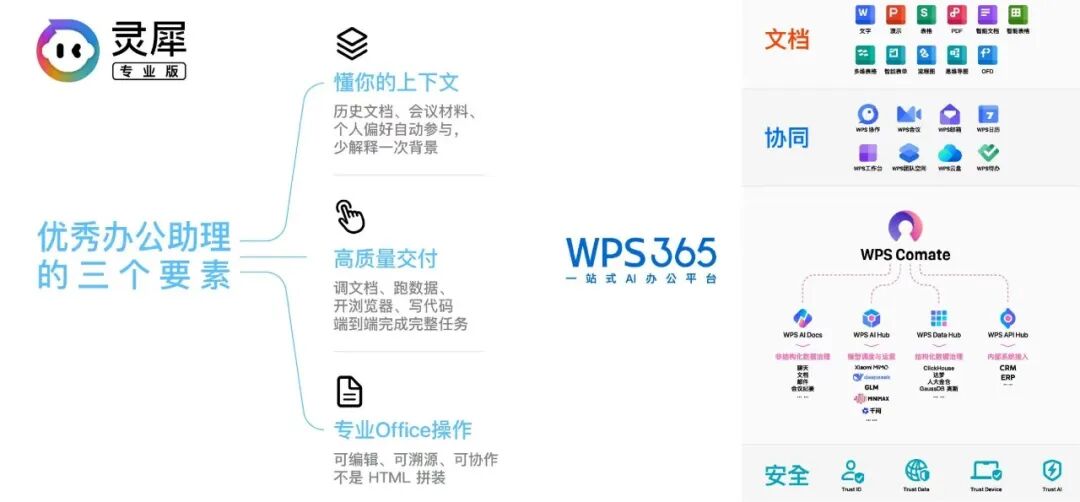
Kingsoft Office, for example, supports private deployment to meet data compliance requirements in highly sensitive industries such as finance and government affairs. WPS Comate has become one of the first enterprise-level office agent products in China to pass the dual assessment under the "Internet Agent Governance" framework of the China Academy of Information and Communications Technology.
On August 24, Alibaba announced a placement of 80 billion Hong Kong dollars in new shares, with net proceeds fully allocated to building full-stack AI capabilities, focused on global computing infrastructure and ultra-large-scale AI data centers. Alibaba's core advantage lies in B-end infrastructure—from Alibaba Cloud to DingTalk, it has built the most complete enterprise service chain in China.
Conclusion
The AI office competition is not about who can first stuff large models into old software, but about who can truly take on complete work, deliver professional outcomes, and make those outcomes continuously reusable by individuals and organizations. This leap from "can chat" to "can deliver" is where the five giants are truly competing.
Tencent guards the entrance through first-mover advantage and ecosystem, ByteDance moves quickly to complete organizational and brand consolidation, Alibaba bets on organizational-level skill accumulation, Baidu trades internal unification for industry depth and then uses Xiaodu to open up home scenarios, while Kingsoft Office converts format compatibility and customer accumulation into a new billing model.
The routes differ, but there is only one destination: making AI an indispensable productivity tool. The cards have just been dealt, and the outcome is undecided. For each player, the real testing window is not the launch period but the renewal period. (Image source: official WeChat accounts of various companies, etc.)
Risk notice: This article is compiled from public information and does not constitute any investment advice.
-
![]()
AI Office Track Head-to-Head: After the Battle for Entry Points, the Renewal Period Is the Real Test
-
![]()
Why Is the Eyebox Always "Bright in the Center, Dark at the Edges"? — The Polarization Multiplexing Solution
-
![]()
Why Can't the Smartest Coding Assistant Reply to Your Messages Instantly?
-
![]()
Half of Domestic Tokens Used to Make Wish-Fulfillment Dramas? Large Models Face a Compute Bloat Bubble
-
![]()
Apple Picks Qwen — and There's More to It Than Meets the Eye
-
No Blackening, No Fanning—Xiaomi Auto's Goal of Delivering 550,000 Vehicles This Year Is Easier Said Than Done
-
![]()
Automakers' KPI Collapse
-
![]()
The All-New Xiaomi SU7 Ultra Laps the 'Ring Undisguised — Can Chinese Performance Cars Earn a 'Seat at the Table'?