Domestic Computing Power Company Surges 1,800%
 11/03 2026
 411
On October 30, US Eastern Time, US stocks suffered a Black Friday rout, with the Nasdaq falling 2.86%, its largest single-day drop since June 5; Intel plunged 28.58%, the second-largest single-day decline in more than forty years, surpassed only by the 29.9% drop on July 5, 1974. The day before, Google had already fallen 12.64%, wiping out nearly $500 billion in market value.
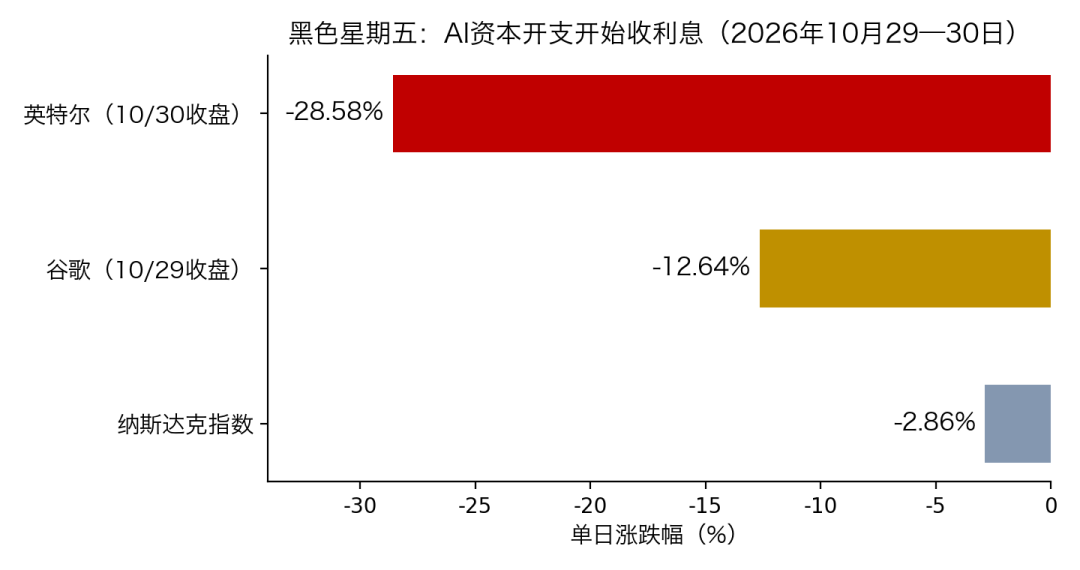
The declines over the past two days share a common cause: AI capex.
Google's quarterly capex reached $51.355 billion, more than double the year-earlier figure, with free cash flow unusually posting an outflow of $9.065 billion. Intel's third-quarter revenue actually beat expectations, but management warned that the company would be unable to turn free cash flow positive in 2027, and the bond market immediately responded with a record CDS spread.
Across the Pacific, A-shares have just wrapped up their third-quarter reports.
Moore Threads, the first domestic GPU stock, wrote in its financial report the first profitable quarter since listing.
Starry Sky Jun puts these two things together to discuss an unavoidable question: how big exactly is the bubble in the AI industry?
1 The Market Has Begun to Charge Interest
Over the past two years, the AI market operated on a default rule: as long as there is investment, it is good news. This rule was rewritten this earnings season.
On October 29, Google delivered a report card with revenue growth of 25% and cloud business growth surging to 103%; either number on its own would be impressive enough.
But what the market focused on was search advertising growth sliding from 19% to 17% and then to 12%, free cash flow of negative $9.065 billion, and capex more than doubling year-on-year. Google's parent company fell 12.64% in a single day, its worst day in 22 years since listing.
In terms of where funds went, on the day Google plunged, Eli Lilly rose 6.57% to a record high, the biopharmaceutical sector strengthened overall, and healthcare, financials, and energy sectors generally rose, with some safe-haven funds flowing into US Treasuries. On Thursday the Nasdaq closed down 1.38%, putting pressure on the next day.
On October 30 it was Intel's turn. Third-quarter revenue was $16.513 billion, up 21% year-on-year and beating market expectations, but fourth-quarter guidance was $1 billion to $2 billion below market expectations.
The CFO's quantitative judgment was that memory price increases suppressed PC purchases, with global PC shipments expected to decline about 12% in 2026 and another 10% in 2027; the company would be unable to achieve positive free cash flow in 2027.
That day the stock fell 28.58%, and its 5-year CDS spread hit a record high.
The bond market and the stock market repriced the same company at the same moment, which is not common.
Amazon was also in the picture that day, with free cash flow net outflow of $42.357 billion over the past 12 months, compared with $7.604 billion three months earlier, amplifying 5.6 times in one quarter.
The four major tech giants' capex this year totals nearly $750 billion. According to estimates, by 2027 the capex of Microsoft, Google, Amazon, Meta, and Oracle will all exceed free cash flow.
AI infrastructure has shifted from consuming own cash to relying on external financing.
Google's stock buybacks in the first three quarters of this year fell to zero, shifting to issuing $12.4 billion in stock and $28.7 billion in bonds. Microsoft announced in the same week a plan to raise at least $25 billion through bond issuance.
Even cash cows are short of money.
2 A-shares Have a Higher AI Concentration
Turning attention back to A-shares.
In the first three quarters, the net profit attributable to parent companies of all A-shares increased by 390.646 billion yuan year-on-year. Among them, the electronics industry alone increased by 264.6 billion yuan, accounting for 67.7% of the whole market's increment.
According to Wind statistics, the information technology sector's revenue growth was 31.95% and net profit growth was 140.25%, far ahead of other sectors. Meanwhile, the whole market's third-quarter single-quarter net profit attributable to parent companies fell 11.02% year-on-year.
The gap between the first three quarters and the single quarter shows that growth almost entirely came from the AI chain, and the slowdown was almost entirely contributed by non-AI industries.
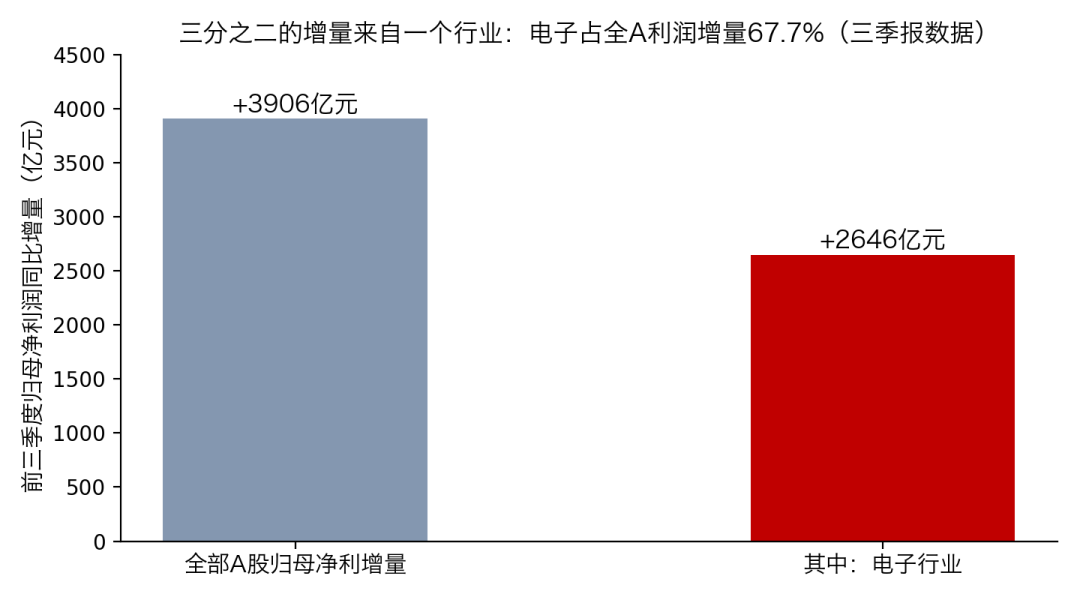
A-share income statements are highly dependent on the AI industry chain.
3 Moore Threads Turns Profitable
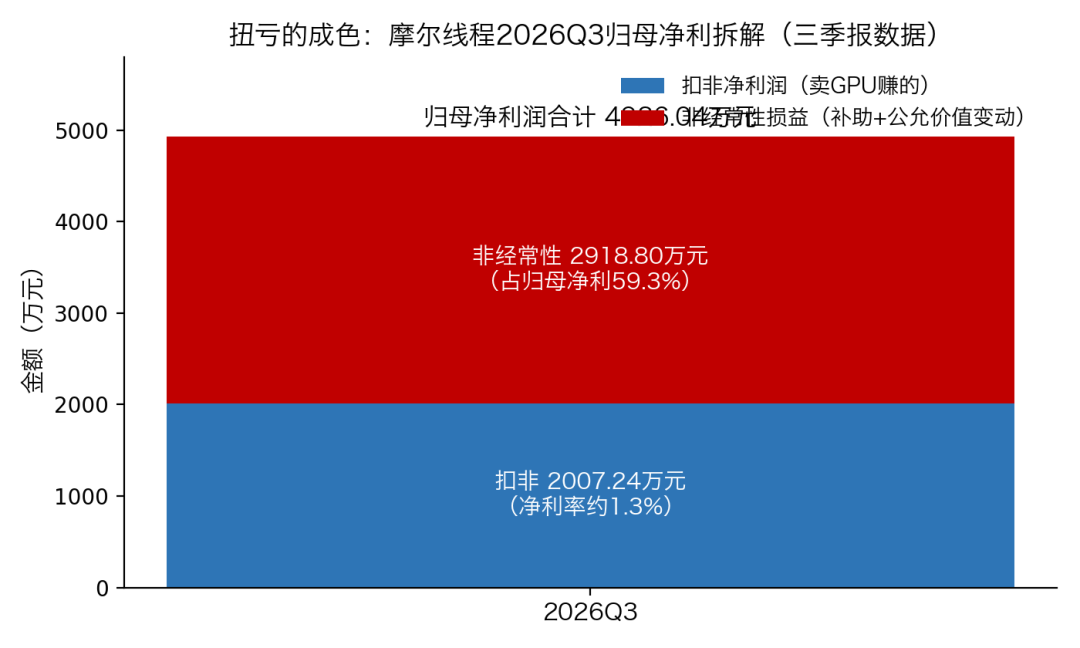
On October 28, Moore Threads released its third-quarter report: third-quarter revenue was 1.552 billion yuan, net profit attributable to parent company was 49.2604 million yuan, and non-recurring net profit was 20.0724 million yuan. Both profit measures turned positive simultaneously in a single quarter, the first time since the company listed.
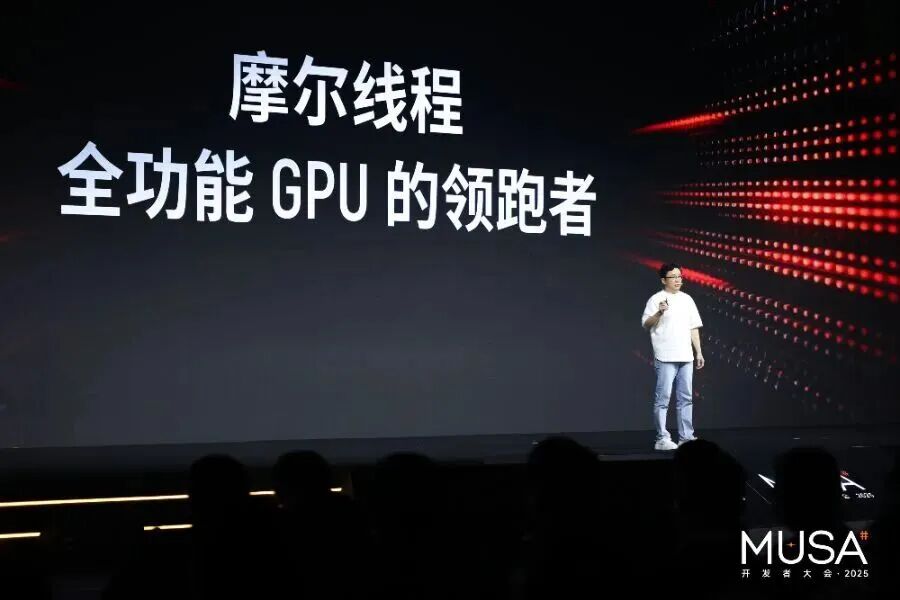
Amid the cheers, Starry Sky Jun took this profit apart.
In terms of non-recurring gains and losses, in the third quarter, the company's non-recurring gains and losses after deducting the income tax effect totaled 29.188 million yuan, accounting for 59.3% of the quarter's net profit attributable to parent company.
Breaking it down, changes in fair value and disposal gains and losses of financial assets and financial liabilities contributed 29.9784 million yuan, and government subsidies contributed 2.7696 million yuan.
The non-recurring net profit actually earned from selling GPUs was 20.0724 million yuan, corresponding to 1.552 billion yuan in revenue, for a non-recurring net margin of about 1.3%.
In the first three quarters, non-recurring gains and losses totaled 168 million yuan, including government subsidies of 91.0009 million yuan and changes in fair value of financial assets of 89.4979 million yuan; over the same period, net profit attributable to parent company totaled 37.6973 million yuan, and it was still at a loss of 131 million yuan after non-recurring deductions.
The fact is that the reason the company's income statement in the first three quarters could turn positive was not profit from its main business, but subsidies and investment income.
If these two parts are stripped out, the main business in the first three quarters was still in a loss-making state.
This is not a sleight of hand, but the basic skill of reading financial statements: when looking at profit, first look at the non-recurring figure.
In terms of comparative R&D investment, R&D investment in the first three quarters was 1.340 billion yuan, up 55.72% year-on-year, accounting for 40.75% of revenue; cumulative R&D investment since 2022 is close to 6.5 billion yuan.
A single quarter's R&D expenditure of 571 million yuan corresponded only to non-recurring profit of 20.07 million yuan. The difference in magnitude has already written the risk in plain sight.
Gross margin was 53.71%, down 8.16 percentage points year-on-year. The company explained this as the impact of delivery structure and strategic inventory costs.
This explanation is reasonable, but it also shows that scale expansion has not yet brought stronger pricing power.
The 1.3% non-recurring net margin shows that it still has a considerable way to go before it can stably make money from its main business. The statement that the profitability timetable was moved forward by one year compared with the original plan had a market impact far exceeding the substance of the profit figure itself.
The real long-term test lies in the software ecosystem. Selling hardware is a one-off business; to make revenue sustainable, developers must take root in its own software stack, and the payback period for such construction is measured in decades.
4 Guarding Against Bubbles Is Not the Same as Denying the Industry
Another extreme Starry Sky Jun wants to avoid is equating bubbles directly with fraud.
Demand is real. Google Cloud grew 103% in a single quarter, showing that enterprise customers' procurement of computing power has not slowed; intelligent computing procurement by the three major domestic telecom operators and major internet companies is advancing as planned, and the adoption of domestic chips is moving from trial use to large-scale deployment. These are facts that can be verified in research.
There is an inherent time lag of 12 to 18 months between capex and cloud revenue. It takes time for data centers to go from power-on to racking and debugging. Most of the hundreds of billions of dollars invested over the past year has not yet entered the output period. Declaring now that AI investment cannot be recovered lacks sufficient evidence.
-END-
Disclaimer: This article is an analytical study based on the public company attributes of listed companies and the information publicly disclosed by listed companies in accordance with their legal obligations (including but not limited to temporary announcements, periodic reports, and official interactive platforms) as the core basis; Poetry and Starry Sky strives to make the content and views contained in the article fair, but does not guarantee their accuracy, completeness, timeliness, etc.; the information or opinions expressed in this article do not constitute any investment advice, and Poetry and Starry Sky assumes no responsibility for any actions taken due to the use of this article.
Copyright statement: The content of this article is original by Poetry and Starry Sky and may not be reproduced without authorization.
-
Privacy Disputes, Experience Bottlenecks, and Commercialization Confusion: Has the AI Glasses Industry Still Not Escaped the Novelty Trap?
-
Apple's Q3 Was a Warm-Up: The iPhone 18 Pro Plays It Safe While the iPhone Duo Steals the Show
-
![]()
Daoming Optics Q3 Report: Net Profit Plunges 56.54% YoY
-
![]()
$115 Billion Bet on Light Sources: Why Marvell Had to Buy
-
Farewell to Half-Baked Products: AI Apps Finally "Fly Into Ordinary Homes"
-
![]()
Quarterly Report | China's Smart Projector Sales Fell 26% in Q3 2026, Full-Year Forecast Lowered to Below 4 Million Units
-
![]()
NVIDIA, Google, and Intel Make Their Moves in Succession as Physical AI Sparks an Infrastructure Battle
-
NXP to Adjust Prices for Select Chips as Automotive Business Returns to Growth