NVIDIA, Google, and Intel Make Their Moves in Succession as Physical AI Sparks an Infrastructure Battle
 11/03 2026
 565
Physical AI has recently emerged as a new focal point of shared interest across the technology industry and capital markets. As sectors such as semiconductors and storage ride out market fluctuations, Physical AI-related concepts have demonstrated a notable level of enthusiasm. This reflects the market's expectations for the next stage of AI development: as large models gradually migrate from the digital world into the real world, AI capable of understanding physical environments, interacting with real devices, and autonomously executing tasks may unlock new industrial space.
In late October 2026, three noteworthy developments emerged in succession in the field of Physical AI:
On October 21, at GTC Berlin, NVIDIA announced the expansion of the Isaac open robot development platform, adding a humanoid robot reference platform, datasets, and a runtime, and updating the robot learning framework.
On October 27, Google DeepMind released research results on the Genie 4 world model, improving the realism of interactive simulated environments and adding native audio generation capabilities, enabling users to change simulated scenes in real time through natural language.
At the same time, Intel and SAP demonstrated a proof of concept (PoC) for Physical AI and the autonomous warehouse, translating business tasks in enterprise warehouse management systems into operations that robots can execute, and feeding execution status and results back to enterprise systems.
The three developments come respectively from world models, robot development platforms, and industrial applications, yet they jointly point to a key shift in the development of Physical AI: the competitive focus is extending from simply improving the intelligence of models to building a complete set of technological and industrial infrastructure—enabling AI to understand the physical world, learn in simulated environments how to act, and ultimately complete tasks through real devices and create measurable business value.
Before AI acts, it must first learn to understand the physical world
Traditional generative AI mainly processes text, image, and video information in the digital world, while Physical AI faces a more complex real-world environment. It not only needs to recognize objects, but also to understand the spatial relationships, shapes, and attributes among objects, determine how they move, and assess what different actions may lead to. For a robot, seeing a cup is only the first step: it also needs to determine the cup's position, shape, and grasping method, and predict the force changes that may occur during grasping.
This means that Physical AI cannot simply generate actions directly from current perception results; it also needs the ability to predict future states. World models are providing a new technical approach for this: by building an internal model capable of representing environmental states and simulating environmental changes, AI can, before actually taking action, first simulate the possible outcomes of different actions in a virtual environment and then adjust its decisions accordingly.
On October 27, Google announced the release of Genie 4, its most realistic and most interactive world model to date. Unlike traditional video generation models that mainly generate video clips based on prompts, Genie 4 can build explorable virtual environments based on text instructions and adjust scenes in real time as users continue to input instructions, allowing users not only to watch the world generated by AI but also to enter it and interact with the environment. For example, users can ask the scene to switch from sunny to heavy rain, change the camera perspective, or add new characters and objects to the original environment. The system executes these instructions while the simulation continues running, rather than generating a separate video from scratch each time.
It is worth noting that Google is also trying to combine Gemini's reasoning capabilities with Genie 4's world simulation capabilities. In this architecture, Gemini is responsible for observing the simulated environment, understanding task goals, breaking complex tasks into multiple steps, and continuously checking execution progress; Genie 4 generates and adjusts simulated scenes in real time according to these instructions. In one experiment demonstrated by Google, Gemini 4 Argon broke down a user-proposed task into a series of steps and then passed these steps as real-time instructions to Genie 4, simulating Apptronik's Apollo humanoid robot completing a chess-playing task.
Of course, the potential applications of world models are not limited to robots. Fields such as game development, interactive education, and film and television production can all use them to generate explorable and adjustable virtual environments. But for Physical AI, the more important value lies in the fact that they are expected to provide richer training and testing environments for robots and agents, allowing them to simulate different tasks and complex scenarios before entering the real world.
For humanoid robots, world models have particularly important application potential. Currently common vision-language-action models (VLA) can directly generate robot actions by combining camera images and human instructions. For familiar tasks, this approach has already made notable progress. However, in complex scenarios such as grasping fragile objects, robots still need to judge contact, forces, collisions, and object motion more accurately. World models can work together with VLA to first understand the current environment and task, rehearse the possible outcomes of different operations, then select a more appropriate action and adjust according to actual feedback after execution. This helps improve the success rate and exception-handling capability of humanoid robots in unfamiliar scenarios.
Building a full-stack system from data to deployment
If world models address how AI understands and simulates the physical world, then robot development platforms address how to train these intelligent capabilities and ultimately deploy them on real robots. From data collection, model training, and simulation testing to edge computing and on-site operation, robots need a complete set of interconnected technical infrastructure to truly possess autonomous action capabilities.
Taking NVIDIA's expansion of the Isaac open robot development platform this time as an example, its layout already covers multiple key stages of robot development—
Data infrastructure: Human 1M includes diverse human activities, synchronized three-view video, and 3D hand-tracking data; SimReady Central Library provides more than 2,000 simulation-ready assets, offering data and environmental resources for robot training.
Simulation training: Isaac Lab 3.0 is an open-source learning framework that supports agents, using multi-GPU workflows and physics engines including Newton and NVIDIA PhysX to support training and optimizing robot policies from desktops to data centers.
Runtime and deployment: Isaac OS is an open-source runtime framework built on NVIDIA Holoscan that seamlessly connects AI, sensors, control systems, and robot hardware, thereby achieving deterministic real-time performance from simulated environments to physical robots.
Edge computing and security: Computing platforms such as Jetson Thor provide robots with local inference and real-time control capabilities, while Halos further focuses on safety issues during robot deployment.
From data resources and simulation training frameworks to runtime software, edge computing platforms, and security systems, NVIDIA is integrating technical stages in robot development that were originally relatively scattered. This also shows that NVIDIA is not satisfied with merely playing the role of a robot AI chip supplier, but hopes to establish a technology ecosystem covering the entire lifecycle of robot development through computing power, models, data, simulation tools, and software frameworks.
This is reminiscent of NVIDIA's earlier path of building a GPU software ecosystem through CUDA—CUDA not only improved the convenience for developers using GPUs for parallel computing, but also gradually became important infrastructure in the field of AI computing. Today, NVIDIA hopes to extend similar ecosystem advantages to the robotics field through Isaac: developers use its tools to generate data, train models, conduct simulations, and further deploy applications on platforms based on its computing power. As more robot companies and developers work around this system, the value of Isaac will no longer be limited to a particular piece of software or hardware, but may be reflected in the clustering effect of the entire development ecosystem.
Turning AI truly into actions in the real world
The fact that a robot possesses perception, reasoning, and action capabilities does not mean it can truly integrate into enterprise production and operations. Physical AI also needs to understand enterprise business goals and translate tasks in business systems into execution activities in the real world. The autonomous warehouse proof of concept (PoC) demonstrated by Intel and SAP provides a good case for observation.
The solution combines the business scenario information and workflow orchestration capabilities provided by the SAP Extended Warehouse Management (SAP EWM) system with edge AI and robot software and hardware based on Intel technology, demonstrating how Physical AI can automate warehouse material handling processes and translate business requests in enterprise systems into execution tasks for autonomous robots. Specifically, task requests are initiated by SAP EWM and dispatched to autonomous robots through Intel's edge AI hardware and software. The robots are responsible for transporting materials and feeding task status and completion back to SAP EWM, thereby establishing a closed loop between enterprise workflows and physical execution. This PoC demonstrated improvements in operational efficiency, including shortening material transport distances and reducing repetitive manual handling work.
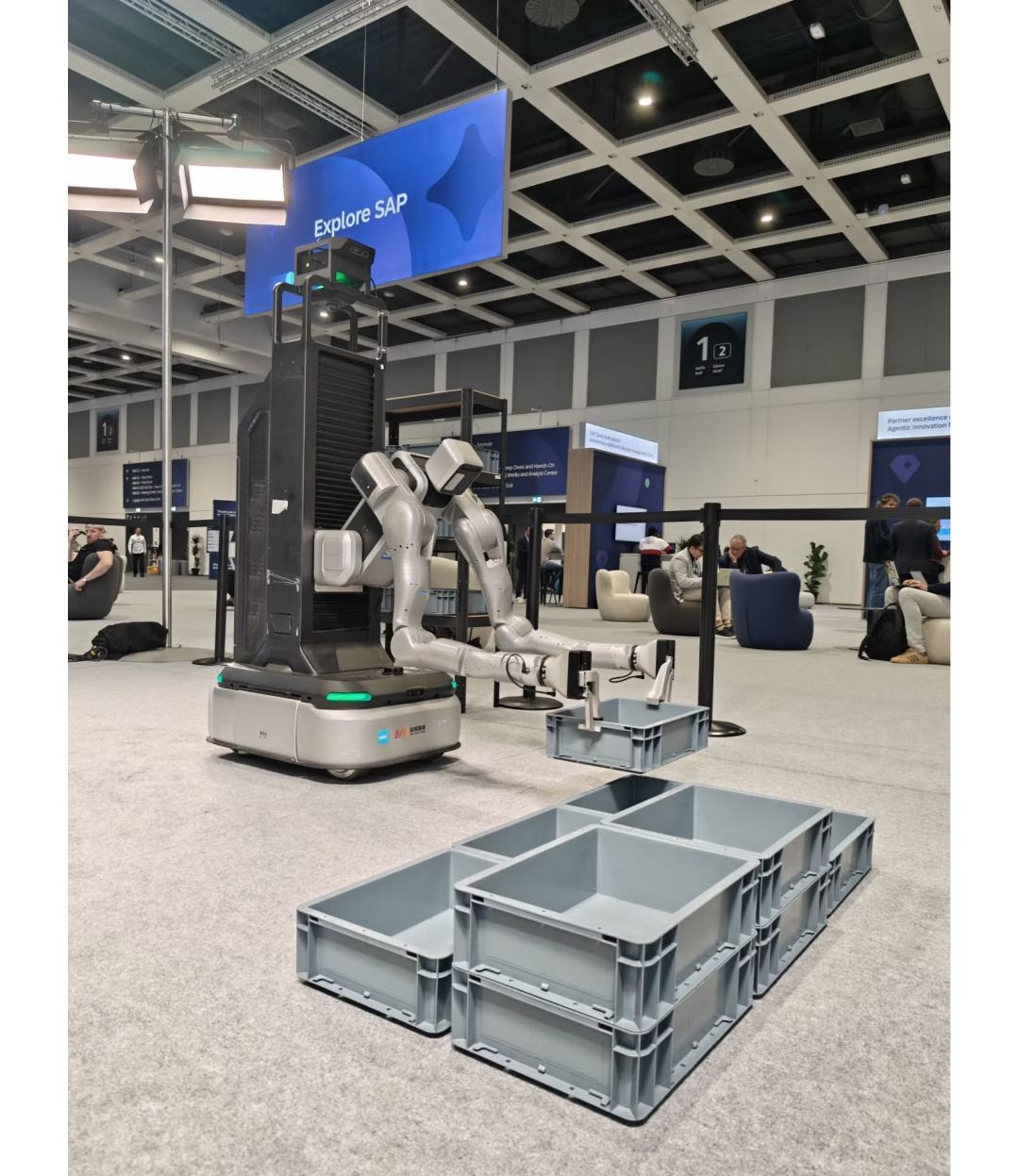
Intel and SAP demonstrated the practical application of Physical AI through a live robot demonstration at the SAP TechEd conference
Intel provided the technical foundation for edge AI and robotics, including scalable heterogeneous computing capabilities, that is, completing environmental perception, reasoning, path navigation, detection, and real-time control locally through the coordinated work of CPU, GPU, and NPU. Around Physical AI, Intel has also built a technology system covering industrial-grade chips, real-time computing capabilities, and open software, including OpenVINO Physical AI, Physical AI Studio, and Robotics AI Suite, aiming to reduce the integration complexity of different software and hardware systems and support solutions in moving from proof of concept to large-scale, repeatable deployment.
Seeing this case, some people may wonder—"Isn't this just an ordinary robot material handling scenario?"
In the author's view, the core difference is that traditional robot automation often revolves around preset tasks and relatively fixed control processes, while this solution attempts to further connect enterprise business systems with physical execution systems. SAP does not just send a transport instruction to the robot; it provides the business context, workflows, and process rules behind the task; Intel's edge AI technology provides computing support for the robot to perceive the environment, assess conditions, and execute tasks on site. More importantly, the status, results, and exception information during robot execution can be sent back to SAP EWM, enabling the enterprise business system not only to issue tasks but also to grasp the actual execution of tasks.
This means that the robot is no longer just a relatively independent automation device, but is incorporated into the enterprise's overall business process. Enterprises can dispatch physical devices based on business needs and understand on-site execution through information fed back by the devices. This two-way collaboration between IT and OT also provides a reference for expanding Physical AI in the future to different factory areas, robot platforms, and operational scenarios.
From this, it can be seen that for Physical AI to truly enter industrial applications, the key is not only to connect robots to AI models and give them stronger perception and action capabilities, but to integrate intelligent capabilities into enterprise business processes and establish a complete closed loop from business decision-making and task execution to result feedback. Only when AI can not only understand the real world but also understand what enterprises want to happen in the real world and drive it through physical devices does Physical AI truly begin to create measurable business value.
Conclusion
From Google's world model to NVIDIA's robot development platform and then to Intel and SAP's autonomous warehouse practice, it can be seen that Physical AI is forming a new infrastructure system. This system requires not only models and computing power, but also sensors, edge computing, communication networks, industrial software, and device management platforms.
For the traditional IoT industry, this means new value space: sensors are no longer just data collection tools, edge computing is no longer just a data preprocessing node, and industrial networks are no longer just device connection channels. Together they will support AI's perception, understanding, and autonomous execution of the physical environment.
References:
Google launches its strongest world model Genie 4, doubling simulation duration to 2 minutes and achieving synchronized audio-video generation for the first time, gaming stocks face another AI shock—Wallstreetcn
NVIDIA advances Isaac platform for general-purpose robots with a new humanoid robot reference platform, framework, simulation workflow, and data—NVIDIA
From Task to Fulfillment – Intel and SAP Demonstrate Physical AI and the Autonomous Warehouse in Action—Intel
-
Privacy Disputes, Experience Bottlenecks, and Commercialization Confusion: Has the AI Glasses Industry Still Not Escaped the Novelty Trap?
-
Apple's Q3 Was a Warm-Up: The iPhone 18 Pro Plays It Safe While the iPhone Duo Steals the Show
-
![]()
Daoming Optics Q3 Report: Net Profit Plunges 56.54% YoY
-
![]()
$115 Billion Bet on Light Sources: Why Marvell Had to Buy
-
Farewell to Half-Baked Products: AI Apps Finally "Fly Into Ordinary Homes"
-
![]()
Quarterly Report | China's Smart Projector Sales Fell 26% in Q3 2026, Full-Year Forecast Lowered to Below 4 Million Units
-
![]()
NVIDIA, Google, and Intel Make Their Moves in Succession as Physical AI Sparks an Infrastructure Battle
-
NXP to Adjust Prices for Select Chips as Automotive Business Returns to Growth