Quarterly Report | China's Smart Projector Sales Fell 26% in Q3 2026, Full-Year Forecast Lowered to Below 4 Million Units
 11/03 2026
 460
This article runs about 2,800 words at extremely high information density. A detailed read is expected to take 10 minutes. We recommend following and bookmarking first, or reading selected chapters.
Data Release
According to RUNTO data, in the third quarter of 2026, China's smart projector market (excluding laser TVs) sold 829,000 units, down 26.2% year-on-year; sales revenue reached 1.23 billion yuan, down 27.1% year-on-year.
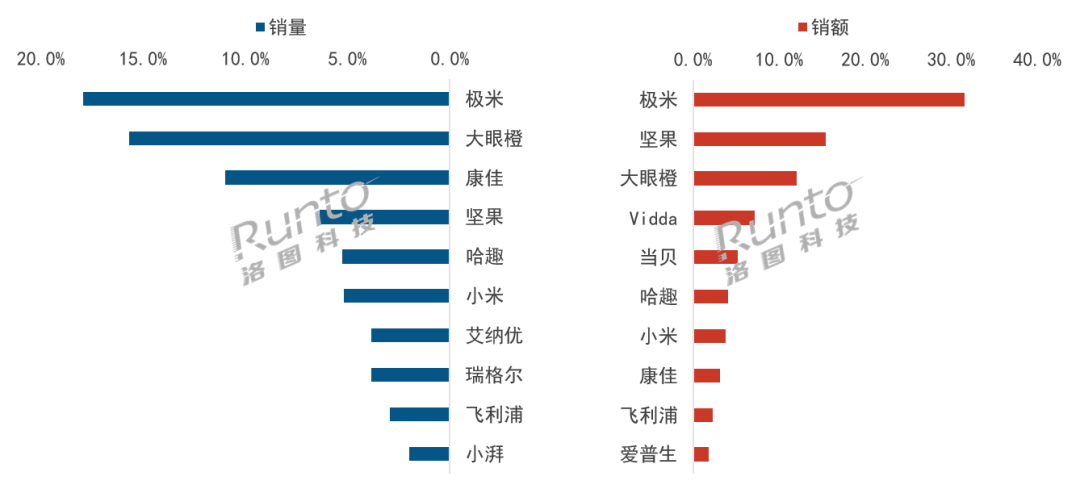
In the online market, XGIMI firmly held first place on both the volume and revenue rankings. Dangbei, the leading brand in the 1LCD segment, leveraged a complete price layout to secure second place in sales volume and third place in sales revenue. Nut and Vidda, two brands focused on the DLP route, ranked second and fourth in sales revenue respectively, with product structures skewed toward the high end.
Laser light sources accounted for 19.9% of sales volume, up 5.7 percentage points year-on-year; within this, tri-color laser accounted for as much as 98.1% of sales volume.
According to the latest "China Smart Projector Retail Market Monthly Tracker" report from RUNTO, in the third quarter of 2026, China's smart projector market (excluding laser TVs) sold 829,000 units, down 26.2% year-on-year; sales revenue reached 1.23 billion yuan, down 27.1% year-on-year.
Since the fourth quarter of 2025, the market has posted year-on-year declines exceeding 20% for four consecutive quarters.
The macroeconomic environment and end-consumer spending have shown no substantive improvement. The demand base continues to weaken, inefficient supply is accelerating its exit, and the positioning of smart projectors within the home large-screen ecosystem is being readjusted. Multiple factors are jointly driving the market size downward under pressure.
2025–2026Q3 China Smart Projector Market Quarterly Sales Volume
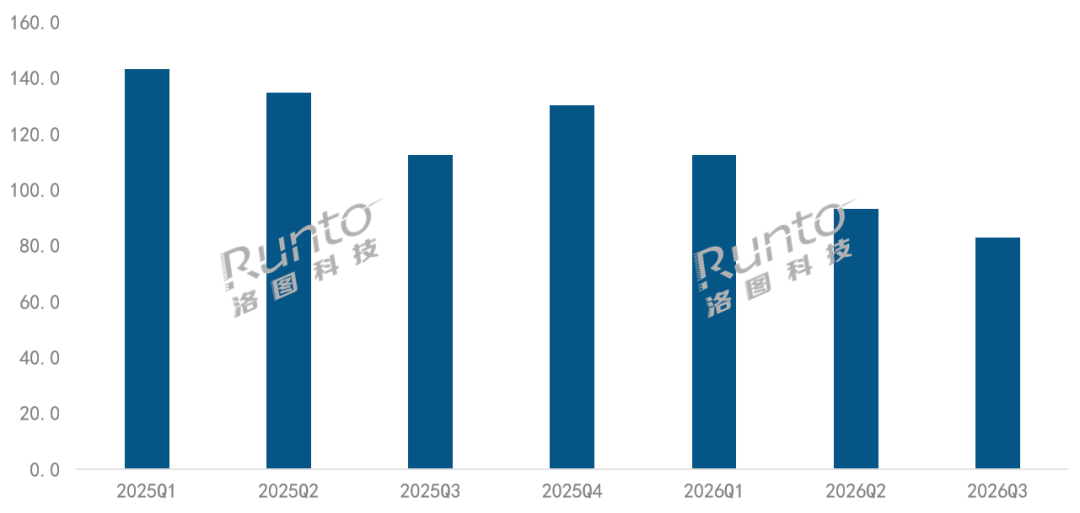
Data source: RUNTO; unit: ten thousand units
In addition, the third quarter falls in the traditional off-season between the two major promotion periods of 618 and Double 11. This year, mainstream brands generally deferred their marketing and new product resource investments, market competition mostly revolved around existing models, and new product supply was significantly insufficient compared with last year, with limited effect on driving up overall average prices. As a result, the decline in sales revenue was slightly steeper than that in sales volume.
Top Brand Positioning Diverges; Manufacturers Begin Cross-Category Ecosystem Extension
In the third quarter of 2026, according to RUNTO data, in China's smart projector online market, the top 10 brands accounted for 74.0% and 81.7% of total sales volume and sales revenue respectively, indicating high market concentration.
The top brand landscape shows clear divergence, and differences in volume and revenue rankings reflect distinctions in brand product positioning.
XGIMI firmly held first place on both the online market volume and revenue rankings, with a solid leading position.
Dangbei, the leading brand in the 1LCD segment, leveraged a complete price layout to secure second place in sales volume and third place in sales revenue.
Konka focuses on affordable volume-driven sales, ranking high in sales volume but contributing relatively weakly to sales revenue.
Nut and Vidda, two brands focused on the DLP route, ranked second and fourth in sales revenue respectively, with product structures skewed toward the high end.
Ainayou and Rigal entered the top ten in terms of sales volume. Dangbei and Epson ranked fifth and in the top ten respectively in terms of sales revenue.
2026Q3 China Smart Projector Online Market Major Brand Sales Share
Data source: RUNTO online monitoring data; unit: %
It is worth noting that XGIMI and Dangbei, the two top manufacturers representing the two major technology routes, both launched new smart glasses products in mid-October. XGIMI entered the AR display segment, while Dangbei chose office dictation scenarios. Next, XGIMI will continue to launch a non-display version, and RUNTO judges that Dangbei may also continue to launch a version with display. In fact, Vidda had already completed the market launch of smart glasses earlier on.
Leveraging technical homology advantages in optics and display, projector brands are seeking a second growth curve and building a cross-scenario large-screen ecosystem of "fixed projector + portable glasses." For detailed analysis, please refer to RUNTO's previously published "Observation | Projector Manufacturers Enter the AI Glasses Segment: The Battlefield in Front of the Eyes Extends from the Living Room and Bedroom to the Face."
Technology: DLP Deepens Scenario Breakthroughs; 1LCD Shifts Toward Compliance Upgrades
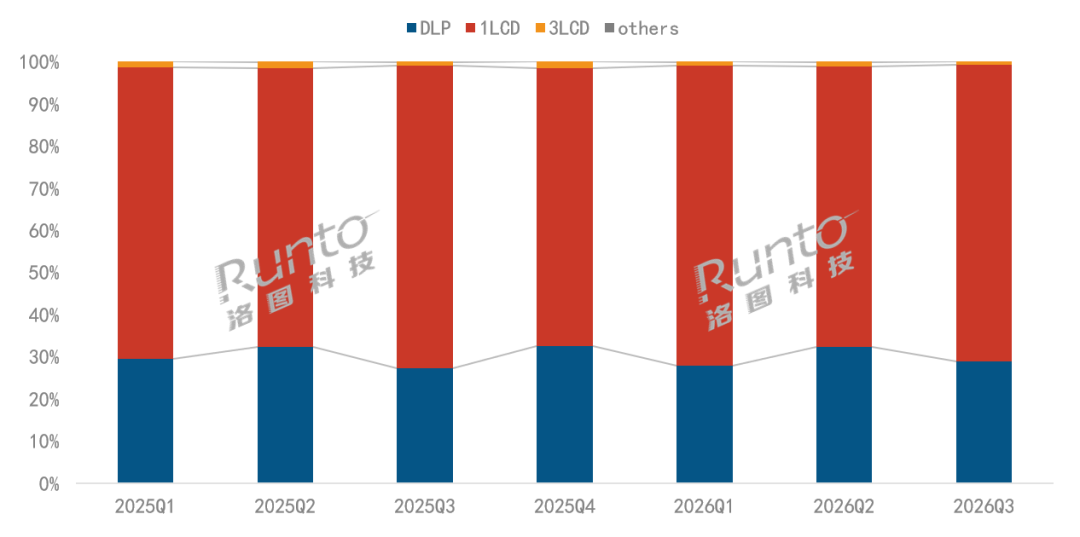
In the third quarter, in the Chinese market, the dominant position of the 1LCD technology route remained solid.
RUNTO monitoring data shows that in the quarter, 1LCD technology accounted for 70.3% of the online market, down 1.4 percentage points from the same period last year; the sales volume share of DLP recovered from 27.3% in 2025Q3 to 29.0% in 2026Q3; the market share of 3LCD was 0.7%.
Relying on fundamental advantages of high native contrast, fast response speed, and greater freedom in overall device design, DLP establishes differentiation through scenario entry points. Gaming scenarios are one of the key implementation directions. Brands such as Nut and XGIMI have successively launched models capable of 4K@120Hz output, paired with low-latency transmission, adapting to the dynamic image needs of console and PC gaming.
The vertical screen form is another important exploration direction. Nut MIGO enters fragmented content scenarios such as short dramas, livestreaming, and home fitness with a native vertical screen mode and 360° gimbal.
The iteration focus of the 1LCD route is performance upgrading under the compliance system. Previously, 1LCD products were generally concentrated in the low-to-medium brightness range. Starting in 2026, new product brightness began to break through 1,000 lumens, and in the second quarter it even broke through 1,500 lumens. By the third quarter, in the 1LCD online market, products with brightness above 1,500 lumens accounted for 6.7% of sales volume.
With the implementation of the new national energy efficiency standard for projectors, energy efficiency indicators have been incorporated into the core considerations of 1LCD new product development. Dangbei and Honor have successively launched 1LCD models meeting the Tier 1 energy efficiency standard. Through systematic tuning of optical structures, light source drivers, and overall power consumption, they achieved energy efficiency compliance on high-brightness models exceeding 1,000 lumens. The simultaneous achievement of high brightness performance and Tier 1 energy efficiency has gradually broken the market's traditional perception of 1LCD products as low-power and low-brightness.
2025–2026Q3 China Smart Projector Online Market Technology Structure
Data source: RUNTO online monitoring data; unit: %
Light Source: Laser Share Grows 6 Percentage Points; Laser Components Attract Attention
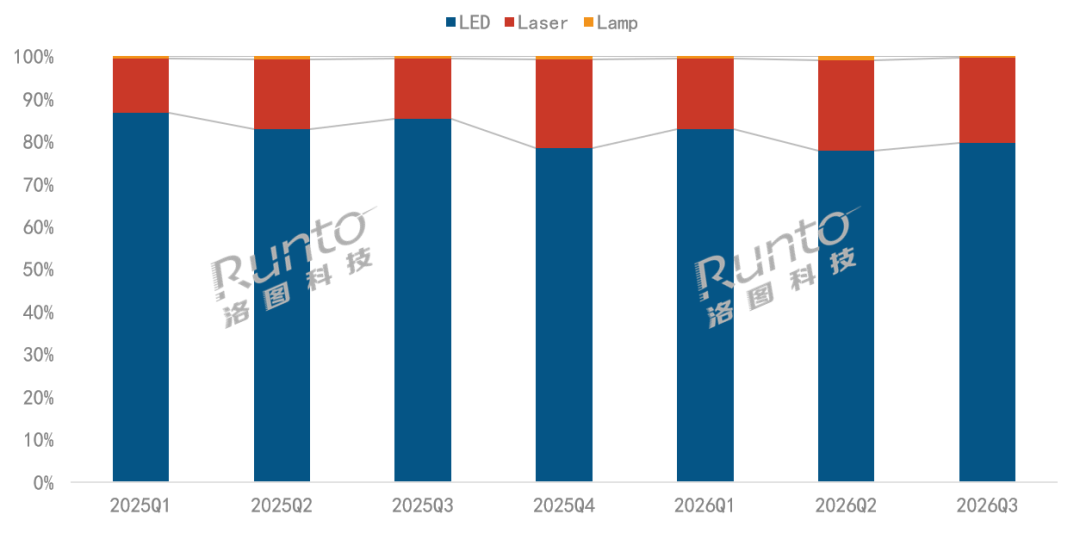
According to RUNTO monitoring data, in the third quarter of 2026, LED light sources accounted for 79.7% of sales volume in the online market, down 5.5 percentage points year-on-year; laser light sources accounted for 19.9%, up 5.7 percentage points year-on-year; traditional lamp sources accounted for only 0.4%, having essentially exited the mainstream market.
Within the laser projector market, tri-color laser has nearly become standard. In the third quarter of 2026, tri-color laser technology accounted for as much as 98.1% of sales volume.
Against this backdrop, attention in the laser segment has begun to extend from terminal device segments to upstream laser components. On the one hand, leading device manufacturers have begun upstream vertical integration. Hisense completed the acquisition of Kaipulin.
On the other hand, overseas light source suppliers are accelerating the pace of component performance iteration. Nichia completed two generations of laser iteration within two quarters. At the same time, the domestic laser component supply system has made phased progress. Shanghai HiSilicon launched the HiLaser laser series, covering red, green, and blue monochromatic light sources as well as multi-channel co-packaged solutions, applicable to diversified power scenarios such as laser display, home and professional lighting.
2025–2026Q3 China Smart Projector Online Market Light Source Structure
Data source: RUNTO online monitoring data; unit: %
Products: Performance Indicators Continue to Upgrade; Optical Zoom Moves Down in Price Segments
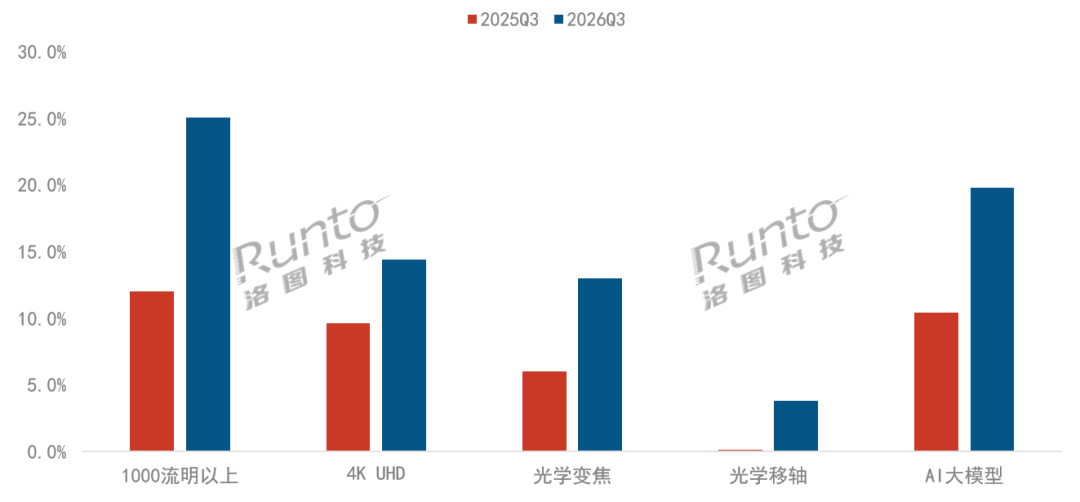
In terms of brightness, RUNTO online monitoring data shows that in the third quarter of 2026, the sales volume share of products below 500 lumens dropped sharply by 18.6 percentage points to 55.5%; the shares of products in the 500–1,000 lumens, 1,000–2,000 lumens, and above 3,000 lumens ranges increased by 5.6, 13.3, and 1.5 percentage points year-on-year respectively.
In terms of resolution, in the third quarter of 2026, FHD still occupied a dominant position with a market share of 57.1%, basically flat compared with the same period last year; 4K UHD accounted for 14.4% of sales volume in the online market, up 4.8 percentage points from the third quarter of 2025.
Optical zoom has begun to move down to mass-market price levels. Nut MIGO brought optical zoom to the 1,500 yuan price band. This hardware configuration, previously concentrated in mid-to-high-end models, has entered the mainstream price segment. In the third quarter of 2026, the sales volume penetration rate of optical zoom in the online market reached 13.0%, doubling from 6.0% in the same period last year.
Optical lens shift accounted for 3.8% of sales volume in the online market in the third quarter of 2026. This function is mostly equipped on mid-to-high-end models, and its contribution to sales revenue is significantly higher, with a share of 18.6%.
In the third quarter of 2026, products equipped with AI large model functions accounted for 19.8% of sales volume and 35.1% of sales revenue, up 9.4 and 15.7 percentage points year-on-year respectively. AI functions remain an important configuration for widening product price gaps and supporting premium pricing of mid-to-high-end models.
2025–2026Q3 China Smart Projector Online Market Feature Share
Data source: RUNTO online monitoring data; unit: %
Double 11 Unlikely to Reverse the Downward Trend; Annual Sales Volume Forecast Lowered to Below 4 Million Units
The 2026 Double 11 shopping festival has already begun, but the pace of new product launches in the smart projector industry has noticeably slowed compared with previous years. The decline in new product density is both a direct reflection of brands' demand expectations and means that there will be an insufficient supply of new selling points to stimulate consumption during Double 11.
RUNTO has further lowered its full-year size forecast to: retail volume of 3.857 million units, down 25.9% year-on-year; sales revenue of 6.28 billion yuan, down 24.8% year-on-year.
Negative factors are clear and difficult to reverse in the short term. ① There is no sign of stabilization on the demand side, and consumers' habitual preference for large-screen alternatives is still strengthening; ② after the exit of national subsidies, price elasticity has narrowed, and the room for balance between price increases and volume contraction is limited; ③ upstream cost pressure is being transmitted to terminals, and profit squeeze may further suppress brands' willingness to invest in products.
However, positive factors should not be ignored either, though they act in a structural rather than aggregate manner. ① The diversification of laser components is reducing the system cost of laser solutions; ② the implementation of the new energy efficiency national standard will accelerate the exit of inefficient capacity in the medium term; ③ automotive laser projection and commercial lighting and shadow scenarios provide marginal increments; ④ new LCoS projector products will be launched within the year. These variables may not be enough to return total volume to growth in 2026 and 2027, but they determine whether, when the next cycle begins, the industry's supply structure will be healthier than it was at the start of the downturn.
-
Privacy Disputes, Experience Bottlenecks, and Commercialization Confusion: Has the AI Glasses Industry Still Not Escaped the Novelty Trap?
-
Apple's Q3 Was a Warm-Up: The iPhone 18 Pro Plays It Safe While the iPhone Duo Steals the Show
-
![]()
Daoming Optics Q3 Report: Net Profit Plunges 56.54% YoY
-
![]()
$115 Billion Bet on Light Sources: Why Marvell Had to Buy
-
Farewell to Half-Baked Products: AI Apps Finally "Fly Into Ordinary Homes"
-
![]()
Quarterly Report | China's Smart Projector Sales Fell 26% in Q3 2026, Full-Year Forecast Lowered to Below 4 Million Units
-
![]()
NVIDIA, Google, and Intel Make Their Moves in Succession as Physical AI Sparks an Infrastructure Battle
-
NXP to Adjust Prices for Select Chips as Automotive Business Returns to Growth