Palantir: Guidance Turns More Aggressive, but New Orders Become a Target for Nitpicking
 11/03 2026
 592
Palantir's Q3 current-period results remain strong, but given overly high capital expectations and weak forward-looking indicators, this earnings report is unlikely to deliver much short-term positive feedback to the stock price.
Specifically:
1. Outlook: Guidance beat versus forward-looking indicators miss
Because Palantir's high valuation is underpinned by future growth expectations, Dolphin first addresses the outlook issue.
The outlook here includes the next-quarter and full-year guidance the company provides directly, as well as forward-looking indicators such as order conditions and customer counts.
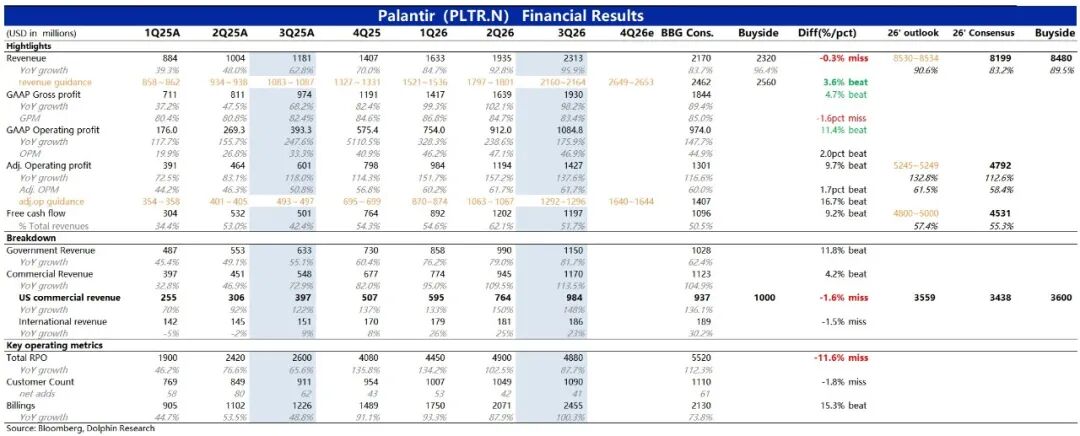
The information in the Q3 earnings report presents a contradiction: Q4 revenue and profit guidance is very good, reflecting a trend of accelerating growth and continuously improving profitability. But new order contracts declining QoQ and the absolute amount of remaining performance obligations declining cast a shadow over growth after Q4.
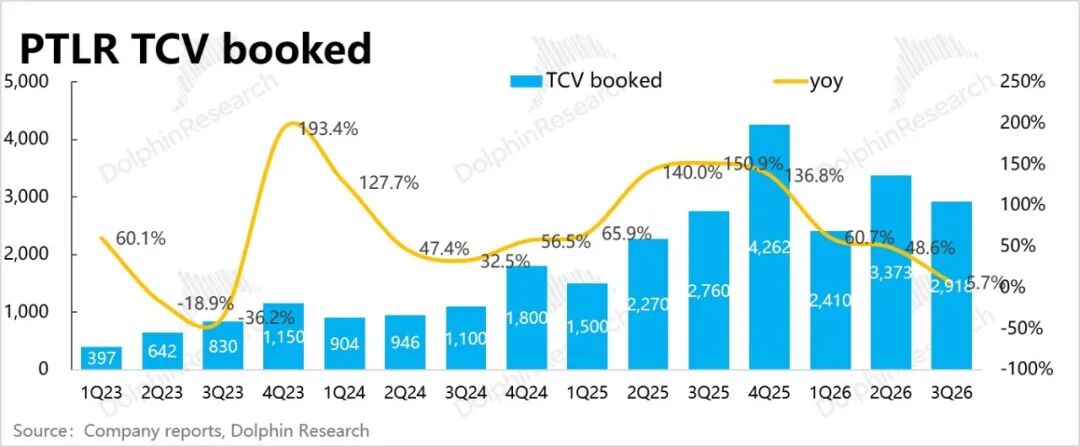
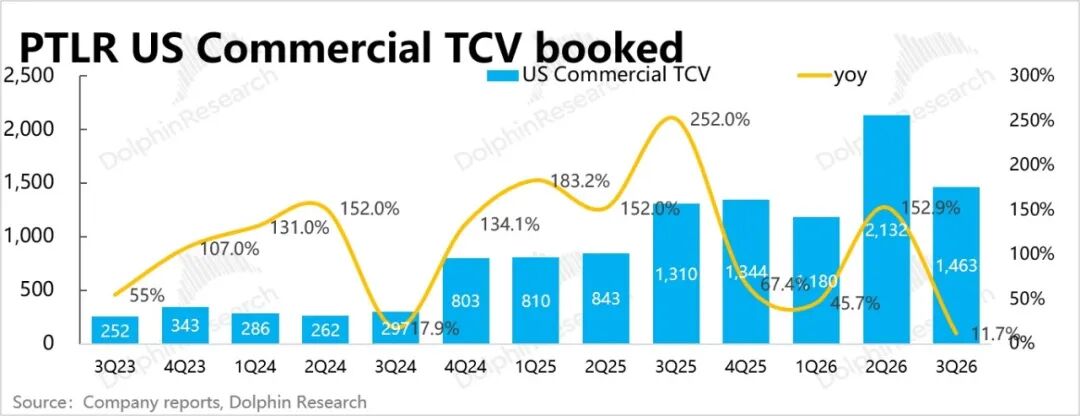
(1) Pace of acquiring new long-term contracts is slowing: Q3 TCV (current-period new contract value) was $2.9 billion, declining QoQ in absolute terms. The decline mainly came from U.S. commercial orders, which carry the load, and this is also the main area where the market is dissatisfied with the earnings report.
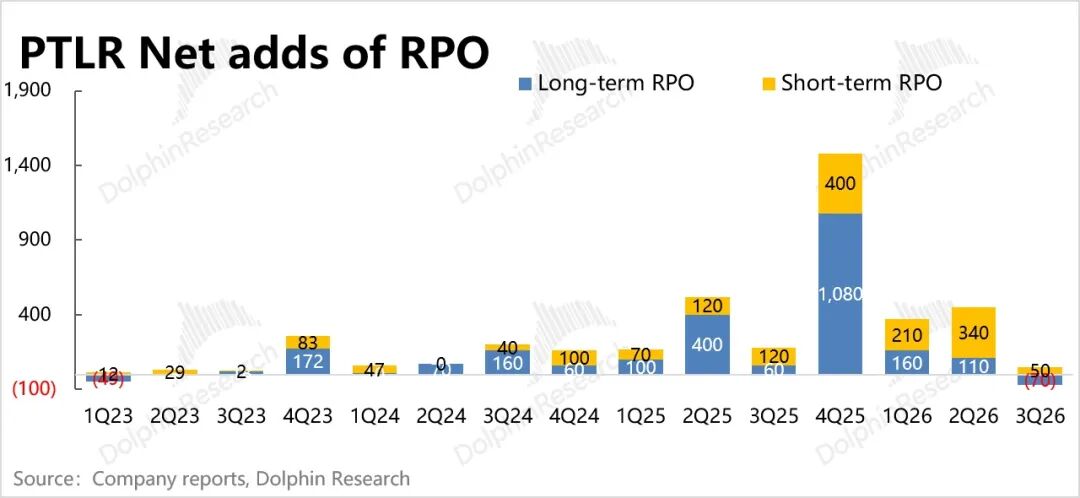
The reduction in new orders also caused remaining performance obligations (RPO) to decline QoQ. Breaking it down, this mainly came from a decrease in long-term order amounts.
(2) Short-term willingness to pay remains high: however, delivery and fulfillment of existing contracts was fairly good. On one hand, Q4 guidance (revenue $2.65 billion, YoY growth 88%) reflects continued high revenue growth. The growth rate appears to be slowing, but Palantir has always given conservative guidance; based on the magnitude of actual beats versus guidance, it is quite possible that growth stays flat or accelerates.
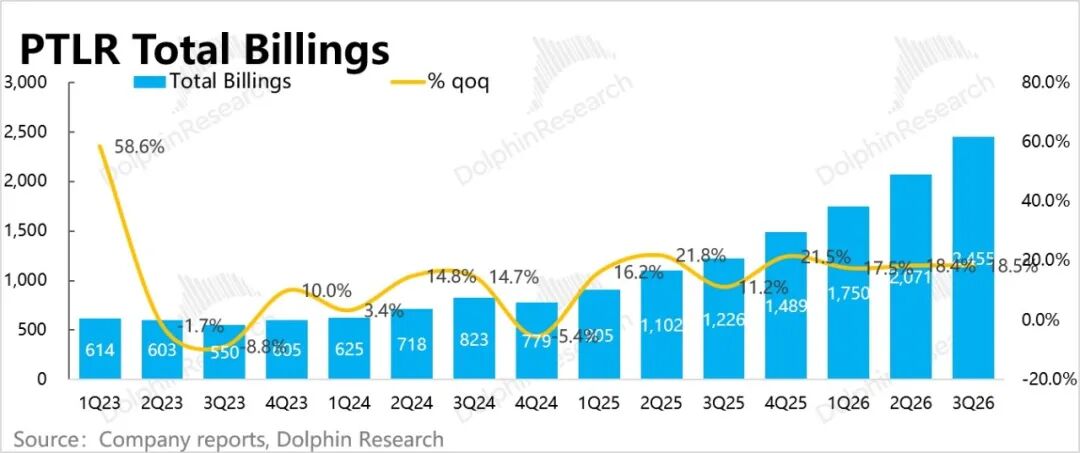
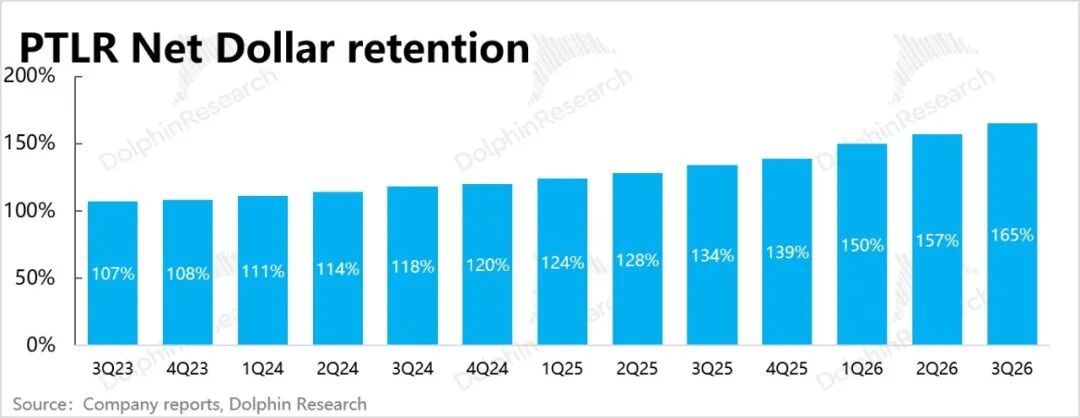
Q3 billings grew 100%, and overall contract liabilities (including customer deposits) increased by nearly $140 million net QoQ. The net dollar retention rate (NDR) from existing customers also further rose to 165%, showing that fulfillment of existing orders and paid upgrades by old customers are unexpectedly healthy.
(3) How to view "guidance beat versus forward-looking indicators miss"?
Although both represent the outlook, revenue is the fulfillment of short-term existing contracts, while orders represent medium- to long-term revenue.
Poor order signings in Q3 may partly be due to seasonal factors, especially since the previous quarter had a sales peak driven by AIPCon 10; on the other hand, it also reflects problems in expanding new customers or demand for long-term orders.
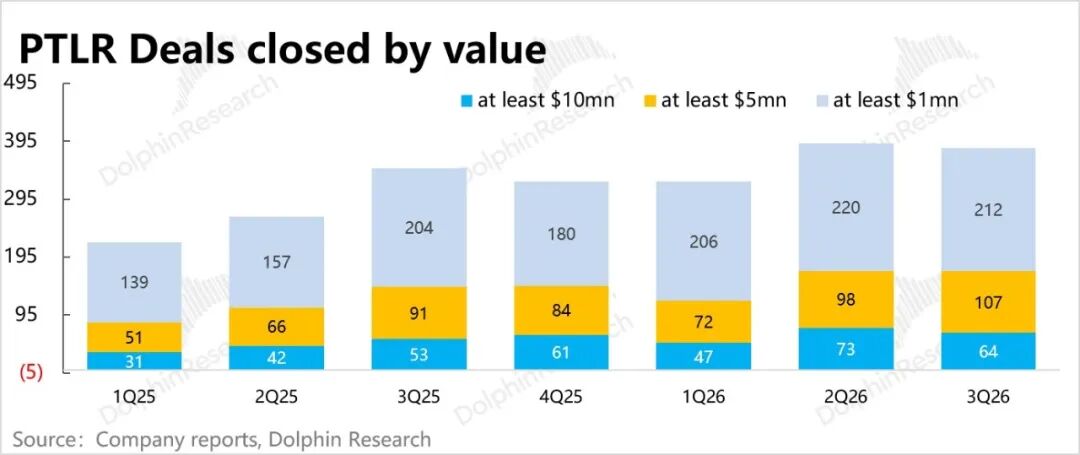
This can also be corroborated by the QoQ decline in the number of orders above $10 million each and the QoQ decline in long-term contracts within remaining performance obligations. At the same time, the number of new customers also declined between quarters, which also indicates that the difficulty of new customer acquisition is quietly rising.
But existing customers maintain inertial paid upgrades and are even willing to increase usage. This indirectly reflects that Palantir's products and services can indeed meet the customized needs of core customers, but due to high-cost investment and deployment cycle considerations, penetration and conversion of enterprises outside the core circle is not so smooth.
2. Current-period performance: high prosperity, but expectations are full
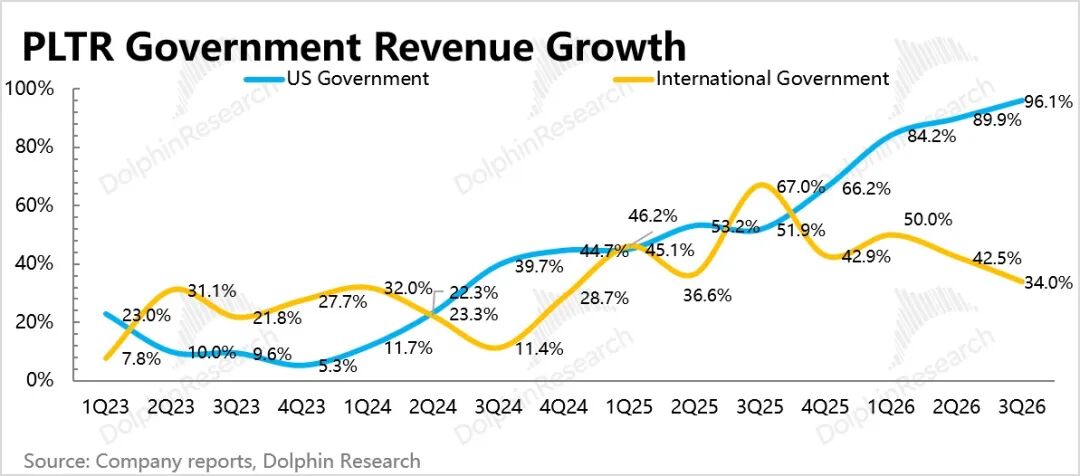
(1) Government services: slight acceleration in growth. By region, the U.S. region still contributed both scale ($950 million) and growth (+96% YoY). Recent U.S. government dynamics support Palantir's transition from independent projects to production deployment and enterprise-level platforms, which helps Palantir raise the barriers of its base business.
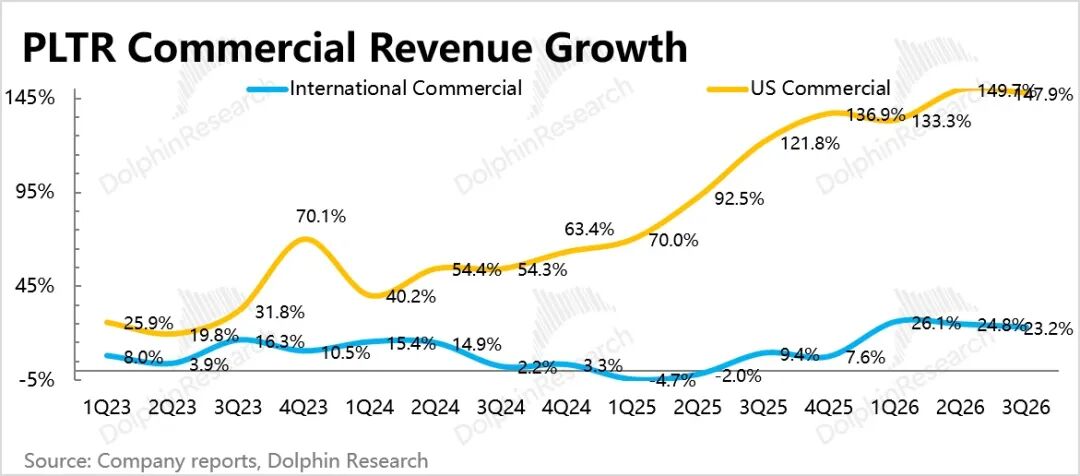
(2) Enterprise commercial: continued accelerated growth. Revenue in the key U.S. region grew 148%, while international regions grew 23%, both roughly flat QoQ, but buy-side expectations were higher. Since Q3, the customer range has expanded somewhat, while continuing to deepen and expand ecosystem cooperation around the three engines of the verticalization strategy (industries with lower customer software density)—finance, semiconductors, and new cloud.
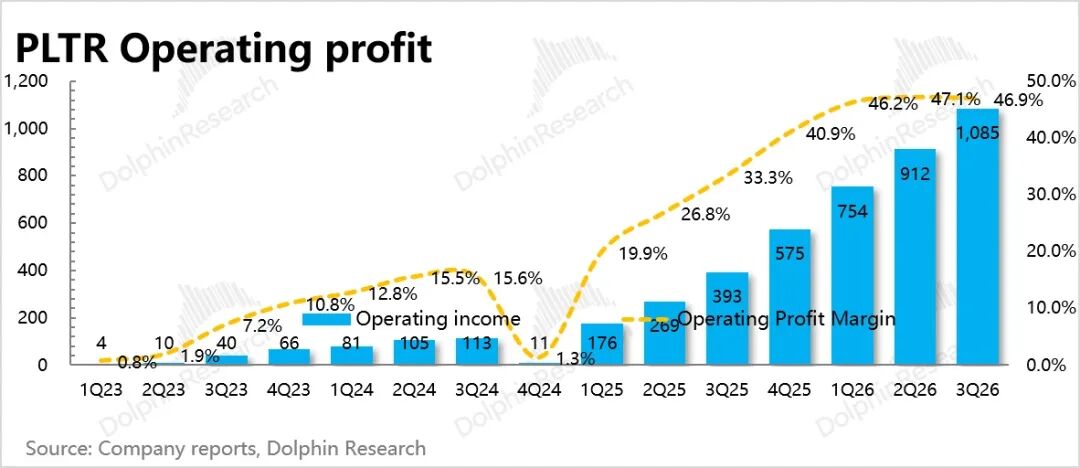
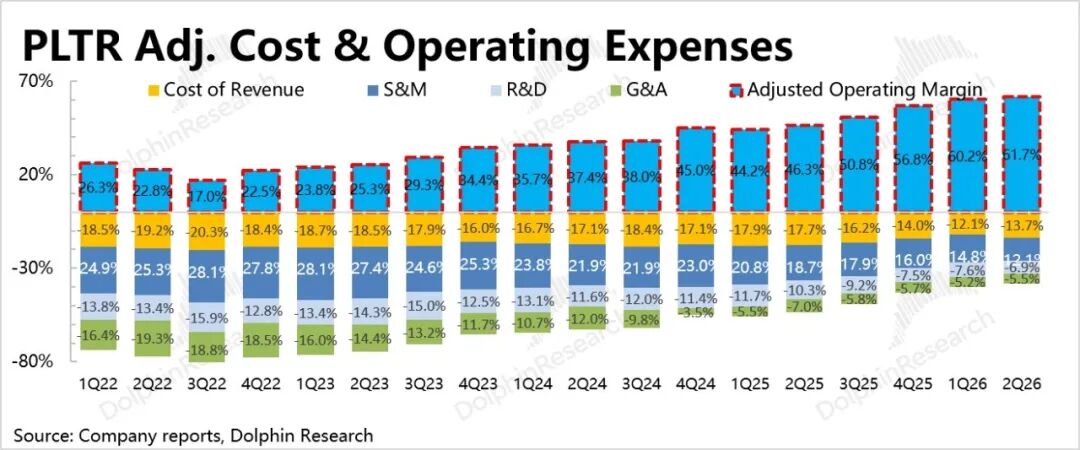
3. Profit margin temporarily stable: Q3 gross margin declined slightly QoQ, while expenses continued to be controlled and optimized, ultimately leaving the operating margin after excluding SBC flat QoQ and stable.
Because it is still in a period of rapid expansion, a short-term seasonal slowdown is not a big problem. Even if competition marginally increases, it has not yet reached the level requiring increased spending and product development investment that would affect profit margins.
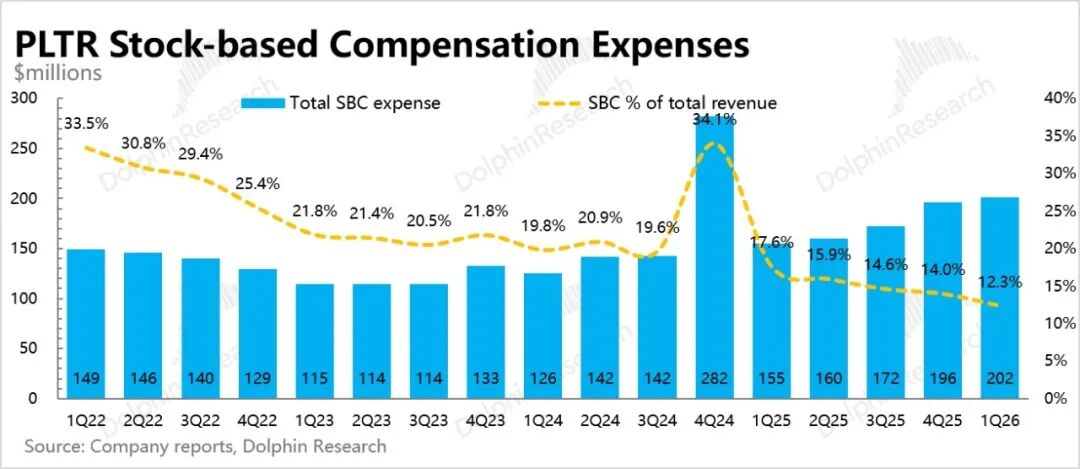
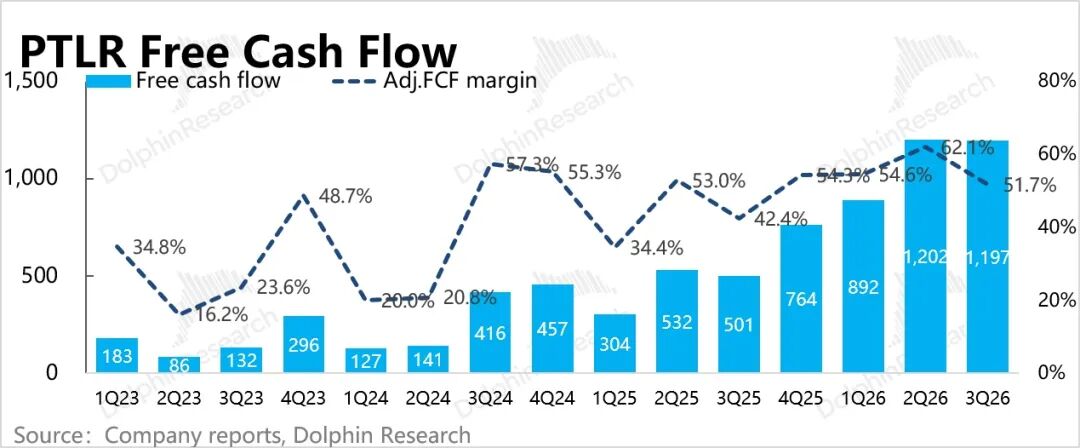
Palantir's cash flow is tied to contract payments, so there will be seasonal fluctuations. In Q3, customer payments were active, especially on fulfillment of existing contracts, but the slowdown in acquiring new orders also had some impact, so current-period cash flow remained flat at a high level. Management guides full-year cash flow of $4.8-5.0 billion; by the end of Q3, cash plus short-term investments on the books had accumulated to $10.5 billion.
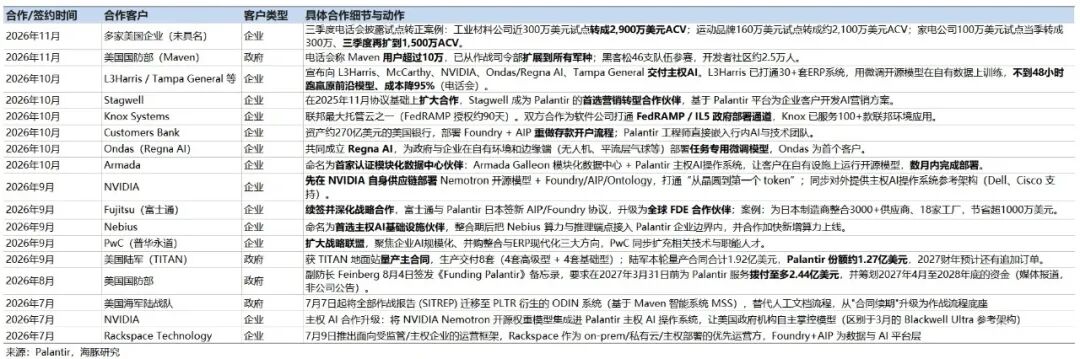
4. Overview of performance indicators & ecosystem cooperation dynamics in the quarter
Dolphin's view
Overall, Palantir's short-term fundamentals still have no major problems, but the slowdown in new orders reflected in the earnings report will still be picked on by bears right now. Dolphin believes this slowdown may include seasonal fluctuations, especially the impact of product sales cycles; for example, the previous quarter likely included the boost from AIPCon 10.
At the same time, faster consumption of existing contracts and higher renewal rates from old customers still demonstrate the competitiveness of Palantir's products and services. Once core customers use them, the possibility of further conversion is high.
But to be cautious, the current tendency of new customers to sign short contracts still reminds us to pay attention to marginal competitive changes brought by AI. This is especially true for frontier AI labs and traditional software companies that have enterprise channel advantages after AI transformation, with typical examples being OpenAI, Anthropic, and Microsoft. Since this year, these peers have also been actively carrying out the FDE model to imitate Palantir's successful path.
Dolphin believes that current competition has not yet brought much impact to Palantir; after all, there is still a large gap in the practicality of products and services. Although Palantir is famous for the FDE model (forward deployed engineer), it does not rely only on FDE.
Palantir's FDE is not simply stacking manpower, but a closed-loop feedback mechanism among deployment teams, product development, ontology construction, and platform verticalization. AI FDE and AIP Evolve are solidifying deployment intelligence into product code.
That is, Palantir's FDE focuses on feeding the industry know-how of customers during deployment back into the platform and solidifying it into platform knowledge and reusable software, embedding the experience of interacting with a single customer into the entire platform so that it can be quickly reused for other customers in the same industry. This differs from the extensive FDE model in current AI model and Agent sales, which focuses on customer deployment rather than feedback.
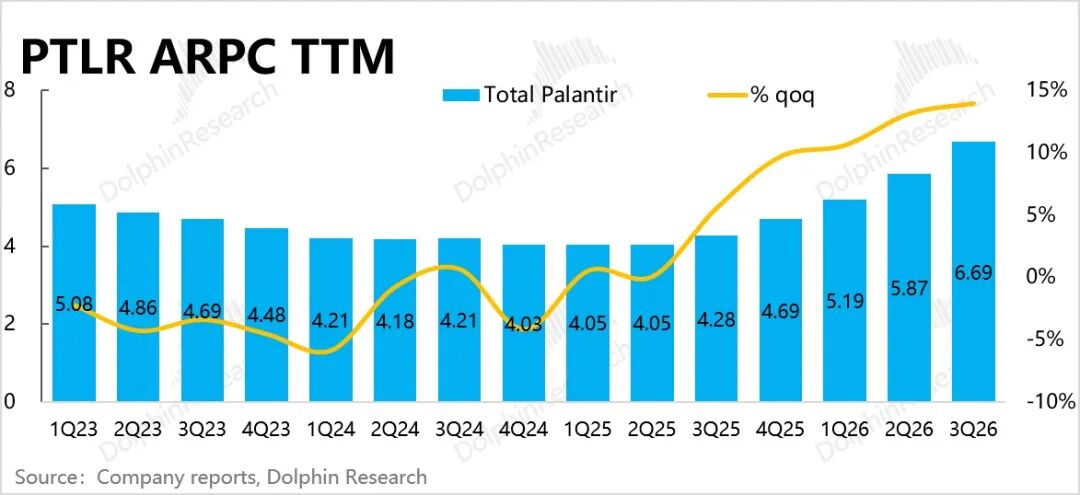
Therefore, Dolphin believes there is no need to worry about competitive substitution for core needs in the short term, but AI may still be able to replace some needs of non-core users with cost advantages. After all, Palantir's average customer value over the past 12 months has reached $6.69 million, and in Q3 it increased another 14% QoQ.
Given full expectations and high valuation (implying 27E PS 35x, GAAP PE 84x), whether the order slowdown will continue to be affected by competition will affect current bullish sentiment when valuation is too high.
- END -
// Reprint authorization
This article is an original article by Dolphin Research. Authorization is required for reprinting.
// Disclaimer and general disclosure notice
This report is only for general comprehensive data purposes, intended for general reading and data reference by users of Dolphin Research and its affiliates, and does not consider the specific investment objectives, investment product preferences, risk tolerance, financial condition, and special needs of any person receiving this report. Investors must consult independent professional advisers before making investments based on this report. Anyone who makes investment decisions due to use of or reference to the content or information mentioned in this report must bear the risk themselves. Dolphin Research shall not be liable for any direct or indirect liability or loss that may arise from use of the data contained in this report. The information and data contained in this report are based on publicly available materials and are for reference only. Dolphin Research strives for but does not guarantee the reliability, accuracy, and completeness of the relevant information and data.
The information mentioned or views expressed in this report shall not be regarded or deemed in any jurisdiction as an offer to sell securities or an invitation to buy or sell securities, nor do they constitute advice, inquiry, or recommendation regarding relevant securities or related financial instruments. The information, tools, and materials contained in this report are not intended or planned to be distributed to citizens or residents of any jurisdiction where distribution, publication, provision, or use of such information, tools, and materials conflicts with applicable laws or regulations or would cause Dolphin Research and/or its subsidiaries or affiliates to need to comply with any registration or licensing requirements in that jurisdiction.
This report only reflects the personal views, opinions, and analytical methods of the relevant creators and does not represent the position of Dolphin Research and/or its affiliates.
This report is produced by Dolphin Research, and the copyright belongs solely to Dolphin Research. Without prior written consent from Dolphin Research, no institution or individual may (i) produce, copy, reproduce, duplicate, forward, or otherwise create any form of copies or reproductions in any way, and/or (ii) directly or indirectly redistribute or transfer them to other unauthorized persons. Dolphin Research reserves all relevant rights.
-
Privacy Disputes, Experience Bottlenecks, and Commercialization Confusion: Has the AI Glasses Industry Still Not Escaped the Novelty Trap?
-
Apple's Q3 Was a Warm-Up: The iPhone 18 Pro Plays It Safe While the iPhone Duo Steals the Show
-
![]()
Daoming Optics Q3 Report: Net Profit Plunges 56.54% YoY
-
![]()
$115 Billion Bet on Light Sources: Why Marvell Had to Buy
-
Farewell to Half-Baked Products: AI Apps Finally "Fly Into Ordinary Homes"
-
![]()
Quarterly Report | China's Smart Projector Sales Fell 26% in Q3 2026, Full-Year Forecast Lowered to Below 4 Million Units
-
![]()
NVIDIA, Google, and Intel Make Their Moves in Succession as Physical AI Sparks an Infrastructure Battle
-
NXP to Adjust Prices for Select Chips as Automotive Business Returns to Growth